5CGXFC7C7F23C8N Datasheet, Pinout, Equivalents, and Specs
The 5CGXFC7C7F23C8N is a high-performance FPGA from Intel's (formerly Altera) Cyclone V GX family, fabricated on a 28nm process node. With 149,500 logic elements, 56,480 adaptive logic modules (ALMs), 7.696 Mb of embedded memory, 156 variable-precision DSP blocks, and up to 6 transceivers operating at 3.125 Gbps, it targets cost-sensitive applications requiring both high logic density and serial connectivity. The device ships in a 484-ball FBGA package (23 × 23 mm) at commercial temperature grade (0 °C to 85 °C) with a C8 speed grade.
What Is the 5CGXFC7C7F23C8N?
The 5CGXFC7C7F23C8N belongs to the Cyclone V GX sub-family — Intel's low-cost, low-power FPGA line with integrated multi-gigabit transceivers, built on TSMC's 28nm low-power (28LP) process. The "GX" designation indicates the presence of high-speed serial I/O blocks, distinguishing it from Cyclone V E variants that lack transceivers. Internally the device organizes 149,500 logic elements into 56,480 Adaptive Logic Modules (ALMs), each featuring an 8-input fracturable look-up table (LUT) that can implement two independent 4-input functions or one 6-input function. The ALM architecture provides 225,920 registers for pipelining and state storage.
Embedded memory is distributed across M10K blocks (each providing 10,240 bits of true dual-port SRAM) and MLAB blocks (640-bit distributed LUTRAM using up to 25% of ALMs), totaling 7.696 Mb of on-chip storage configurable as single-port RAM, dual-port RAM, FIFO buffers, or ROM. On the DSP front, 156 variable-precision DSP blocks support 18 × 18, 27 × 27, and floating-point multiply-accumulate operations, enabling efficient implementation of FIR filters, FFTs, and matrix computations. Clock management relies on 7 fractional PLLs delivering frequency synthesis, clock multiplication/division, and fine-grained phase shifting across independent I/O banks.

Pinout Configuration and Packaging
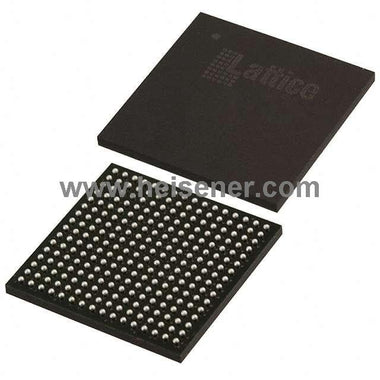
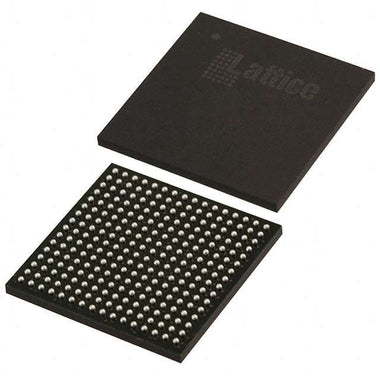
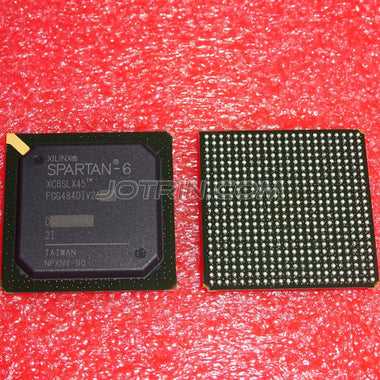
The 5CGXFC7C7F23C8N is housed in a 484-ball FineLine BGA (FBGA) package designated F23 (23 × 23 mm body, 1.0 mm ball pitch). Of the 484 balls, up to 240 are available as general-purpose I/O pins distributed across multiple I/O banks. Each I/O bank supports independent VCCIO supply rails, enabling mixed-voltage interfacing (1.2 V, 1.5 V, 1.8 V, 2.5 V, and 3.3 V) within a single device. The package supports up to 120 LVDS differential pairs for high-speed parallel data transfer.
Critical power pins include VCCINT (1.1 V core supply), VCCIO (per-bank selectable), and VCCA / VCCD (analog and digital PLL supply). Up to 6 transceiver channels are available in this package variant, with dedicated reference clock inputs on differential pairs (REFCLK). The hard memory controller interface pins support DDR2, DDR3, and LPDDR2 external memory with automated calibration. Configuration modes include Active Serial (AS), Passive Serial (PS), Fast Passive Parallel (FPP), and JTAG, selectable via MSEL pin strapping.

Specifications Parameter Table
| Specification | Technical Details |
|---|---|
| Device Family | Cyclone V GX (Intel / Altera) |
| Logic Elements (LEs) | 149,500 |
| Adaptive Logic Modules (ALMs) | 56,480 |
| ALM Registers | 225,920 |
| Embedded Memory | 7,696 Kbit (7.696 Mb) — M10K + MLAB |
| DSP Blocks | 156 (variable-precision 18×18 / 27×27) |
| PLLs | 7 fractional PLLs |
| Transceivers | Up to 6 channels (in FBGA-484), 3.125 Gbps max |
| User I/O Pins | Up to 240 |
| LVDS Pairs | Up to 120 |
| Hard Memory Controller | DDR2 / DDR3 / LPDDR2 |
| PCIe Hard IP | Gen1 x1 / x2 / x4 endpoint |
| Package | 484-FBGA, 23 × 23 mm, 1.0 mm pitch |
| Process Node | 28 nm (TSMC 28LP) |
| Core Voltage | 1.1 V (VCCINT, range 1.07 V – 1.13 V) |
| Speed Grade | C8 (Commercial, 0 °C to 85 °C) |
| I/O Standards | LVTTL, LVCMOS, SSTL, HSTL, HSUL, LVDS, Mini-LVDS, RSDS, LVPECL, PCI, PCI-X |
| Configuration Modes | AS, PS, FPP, JTAG |
| RoHS / Lead-Free | Yes (N suffix) |
Typical Applications and Circuit Considerations
The 5CGXFC7C7F23C8N is widely deployed in designs that require substantial logic density combined with multi-gigabit serial links at an optimized power budget. The 28nm process delivers up to 40% lower power consumption compared to the previous-generation Cyclone IV GX at equivalent performance levels. Typical system-level applications include:
- Wireless Infrastructure: CPRI/OBSAI front-haul interfaces between remote radio heads and baseband units leverage the 3.125 Gbps transceivers, while the 156 DSP blocks handle digital up/down-conversion and crest-factor reduction algorithms.
- Video and Broadcast Processing: SDI, HDMI, and Camera Link serial video pipelines use the transceiver channels for data ingestion, with M10K blocks serving as multi-line frame buffers and the variable-precision DSPs implementing real-time color-space conversion.
- Industrial Automation and Motor Control: The hard memory controller enables high-bandwidth DDR3 interfaces for data logging, while the FPGA fabric implements multi-axis servo controllers, EtherCAT protocol stacks, and high-speed ADC/DAC interfaces.
- PCI Express Endpoint and Bridging: The Gen1 hard IP block enables rapid bring-up of PCIe endpoint adapters for data-acquisition boards, NIC offload engines, and protocol-bridging applications requiring low-latency DMA transfers.
From a circuit-design standpoint, Intel recommends separate filtered 1.1 V supplies for VCCINT with ferrite-bead isolation between core and PLL digital domains. Each transceiver channel requires a dedicated 2.5 V VCCA rail with LC filtering. Decoupling capacitors (100 nF MLCC per power pin, plus 10 µF bulk per rail) should be placed as close to the BGA pads as possible on inner PCB layers. High-speed differential pairs for transceivers demand 100 Ω differential impedance with length-matched routing and AC-coupling capacitors (100 nF, 0402) at the transmitter output. The DDR3 hard memory controller interface should follow Intel's recommended reference schematic for fly-by topology with on-die termination (ODT).

Video: Getting Started with Intel Cyclone V GX FPGA
Equivalents, Cross-Reference, and Lifecycle
The 5CGXFC7C7F23C8N carries an Active lifecycle status as of 2026, with no Product Discontinuation Notice (PDN) issued. Intel continues to manufacture the Cyclone V GX family through its 28nm foundry agreements with TSMC. However, lead times have periodically extended beyond 26 weeks during supply-chain disruptions, making cross-referencing critical for procurement teams.
Within the Cyclone V GX family, the closest pin-compatible variants in the same F23 (484-FBGA) package are:
- 5CGXFC7C6F23C7N — same die, C7 (faster) speed grade. Drop-in replacement with improved timing margins.
- 5CGXFC7C7F23I8N — industrial-temperature variant (–40 °C to 100 °C), functionally identical, same pinout.
Cross-family migration paths:
- Intel Cyclone V GX (5CGXFC7D6F27C7N): Same silicon in a larger 672-FBGA package, offering more I/O pins (up to 480) and more transceiver channels (up to 9). Ideal for designs requiring additional I/O.
- Intel Cyclone 10 GX: 20nm successor offering higher transceiver speeds (up to 12.5 Gbps) and improved power efficiency for next-generation designs.
- Xilinx Artix-7 (XC7A200T): Comparable 28nm FPGA with 215,360 logic cells and 740 DSP slices, offering an alternative ecosystem for designs not locked into Intel IP.
For engineers evaluating alternative FPGAs, see also our technical guides on the EP4CGX150DF27C7N Cyclone IV GX, the Xilinx XC7A200T-2FBG484I Artix-7, and the EP4CE6E22C8N Cyclone IV E.
Frequently Asked Questions (FAQ)
What is the maximum transceiver data rate of the 5CGXFC7C7F23C8N?
The 5CGXFC7C7F23C8N supports up to 6 full-duplex transceiver channels in the FBGA-484 package, with data rates up to 3.125 Gbps per channel. The transceivers include both PMA and PCS blocks and support protocols such as PCI Express Gen1 (x1/x2/x4), Gigabit Ethernet (SGMII), CPRI, OBSAI, serial RapidIO, and XAUI.
What package does the 5CGXFC7C7F23C8N use and how many user I/O pins are available?
The device is packaged in a 484-ball FineLine BGA (FBGA) with a 23 × 23 mm body and 1.0 mm ball pitch. It provides up to 240 user I/O pins distributed across multiple I/O banks, each supporting independent VCCIO voltage levels from 1.2 V to 3.3 V. Up to 120 LVDS differential pairs are available for high-speed parallel interfaces.
What design software is required to develop with the 5CGXFC7C7F23C8N?
The 5CGXFC7C7F23C8N is supported by Intel Quartus Prime Lite Edition (free, no license required) and Quartus Prime Standard Edition. Cyclone V devices require Quartus Prime version 15.1 or later. The design flow supports Verilog, SystemVerilog, and VHDL, along with Platform Designer (formerly Qsys) for system integration, and includes Nios II soft processor support.
How does the 5CGXFC7C7F23C8N compare to the Cyclone IV GX EP4CGX150DF27C7N?
Both devices offer approximately 150K logic elements with multi-gigabit transceivers. However, the 5CGXFC7C7F23C8N (Cyclone V GX, 28nm) delivers up to 40% lower core power, features the more efficient ALM-based architecture (vs. Cyclone IV's LE-based), includes hard DDR3 memory controllers, and provides variable-precision DSP blocks. The Cyclone IV GX uses a 60nm process and lacks hard memory controllers. The Cyclone V GX is the recommended choice for new designs.
What external memory interfaces does the 5CGXFC7C7F23C8N support?
The device includes a hard memory controller supporting DDR2, DDR3, and LPDDR2 external memory interfaces with automated calibration. DDR3 interfaces can operate at up to 400 MHz (800 Mbps effective data rate per pin). The hard controller handles all training, leveling, and calibration automatically, reducing FPGA fabric resource usage compared to soft memory controller implementations.
What power supply voltages are needed for the 5CGXFC7C7F23C8N?
The core logic (VCCINT) requires 1.1 V (range 1.07 V – 1.13 V). Each I/O bank has an independent VCCIO rail selectable from 1.2 V, 1.5 V, 1.8 V, 2.5 V, or 3.3 V. The PLL analog supply (VCCA) requires 2.5 V, and the transceiver analog supply (VCCA_FPLL / VCCA_L) is also 2.5 V. Intel recommends ferrite-bead isolation between VCCINT and PLL digital domains, with dedicated LC filtering for each transceiver power rail.

Alan Carter
Senior Hardware Engineer & Component Specialist
Alan has over 15 years of expertise in embedded systems design, FPGA architecture, and global semiconductor supply chains. He specializes in component cross-referencing, lifecycle management, and helping OEMs navigate supply shortages.