LCMXO2-7000HC-4TG144C Design-In Guide: Why Choose It and How to Use It
Modern embedded systems are a complex dance of power sequencing, I/O level shifting, and peripheral management that must happen reliably at power-on. Relying on a main processor or microcontroller for these critical "housekeeping" tasks can introduce timing uncertainties and add software complexity. The Lattice LCMXO2-7000HC-4TG144C addresses this challenge directly, offering a non-volatile, instant-on programmable logic device that acts as a robust system manager, bridging logic families and ensuring your board comes up correctly, every time.

Table of Contents
The Design Challenge LCMXO2-7000HC-4TG144C Solves
As a hardware engineer, you've likely faced the "glue logic" problem. Your main SoC has the processing power, but its GPIOs are limited, or it can't directly interface with a legacy 5V peripheral. Or perhaps the most critical challenge: managing the complex power-up sequence of multiple power rails for a high-performance processor and its DDR memory. Using a small microcontroller for this seems plausible, but it introduces its own boot-up time, potential for firmware bugs, and struggles with the truly parallel, time-critical nature of monitoring and reacting to multiple signals simultaneously. Larger, SRAM-based FPGAs are powerful but come with their own baggage: they require an external configuration memory, consume significant static power, and have a noticeable configuration time after power is stable.
This is the precise gap where the LCMXO2-7000HC-4TG144C excels. It is a member of the MachXO2 family, which Lattice calls "PLDs" (Programmable Logic Devices) but are functionally low-density FPGAs with a crucial difference: on-chip flash configuration memory. This non-volatile nature means the device is "instant-on." As soon as power is applied, it configures itself in microseconds and is ready to perform its function. This makes it an ideal candidate for:
- Power-Up Sequencing: Monitor power-good signals and enable DC-DC converters in a specific, deterministic order. The parallel nature of the FPGA fabric can handle this far more reliably than a sequential MCU.
- I/O Expansion and Level Shifting: With up to 114 user I/Os in the 144-TQFP package and programmable I/O banks, you can drive dozens of extra signals. You can configure one bank to operate at 1.8V to talk to a modern SoC and another at 3.3V to interface with other peripherals, all within the same chip.
- Interface Bridging: Need to connect a modern SPI-based sensor to a legacy processor with only a parallel bus? The MachXO2 has enough logic (6864 LUTs) and embedded block RAM to implement state machines and buffers for complex protocol conversion. - System Control and Monitoring: Implement a system watchdog, monitor temperature sensors, control fan speeds based on PWM logic, and aggregate interrupt signals into a single line for the main processor. Because the logic is implemented in hardware, its response is deterministic and not subject to software task scheduling.
The "HC" in the part number denotes the high-performance, 1.2V core voltage variant, offering a balance of speed and low power consumption. The LCMXO2-7000HC-4TG144C provides a substantial amount of logic resources for these tasks without the cost, power, or complexity of a mid-range FPGA, making it a workhorse for system-level integration and control.
Key Specifications at a Glance
The decision to design-in a component hinges on its specifications. Here are the critical parameters for the LCMXO2-7000HC-4TG144C, based on the official Lattice datasheet.
| Parameter | Value | Why It Matters |
|---|---|---|
| LUTs (Look-Up Tables) | 6864 | This is the fundamental measure of logic capacity. 6.9k LUTs is sufficient for significant logic consolidation, state machines, and multiple interface bridges. |
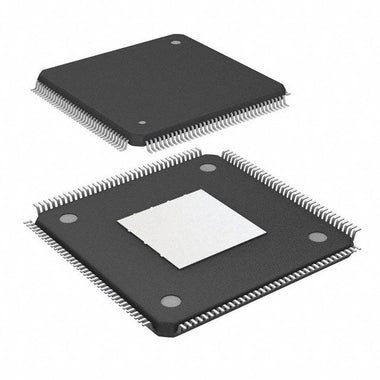
| Package | 144-pin TQFP | The TQFP package is easier to solder and inspect than BGA packages, reducing manufacturing complexity and cost, making it suitable for prototyping and volume production. |
| Maximum User I/O | 114 | Provides a high I/O-to-logic ratio, making it excellent for I/O expansion and designs requiring many parallel connections. |
| Embedded Block RAM (EBR) | 240 kbits | Essential for creating FIFOs, data buffers, or implementing soft processors with local memory. This amount supports complex protocol bridging. |
| User Flash Memory (UFM) | 256 kbits | A key differentiator. This non-volatile memory can store configuration data, serial numbers, or calibration tables, eliminating the need for an external EEPROM. |
| Core Voltage (VCC) | 1.2V | The low core voltage contributes to lower static and dynamic power consumption, a critical factor in battery-powered or thermally constrained systems. |
| I/O Bank Voltages (VCCIO) | 1.2V, 1.5V, 1.8V, 2.5V, 3.3V | Multiple, independent I/O banks allow the device to act as a voltage level translator, interfacing directly with different logic families without external shifter ICs. |
| Configuration Memory | On-Chip Flash | Enables "instant-on" operation. The device is live and functional almost immediately after power-up, critical for system sequencing and control. |
LCMXO2-7000HC-4TG144C vs Alternatives: Head-to-Head
Choosing the right component means understanding the trade-offs. Here’s how the LCMXO2-7000HC stacks up against a direct competitor and a different class of device.
| Feature | LCMXO2-7000HC-4TG144C | Intel/Altera MAX 10 (e.g., 10M08) | High-End MCU (e.g., STM32F4) |
|---|---|---|---|
| Configuration | Instant-on, internal Flash | Instant-on, internal Flash (some variants dual-config) | Internal Flash, boots in milliseconds |
| Logic Type | 6.9k LUTs, fully parallel | 8k Logic Elements (LEs), fully parallel | Sequential CPU core + fixed-function peripherals (SPI, I2C, UART) |
| I/O Flexibility | Highly flexible, programmable standards (LVCMOS, LVDS) on multiple banks | Highly flexible, programmable standards on multiple banks | Limited flexibility, pins are often multiplexed with specific peripherals |
| On-Chip Analog | No | Yes (ADC, temperature sensor on some variants) | Yes (Multiple ADCs, DACs, comparators) |
| Development Tools | Lattice Diamond | Intel Quartus Prime | Vendor IDE (e.g., STM32CubeIDE), Keil, IAR |
| Best For | System control, power sequencing, interface bridging, logic consolidation. | Similar to MachXO2, but with analog features for integrated system monitoring. | Algorithm-heavy tasks, communication stacks (USB, TCP/IP), user interfaces. |
In summary, the choice depends on the nature of your problem. Choose the LCMXO2-7000HC-4TG144C when your primary need is deterministic, parallel control and I/O manipulation. Its instant-on capability is paramount for managing the startup of other, more complex chips. The on-chip UFM is a significant bonus for storing system-critical data without adding another component to your BOM.
An Intel MAX 10 is a very strong competitor and a valid choice, particularly if your design can benefit from its integrated ADC. The decision may come down to prior team experience with the development tools, specific I/O features, or supply chain availability. An MCU like the STM32F4 is the wrong tool for power sequencing but the right tool for running a complex application layer. Often, the best architecture involves an MCU for the "brains" and a MachXO2 for the "reflexes," handling the low-level hardware management that the MCU is not well-suited for.
Recommended Application Circuit
Integrating the LCMXO2-7000HC-4TG144C is straightforward, but attention to power and programming interfaces is key for a stable design. A minimal application circuit requires careful power supply decoupling, JTAG connections for programming, and clocking considerations.
Power Supply: The device requires a 1.2V core voltage (VCC) and one or more I/O voltages (VCCIO).
- VCC (1.2V): This rail powers the internal logic. It's critical to provide a clean supply. Each VCC pin should have a 0.1µF ceramic capacitor placed as close as possible to the pin. Additionally, a bulk capacitance of 10µF or more should be placed near the device for the VCC rail.
- VCCIO (1.2V to 3.3V): The 144-TQFP package has multiple VCCIO banks. Each bank can be powered independently to support different I/O standards. For example, VCCIO Bank 0 could be 1.8V to interface with a processor, while VCCIO Bank 1 is 3.3V to drive LEDs and other peripherals. Each VCCIO pin needs its own 0.1µF decoupling capacitor, with a bulk capacitor per bank.
- GND: A solid ground plane is non-negotiable for signal integrity and proper power delivery. All GND pins must be connected directly to this plane.
Programming and Configuration: The MachXO2 uses a standard JTAG interface (TCK, TMS, TDI, TDO) for in-system programming via the Lattice Diamond software and a programming cable.
- Pull-up resistors are recommended on TMS and TDO, and a pull-down resistor on TCK, as specified in the Lattice System Design Guidelines. This ensures the JTAG state machine is in a known state when not being actively driven.
- The PROGRAMN pin should be pulled high to VCCIO_0 through a resistor for normal operation. It can be driven low to initiate a reconfiguration from the internal flash.
Clocking: The MachXO2 includes a robust internal oscillator, which is sufficient for many control-plane tasks like power sequencing. For applications requiring precise timing, such as high-speed interface bridging, an external clock source should be provided to one of the dedicated clock input pins (PCLK). The entire Browse MachXO2 Series is designed for this flexibility, allowing you to optimize for cost or performance.
PCB Layout and Thermal Design Tips
A successful design with the LCMXO2-7000HC-4TG144C depends on good PCB layout practices. While it's not a high-power device, signal integrity and thermal management are still important for reliability.
Decoupling Capacitor Placement: This is the most critical layout consideration. Decoupling capacitors must be placed as physically close to the device pins as possible. Place the small-value capacitors (e.g., 0.01µF-0.1µF) on the same side of the board as the IC, with a short, direct trace to the pin and a via straight to the ground plane. Bulk capacitors (10µF-100µF) can be slightly further away but should still be close to the device.
Power and Ground Planes: Use a multi-layer PCB with dedicated, solid power and ground planes. A 4-layer stackup (Signal-GND-Power-Signal) is highly recommended. This provides a low-impedance path for power delivery and return currents, minimizing noise and improving signal integrity. Avoid splitting the ground plane unless absolutely necessary for isolating analog and digital sections (not typically required for this device).
Signal Routing: For high-speed signals (e.g., external clocks, LVDS pairs), keep traces short and route them with controlled impedance. Refer to the Lattice design documentation for recommended trace widths and spacing for your specific PCB stackup. Avoid sharp 90-degree turns; use 45-degree bends instead to minimize impedance discontinuities.
Thermal Management: The 'C' in the part number indicates a commercial operating temperature range (0°C to 85°C junction temperature). The 144-TQFP package is not designed for high-power dissipation. For most control-plane applications, the power consumption will be low, and no special thermal management is needed beyond good layout practices. However, to maximize thermal performance, you can create a large copper pad on the PCB directly under the device and connect it to the ground plane using multiple thermal vias. This effectively uses the PCB as a heatsink, drawing heat away from the package.
Where to Buy LCMXO2-7000HC-4TG144C
The LCMXO2-7000HC-4TG144C is a popular part, but like many electronic components, its availability can fluctuate. It is supplied in a 144-pin Thin Quad Flat Pack (TQFP) package, typically on tape and reel for automated assembly. When sourcing this component, especially for production, it is crucial to work with an authorized or reputable global distributor.
Sourcing from unverified channels or auction sites carries a high risk of receiving counterfeit, remarked, or improperly stored components, which can lead to catastrophic field failures. A trusted distributor ensures full traceability back to the original manufacturer, proper handling, and storage in controlled environments. This guarantees that the parts you receive meet the full specifications outlined in the datasheet. For procurement professionals and EMS companies, this traceability is essential for quality control and compliance. For engineers, it provides confidence that the prototype and production units will behave identically. To ensure you are getting authentic components for your design, you can Check LCMXO2-7000HC-4TG144C Inventory & Pricing with a reliable supplier.
Video Demonstration
Frequently Asked Questions (LCMXO2-7000HC-4TG144C FAQ)
What is the difference between the MachXO2 HC and HE variants?
The primary difference lies in their core voltage and feature set. The "HC" variant, like the LCMXO2-7000HC, uses a 1.2V core and is optimized for high-performance applications with low power consumption. The "HE" variant uses a 1.2V core as well but is designed for applications requiring specific features like additional embedded memory or higher I/O counts, often found in higher-density parts of the family. Always consult the family datasheet to compare specific part numbers, as features can vary. For general-purpose control and bridging, the HC variant is often the most cost-effective choice.
Do I need an external configuration flash memory for the LCMXO2-7000HC-4TG144C?
No, you do not. A key feature of the MachXO2 family is its on-chip flash configuration memory. This makes the device non-volatile and "instant-on." When power is applied, the device loads its configuration from this internal memory automatically, typically within microseconds. This eliminates the cost and board space of an external SPI flash chip and simplifies the system design, which is a major advantage over traditional SRAM-based FPGAs.
How does the MachXO2-7000HC compare to an Intel/Altera MAX 10 for system control?
Both are excellent choices for system control as they are non-volatile, instant-on devices. The MachXO2-7000HC often excels in designs where I/O flexibility and the User Flash Memory (UFM) are critical. The UFM acts like a small, on-chip EEPROM for storing system parameters. Some MAX 10 devices offer an on-chip ADC, which can be a deciding factor if you need to monitor analog voltages without an external ADC. The choice often comes down to specific feature needs, power budget, and your team's familiarity with the respective development environments (Lattice Diamond vs. Intel Quartus).
Can I power the I/O banks of the LCMXO2-7000HC-4TG144C with different voltages?
Yes, absolutely. This is a core feature of the device's architecture. The LCMXO2-7000HC-4TG144C has multiple independent I/O banks (VCCIO banks). Each bank can be powered by a different voltage, such as 1.8V, 2.5V, or 3.3V. This allows the device to act as a seamless logic level shifter, interfacing directly between components operating at different voltage standards without requiring external level-shifting ICs, which saves board space and cost.
What is the User Flash Memory (UFM) and how is it used?
The User Flash Memory (UFM) is a block of non-volatile flash memory, separate from the configuration flash, that is accessible to your logic design. In the LCMXO2-7000HC, this is 256 kbits in size. It functions like an on-chip EEPROM, allowing you to read and write data that will be retained even when the device is powered off. Common uses include storing a product serial number, MAC address, manufacturing date, system calibration data, or error logs. This is a powerful feature that can eliminate the need for a separate external EEPROM on your PCB.