88EA1512B2-NNP2A000 Datasheet, Pinout, Equivalents, and Specs
The 88EA1512B2-NNP2A000 is an automotive-qualified single-port Gigabit Ethernet PHY transceiver from Marvell's Alaska family (now part of Infineon's Brightlane portfolio). It implements the IEEE 802.3 physical layer for 10BASE-T, 100BASE-TX, and 1000BASE-T standards, supporting RGMII and SGMII MAC-side interfaces with auto-media detect capability. Housed in a 56-pin QFN package with exposed pad and fully AEC-Q100 qualified, the device targets automotive in-vehicle networking, ADAS gateway modules, and industrial Ethernet applications requiring robust operation across extended temperature ranges.
What Is the 88EA1512B2-NNP2A000?
The 88EA1512B2-NNP2A000 belongs to the Marvell Alaska 88E1512 Ethernet PHY family — a line of single-port Gigabit Ethernet transceivers designed for copper-medium physical layer interfacing. The "88EA" prefix denotes the automotive-grade variant, indicating full AEC-Q100 qualification for deployment in vehicles and safety-critical industrial environments. Internally, the device integrates an advanced mixed-signal processing engine that performs adaptive equalization, echo cancellation, crosstalk cancellation, data recovery, and forward error correction at gigabit data rates. This signal processing chain enables reliable 1000BASE-T operation over standard Category 5e unshielded twisted pair (UTP) cabling up to 100 meters.
The transceiver supports five distinct MAC-side operating modes: RGMII to Copper, SGMII to Copper, RGMII to Fiber/SGMII, RGMII to Copper/Fiber/SGMII with Auto-Media Detect, and Copper to Fiber (1000BASE-X media conversion). Four RGMII timing modes with integrated TX and RX clock delays eliminate the need for PCB trace delay matching, simplifying board layout. An integrated switching voltage regulator generates all required internal supply rails from a single 3.3V input, while the I/O interface supports 1.8V, 2.5V, and 3.3V LVCMOS standards for flexible MAC-side voltage domain bridging.

Pinout Configuration and Packaging
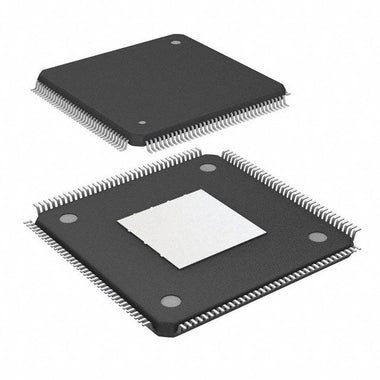
The 88EA1512B2-NNP2A000 is housed in a 56-pin QFN (Quad Flat No-lead) package with a thermally enhanced exposed pad on the underside for effective heat dissipation directly into the PCB ground plane. The compact QFN footprint is well-suited for space-constrained automotive ECU designs. Key pin groups are organized into functional blocks:
- MDI Pins (MDI[3:0]+/−): Four differential pairs connect to the RJ45 connector through magnetics (transformer module). Each pair carries bidirectional data using hybrid echo-cancellation circuitry to achieve full-duplex 1000BASE-T on all four pairs simultaneously.
- RGMII Interface: TXD[3:0], TX_CLK, TX_CTL for transmit; RXD[3:0], RX_CLK, RX_CTL for receive. The RGMII bus uses DDR signaling at 125 MHz to achieve 1 Gbps throughput on a reduced 12-pin interface.
- SGMII Interface: A single differential TX pair and RX pair operating at 1.25 Gbps (8B/10B encoded) provide an alternative MAC connection requiring only 4 signal pins.
- Management Interface (MDIO/MDC): IEEE 802.3 clause 22/45 compatible serial management bus for register configuration, PHY status monitoring, and link diagnostics.
- Configuration Pins: CONFIG[3:0] hardware strapping pins select the operating mode, PHY address, and LED configuration at power-on reset.
- Power Pins: AVDD (3.3V analog), DVDD (1.0V/1.2V digital core — internally regulated), VDDIO (1.8V/2.5V/3.3V I/O). The exposed pad must be soldered to a solid ground plane.

Specifications Parameter Table
| Specification | Technical Details |
|---|---|
| Manufacturer | Marvell (Infineon Brightlane) |
| Product Family | Alaska 88E1512 (Automotive Grade) |
| Type | Single-Port Gigabit Ethernet PHY Transceiver |
| Ethernet Standards | IEEE 802.3 10BASE-T, 100BASE-TX, 1000BASE-T |
| Data Rates | 10 Mbps / 100 Mbps / 1000 Mbps |
| MAC-Side Interfaces | RGMII, SGMII (1.25 Gbps) |
| Operating Modes | RGMII-to-Copper, SGMII-to-Copper, RGMII-to-Fiber/SGMII, Auto-Media Detect, Copper-to-Fiber (1000BASE-X) |
| Supply Voltage | Single 3.3V (integrated switching regulator) |
| I/O Voltage Levels | 1.8V, 2.5V, 3.3V LVCMOS |
| Package | 56-pin QFN with exposed pad (EP) |
| RGMII Timing Modes | 4 modes with integrated TX/RX clock delays |
| Energy Efficient Ethernet | IEEE 802.3az EEE supported |
| Cable Diagnostics | Marvell Advanced VCT (Virtual Cable Tester) with TDR |
| MDI Termination | Integrated on-chip (no external resistors required) |
| Management Interface | MDIO/MDC (IEEE 802.3 Clause 22/45) |
| Automotive Qualification | AEC-Q100 qualified |
| Operating Temperature | −40 °C to +105 °C (AEC-Q100 Grade 2) |
| RoHS / Compliance | RoHS compliant, EU 2011/65/EU, 2015/863 |
| Packaging Format | Tray |
Typical Applications and Circuit Considerations
The 88EA1512B2-NNP2A000 is engineered for automotive and industrial environments where Gigabit Ethernet connectivity must operate reliably under extreme temperature, vibration, and EMC conditions. The AEC-Q100 qualification makes it suitable for deployment in safety-critical vehicle subsystems. Typical system-level applications include:
- ADAS Gateway and Domain Controllers: Bridges high-bandwidth sensor data (cameras, LiDAR, radar) between zonal ECUs and central compute platforms over Gigabit Ethernet backbones, with the SGMII interface minimizing pin count on high-density SoC packages.
- Telematics and Infotainment: The RGMII interface connects directly to automotive-grade application processors (e.g., NXP S32G, TI TDA4VM) for streaming multimedia data and V2X communications, with EEE support reducing power consumption during idle periods.
- Industrial Ethernet Gateways: Serves as the physical layer for PROFINET, EtherNet/IP, and Modbus TCP industrial protocol stacks, with VCT diagnostics enabling remote cable fault detection in factory-floor installations.
- Network-Attached Test and Measurement: Provides reliable Gigabit Ethernet connectivity in benchtop instruments, oscilloscopes, and data acquisition systems where long cable runs and noisy environments demand robust link integrity.
For reference circuit design, the 88EA1512B2-NNP2A000 requires a single 3.3V supply rail connected to the AVDD pins, with the internal switching regulator generating all required core voltages. Decoupling capacitors (100 nF MLCC on each AVDD pin, plus 10 µF bulk capacitors) should be placed within 2 mm of the power pins. The MDI interface connects to the RJ45 through a 1:1 isolation transformer (e.g., Pulse H5007NL or equivalent) with center-tap termination per IEEE 802.3 specifications. The exposed pad must be soldered to a continuous copper ground plane with at least nine thermal vias (0.3 mm diameter) for adequate heat dissipation. CONFIG strap resistors (4.7 kΩ to VDD or GND) set the operating mode and PHY address at power-on. For RGMII connections, use 50 Ω single-ended impedance traces with length matching within 25 mils across the data bus.

Video: Marvell Automotive Ethernet Technology Overview
Equivalents, Cross-Reference, and Lifecycle
The 88EA1512B2-NNP2A000 is currently in Active production with availability through major automotive distributors. Following Infineon's acquisition of Marvell's automotive Ethernet product line, the device continues to be manufactured under the Brightlane brand. Lead times have fluctuated between 16–30 weeks depending on demand cycles, making it prudent to qualify alternate sources. Check 88EA1512B2-NNP2A000 Inventory & Pricing for current stock and lead-time data.
Within the Alaska 88E1512 family, the closest variants are:
- 88E1512-A0-NNP2C000 — commercial/industrial grade equivalent (non-automotive). Identical silicon and pinout, without AEC-Q100 qualification. Suitable for enterprise and embedded applications.
- 88E1512-A0-NNP2I000 — industrial temperature variant (−40 °C to +85 °C) for ruggedized non-automotive deployments.
Cross-family migration paths:
- Marvell 88EA1510 (Alaska): Same family, quad-port variant offering four independent 10/100/1000BASE-T channels for multi-port gateway applications. Pin-incompatible but software-compatible at the register level.
- Analog Devices ADIN1300: Single-port Gigabit Ethernet PHY with RGMII/RMII interface, −40 °C to +105 °C operation, and low power (< 500 mW). A viable second-source option — Analog Devices provides a detailed PHY Exchange Guide for migrating from 88E1512 to ADIN1300.
- TI DP83867E: Industrial/automotive-qualified Gigabit Ethernet PHY with RGMII interface, integrated termination, and IEEE 1588 timestamping. Available in 48-pin QFN.
- Microchip KSZ9131RNX: Gigabit Ethernet PHY with RGMII, low-latency operation, and IEEE 802.3az EEE support. Commonly used in automotive gateways as an alternative to Marvell Alaska.
For engineers evaluating related components, see our technical guides on the STM32F407ZGT6 microcontroller (commonly paired with Ethernet PHYs), the W25Q128JVSIQ flash memory, and Browse Ethernet PHY Series for additional transceiver options.
Frequently Asked Questions (FAQ)
What Ethernet speeds does the 88EA1512B2-NNP2A000 support?
The 88EA1512B2-NNP2A000 supports three Ethernet speed grades: 10BASE-T (10 Mbps), 100BASE-TX (100 Mbps), and 1000BASE-T (1 Gbps). Speed negotiation is handled automatically via IEEE 802.3 auto-negotiation (Clause 28/37). The device operates at full duplex across all three speeds and supports IEEE 802.3az Energy Efficient Ethernet for reducing power during low-traffic periods.
What MAC-side interfaces are available on the 88EA1512B2-NNP2A000?
The device provides two MAC-side interface options: RGMII (Reduced Gigabit Media Independent Interface) using a 12-pin DDR bus at 125 MHz, and SGMII (Serial Gigabit Media Independent Interface) using a single differential pair at 1.25 Gbps with 8B/10B encoding. SGMII is preferred for SoCs with limited pin count, while RGMII offers simpler timing and wider ecosystem support. Both interfaces operate at 1.8V, 2.5V, or 3.3V LVCMOS levels.
What is the Marvell Virtual Cable Tester (VCT) feature?
The Marvell Advanced VCT uses Time Domain Reflectometry (TDR) technology to remotely diagnose cable plant issues without physical inspection. It detects and reports pair swaps, pair polarity errors, severe pair skew, open circuits, short circuits, and impedance mismatches, accurately locating the fault within one meter. This feature is accessible via MDIO register reads and is particularly valuable in automotive and industrial deployments where cables are inaccessible after installation.
What power supply design is required for the 88EA1512B2-NNP2A000?
The device operates from a single 3.3V supply rail. An integrated switching voltage regulator generates all required internal core voltages, eliminating the need for external 1.0V or 1.2V regulators. Each AVDD power pin requires a 100 nF bypass capacitor placed within 2 mm, plus 10 µF bulk capacitors shared across the supply rail. The I/O voltage (VDDIO) can be set to 1.8V, 2.5V, or 3.3V depending on the MAC controller's I/O standard. Total power dissipation is approximately 750 mW at 1000BASE-T with active traffic.
Is the 88EA1512B2-NNP2A000 automotive qualified, and what temperature range does it support?
Yes, the 88EA1512B2-NNP2A000 is fully AEC-Q100 qualified for automotive deployment. It is rated for AEC-Q100 Grade 2 operation covering −40 °C to +105 °C ambient temperature. This qualification encompasses HTOL (High Temperature Operating Life), temperature cycling, moisture sensitivity, ESD (HBM and CDM), and latch-up testing per AEC-Q100 Rev. H requirements.
What are the main differences between the 88EA1512 and the ADIN1300 for PHY migration?
Both are single-port Gigabit Ethernet PHYs with RGMII interfaces and −40 °C to +105 °C operation. The 88EA1512 offers SGMII in addition to RGMII, supports Fiber/Copper auto-media detect, and includes VCT cable diagnostics. The ADIN1300 provides lower power consumption (under 500 mW vs. approximately 750 mW), adds RMII interface support, and includes IEEE 1588 hardware timestamping capability. Pin assignments differ, so a board redesign is required. Analog Devices publishes a detailed PHY Exchange Guide to assist with register-level migration from 88E1512 to ADIN1300.

Alan Carter
Senior Hardware Engineer & Component Specialist
Alan has over 15 years of expertise in embedded systems design, FPGA architecture, and global semiconductor supply chains. He specializes in component cross-referencing, lifecycle management, and helping OEMs navigate supply shortages.