The 10M16SAU169I7G is a high-performance, non-volatile FPGA from the Intel (Altera) MAX 10 family. Built on a mature 55nm process node, this device delivers 16,000 logic elements, an integrated dual analog-to-digital converter (ADC), user flash memory (UFM), and instant-on capability—all within a compact 169-ball UBGA package. It is ideally suited for industrial control, sensor aggregation, motor drives, and cost-sensitive embedded designs that demand single-chip programmable logic with no external configuration memory.
Overview & Key Features
The MAX 10 FPGA family bridges the gap between CPLDs and traditional FPGAs by offering non-volatile, single-chip programmable logic with integrated analog features. The 10M16SAU169I7G variant provides the industrial temperature range (−40 °C to +100 °C) and speed grade 7, making it a reliable choice for harsh-environment deployments.
- Non-Volatile Configuration: Internal dual configuration flash memory enables instant-on operation without an external EEPROM or flash chip.
- Integrated ADC: Up to two 12-bit SAR ADCs with up to 18 analog input channels for direct sensor interfacing.
- User Flash Memory (UFM): On-chip user flash for storing calibration data, encryption keys, or application constants.
- Nios II Soft Processor: Supports the 32-bit Nios II embedded processor for software-defined control tasks.
- Quartus Prime Lite Support: Full design support with the free Quartus Prime Lite Edition toolchain.
Detailed Specifications
| Parameter | Value |
|---|---|
| Part Number | 10M16SAU169I7G |
| Manufacturer | Intel (Altera) |
| Family | MAX 10 (10M16) |
| Process Technology | 55 nm |
| Logic Elements (LEs) | 16,000 |
| Logic Array Blocks (LABs) | 1,000 |
| Embedded Memory (M9K RAM) | 549 Kb (562,176 bits) |
| Embedded 18×18 Multipliers | 45 |
| Phase-Locked Loops (PLLs) | 4 |
| Global Clock Networks | 20 |
| User I/O Pins | 130 |
| ADC Blocks | 1 (dual 12-bit SAR ADC) |
| Analog Input Channels | Up to 9 (U169 package) |
| User Flash Memory (UFM) | 128 Kb |
| Configuration Flash Memory (CFM) | Dual-image internal flash |
| Core Voltage (VCC) | 1.2 V (1.15–1.25 V) |
| I/O Voltage | 1.2 V / 1.5 V / 1.8 V / 2.5 V / 3.3 V |
| Package | 169-UBGA (11 × 11 mm, 0.8 mm pitch) |
| Operating Temperature | −40 °C to +100 °C (TJ, Industrial) |
| Speed Grade | 7 |
| RoHS Compliant | Yes (Pb-free) |
| I/O Standards Supported | LVTTL, LVCMOS, SSTL, HSTL, LVDS, RSDS, mini-LVDS |
| External Memory Interface | DDR3, DDR3L, DDR2, LPDDR2 (up to 300 MHz) |
Block Diagram & Architecture
The MAX 10 architecture integrates logic, memory, DSP, clock management, I/O, and analog functions on a single die. The diagram below illustrates the development kit block-level connectivity, representative of a typical MAX 10 system design:
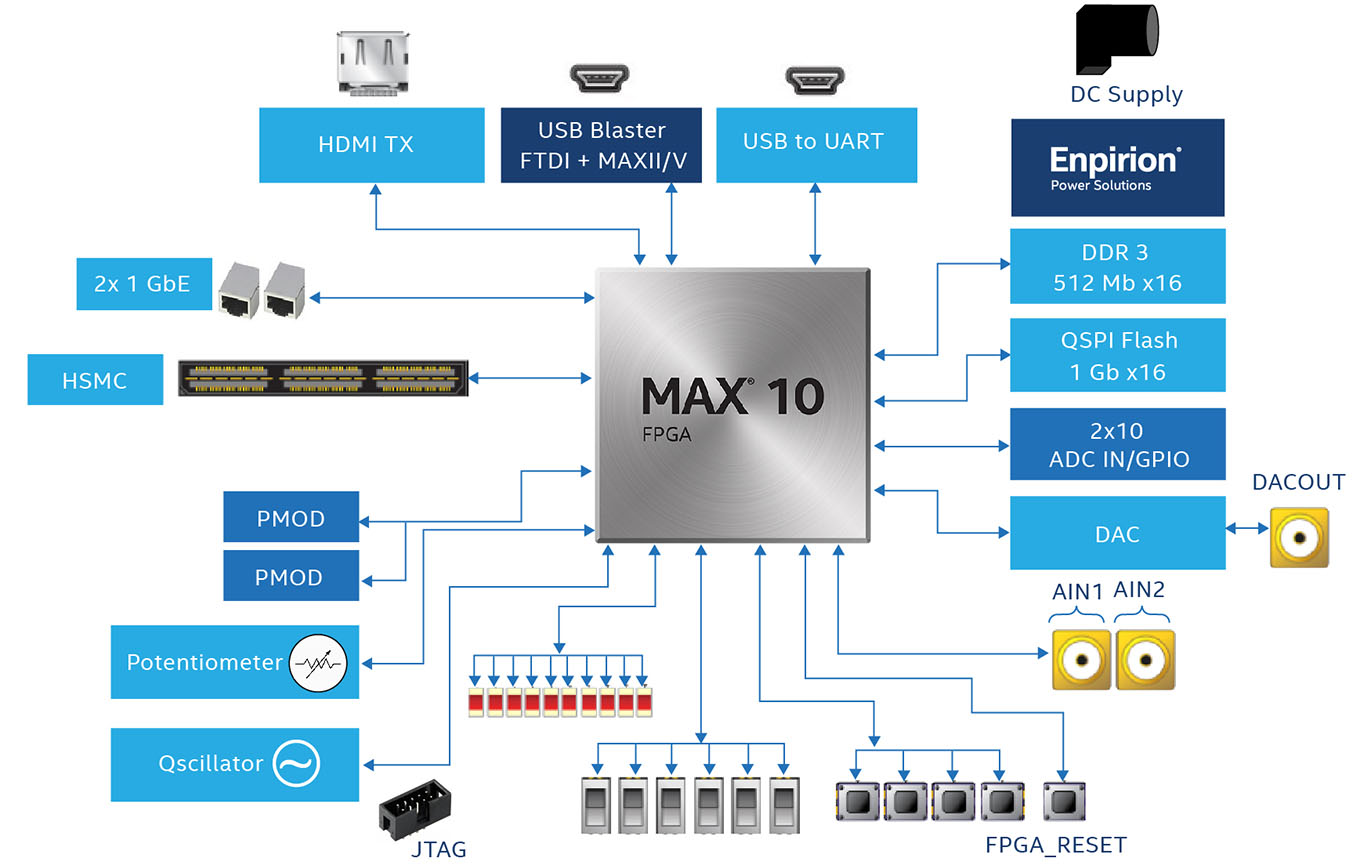
Key architectural blocks include 16 LEs per LAB, M9K embedded RAM, an 18×18 multiplier array for DSP workloads, four PLLs for flexible clock synthesis, and dedicated I/O banks supporting a range of single-ended and differential standards.
Pinout & Package Information
The 10M16SAU169I7G uses a 169-ball Ultra-Thin Fine-Pitch BGA (UBGA) package measuring 11 × 11 mm with 0.8 mm ball pitch. The device provides 130 general-purpose I/O pins distributed across multiple I/O banks, plus dedicated configuration, JTAG, and power pins.

Pin assignment and bank mapping should be performed using the Intel Quartus Prime Pin Planner tool, referencing the official MAX 10 Pin-Out Files available on the Intel FPGA download center.
Application Circuit & Design Tips
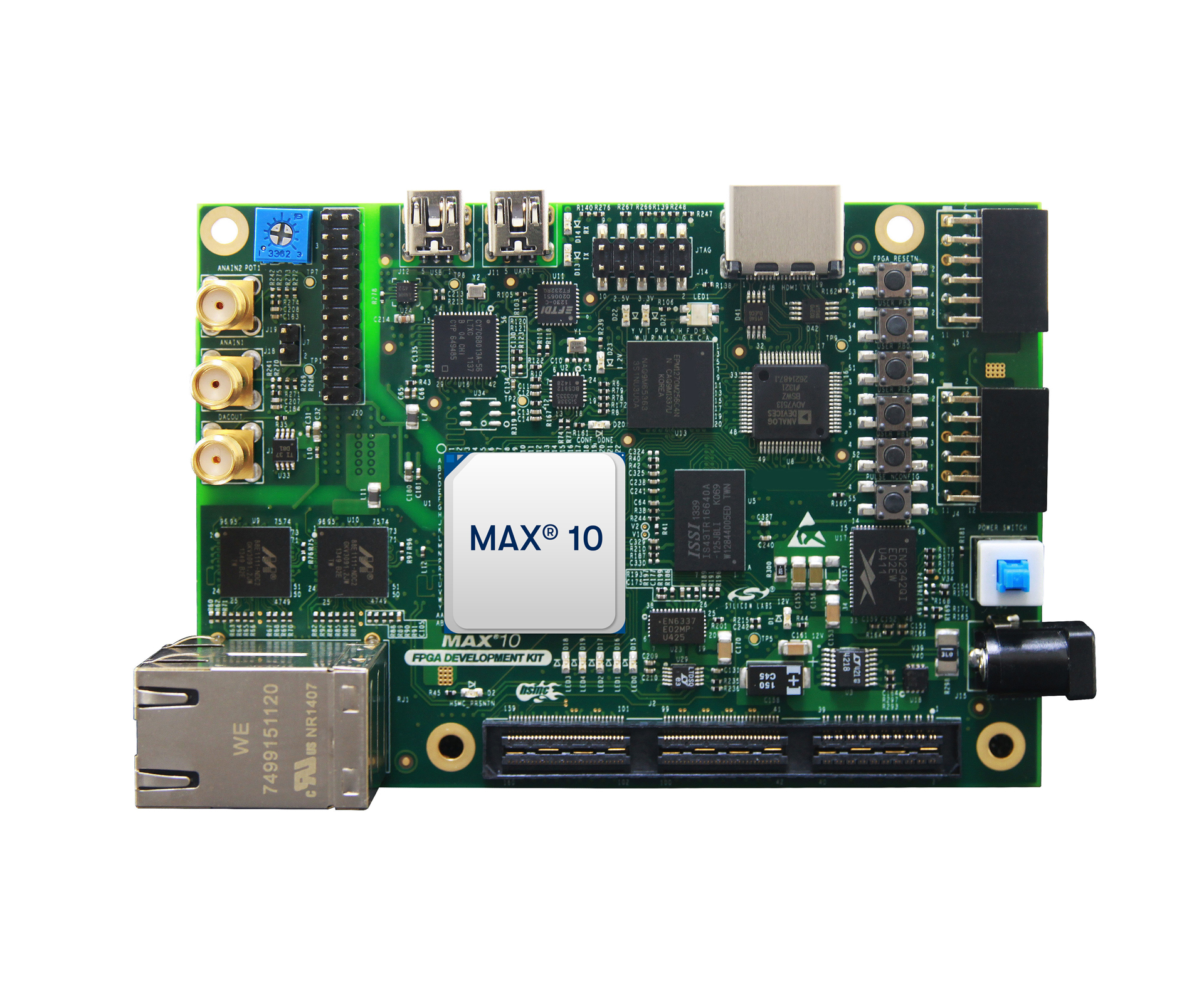
The 10M16SAU169I7G excels in single-board designs requiring sensor fusion, motor control, protocol bridging, or video pre-processing. The MAX 10 FPGA Development Kit shown below demonstrates a typical reference design with Ethernet, USB, HDMI, and expansion connectors:
- Power Supply: Provide a regulated 1.2 V core supply with low-noise LDO; use separate 3.3 V for I/O banks. Place decoupling capacitors (100 nF ceramic + 10 µF bulk) near every VCC pin.
- Configuration: Internal flash configuration eliminates external memory. Use JTAG for development; leverage dual-image flash for safe remote firmware updates.
- ADC Layout: Route analog inputs with short traces away from digital switching noise; use a dedicated analog ground plane partition for best ADC performance.
- High-Speed I/O: For LVDS pairs, maintain 100 Ω differential impedance; keep trace length mismatch under 5 mil within a pair.
Video Tutorial
Watch this tutorial on getting started with Intel MAX 10 FPGA development:
Frequently Asked Questions
What is the 10M16SAU169I7G and what family does it belong to?
The 10M16SAU169I7G is a non-volatile FPGA from the Intel (Altera) MAX 10 family. It contains 16,000 logic elements, 549 Kb of embedded RAM, 45 DSP multipliers, an integrated 12-bit ADC, and user flash memory—all in a 169-UBGA package rated for the industrial temperature range (−40 °C to +100 °C).
Does the 10M16SAU169I7G require an external configuration memory chip?
No. MAX 10 FPGAs feature internal dual configuration flash memory, enabling instant-on operation without any external EEPROM or SPI flash. This reduces BOM cost, board area, and simplifies the power-on sequence.
What development software is used with the 10M16SAU169I7G?
Intel Quartus Prime Lite Edition (free, no license required) fully supports MAX 10 devices including the 10M16SAU169I7G. It provides synthesis, place-and-route, timing analysis, the Pin Planner, Signal Tap logic analyzer, and Nios II soft-processor support.
What are typical applications for the 10M16SAU169I7G?
Common applications include industrial sensor hubs, motor drive controllers, protocol bridges (SPI/I2C/UART to Ethernet), video pre-processing pipelines, LED display controllers, medical instrumentation, and IoT edge-processing nodes where a single-chip FPGA with analog input is advantageous.
What is the difference between 10M16SAU169I7G and 10M16SAU169C8G?
Both are MAX 10 10M16 FPGAs in the 169-UBGA package. The key differences are: the "I7" variant is industrial grade (−40 °C to +100 °C) with speed grade 7, while the "C8" variant is commercial grade (0 °C to +85 °C) with speed grade 8. The I7G offers wider temperature tolerance for harsh environments at a slightly lower maximum clock speed.
How many analog input channels are available on the 10M16SAU169I7G?
The 10M16SAU169I7G integrates a 12-bit successive-approximation-register (SAR) ADC with up to 9 dedicated analog input channels in the U169 package. The ADC supports a 1 MSPS conversion rate and can be used for voltage monitoring, temperature sensing, or direct sensor digitization.
Related Articles on WWDParts
- 5CSXFC6D6F31C6N Intel Cyclone V SX SoC FPGA: Datasheet, Pinout, and Application Guide
- 5CEBA4F23C8N Intel Cyclone V E FPGA: Datasheet, Pinout, and Application Guide
- M2S025-FGG484 Datasheet, Specs & Pricing (Microchip SmartFusion2)