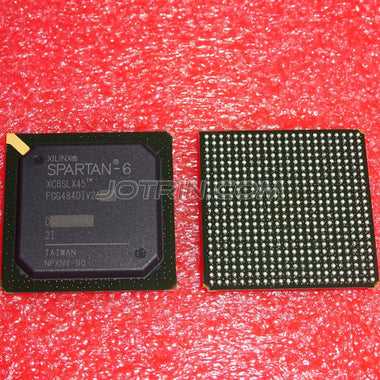
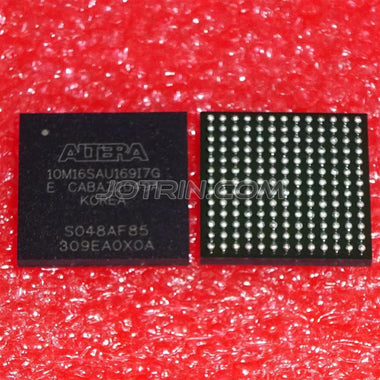
The 10M16SAU169I7G is a non-volatile, single-chip FPGA from Altera's (now Intel) MAX 10 family, fabricated on TSMC's 55 nm flash process. It integrates 16,000 logic elements, 549 Kbit of M9K embedded SRAM, 4 phase-locked loops, an integrated 12-bit SAR ADC, and dual-image on-die configuration flash — all within a compact 169-pin UBGA package. Rated for the industrial temperature range (−40 °C to +100 °C) at speed grade 7, the 10M16SAU169I7G is designed for harsh-environment applications where instant-on boot (under 10 ms), single-supply operation, and integrated analog-to-digital conversion eliminate external components and reduce total BOM cost.
Overview and Part Number Decoding
The 10M16SAU169I7G belongs to the Altera MAX 10 product line — the industry's first single-chip, non-volatile FPGA family. Unlike SRAM-based FPGAs such as Xilinx Spartan-7 or Intel Cyclone V that require external SPI flash for configuration bitstream storage, MAX 10 devices store up to two complete configuration images in on-die flash memory. This architecture enables instant-on operation within milliseconds of power-up and supports fail-safe remote field updates via the Remote System Upgrade (RSU) IP core — without any external EPCQ or SPI NOR flash on the BOM.
The part number encodes the following attributes:
- 10M16 — MAX 10 family, 16,000 logic elements
- SA — Single-supply, Analog variant (internal 1.2 V regulator, integrated 12-bit ADC)
- U169 — 169-ball Ultra Fine-pitch BGA (UBGA), 11 × 11 mm body, 0.8 mm pitch
- I7 — Industrial temperature range (−40 °C to +100 °C), speed grade 7
- G — Green / RoHS / Pb-free compliant
The “SA” designation indicates this variant includes the on-chip 12-bit, 1 MSPS successive-approximation register (SAR) ADC with up to 18 analog channels and an internal temperature sensor. This makes the 10M16SAU169I7G ideal for mixed-signal designs where FPGA logic and analog sensing must coexist in a single die. The device is fully supported by Intel Quartus Prime Lite Edition, which is free to download and requires no license file. For current stock and pricing, check 10M16SAU169I7G availability on WWDParts.
Specifications and Parameter Table
| Parameter | Value |
|---|---|
| Manufacturer | Altera (Intel) |
| Product Family | MAX 10 |
| Part Number | 10M16SAU169I7G |
| Logic Elements (LEs) | 16,000 |
| Logic Array Blocks (LABs) | 1,000 (16 LEs per LAB) |
| M9K Embedded Memory Blocks | 60 |
| Total Embedded SRAM | 549 Kbit |
| 18×18 Embedded Multipliers | 45 |
| Phase-Locked Loops (PLLs) | 4 (4 output counters each) |
| Integrated ADC | 12-bit, 1 MSPS SAR ADC (up to 18 analog inputs + temperature sensor) |
| User Flash Memory (UFM) | 2,368 Kbit |
| Configuration Flash Memory | Dual-image internal flash (instant-on, <10 ms boot) |
| User I/O Pins (U169 package) | 130 |
| I/O Banks | 8 |
| Maximum LVDS Differential Pairs | 22 |
| I/O Standards Supported | 3.3 V / 2.5 V / 1.8 V / 1.5 V LVTTL/LVCMOS, LVDS, SSTL, HSTL |
| Core Voltage (VCC) | 1.2 V (internally regulated from 3.3 V) |
| External Supply (VCCA / VCCIO) | 3.3 V single rail |
| Process Technology | 55 nm (TSMC) |
| Package | 169-UBGA (11 × 11 mm body, 0.8 mm pitch) |
| Operating Temperature | −40 °C to +100 °C (Industrial) |
| Speed Grade | 7 |
| External Memory Interface | DDR2, DDR3, LPDDR2, SRAM |
| Bitstream Security | AES-256 encryption |
| RoHS Compliant | Yes (Pb-free) |
| Lifecycle Status | Active (2026) |
Architecture and Block Diagram
The MAX 10 FPGA architecture is organized around a fabric of configurable logic, embedded memory, and DSP resources interconnected by a hierarchical routing network with 20 global clock networks. The 10M16SAU169I7G integrates six core building blocks:
- 16,000 Logic Elements (LEs): Each LE contains a 4-input look-up table (LUT), a programmable register with synchronous load and asynchronous clear, carry chain logic, and register feedback. LEs are grouped into 1,000 Logic Array Blocks (LABs) of 16 LEs each, with dedicated local interconnect enabling fast intra-LAB routing at minimal skew.
- 60 M9K Memory Blocks (549 Kbit): Each 9,216-bit block (including parity) is configurable as single-port RAM, simple dual-port RAM, true dual-port RAM, ROM, or FIFO buffer. Supports data widths from ×1 to ×36 with byte-enable control.
- 45 Embedded 18×18-bit Multipliers: Dedicated DSP blocks for arithmetic operations. Each block operates as one 18×18-bit multiplier or splits into two independent 9×9-bit multipliers — suitable for FIR filters, PID control loops, motor drive algorithms, and fixed-point arithmetic pipelines.
- 4 PLLs: On-chip phase-locked loops provide clock synthesis, multiplication (up to ×512), division, and dynamic phase shifting. Input frequency range spans 5 MHz to 472.5 MHz with up to 4 independent output clocks per PLL.
- 12-bit SAR ADC: The integrated analog-to-digital converter delivers 1 MSPS throughput with up to 18 external analog channels and an internal die temperature sensor. This eliminates the need for an external ADC IC in mixed-signal designs such as voltage monitoring, current sensing, or sensor data acquisition.
- Dual Configuration Flash + 2,368 Kbit UFM: Two on-die configuration images enable fail-safe remote updates via the RSU IP core. The User Flash Memory stores calibration constants, serial numbers, or firmware data non-volatilely, accessible at runtime through the UFM IP core or Avalon-MM interface.
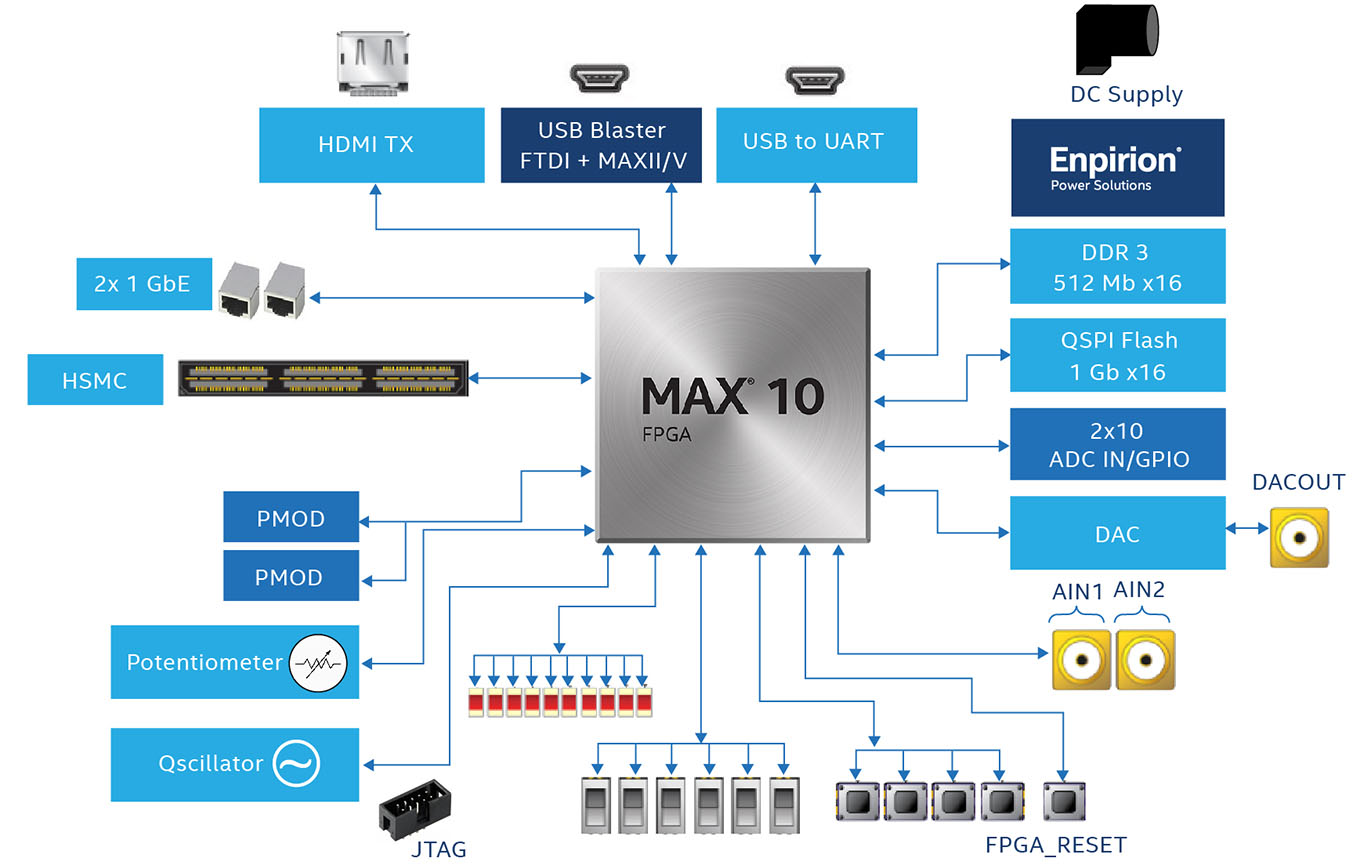
Figure 1: Altera MAX 10 FPGA family architecture — configurable logic fabric, embedded memory columns, PLLs, DSP blocks, integrated ADC, user flash, and I/O ring. The 10M16SAU169I7G implements this architecture with 16K LEs, 60 M9K blocks, and 4 PLLs.
Pinout, Package, and PCB Layout
The 10M16SAU169I7G is housed in a 169-ball UBGA (Ultra Fine-pitch Ball Grid Array) with a body size of 11 mm × 11 mm and 0.8 mm ball pitch. The package provides 130 user I/O pins organized across 8 I/O banks, each with an independent VCCIO supply rail for mixed-voltage interfacing.
Key pinout and layout considerations:
- VCCIO Banks: Each I/O bank supports independent VCCIO. For single-supply designs, all VCCIO pins are typically tied to 3.3 V. Mixed-voltage designs can set individual banks to 2.5 V, 1.8 V, or 1.5 V for direct interfacing to external ICs.
- JTAG Pins (TCK, TDI, TDO, TMS): Dedicated configuration and boundary-scan pins. Apply 10 kΩ pull-up resistors on TDI and TMS, even when JTAG is unused in production — these pins must not float.
- ADC Analog Inputs: The “SA” variant provides dedicated analog input pins (ANAIN1–ANAIN18) with a 0–2.5 V input range. These pins require separate VREFP/VREFN reference connections and analog ground plane isolation for optimal 12-bit SNR performance.
- MSEL[0]: Configuration mode select. Tie to GND for internal configuration mode (standard for MAX 10 instant-on operation).
- Power / Ground: All VCC and GND balls must be connected. Place 100 nF MLCC decoupling capacitors on every power pin, plus a 10 µF bulk capacitor per supply rail near the device.
- BGA Landing Pads: Use NSMD (non-solder-mask-defined) pads with a diameter of 0.4 mm for 0.8 mm pitch. Route escape channels using via-in-pad with filled and capped microvias for inner-layer fan-out.
- LVDS Pairs: Up to 22 true differential LVDS pairs are available. Route with 100 Ω differential impedance, matched-length, on inner PCB layers.

Figure 2: 10M16SAU169I7G in 169-UBGA package — 11 × 11 mm body, 0.8 mm pitch, 169-ball BGA footprint for compact high-density PCB designs.
Application Circuits and Design Guidelines
The 10M16SAU169I7G targets systems requiring instant-on, non-volatile programmable logic with integrated ADC capability and industrial temperature resilience. Typical application domains include:
- Industrial Automation: Motor drive encoder interfaces, PLC I/O expansion modules, sensor aggregation hubs, and protocol bridging (SPI ↔ UART, I2C ↔ parallel bus). The instant-on capability ensures deterministic control outputs within milliseconds of power-up. The integrated ADC enables direct measurement of analog sensors (temperature, pressure, current) without an external ADC IC.
- Communications Equipment: Small-cell baseband glue logic, Ethernet MAC-to-PHY bridging, CPRI/OBSAI framing, and multi-protocol serial conversion. The 45 embedded multipliers handle DSP pre-processing, FIR filtering, and baseband signal conditioning in the datapath.
- Board Management Controllers: Voltage rail power sequencing, system health monitoring (temperature, current via ADC), fan speed control, and watchdog supervision. The dual-image flash enables safe firmware updates in the field, while the industrial temperature rating ensures operation in server rooms and outdoor cabinets.
- IoT and Edge Computing: Smart sensor hubs, LED matrix display controllers, HMI panel interfaces, and compact data loggers. The 2,368 Kbit UFM provides non-volatile storage for calibration data and event logs without external EEPROM.
Power Supply Design: The “SA” single-supply variant requires only a single 3.3 V rail. The internal 1.2 V core regulator draws approximately 80–250 mA depending on logic utilization and clock frequency. The ADC requires a clean VREFP (2.5 V typical) and VREFN (GND) reference — use a dedicated LDO (such as TI TLV70025 or Microchip MIC5365) with ferrite bead filtering to minimize noise on the reference rail.
PCB Layout Best Practices:
- Use a 4-layer minimum stackup (signal–ground–power–signal) with dedicated power and ground planes
- For the 0.8 mm pitch UBGA, use via-in-pad with filled and capped microvias for reliable escape routing
- Route clock signals on inner layers with 50 Ω controlled impedance; use 100 Ω differential for LVDS pairs
- Keep PLL input clock trace lengths under 50 mm with length-matched output clock routing
- Isolate ADC analog input traces from digital signal layers; use guard rings and separate analog ground pour
- Provide a 10-pin JTAG header (2×5, 2.54 mm pitch) with trace lengths under 150 mm
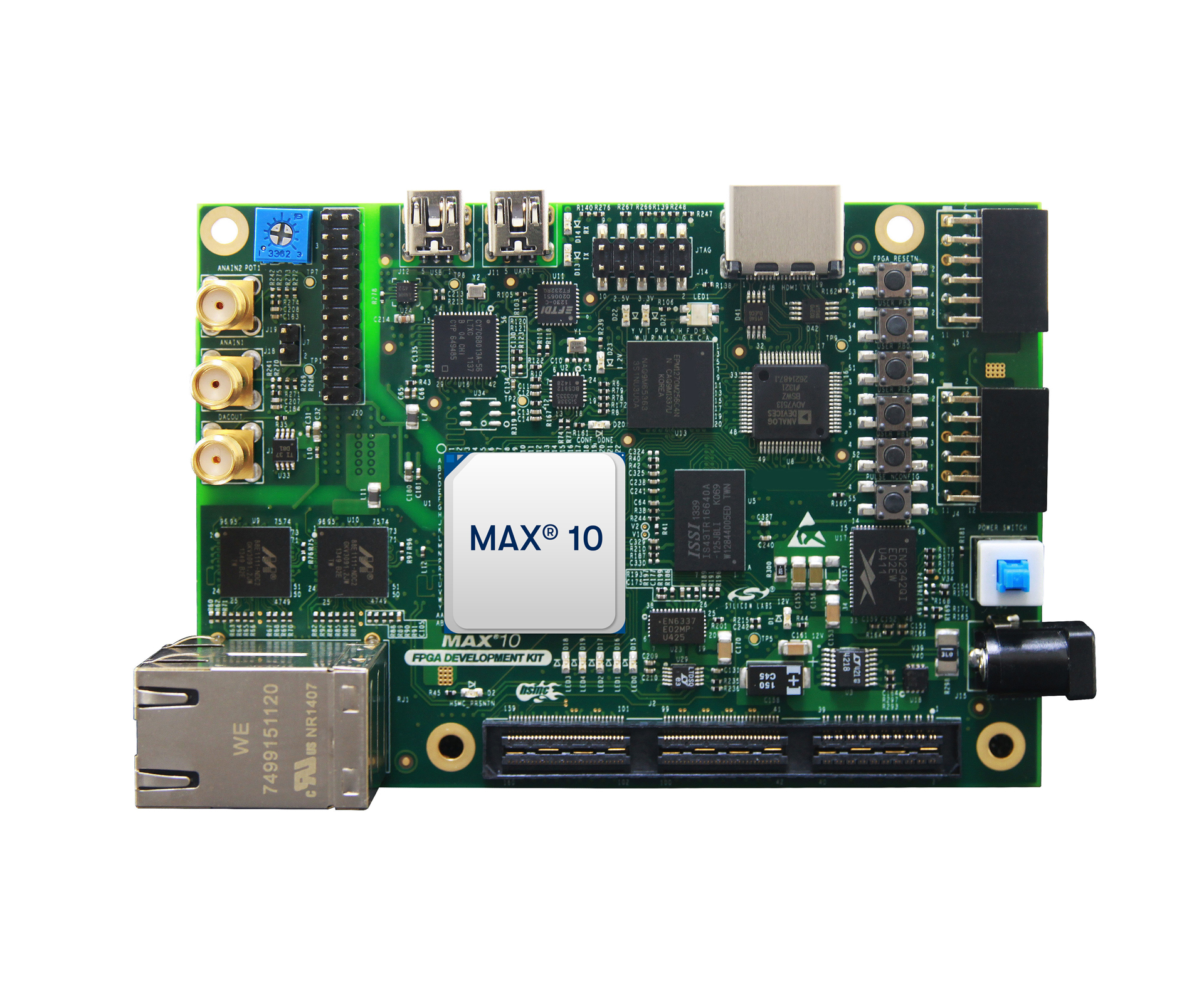
Figure 3: MAX 10 FPGA development kit — a typical application platform showing power supply section, JTAG programming, user I/O headers, and peripheral expansion for prototyping with MAX 10 devices including the 10M16SAU169I7G.
Equivalents, Cross-Reference, and Lifecycle
The 10M16SAU169I7G carries an Active lifecycle status as of 2026 and is stocked by major distributors including Digi-Key, Mouser, Arrow, and Octopart.
Pin-compatible alternatives within the MAX 10 family:
- 10M16SAU169C8G — Commercial temperature variant (0 °C to +85 °C), speed grade 8. Same pinout and package, faster timing for designs that do not require industrial temperature rating.
- 10M08SAU169I7G — Same package, 8,000 LEs. Pin-compatible logic capacity downgrade for cost-sensitive designs that need fewer resources.
- 10M16SAU169A7G — Automotive temperature variant (−40 °C to +125 °C). Same pinout for harsh-environment deployments requiring extended temperature range.
Cross-vendor alternatives:
- Lattice MachXO3LF-6900 (LCMXO3LF-6900C-5BG256C): Comparable logic density with integrated flash and instant-on boot. Requires Lattice Diamond; pinout is not compatible.
- Microchip PolarFire MPF100T: Higher-density, low-power flash FPGA for designs outgrowing MAX 10 capacity, with SEU-immune flash configuration.
To check real-time stock, pricing, or request a quote, upload your BOM to WWDParts for fast processing.
Video: Getting Started with Altera MAX 10 FPGA Development
Video: Getting started with Altera MAX 10 FPGA development using Quartus Prime — workflow applicable to the 10M16SAU169I7G.
Related technical guides on WWDParts:
- EP4CE6E22C8N FPGA: Datasheet, Pinout, Equivalents, and Specs
- 10M04SCE144C8G: Datasheet, Pinout, Block Diagram & Application Guide
- XC7K325T FPGA: Architecture, Specs, and Industrial Applications
Frequently Asked Questions (FAQ)
Does the 10M16SAU169I7G include an integrated ADC?
Yes. The “SA” (Single-supply, Analog) variant includes a 12-bit, 1 MSPS successive-approximation register (SAR) ADC with up to 18 external analog channels and an internal die temperature sensor. This enables direct analog measurement of sensors, voltages, and currents without an external ADC IC. For designs that do not require the ADC, the pin-compatible “SC” (Compact) variant (10M16SCU169I7G) converts analog pins to additional digital I/O.
What development tools and software are required for the 10M16SAU169I7G?
Intel Quartus Prime Lite Edition (free, no license required) fully supports all MAX 10 devices for design entry, synthesis, place-and-route, and timing analysis. A USB-Blaster or USB-Blaster II JTAG cable is needed for programming and SignalTap debugging. The Quartus package includes Platform Designer (formerly Qsys) for system integration and ModelSim-Intel FPGA Starter Edition for RTL simulation. The ADC IP core is configured through Platform Designer's Modular ADC wizard.
Can the 10M16SAU169C8G replace the 10M16SAU169I7G without PCB changes?
Yes, the 10M16SAU169C8G is fully pin-compatible in the same 169-UBGA package. The C8G variant is the commercial temperature version (0 °C to +85 °C) at speed grade 8, which offers faster timing performance. However, it does not support the industrial temperature range. If your application operates within 0–85 °C, the C8G can be a drop-in replacement with improved speed margins. Only re-synthesis and re-programming in Quartus Prime are required.
How fast does the 10M16SAU169I7G boot after power-on?
MAX 10 devices with internal configuration flash complete initialization and become fully operational in under 10 milliseconds after all supply voltages reach valid levels. This instant-on capability is essential for power sequencing controllers, safety interlocks, and applications where I/O pins must reach a known, deterministic state immediately at startup — before external processors finish their own boot sequences.
What external memory interfaces does the 10M16SAU169I7G support?
The 10M16SAU169I7G supports DDR2, DDR3, LPDDR2, and SRAM external memory interfaces. The Quartus Prime External Memory Interface Toolkit provides ready-made controllers with calibrated timing. For the U169 package, the available I/O count (130 pins) supports one DDR3 x16 interface at up to 300 MHz (600 Mbps). Place DDR memory ICs as close as possible to the FPGA with matched-length address/data routing on a dedicated signal layer.
Is the 10M16SAU169I7G suitable for safety-critical or harsh-environment deployments?
The I7G variant is rated for the industrial temperature range (−40 °C to +100 °C) and includes AES-256 bitstream encryption for IP security. The non-volatile flash configuration eliminates SRAM-based single-event upset (SEU) concerns in the configuration memory, making it inherently more robust than SRAM FPGAs in radiation or electrically noisy environments. For extended temperature (−40 °C to +125 °C) or AEC-Q100 automotive qualification, consider the 10M16SAU169A7G variant.