10M16SAU169I7G Datasheet, Pinout & Application Guide | Altera MAX 10 FPGA
Table of Contents
1. Overview of the 10M16SAU169I7G
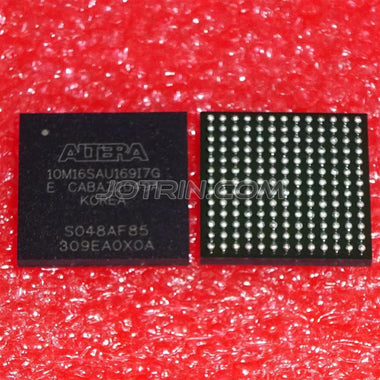
The 10M16SAU169I7G is a non-volatile FPGA from the Intel (Altera) MAX 10 family, built on a 55 nm process node. It provides 16,000 logic elements (LEs), integrated analog-to-digital converters (ADC), and dual configuration flash memory in a compact 169-ball UBGA package. Designed for industrial-temperature operation from −40°C to +100°C, the device is ideal for cost-sensitive embedded systems that require instant-on capability and single-chip programmable logic without external configuration memory.
MAX 10 FPGAs are unique in combining flash-based non-volatile storage with FPGA fabric, enabling features such as dual boot images, remote field upgrades, and built-in analog functionality—all without external flash or EEPROM chips. The “I7G” suffix denotes the industrial temperature grade and speed grade 7, making this variant well-suited for harsh-environment deployments including factory automation, motor drives, and ruggedized communications equipment.
2. Key Specifications & Parameters
| Parameter | Value |
|---|---|
| Part Number | 10M16SAU169I7G |
| Manufacturer | Intel / Altera |
| Device Family | MAX 10 FPGA |
| Logic Elements (LEs) | 16,000 |
| Logic Array Blocks (LABs) | 1,000 |
| Embedded Memory | 549 Kb (M9K blocks) |
| User Flash Memory (UFM) | Yes |
| PLLs | 4 |
| Max User I/O Pins | 130 |
| Max LVDS Pairs | 22 |
| Integrated ADC | Yes (12-bit, dual ADC) |
| Package | UBGA-169 (11 × 11 mm) |
| Core Voltage | 1.2 V |
| I/O Voltage | 3.0 V – 3.3 V |
| Operating Temperature | −40°C to +100°C (Industrial) |
| Speed Grade | 7 |
| Process Technology | 55 nm |
| External Memory Support | DDR2, DDR3, LPDDR2, SRAM |
| Configuration | Internal flash (dual boot images) |
| Bitstream Security | AES-128 encryption |
3. Pinout & Package Information
The 10M16SAU169I7G uses the UBGA-169 (Ultra-thin Ball Grid Array) package measuring 11 × 11 mm with a 0.8 mm ball pitch. This compact form factor delivers up to 130 user-configurable I/O pins organized across multiple I/O banks supporting LVCMOS (1.2 V to 3.3 V), LVTTL (3.0 V to 3.3 V), and differential signaling standards including LVDS and mini-LVDS.
Each I/O bank has its own dedicated VCCIO supply, allowing mixed-voltage interfaces within a single device. The package supports DDR3 memory interfaces with on-chip termination (OCT) and is pin-compatible with other MAX 10 U169 variants, simplifying design migration across different logic density options.

4. Typical Applications & Design Integration
The 10M16SAU169I7G is widely deployed in applications where instant-on operation, compact board space, and mixed-signal integration are critical. Its built-in ADC eliminates the need for external analog front-end components, reducing BOM cost and PCB area. Common use cases include:
- Industrial Automation & Motor Control – Sensor signal conditioning via integrated ADC, real-time PWM generation, and communication protocol bridges (Modbus, EtherCAT).
- Communications Infrastructure – Protocol conversion, packet inspection, and timing/synchronization functions in base stations and small cells.
- Embedded Vision & Video Processing – Image pre-processing pipelines, MIPI CSI-2 bridging, and display interface conversion.
- IoT Edge Devices – Secure boot with AES-128 encryption, sensor fusion, and low-power always-on monitoring.
- Test & Measurement Equipment – High-speed data acquisition with the dual 12-bit ADC, custom digital signal processing, and flexible I/O interfacing.
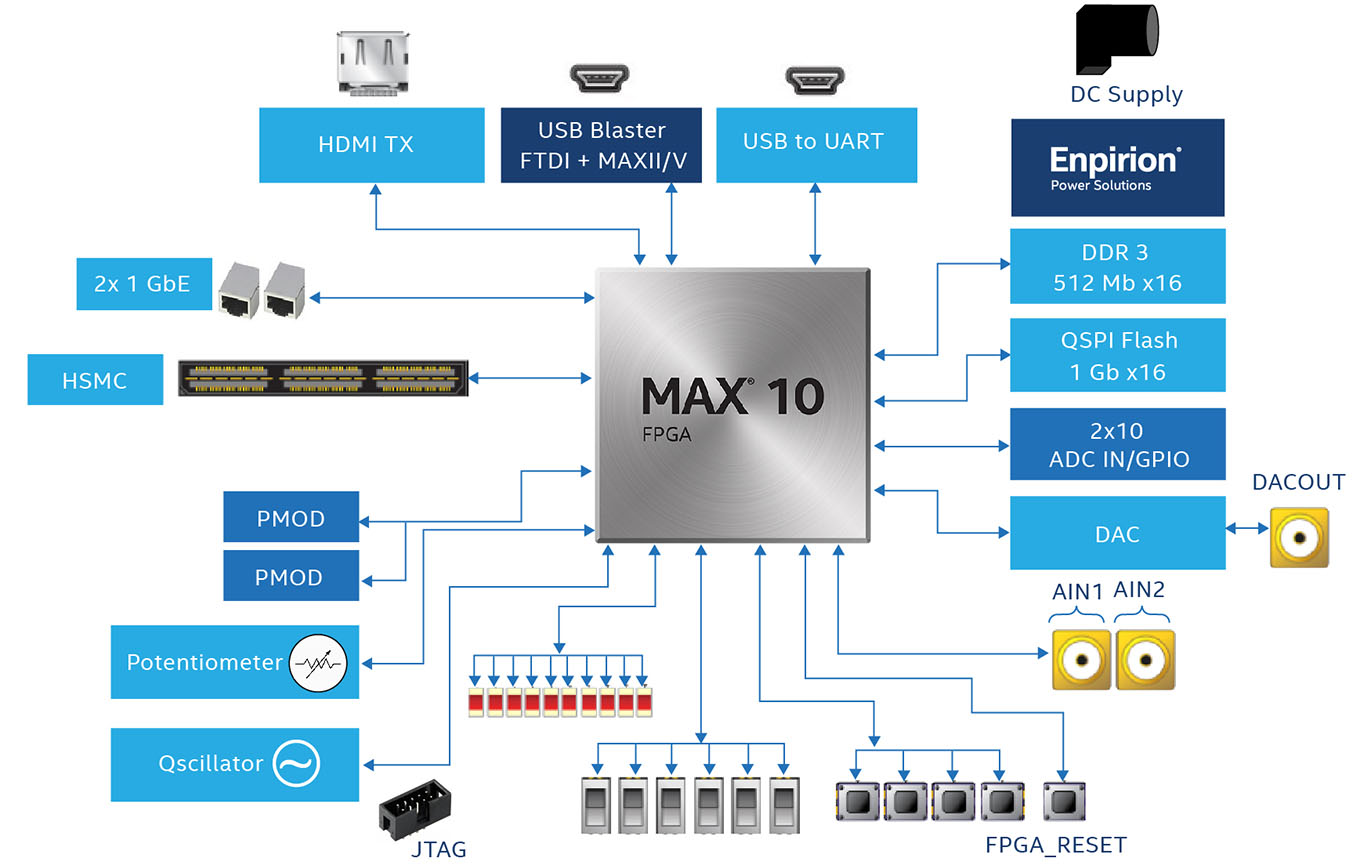
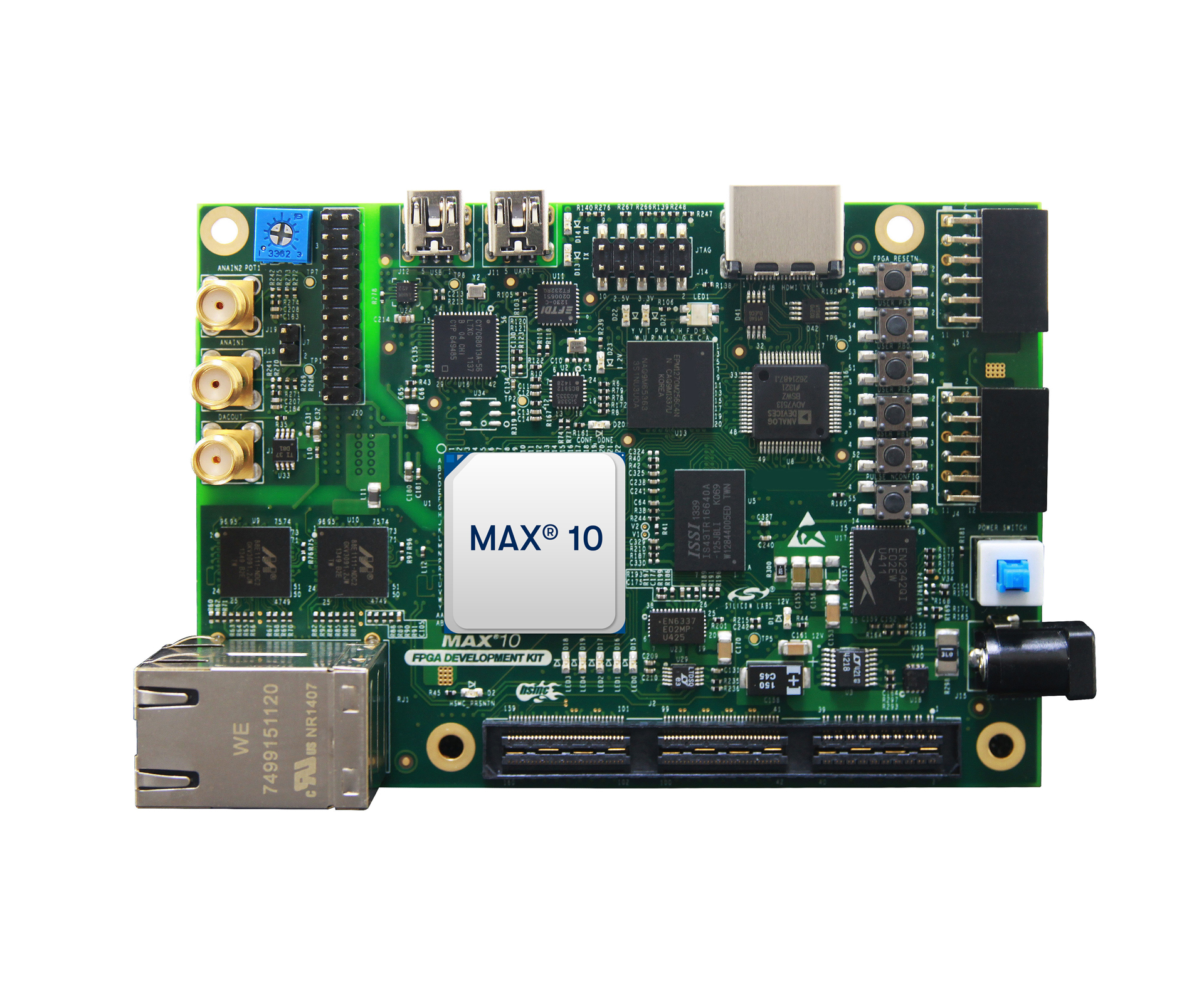
For rapid prototyping, Intel offers the MAX 10 FPGA Development Kit and third-party boards from Terasic (DE10-Lite) that support the MAX 10 device family. Design entry uses Intel Quartus Prime Lite Edition, which is available as a free download.
5. Design Tips & Best Practices
To maximize reliability and performance with the 10M16SAU169I7G, follow these key design guidelines:
- Power Sequencing: Apply VCCINT (1.2 V core) before VCCIO bank supplies. Use a dedicated voltage regulator for the core rail with adequate decoupling capacitors (100 nF MLCC per power pin plus 10 µF bulk capacitors).
- Configuration: Take advantage of dual configuration images for fail-safe remote firmware updates. Store a known-good “golden” image in the first flash sector and the application image in the second.
- ADC Usage: Route analog input traces away from high-speed digital signals. Use a dedicated analog ground plane tied to the device’s AGND pins for best ADC accuracy.
- Clock Management: Utilize the four on-chip PLLs for clock synthesis and jitter cleaning. Keep external oscillator traces short and matched in length for differential clock inputs.
- Thermal Design: Although the UBGA-169 package has a low thermal resistance, ensure adequate airflow and copper pour on the PCB ground plane beneath the device for industrial-temperature operation.
For additional design guidance, explore our articles on the Xilinx Kintex-7 XC7K325T troubleshooting and the Artix-7 XC7A200T design-in guide for complementary FPGA design insights.
Video Tutorial: Getting Started with MAX 10 FPGAs
6. Frequently Asked Questions
What is the difference between the 10M16SAU169I7G and 10M16SAU169C8G?
The primary differences are temperature range and speed grade. The 10M16SAU169I7G is rated for industrial temperatures (−40°C to +100°C) with speed grade 7, while the 10M16SAU169C8G targets commercial temperatures (0°C to +85°C) with the faster speed grade 8. Choose the I7G variant for harsh-environment applications and the C8G for cost-optimized commercial designs requiring higher clock speeds.
Does the 10M16SAU169I7G require external configuration flash memory?
No. MAX 10 FPGAs include internal flash memory for configuration storage, enabling instant-on operation without external EEPROM or flash chips. The device supports dual configuration images for fail-safe remote firmware updates, and user flash memory (UFM) is available for storing application data such as calibration constants or serial numbers.
What development tools are needed for the 10M16SAU169I7G?
You need Intel Quartus Prime Lite Edition, which is a free download from Intel/Altera’s website. It includes the FPGA design flow (synthesis, place-and-route, timing analysis) and the Nios II soft processor toolchain. For simulation, ModelSim-Intel FPGA Edition is bundled with Quartus Prime. Programming is done via JTAG using a USB-Blaster or USB-Blaster II cable.
Can the 10M16SAU169I7G interface with DDR3 memory?
Yes. The MAX 10 10M16 device supports DDR3, DDR2, LPDDR2, and SRAM external memory interfaces. The U169 package provides sufficient I/O pins for a 16-bit DDR3 interface with on-chip termination (OCT). Use the Intel EMIF (External Memory Interface) IP core in Quartus Prime for automated memory controller generation and calibration.
How does the integrated ADC work in the 10M16SAU169I7G?
The MAX 10 features a dual 12-bit SAR ADC capable of sampling up to 1 MSPS per channel. It supports up to 18 analog input channels (device-dependent) and can be configured for single-ended or differential input modes. The ADC is controlled via a soft IP core instantiated in the FPGA fabric, and conversion results are available through an Avalon-MM register interface. This eliminates the need for external ADC chips in sensor-monitoring and data-acquisition applications.
Is the 10M16SAU169I7G suitable for safety-critical or high-reliability applications?
The 10M16SAU169I7G offers several features that support high-reliability designs: AES-128 bitstream encryption for IP security, internal configuration with CRC error detection, and the industrial temperature range (−40°C to +100°C). However, it is not inherently certified for aerospace or automotive safety standards (e.g., DO-254, ISO 26262). For such applications, additional design measures including triple modular redundancy (TMR) and external SEU mitigation may be required. Contact Intel/Altera for device-specific qualification data.