10M16SAU169I7G Datasheet, Pinout, Block Diagram & Application Guide | Intel MAX 10 FPGA
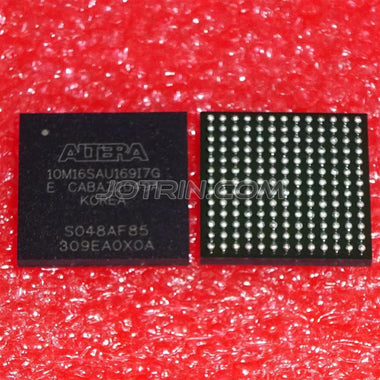
The 10M16SAU169I7G is a non-volatile, single-chip FPGA from Intel's (formerly Altera) MAX 10 family, fabricated on TSMC's 55 nm embedded flash process. It integrates 16,000 logic elements, 549 Kbit of M9K embedded SRAM, 48 hardware 18×18-bit multipliers, dual on-die configuration flash images, user flash memory, 4 PLLs, and a 12-bit 1 MSPS SAR ADC — all within a compact 169-ball UBGA package. Rated for the industrial temperature range (−40 °C to +100 °C), speed grade 7, the 10M16SAU169I7G targets ruggedized deployments in motor control, industrial IoT edge nodes, sensor aggregation, and building automation systems.
Overview and Part Number Decoding
The 10M16SAU169I7G belongs to the Intel MAX 10 product line — the industry's first single-chip, non-volatile FPGA family. Unlike SRAM-based FPGAs such as Xilinx Spartan-7 or Intel Cyclone V that require external SPI flash for configuration bitstream storage, MAX 10 devices store up to two complete configuration images in on-die flash memory. This architecture enables instant-on operation within milliseconds of power-up and supports fail-safe remote field updates via the Remote System Upgrade (RSU) IP core — without any external EPCQ or SPI NOR flash on the BOM.
A key differentiator of the "SA" variant is the integrated 12-bit, 1 MSPS SAR ADC with up to 9 external analog input channels and an internal temperature sensor. This on-chip ADC eliminates the need for an external ADC IC, saving board space, reducing BOM cost, and simplifying routing in mixed-signal designs such as sensor acquisition, power monitoring, and industrial control.
The part number encodes the following attributes:
- 10M16 — MAX 10 family, 16,000 logic elements
- SA — Single-supply, Analog variant (internal 1.2 V regulator + integrated 12-bit ADC)
- U169 — 169-ball Ultra-thin Fine-pitch BGA (UBGA), 11 × 11 mm body
- I7 — Industrial temperature range (−40 °C to +100 °C), speed grade 7
- G — Green / RoHS / Pb-free compliant
The "SA" designation distinguishes this variant from the "SC" (single-supply, compact) variants that omit the analog-to-digital converter. In the SC variant, the analog input pins become general-purpose digital I/O or LVDS channels instead. The "I7" suffix indicates that this device is qualified for industrial-grade operation — unlike the "C8" commercial variant limited to 0 °C to +85 °C. The device is fully supported by Intel Quartus Prime Lite Edition, which is free to download and requires no license file. For current stock and pricing, check 10M16SAU169I7G availability on WWDParts.
Specifications and Parameter Table
| Parameter | Value |
|---|---|
| Manufacturer | Intel (Altera) |
| Product Family | MAX 10 |
| Part Number | 10M16SAU169I7G |
| Logic Elements (LEs) | 16,000 |
| Logic Array Blocks (LABs) | 1,000 (16 LEs per LAB) |
| M9K Embedded Memory Blocks | 61 |
| Total Embedded SRAM | 549 Kbit (562,176 bits) |
| 18×18 Embedded Multipliers | 48 |
| Phase-Locked Loops (PLLs) | 4 (4 output counters each) |
| User Flash Memory (UFM) | 2,368 Kbit |
| Configuration Flash Memory | Dual-image internal flash (instant-on, <10 ms boot) |
| Integrated ADC | 1 × 12-bit SAR ADC, 1 MSPS, up to 9 analog channels + temperature sensor |
| User I/O Pins (U169 package) | 130 |
| I/O Banks | 8 |
| Global Clock Networks | 20 |
| Maximum LVDS Differential Pairs | 22 |
| I/O Standards Supported | 3.3 V / 2.5 V / 1.8 V / 1.5 V LVTTL/LVCMOS, LVDS, SSTL, HSTL |
| Core Voltage (VCC) | 1.2 V (internally regulated from 3.3 V) |
| External Supply (VCCA / VCCIO) | 3.3 V single rail (2.85–3.465 V) |
| Package | 169-ball UBGA (11 × 11 mm, 0.8 mm pitch) |
| Operating Temperature | −40 °C to +100 °C (industrial) |
| Speed Grade | 7 |
| Process Technology | 55 nm (TSMC embedded flash) |
| RoHS Compliance | Yes (Pb-free, Green) |
Looking for 10M16SAU169I7G Inventory?
Check our real-time stock levels, pricing, and volume discounts for global distribution.
Check 10M16SAU169I7G StockArchitecture and Block Diagram
The MAX 10 architecture is a single-chip programmable logic platform that merges an FPGA fabric with non-volatile configuration storage, user flash, and mixed-signal peripherals. At its core, the logic fabric consists of 1,000 logic array blocks (LABs), each containing 16 adaptive logic elements (LEs). Each LE provides a four-input look-up table (LUT), a programmable register with synchronous load/clear, and carry-chain logic for efficient arithmetic operations.
Embedded memory is organized as 61 M9K blocks of 9,216 bits each, configurable as single-port RAM, dual-port RAM, ROM, shift registers, or FIFO buffers in various width×depth combinations. The 48 embedded 18×18-bit multipliers can be paired for 36-bit precision or split into independent 9×9-bit units, enabling efficient DSP filter and mathematical functions without consuming LUT resources.
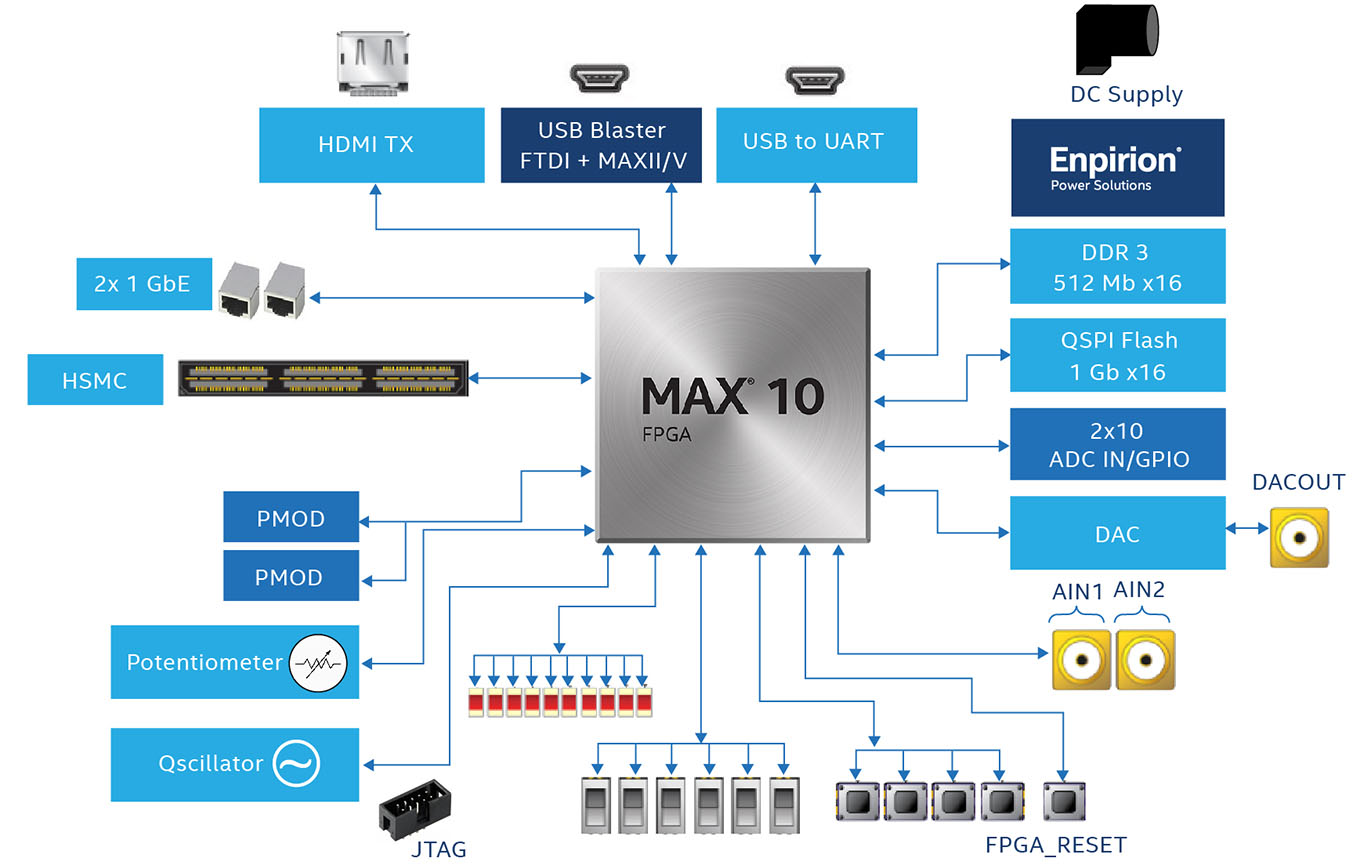
MAX 10 FPGA Development Kit Block Diagram
Four general-purpose PLLs provide clock synthesis and frequency multiplication/division with low jitter. The 20 global clock networks distribute clocks across the device with minimal skew. The integrated 12-bit ADC with a 1 MSPS sampling rate includes a prescaler, channel sequencer, and a dedicated interface to the FPGA fabric through the Modular ADC IP core, allowing real-time monitoring of external analog signals alongside digital processing.
Configuration is stored in on-die flash memory supporting two complete bitstream images. On power-up, the device loads within milliseconds (instant-on) from the active image. The Remote System Upgrade (RSU) controller enables field updates with automatic fallback to a known-good image if the new configuration fails CRC verification.
Pinout, Package, and PCB Layout
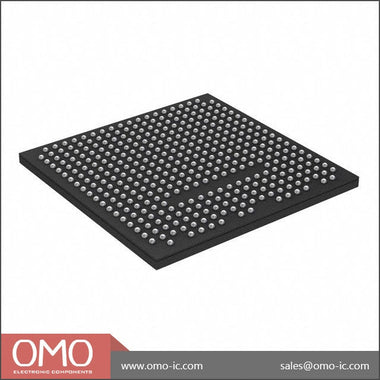
The 10M16SAU169I7G is housed in a 169-ball UBGA package with an 11 × 11 mm body and 0.8 mm ball pitch, organized in a 13 × 13 grid. Of the 169 balls, 130 are available as user I/O pins distributed across 8 I/O banks. Each bank can be independently configured for a specific I/O voltage standard (3.3 V, 2.5 V, 1.8 V, or 1.5 V). The remaining balls serve power supply (VCC, VCCIO, VCCA), ground (GND), dedicated clock inputs, JTAG, and ADC analog input functions.

169-UBGA Package (11 × 11 mm, 0.8 mm pitch)
For PCB layout, the UBGA package requires a minimum 4-layer stackup with controlled impedance for LVDS pairs. Intel recommends 100 ohm differential impedance for LVDS routing and adequate decoupling capacitors (100 nF MLCC) on each VCCIO and VCC pin, placed as close as possible to the BGA pad. The thermal pad on the bottom of the package should be connected to a ground copper pour with an array of thermal vias (0.3 mm drill, 1 mm pitch) for effective heat dissipation. Pin-out files in CSV and PDF format are available from the WWDParts engineering blog or Intel's Quartus Pin Planner.
Application Circuits and Design Guidelines
The 10M16SAU169I7G is well-suited for applications requiring moderate logic density with integrated analog sensing in harsh operating environments. Typical application domains include:
- Industrial Motor Control — The integrated ADC samples current/voltage feedback while the FPGA fabric implements PWM generation, encoder interfaces, and PID loops in a single chip.
- Building Automation & HVAC — The industrial temperature rating and non-volatile configuration make it reliable for unattended sensor aggregation nodes.
- Communications Infrastructure — Clock management via 4 PLLs and LVDS I/O support enable protocol bridging and data-path conversion between legacy and modern interfaces.
- Test & Measurement — The on-chip ADC and 48 multipliers support signal conditioning, digital filtering, and data acquisition front-ends.

MAX 10 FPGA Development Board — Typical Application and Evaluation Setup
For single-supply operation, the 10M16SAU169I7G requires only a 3.3 V rail. The internal voltage regulator generates the 1.2 V core supply. A recommended power-up sequence applies VCCA (3.3 V) first, followed by VCCIO banks. Intel's Power Delivery Network (PDN) design tool can model decoupling requirements based on toggle rate and I/O utilization. For a reference design incorporating DDR3 SDRAM, Ethernet PHY, and HDMI output with a MAX 10 device, refer to the MAX 10 FPGA Development Kit schematics on WWDParts.
Video: MAX 10 FPGA Tutorial
Frequently Asked Questions (FAQ)
What is the difference between 10M16SAU169I7G and 10M16SAU169C8G?
Both devices share the same 16,000-LE logic fabric and 169-UBGA package. The I7 suffix indicates industrial temperature range (−40 °C to +100 °C) with speed grade 7, while C8 designates commercial temperature range (0 °C to +85 °C) with speed grade 8. The C8 variant achieves slightly higher clock frequencies due to its relaxed temperature envelope, but the I7 variant is required for outdoor, automotive, or factory-floor deployments where ambient temperatures may exceed 85 °C.
Does the 10M16SAU169I7G require external configuration flash memory?
No. MAX 10 devices integrate on-die configuration flash memory that stores up to two complete bitstream images. The device boots from internal flash within milliseconds of power-up (instant-on), eliminating the need for external EPCQ, SPI NOR, or parallel flash ICs found in SRAM-based FPGA designs. This reduces BOM cost, board area, and supply-chain complexity.
What software tools are required to program the 10M16SAU169I7G?
Intel Quartus Prime Lite Edition (free, no license required) provides full support for MAX 10 devices, including synthesis, place-and-route, timing analysis, the Pin Planner, and the integrated Modular ADC IP core. Programming is performed via a USB-Blaster or USB-Blaster II cable through the JTAG interface. ModelSim Intel FPGA Edition (included) supports RTL simulation.
How many analog input channels does the integrated ADC support?
The 10M16SAU169I7G's 12-bit SAR ADC supports up to 9 external analog input channels plus an internal die temperature sensor. The ADC samples at up to 1 MSPS with a dedicated voltage reference. Analog inputs accept 0–2.5 V or 0–3.3 V ranges depending on the VREF configuration. The Modular ADC IP core provides a register-based or streaming interface to the FPGA fabric.
Can the 10M16SAU169I7G run on a single 3.3 V power supply?
Yes. The "SA" (single-supply, analog) variant includes an internal 1.2 V low-dropout regulator that generates the FPGA core voltage from the 3.3 V VCCA rail. Only a single 3.3 V supply is needed, though all VCCIO banks must also be powered at the desired I/O voltage level (3.3 V, 2.5 V, 1.8 V, or 1.5 V). This single-supply capability simplifies power-supply design and reduces regulator count.
What are compatible alternative or equivalent parts to the 10M16SAU169I7G?
Within the MAX 10 family, the 10M16SCU169I7G is pin-compatible but omits the ADC (SC variant). The 10M08SAU169I7G provides 8,000 LEs in the same package for lower-density designs. For cross-family comparison, the Lattice MachXO3LF-6900 and Microchip PolarFire SoC occupy similar non-volatile FPGA segments, though they differ in architecture and toolchain. Always verify pin-mapping, voltage, and timing compatibility before substitution. For sourcing alternatives, browse MAX 10 FPGA options on WWDParts.
Alan Carter, Senior Hardware Engineer
Alan has over 15 years of experience in embedded systems design, specializing in ARM Cortex architectures, PCB routing for high-speed digital signals, and industrial IoT deployments. He frequently contributes technical teardowns and architecture comparisons.