10M04SCE144C8G Datasheet, Pinout, Specifications & Application Guide | Intel MAX 10 FPGA
Overview of the 10M04SCE144C8G
The 10M04SCE144C8G is a non-volatile FPGA from Intel's (formerly Altera) MAX 10 family. Built on a 55nm flash-based process, this entry-level device integrates 4,000 logic elements with on-chip configuration flash memory for instant-on operation — no external boot ROM required. The "SC" designation identifies it as a single-supply compact variant, meaning it operates from a single 3.3V power rail without an integrated ADC, prioritizing low cost and minimal board footprint.
The MAX 10 family uniquely bridges the gap between CPLDs and FPGAs. Like a CPLD, the 10M04SCE144C8G powers up instantly with its configuration stored in internal flash. Like an FPGA, it provides flexible logic density, embedded memory, DSP multipliers, and versatile I/O — capabilities that traditional CPLDs cannot match. Dual configuration image support enables safe remote field updates with automatic fallback to a known-good factory image.
Typical applications include I/O expansion, LED panel controllers, communications protocol bridging, sensor interface hubs, industrial automation glue logic, and compact embedded controllers. The 10M04SCE144C8G is fully supported by Intel Quartus Prime Lite Edition (free), providing a complete RTL-to-bitstream development flow with synthesis, place-and-route, timing analysis, and on-chip debugging via Signal Tap.
Key Specifications and Parameters
| Parameter | Value |
|---|---|
| Manufacturer | Intel (formerly Altera) |
| Family | MAX 10 |
| Part Number | 10M04SCE144C8G |
| Logic Elements (LEs) | 4,000 |
| Logic Array Blocks (LABs) | 250 |
| M9K Memory Blocks | 21 (189 Kb total) |
| Total RAM Bits | 193,536 |
| 18×18 Embedded Multipliers | 16 |
| Phase-Locked Loops (PLLs) | 2 |
| Global Clock Networks | 20 |
| User I/O Pins (E144) | 101 |
| Maximum LVDS Pairs | 15 |
| User Flash Memory (UFM) | 32 Kb |
| Internal Configuration Flash | Yes (dual-image CFM) |
| ADC Blocks | None (SC = Compact variant, no ADC) |
| On-chip Temperature Sensor | Yes |
| Package Type | 144-EQFP (20 × 20 mm, 0.5 mm pitch) |
| Core Supply Voltage | 1.2V (internally regulated from 3.3V) |
| I/O Supply Voltage | 2.85V – 3.465V (single 3.3V supply) |
| Speed Grade | 8 (C8 = commercial, speed grade 8) |
| Maximum Clock Frequency | 402 MHz |
| Operating Temperature | 0°C to 85°C (commercial) |
| Process Technology | 55 nm flash-based |
| Built-in Oscillator | 116 MHz internal oscillator |
| RoHS Compliance | Yes (G = Green/Lead-Free) |
| Product Status | Active |
The part number decodes as: 10M04 (MAX 10 family, 4K LEs), SC (Single-supply, Compact — no integrated ADC), E144 (EQFP 144-pin package), C8 (commercial temperature, speed grade 8), G (Green/RoHS-compliant). The single-supply compact variant integrates an internal 1.2V voltage regulator so the entire device runs from a single 3.3V rail, simplifying power supply design while omitting the ADC to reduce die cost.
Block Diagram and Architecture
The MAX 10 architecture in the 10M04SCE144C8G uses a column-based fabric with logic array blocks (LABs), M9K embedded memory columns, 18×18 multiplier blocks, PLLs, and I/O elements arranged around the device perimeter. The internal configuration flash memory (CFM) and user flash memory (UFM) are embedded directly within the FPGA fabric, enabling non-volatile instant-on operation.

Key architectural highlights of the 10M04SCE144C8G include:
- Logic Elements (LEs): Each of the 4,000 LEs contains a four-input look-up table (LUT), a programmable register, and carry chain logic. LEs are grouped into 250 LABs of 16 LEs each, enabling efficient local routing and high utilization.
- M9K Memory Blocks: 21 blocks provide 189 Kb of true dual-port SRAM, configurable as RAM, ROM, FIFO, or shift register in various width/depth combinations up to 256×36 bits per block.
- Embedded Multipliers: 16 dedicated 18×18-bit multiplier blocks support DSP functions including FIR filters, FFTs, and fixed-point arithmetic without consuming general-purpose logic resources.
- Configuration Flash Memory (CFM): Supports dual compressed images for remote update with automatic fallback to the factory image if the application image fails — ideal for field-deployed systems.
- User Flash Memory (UFM): 32 Kb of on-chip non-volatile storage accessible via Avalon Memory-Mapped interface for calibration data, serial numbers, encryption keys, or small lookup tables.
Pinout and Package Information
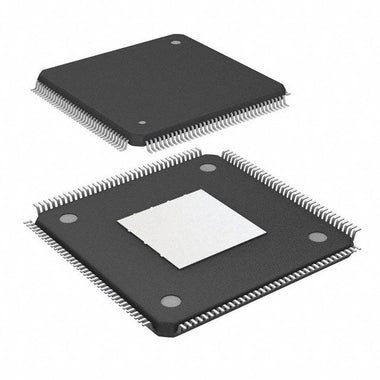
The 10M04SCE144C8G is housed in a 144-pin Enhanced Quad Flat Package (EQFP) with an exposed thermal pad, measuring 20mm × 20mm with 0.5mm lead pitch. The E144 package provides 101 user-programmable I/O pins organized across multiple I/O banks supporting voltage standards from 1.2V to 3.3V.

The I/O banks support multiple single-ended standards including 3.3V/2.5V/1.8V/1.5V/1.2V LVCMOS and LVTTL, as well as differential standards such as LVDS with up to 15 differential pairs for high-speed serial links. Each I/O pin features programmable drive strength, slew rate control, and optional internal pull-up resistors. The exposed thermal pad on the package bottom must be soldered to the PCB ground plane for proper electrical grounding and thermal dissipation.
For complete pin assignment tables, bank-to-pin mappings, and recommended PCB footprints, refer to the official Intel MAX 10 FPGA Device Handbook.
Application Circuit and Design Guide
The 10M04SCE144C8G is commonly deployed in industrial control, communications equipment, consumer electronics, automotive subsystems, and IoT edge nodes. Its non-volatile instant-on behavior, compact EQFP footprint, and low cost make it ideal for glue logic consolidation, LED display drivers, motor control state machines, SPI/I2C bridge interfaces, and protocol converters.

When designing with the 10M04SCE144C8G, follow these guidelines:
- Power Supply Design: The single-supply SC variant integrates an internal 1.2V regulator, requiring only a 3.3V ±5% input rail. Place 100nF + 10µF decoupling capacitors near each VCC pin pair. Unlike the SA variant, no analog supply filtering is needed since the SC variant has no ADC.
- Configuration: The internal CFM stores the FPGA bitstream — no external configuration memory is needed. Program via JTAG using an Intel USB Blaster or compatible programmer. Enable dual-image mode in Quartus Prime for field-updatable designs with safe rollback capability.
- Clock Design: Connect a 3.3V LVCMOS oscillator (typically 50 MHz) to a dedicated clock input pin. The two on-chip PLLs provide frequency synthesis from 5 MHz to 472.5 MHz output. The 116 MHz internal oscillator can serve as a basic system clock for reduced component count.
- PCB Layout: Use a 4-layer minimum PCB stackup with dedicated ground and power planes. The EQFP exposed pad must be soldered to the ground plane. Keep high-speed signal traces short and impedance-controlled for LVDS pairs. Place decoupling capacitors as close as possible to power pins.
- External ADC Integration: Since the SC variant lacks an on-chip ADC, interface external ADC devices (such as the ADC128S022 or ADS7924) via SPI or I2C using the FPGA's general-purpose I/O. For designs requiring integrated analog, consider upgrading to the 10M08SAE144C8G (SA variant with 12-bit ADC).
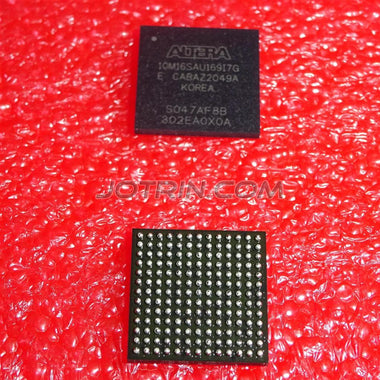
The 10M16SAU169C8G offers a higher-density upgrade path with 16,000 logic elements for designs requiring additional resources. Browse our full FPGA and CPLD catalog for additional Intel MAX 10 and Altera FPGA options.
Video Tutorial: Getting Started with Intel MAX 10 FPGA
Frequently Asked Questions
What is the 10M04SCE144C8G and what family does it belong to?
The 10M04SCE144C8G is a non-volatile FPGA from Intel's MAX 10 family. It features 4,000 logic elements, 189 Kb of M9K embedded memory (21 blocks), 16 embedded 18×18 multipliers, 2 PLLs, and 101 user I/O pins in a 144-EQFP package. Built on 55nm flash-based process technology, it stores its configuration internally for instant-on operation without external boot memory.
What does "SC" mean in the 10M04SCE144C8G part number?
The "SC" designation stands for Single-supply Compact. This means the device operates from a single 3.3V power rail (with an internal 1.2V regulator) but does not include an integrated ADC. The compact variant reduces die cost while retaining all digital FPGA resources. For designs requiring an on-chip analog-to-digital converter, choose the "SA" (Single-supply Analog) variant such as the 10M04SAE144C8G.
Does the 10M04SCE144C8G need an external configuration memory?
No. The 10M04SCE144C8G integrates on-chip configuration flash memory (CFM) that stores the FPGA bitstream internally. The device configures itself within milliseconds at power-up without requiring any external EPCS, EPCQ, or other configuration PROM. Dual-image CFM support enables remote field updates with automatic fallback to the factory image if an update fails.
What is the difference between the 10M04SCE144C8G and the 10M08SAE144C8G?
The 10M08SAE144C8G offers double the logic elements (8,000 vs. 4,000), more M9K memory (32 blocks / 378 Kb vs. 21 blocks / 189 Kb), additional multipliers (24 vs. 16), and an integrated 12-bit ADC with up to 18 analog input channels. The 10M04SCE144C8G (SC = Compact) omits the ADC for lower cost. Both share the same 144-EQFP package and 101 user I/O pins, making the 10M08SAE144C8G a drop-in upgrade.
What development tools support the 10M04SCE144C8G?
The 10M04SCE144C8G is fully supported by Intel Quartus Prime Lite Edition, which is available as a free download. Quartus Prime Lite provides synthesis, place-and-route, timing analysis, the Signal Tap embedded logic analyzer, Platform Designer (Qsys) for system integration, and ModelSim-Intel FPGA Starter Edition for simulation. An Intel USB Blaster or USB Blaster II cable is required for JTAG programming. Third-party evaluation boards featuring MAX 10 devices are widely available for rapid prototyping.
Can the 10M04SCE144C8G be used for DSP applications?
Yes. The 10M04SCE144C8G includes 16 dedicated 18×18-bit hardware multipliers that accelerate DSP operations such as FIR/IIR filters, FFTs, and fixed-point arithmetic without consuming general-purpose logic. Combined with 189 Kb of dual-port M9K block RAM for coefficient and data storage, and 2 PLLs for clock generation, the device can handle moderate DSP workloads suitable for audio processing, sensor signal conditioning, and basic communications signal processing.