EP1C6Q240C8N Datasheet, Pinout, Equivalents, and Specs
The EP1C6Q240C8N is a low-cost FPGA from Intel's (formerly Altera) original Cyclone family, fabricated on a 1.5 V, 130 nm all-layer-copper SRAM process. Offering 5,980 logic elements, 20 M4K RAM blocks (92,160 total RAM bits), and two PLLs, it targets cost-sensitive embedded and data-path applications. The device ships in a 240-pin PQFP package with 185 user I/O pins and carries a C8 commercial speed grade (0 °C to 85 °C).
What Is the EP1C6Q240C8N?
The EP1C6Q240C8N belongs to the Cyclone I family — the first generation of Altera's low-cost FPGA line introduced in 2002. The "EP1C6" designation indicates the 5,980-LE density variant, "Q240" identifies the 240-pin PQFP package, "C8" denotes commercial-grade silicon at speed grade 8, and the trailing "N" signifies RoHS-compliant lead-free solder balls.
Internally, the device organizes its 5,980 logic elements into 598 Logic Array Blocks (LABs), each containing 10 adaptive LEs. Every LE includes a four-input look-up table (LUT), a programmable register, carry chain logic, and cascade chain connections — providing efficient implementation of combinational and sequential functions. The MultiTrack interconnect uses continuous routing lines of varying lengths to connect LABs with minimal delay and predictable timing.
The 20 M4K embedded memory blocks occupy a single column through the device, each delivering 4,608 bits (4K + parity) of true dual-port SRAM configurable as single-port RAM, simple dual-port RAM, true dual-port RAM, ROM, or FIFO buffers at up to 250 MHz. Two general-purpose PLLs provide clock multiplication, division, and phase shifting with up to eight global clock lines distributed across the entire die.

Pinout Configuration and Packaging
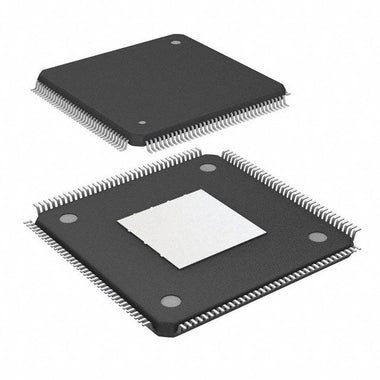
The EP1C6Q240C8N is housed in a 240-pin Plastic Quad Flat Package (PQFP) with a 32 × 32 mm body and 0.5 mm lead pitch. Of the 240 pins, 185 are available as user I/O, distributed across four I/O banks. Each I/O bank supports an independent VCCIO supply rail, enabling mixed-voltage interfacing within a single device.
The I/O element (IOE) architecture supports multiple single-ended standards — LVTTL (3.3 V), LVCMOS (1.5 V / 1.8 V / 2.5 V / 3.3 V), SSTL-2 Class I and II, and SSTL-3 Class I and II — along with differential LVDS at up to 311 Mbps and 640 Mbps (receive-only). PCI compliance covers both 33 MHz and 66 MHz operation with 32-bit and 64-bit bus widths. Dedicated DDR I/O registers in each IOE provide half-cycle data capture for DDR SDRAM (up to 133 MHz) and FCRAM interfaces.
Configuration pins support multiple modes: Active Serial (AS) using a low-cost serial configuration EPROM (e.g., EPCS1 or EPCS4), Passive Serial (PS) from a processor or external controller, and JTAG via the IEEE 1149.1 boundary-scan port. The MSEL[1:0] pins determine the configuration scheme at power-up.

Specifications Parameter Table
| Specification | Technical Details |
|---|---|
| Device Family | Cyclone I (Intel / Altera) |
| Logic Elements (LEs) | 5,980 |
| Logic Array Blocks (LABs) | 598 |
| M4K RAM Blocks | 20 |
| Total RAM Bits | 92,160 |
| Embedded Multipliers | None (introduced in Cyclone II) |
| PLLs | 2 |
| Global Clock Lines | 8 |
| User I/O Pins | 185 |
| I/O Banks | 4 |
| Package | 240-PQFP, 32 × 32 mm, 0.5 mm pitch |
| Process Node | 130 nm (all-layer copper CMOS) |
| Core Voltage (VCCINT) | 1.5 V |
| Maximum Frequency | ~275 MHz |
| Speed Grade | C8 (Commercial, 0 °C to 85 °C) |
| I/O Standards | LVTTL, LVCMOS, SSTL-2, SSTL-3, LVDS, PCI |
| DDR Support | DDR SDRAM (133 MHz), FCRAM, SDR SDRAM |
| Configuration Modes | Active Serial (AS), Passive Serial (PS), JTAG |
| RoHS Compliant | Yes (lead-free, "N" suffix) |
Typical Applications and Circuit Considerations
The EP1C6Q240C8N was designed for cost-sensitive embedded systems requiring moderate programmable logic density. Its combination of nearly 6,000 LEs, embedded RAM, and versatile I/O makes it suitable for a broad range of applications:
- Industrial Control and Automation: Servo motor controllers, PLC coprocessors, and sensor interface bridges leverage the FPGA's parallel processing capability and deterministic timing to implement custom state machines and protocol converters that replace multiple discrete logic ICs.
- Communications Protocol Bridging: The device can implement SPI-to-parallel, UART multiplexing, or custom serial-protocol engines. With 185 I/O pins and DDR SDRAM interface support, it serves as a flexible glue-logic replacement between processors and peripheral subsystems.
- Video and Display Processing: M4K blocks provide line-buffer storage for basic video overlay, on-screen display (OSD) generation, and timing controller functions in LCD/LED panel driver boards.
- Educational and Prototyping Platforms: The Cyclone I family remains popular in university FPGA courses, with low-cost development boards featuring the EP1C6Q240 providing students hands-on experience with VHDL/Verilog design flows in Quartus II.
For power-supply design, Intel recommends a regulated 1.5 V rail for VCCINT with ±50 mV tolerance, filtered through ferrite beads to isolate switching noise from the PLL analog supply (VCCA at 1.5 V). Each I/O bank VCCIO should be decoupled with 100 nF ceramic capacitors on every power pin plus 10 µF bulk capacitance per bank. The PQFP thermal pad should connect to an internal ground plane through multiple vias for adequate heat dissipation, keeping junction temperature well below the 85 °C commercial maximum.
Video: Getting Started with Altera Cyclone FPGA and Quartus II
Equivalents, Cross-Reference, and Lifecycle
The Cyclone I family has reached end-of-life status, with the last supported Quartus version being Quartus II Web Edition 13.0 SP1. While Intel has not issued a formal Product Discontinuation Notice (PDN) for the EP1C6Q240C8N, new designs should plan migration to currently supported families. Existing production runs can still source inventory through authorized distributors and the broker market.
Within the Cyclone I family, the closest variants in the same Q240 package are:
- EP1C6Q240C7N — same die, faster –7 speed grade. Pin-compatible, direct drop-in for designs requiring higher Fmax.
- EP1C6Q240C6N — fastest –6 speed grade variant in the same package. Identical pinout.
- EP1C12Q240C8N — larger 12,060-LE device in the same Q240 footprint, offering a density upgrade without a board redesign.
Cross-family migration paths:
- Intel Cyclone II (EP2C5Q208C8N): 90 nm successor with 4,608 LEs, embedded multipliers, and improved power efficiency. Supported in Quartus II up to v13.0 SP1.
- Intel Cyclone IV E (EP4CE6E22C8N): 60 nm device with 6,272 LEs, 18 × 18 multipliers, and support through Quartus Prime Lite. Widely available on low-cost development boards and supported through 2040.
- Lattice MachXO2 (LCMXO2-4000HC): For designs requiring instant-on non-volatile FPGA logic in a similar density range, the MachXO2 offers 4,320 LUTs with embedded Flash configuration.
For engineers evaluating alternative Intel FPGAs, see also our technical guides on the EP4CGX150DF27C7N Cyclone IV GX, the 5CGXFC7C7F23C8N Cyclone V, and the ECP5-45F-8BG381C Lattice ECP5.
Frequently Asked Questions (FAQ)
What is the EP1C6Q240C8N and what family does it belong to?
The EP1C6Q240C8N is a Field Programmable Gate Array (FPGA) from Intel's (formerly Altera) original Cyclone family, also known as Cyclone I. It contains 5,980 logic elements organized into 598 LABs, 20 M4K embedded memory blocks providing 92,160 RAM bits, and two phase-locked loops (PLLs). It is packaged in a 240-pin PQFP with 185 user I/O pins and operates at a 1.5 V core voltage.
What package does the EP1C6Q240C8N use and what are its dimensions?
The EP1C6Q240C8N uses a 240-pin Plastic Quad Flat Package (PQFP) with a 32 × 32 mm body and 0.5 mm lead pitch. This package provides 185 user I/O pins distributed across four I/O banks, each supporting independent VCCIO voltage levels. The QFP form factor is suitable for both hand-soldering prototypes and high-volume reflow soldering in production.
What I/O standards does the EP1C6Q240C8N support?
The EP1C6Q240C8N supports LVTTL (3.3 V), LVCMOS (1.5 V, 1.8 V, 2.5 V, 3.3 V), SSTL-2 Class I/II, SSTL-3 Class I/II, differential LVDS (up to 311 Mbps transmit and 640 Mbps receive), and PCI (33/66 MHz, 32/64-bit). Dedicated DDR registers in each IOE enable direct interfacing with DDR SDRAM at up to 133 MHz and FCRAM.
Which version of Quartus supports the EP1C6Q240C8N?
The EP1C6Q240C8N is supported by Altera Quartus II Web Edition version 13.0 SP1, which is the last release to include Cyclone I device support. This free edition supports the complete design flow including schematic entry, Verilog/VHDL synthesis, place-and-route, timing analysis, and device programming via the USB-Blaster or ByteBlaster interfaces. Newer Quartus Prime editions do not support Cyclone I devices.
Does the EP1C6Q240C8N have embedded multipliers for DSP?
No. The original Cyclone (Cyclone I) family does not include dedicated embedded multipliers. Multiplier functions must be implemented using general-purpose logic elements, which consumes significant LE resources. Dedicated 18 × 18 embedded multipliers were introduced in the Cyclone II family. If your application requires hardware DSP multiply-accumulate operations, consider migrating to a Cyclone II (EP2C5/EP2C8) or Cyclone IV E (EP4CE6) device.
What is a suitable replacement for the EP1C6Q240C8N in new designs?
For new designs, the recommended migration path is to the Intel Cyclone IV E family, specifically the EP4CE6E22C8N (6,272 LEs, 22-pin TQFP-144) or the EP4CE10E22C8N (10,320 LEs). These 60 nm devices offer higher density, lower power consumption, embedded 18 × 18 multipliers, and long-term availability through 2040. The Quartus design flow is similar, and most Verilog/VHDL IP cores written for Cyclone I can be recompiled for Cyclone IV E with minimal modification. For pin-compatible upgrades within the existing Q240 footprint, the EP1C12Q240C8N (12,060 LEs) is a direct drop-in with doubled logic capacity.
To check real-time stock, pricing, or to request a quote for the EP1C6Q240C8N and its verified alternatives, upload your BOM to WWDParts for fast processing.