ECP5-45F-8BG381C Datasheet, Pinout, Equivalents, and Specs
The ECP5-45F-8BG381C (ordering code LFE5U-45F-8BG381C) is an ultra-low-power FPGA from Lattice Semiconductor's ECP5 family, fabricated on a 40nm process. With 44,000 logic elements, 1,990 Kb of embedded block RAM (sysMEM EBR), 72 sysDSP slices delivering up to 144 multipliers (18x18), 4 PLLs, and embedded SERDES operating up to 3.2 Gbps, it targets cost- and power-sensitive applications requiring moderate logic density with high-speed serial connectivity. The device ships in a 381-ball caBGA package (17 x 17 mm) at commercial temperature grade (0 °C to 85 °C) with a -8 speed grade.
What Is the ECP5-45F-8BG381C?
The ECP5-45F-8BG381C belongs to the Lattice ECP5 family — a low-power, mid-range FPGA line built on 40nm technology, designed to bridge the gap between low-cost CPLDs and high-end FPGAs. The "ECP5" designation stands for "Efficient Connectivity Platform, 5th generation," and the "-45F" indicates the 45K LUT density variant. Internally, the device organizes 44,000 logic elements across 1,100 Logic Array Blocks (LABs), each containing programmable function units (PFUs) with 4-input look-up tables and associated flip-flops for combinational and sequential logic implementation.
On-chip memory is provided through 108 sysMEM Embedded Block RAM (EBR) blocks, each offering 18 Kb of true dual-port SRAM, totaling approximately 1,944 Kb (1.9 Mb) of on-chip storage configurable as single-port RAM, dual-port RAM, pseudo dual-port RAM, FIFO, or ROM. Distributed RAM using PFU slices adds further flexibility for shallow, high-bandwidth storage. The sysDSP architecture provides 72 DSP slices, each capable of implementing half a 36x36, two 18x18, or four 9x9 multiply-accumulate operations, supporting efficient FIR filters, FFTs, and signal-processing pipelines. Clock management relies on 4 PLLs and 4 DLLs for frequency synthesis, multiplication, division, and fine-grained phase adjustment.

Pinout Configuration and Packaging
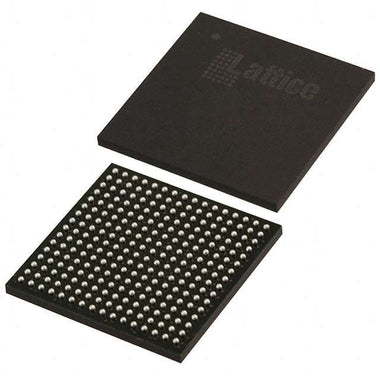
The ECP5-45F-8BG381C is housed in a 381-ball caBGA (chip-array Ball Grid Array) package with a 17 x 17 mm body and 0.8 mm ball pitch. Of the 381 balls, 203 are available as general-purpose I/O pins organized into 8 I/O banks. Each bank supports independent VCCIO supply voltages, allowing mixed-voltage interfacing (1.2 V, 1.5 V, 1.8 V, 2.5 V, and 3.3 V) within a single device. The I/O structure supports both single-ended standards (LVCMOS, LVTTL) and differential standards (LVDS, BLVDS, MLVDS, LVPECL, sub-LVDS) for high-speed parallel interfaces.
Critical power pins include VCC (1.1 V core supply, range 1.045 V to 1.155 V), VCCIO (per-bank, selectable), and VCCAUX (3.3 V auxiliary). The device features dual-function configuration pins supporting Master SPI, Slave SPI, JTAG, and SSPI boot modes. The embedded SERDES block includes dedicated transmit and receive differential pairs for up to 3.2 Gbps serial connectivity. For PCB design, Lattice recommends a minimum 6-layer stackup with dedicated power and ground planes, 100 nF decoupling capacitors per VCC ball, and controlled-impedance routing for SERDES and LVDS pairs (100 ohm differential).

Specifications Parameter Table
| Specification | Technical Details |
|---|---|
| Device Family | ECP5 (Lattice Semiconductor) |
| Ordering Code | LFE5U-45F-8BG381C |
| Logic Elements (LEs) | 44,000 |
| Logic Array Blocks (LABs) | 1,100 |
| sysMEM EBR Blocks | 108 (18 Kb each) |
| Total Embedded RAM | 1,990,656 bits (~1.9 Mb) |
| sysDSP Slices | 72 |
| 18x18 Multipliers | Up to 144 |
| PLLs | 4 |
| DLLs | 4 |
| Embedded SERDES | Up to 3.2 Gbps (ECP5) / 5.0 Gbps (ECP5-5G) |
| SERDES Protocols | PCI Express, GbE (SGMII), XAUI, CPRI |
| User I/O Pins | 203 |
| I/O Banks | 8 |
| Package | 381-CABGA, 17 x 17 mm, 0.8 mm pitch |
| Process Node | 40 nm |
| Core Voltage (VCC) | 1.1 V (range 1.045 V – 1.155 V) |
| VCCAUX | 3.3 V |
| Speed Grade | -8 (Commercial, 0 °C to 85 °C) |
| I/O Standards | LVCMOS, LVTTL, SSTL, HSUL, LVDS, BLVDS, MLVDS, LVPECL, sub-LVDS |
| Configuration Modes | Master SPI, Slave SPI, JTAG, SSPI |
| Mounting | Surface Mount |
| RoHS Compliant | Yes |
Typical Applications and Circuit Considerations
The ECP5-45F-8BG381C targets designs requiring moderate FPGA density combined with low power consumption and integrated high-speed serial connectivity. The 40nm process delivers significantly lower static power than competing 65nm or 60nm alternatives at similar gate counts. Lattice positions the ECP5 family for connectivity bridging and processing acceleration in the following domains:
- Wireless Small Cell Infrastructure: CPRI front-haul bridging between baseband units and remote radio heads leverages the 3.2 Gbps SERDES, while DSP slices handle digital pre-distortion and crest-factor reduction for 4G/LTE deployments.
- Industrial Video and Display: HDMI/MIPI-to-parallel video bridging, frame buffering with sysMEM EBR blocks, and real-time color-space or resolution conversion for industrial HMIs, camera gateways, and multi-display controllers.
- Edge AI Inference Acceleration: The open-source toolchain (Yosys + nextpnr + Project Trellis) enables custom CNN accelerator overlays, with the 72 DSP slices implementing 8-bit or 16-bit MAC arrays for lightweight neural-network inference at the edge.
- Embedded Protocol Bridging: Gigabit Ethernet to PCIe, USB 3.0 PIPE interface implementation, and multi-protocol industrial gateways connecting EtherCAT, PROFINET, and Modbus TCP through the flexible I/O banks and SERDES channels.
From a circuit-design standpoint, Lattice recommends separate 1.1 V and 3.3 V power domains with ferrite-bead isolation between core VCC and VCCAUX. Each VCC ball requires a 100 nF decoupling capacitor placed directly beneath the BGA on inner PCB layers, with 10 uF bulk capacitors per power rail. SERDES differential pairs demand 100 ohm differential impedance with length-matched routing and AC-coupling capacitors at transmitter outputs. The SPI flash for configuration should be connected via dedicated MCLK, MSO, MSI, and MCS pins, supporting dual-boot capability for in-field firmware updates.

Video: Getting Started with Lattice ECP5 FPGA
Equivalents, Cross-Reference, and Lifecycle
The ECP5-45F-8BG381C carries an Active lifecycle status as of 2026, with no Product Discontinuation Notice (PDN) issued. Lattice Semiconductor continues to manufacture the ECP5 family through its 40nm foundry agreements. The device has strong support from the open-source FPGA community via Project Trellis, Yosys, and nextpnr, ensuring long-term software ecosystem viability.
Within the ECP5 family, the closest pin-compatible variants in the same BG381 package are:
- LFE5U-25F-8BG381C (ECP5-25F-8BG381C) — lower-density variant with 24,000 LEs, 56 EBR blocks, and 28 DSP slices. Pin-compatible drop-in for cost-optimized designs requiring less logic.
- LFE5U-85F-8BG381C (ECP5-85F-8BG381C) — higher-density variant with 84,000 LEs, 208 EBR blocks, and 156 DSP slices. Pin-compatible upgrade path for designs needing more resources.
- LFE5U-45F-8BG381I — industrial-temperature variant (-40 °C to 100 °C), functionally identical, same pinout.
Cross-family migration paths:
- Lattice ECP5-5G (LFE5UM5G-45F-8BG381C): Same die architecture with upgraded SERDES supporting up to 5.0 Gbps. Ideal for designs requiring higher-speed serial links.
- Lattice CrossLink-NX: Next-generation 28nm FD-SOI FPGA family offering improved power efficiency and hardened MIPI D-PHY interfaces for camera and display bridging applications.
- Intel Cyclone V (5CGXFC7C7F23C8N): Comparable 28nm FPGA with higher logic density (149,500 LEs) and hard memory controllers, offering an alternative for designs requiring more resources at higher power budgets.
For engineers evaluating alternative FPGAs, see also our technical guides on the ECP5-25F-8BG381C Lattice ECP5, the Intel 5CGXFC7C7F23C8N Cyclone V GX, and the EP4CGX150DF27C7N Cyclone IV GX.
Frequently Asked Questions (FAQ)
What is the maximum SERDES data rate of the ECP5-45F-8BG381C?
The ECP5-45F-8BG381C (LFE5U variant) supports embedded SERDES with data rates up to 3.2 Gbps per channel. The SERDES block supports protocols including PCI Express Gen1, Gigabit Ethernet (SGMII), XAUI, and CPRI. For higher-speed requirements up to 5.0 Gbps, the ECP5-5G variant (LFE5UM5G-45F-8BG381C) is available as a pin-compatible upgrade.
What package does the ECP5-45F-8BG381C use and how many user I/O pins are available?
The device is packaged in a 381-ball caBGA (chip-array BGA) with a 17 x 17 mm body and 0.8 mm ball pitch. It provides 203 user I/O pins distributed across 8 I/O banks, each supporting independent VCCIO voltage levels from 1.2 V to 3.3 V. The I/O supports both single-ended (LVCMOS, LVTTL, SSTL, HSUL) and differential standards (LVDS, BLVDS, MLVDS, LVPECL).
What design software is required to develop with the ECP5-45F-8BG381C?
The ECP5-45F-8BG381C is supported by Lattice Diamond (proprietary IDE with free license for ECP5 devices) and a fully open-source toolchain: Yosys for Verilog/SystemVerilog synthesis, nextpnr-ecp5 for place and route, and Project Trellis for bitstream generation. The open-source flow runs on Linux, macOS, and Windows, making it one of the most accessible FPGA platforms for open-source hardware development.
How does the ECP5-45F compare to the ECP5-25F and ECP5-85F?
All three devices share the same BG381 package and pinout, enabling seamless density scaling. The ECP5-25F provides 24,000 LEs, 56 EBR blocks, and 28 DSP slices for cost-optimized designs. The ECP5-45F offers 44,000 LEs, 108 EBR blocks, and 72 DSP slices as a mid-range option. The ECP5-85F delivers 84,000 LEs, 208 EBR blocks, and 156 DSP slices for the highest density. All variants maintain identical I/O count (203 pins), PLL count (4), and SERDES capability.
What power supply voltages are needed for the ECP5-45F-8BG381C?
The core logic (VCC) requires 1.1 V (range 1.045 V to 1.155 V). An auxiliary supply (VCCAUX) of 3.3 V is required for I/O buffers and configuration logic. Each I/O bank has an independent VCCIO rail selectable from 1.2 V, 1.5 V, 1.8 V, 2.5 V, or 3.3 V. Lattice recommends 100 nF decoupling capacitors per VCC ball and 10 uF bulk capacitors per rail, with ferrite-bead isolation between the core and auxiliary domains.
Is the ECP5-45F-8BG381C supported by open-source FPGA tools?
Yes, the ECP5 family has the most mature open-source FPGA toolchain support available. Project Trellis provides the complete device database including bitstream documentation. Yosys handles synthesis from Verilog/SystemVerilog to the ECP5 architecture, and nextpnr-ecp5 performs place and route. This enables a fully open-source flow from RTL to bitstream, with active community development and CI/CD integration support. Popular open-source development boards like the ULX3S, OrangeCrab, and Colorlight i5 use ECP5 devices.