ECP5-25F-8BG381C Datasheet, Pinout, Equivalents, and Specs
The ECP5-25F-8BG381C is a Field-Programmable Gate Array (FPGA) from Lattice Semiconductor's ECP5 family, designed to provide a low-power, small form-factor solution for high-volume connectivity and acceleration applications. It integrates 24K Look-Up Tables (LUTs), high-speed SERDES channels, and enhanced DSP blocks in a compact 381-ball BGA package. The device is optimized for system-level cost reduction and power efficiency in markets such as industrial control, machine vision, and communications infrastructure.
Table of Contents
What is the ECP5-25F-8BG381C?
The ECP5-25F-8BG381C is a member of the Lattice ECP5 family of FPGAs, specifically engineered to deliver high-performance logic and connectivity features in a cost-optimized architecture. The internal fabric is built upon a 4-input LUT structure, organized into Programmable Function Units (PFUs) which contain the core logic slices and registers. This model features 24K logic elements, making it suitable for moderately complex parallel processing tasks. Key architectural components include embedded block RAM (EBR) for on-chip data storage, DSP slices for efficient arithmetic operations, and up to four 3.2 Gbps SERDES channels. These features enable direct implementation of high-speed interfaces like PCI Express Gen 1, Gigabit Ethernet (GbE), and CPRI, targeting applications that require bridging, aggregation, and co-processing functions without the cost overhead of higher-density FPGAs.

Pinout Configuration and Packaging
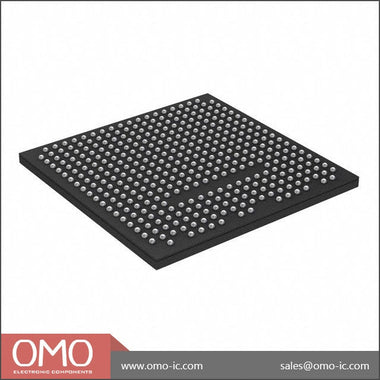
The ECP5-25F-8BG381C is offered in a 381-ball fine pitch BGA (caBGA) package with a 17x17 mm footprint and a 1.00 mm ball pitch. This package provides a high I/O density suitable for space-constrained PCB designs. The pinout includes dedicated pins for power (VCC core, VCCIO for I/O banks, VCCAUX for auxiliary circuits), ground, JTAG configuration (TCK, TDI, TDO, TMS), and clock inputs. A significant portion of the pins are configurable general-purpose I/O (GPIO) organized into banks, each with an independent VCCIO supply to support multiple I/O standards. The high-speed SERDES transceivers have dedicated differential pair pins for transmit (TX) and receive (RX) functions. Due to the complexity of the BGA pinout, designers must refer to the official Lattice documentation and pin migration files for precise pin assignments and PCB layout guidelines.
Core Architectural Features
- Programmable Logic Fabric: Contains 24K 4-input LUTs and associated flip-flops, providing a flexible fabric for implementing custom digital logic circuits.
- High-Speed SERDES Transceivers: Features four dual-channel SERDES blocks capable of data rates up to 3.2 Gbps per channel. These support standard protocols such as PCI Express Gen 1, Serial Gigabit Media-Independent Interface (SGMII), and Common Public Radio Interface (CPRI).
- Embedded DSP Slices: Includes 28 configurable DSP blocks, each supporting functions like 18x18 multiplication, addition, and accumulation. These are optimized for signal processing algorithms, filtering, and FFT calculations.
- Flexible Memory Resources: Provides 1008 Kbits of distributed and embedded block RAM (EBR). The EBR can be configured in various widths and depths to serve as FIFOs, caches, or lookup tables within the user design.
- Programmable I/O (PIO): Offers up to 197 user I/Os in the BG381 package, supporting a wide range of single-ended and differential I/O standards including LVCMOS, LVTTL, and LVDS.
Specifications Parameter Table
| Specification | Technical Details |
|---|---|
| Logic Elements / LUTs | 24,000 |
| Total RAM Bits | 1,008 Kbits |
| Package / Case | 381-caBGA (17x17mm) |
| Number of User I/O | 197 |
| Core Supply Voltage (VCC) | 1.1V |
| Operating Temperature Range | 0°C to 85°C (Junction) |
| Speed Grade | -8 (Fastest) |
ECP5-25F-8BG381C Equivalents, Cross Reference, and Lifecycle
The ECP5-25F-8BG381C is an active production component from Lattice Semiconductor. When considering alternatives, engineers should first look within the ECP5 family for scalability. The ECP5-45F-8BG381C, for instance, offers a pin-compatible upgrade path in the same 381-ball package, providing nearly double the logic resources (44K LUTs) for designs that require more capacity. While direct pin-to-pin equivalents from other manufacturers are rare, functionally similar devices include the Xilinx Artix-7 (e.g., XC7A35T) or Intel Cyclone V E series. However, migrating to a competitor's device requires a complete redesign of the PCB and RTL due to fundamental differences in architecture, pinout, and development tools. For sourcing and lifecycle verification, it is essential to consult with authorized distributors. You can Check ECP5-25F-8BG381C Inventory & Pricing to assess current availability. When evaluating options, it is helpful to Browse FPGA Series to compare different families based on logic density, power consumption, and I/O capabilities.
Typical Application & Circuit Considerations
The ECP5-25F-8BG381C is well-suited for applications requiring data path bridging, interface conversion, and low-latency processing. Common use cases include:
- Machine Vision: Aggregating data from multiple MIPI CSI-2 image sensors and performing real-time image pre-processing before forwarding data over a Gigabit Ethernet link.
- Industrial Motor Control: Implementing high-frequency PWM generators, reading quadrature encoder feedback, and executing closed-loop control algorithms with deterministic latency.
- Communications: Functioning as a small cell baseband processing unit, a video bridge between DisplayPort and LVDS, or a control plane processor in networking equipment.
Video Demonstration
Frequently Asked Questions (ECP5-25F-8BG381C FAQ)
Q: What does the part number "ECP5-25F-8BG381C" signify?
A: The part number is a code for the device's specifications. "ECP5" denotes the product family. "25" indicates the logic density, corresponding to 24K LUTs. "F" signifies that the device includes high-speed SERDES transceivers. "-8" is the speed grade, with -8 being the fastest available for this family. "BG381" specifies the 381-ball BGA package. Finally, "C" indicates the commercial temperature grade (0°C to 85°C junction temperature).
Q: What are the primary power supply requirements for the ECP5-25F-8BG381C?
A: The device requires three main power domains. The core logic runs on a 1.1V supply (VCC). The programmable I/O banks are powered by VCCIO, which can range from 1.2V to 3.3V depending on the I/O standard being used. An auxiliary supply (VCCAUX) of 2.5V is also required for internal circuits like the PLLs and configuration logic. Each of these supplies must be properly sequenced and decoupled according to the datasheet recommendations to ensure reliable operation.
Q: Can the SERDES channels on the ECP5-25F-8BG381C support PCI Express?
A: Yes, the SERDES channels are compliant with the PCI Express (PCIe) Gen 1 specification. The device can be configured to implement a single-lane (x1) PCIe endpoint or root port. Lattice provides pre-engineered IP cores within its Diamond software suite to facilitate the implementation of the PCIe physical layer (PHY) and data link layer, simplifying the design process for engineers.
Q: What is the configuration method for this FPGA?
A: The ECP5-25F-8BG381C is SRAM-based, meaning it must be configured upon every power-up. The primary configuration method is loading a bitstream from an external SPI flash memory device. It also supports configuration via the JTAG interface for debugging and programming purposes. Additionally, it can be configured in a master/slave serial or parallel mode by a host processor, providing flexibility for different system architectures.
Q: What development software is used to program the ECP5-25F-8BG381C?
A: The official integrated development environment (IDE) for all ECP5 devices is the Lattice Diamond software. This tool provides a complete workflow for FPGA design, including HDL synthesis (Verilog/VHDL), place and route, static timing analysis, power estimation, and bitstream generation. The software also includes the Clarity Designer for block-based design and IP core integration, such as for SERDES protocols and memory controllers.

Alan Carter
Senior Hardware Engineer & Component Specialist
Alan has over 15 years of expertise in embedded systems design, FPGA architecture, and global semiconductor supply chains. He specializes in component cross-referencing, lifecycle management, and helping OEMs navigate supply shortages.