10M16SAU169I7G Datasheet, Specifications & Application Guide – Altera MAX 10 FPGA
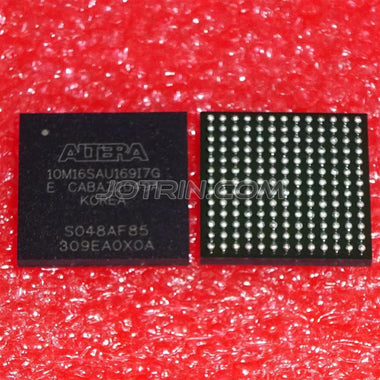
The 10M16SAU169I7G is a non-volatile FPGA from the Altera (Intel) MAX 10 family, built on a 55 nm process node. Featuring 16,000 logic elements, an integrated dual 12-bit ADC, and internal flash configuration memory, this device delivers instant-on capability and single-chip mixed-signal integration in a compact 169-ball UBGA package. It is widely deployed in industrial automation, IoT edge processing, motor control, and medical instrumentation applications where low power, small form factor, and analog front-end consolidation are critical.
1. Overview of the 10M16SAU169I7G
The 10M16SAU169I7G belongs to the Intel (formerly Altera) MAX 10 FPGA family, which combines the benefits of non-volatile flash-based configuration with true FPGA logic flexibility. The part number decodes as follows: 10M16 = MAX 10 with 16K logic elements, S = single power-supply, A = analog block (ADC) enabled, U169 = 169-ball UBGA package, I = industrial temperature range (−40 °C to +100 °C), and 7 = speed grade 7.
Unlike SRAM-based FPGAs that require an external configuration device, the MAX 10 stores its bitstream in on-chip flash, enabling instant-on operation in under 10 ms. The integrated dual 12-bit successive-approximation ADC with up to 18 analog input channels eliminates the need for external ADC chips in many mixed-signal designs. This makes the 10M16SAU169I7G an ideal candidate for consolidating discrete analog and digital functions onto a single chip, reducing BOM cost and PCB area.
Development is fully supported by the free Quartus Prime Lite Edition, which provides synthesis, place-and-route, timing analysis, and JTAG/in-system programming for all MAX 10 devices.
2. Key Specifications & Parameters
| Parameter | Value |
|---|---|
| Part Number | 10M16SAU169I7G |
| Family | Intel (Altera) MAX 10 |
| Process Node | 55 nm |
| Logic Elements (LEs) | 16,000 |
| Logic Array Blocks (LABs) | 1,000 |
| Embedded Memory (M9K) | 549 Kb |
| User Flash Memory (UFM) | 2,304 Kb |
| 18×18 DSP Multiplier Blocks | 45 |
| PLLs | 4 |
| Maximum User I/O Pins | 130 |
| ADC | Dual 12-bit SAR, up to 1 MSPS |
| ADC Analog Input Channels | Up to 18 |
| Package | 169-ball UBGA (11 × 11 mm) |
| Operating Supply Voltage | 3.0 V – 3.3 V (single supply) |
| I/O Voltage Standards | 1.0 V – 3.3 V LVCMOS, LVTTL, SSTL, HSTL, LVDS |
| Temperature Range | −40 °C to +100 °C (Industrial) |
| Speed Grade | 7 |
| External Memory Support | DDR2, DDR3, LPDDR2, SRAM |
| Configuration | Internal flash (instant-on), dual boot images |
| Bitstream Security | AES-128 encryption |
3. Block Diagram & Architecture
The MAX 10 architecture integrates programmable logic, embedded memory, DSP blocks, PLLs, a user flash memory block, and a dual ADC into a monolithic 55 nm device. The diagram below illustrates the high-level functional blocks of the 10M16SAU169I7G.

Key architectural highlights include:
- Logic Array Blocks (LABs): 1,000 LABs, each containing 16 adaptive logic modules (ALMs) providing fine-grained combinational and sequential logic.
- M9K Memory Blocks: 549 Kb of embedded SRAM organized in 9-Kbit blocks, configurable as single-port RAM, dual-port RAM, ROM, or FIFO buffers.
- DSP Blocks: 45 embedded 18×18 multipliers supporting multiply-accumulate operations for filtering, signal processing, and arithmetic-intensive functions.
- Dual ADC: Two independent 12-bit SAR ADCs sharing up to 18 analog input channels, with a dedicated analog hard IP block for temperature sensing and voltage monitoring.
- Configuration Flash: On-chip flash stores up to two configuration images, enabling remote update with a safe fallback image.
4. Pinout & Package Information
The 10M16SAU169I7G is housed in a 169-ball UBGA (Ultra-thin Ball Grid Array) package with a compact 11 × 11 mm body and 0.8 mm ball pitch. The package provides 130 user I/O pins organized across multiple I/O banks supporting a wide range of single-ended and differential I/O standards.

I/O banks support voltage levels from 1.0 V to 3.3 V, enabling direct interfacing with 3.3 V legacy peripherals, 2.5 V sensors, 1.8 V DDR memory, and 1.5 V SSTL logic without external level shifters. LVDS differential pairs are available for high-speed serial communication up to 875 Mbps.
For PCB design, Altera provides the complete pin-out CSV file and board design guidelines in the MAX 10 FPGA Device Pin-Out document, and footprint symbols are available through SnapEDA and the Quartus device migration tool.
5. Typical Applications & Design Guide
The 10M16SAU169I7G's combination of instant-on capability, integrated ADC, and moderate logic density makes it a versatile choice for a broad range of embedded applications.

Industrial Automation & Motor Control
The integrated ADC samples current and voltage feedback for real-time motor control loops, while the FPGA logic implements PWM generation, encoder interfaces, and safety interlocks — all on a single chip replacing discrete ADCs and MCUs.
IoT Edge Gateway & Sensor Hub
With instant-on boot and low standby power, the MAX 10 is ideal for battery-powered or always-on IoT gateways that aggregate data from multiple sensors, perform local preprocessing (filtering, threshold detection), and forward compressed data to cloud platforms.
Video & Image Pre-Processing
The 45 DSP blocks and 549 Kb of embedded RAM enable real-time pixel manipulation such as color-space conversion, edge detection, and histogram computation for surveillance cameras or machine vision front-ends.
Medical Instrumentation
The dual ADC and deterministic FPGA timing support multi-channel physiological signal acquisition (ECG, EEG, SpO2), while the non-volatile configuration eliminates boot-time uncertainty in safety-critical patient monitoring equipment.
Development Ecosystem
Prototyping is streamlined by the Terasic DE10-Lite development board, which integrates a MAX 10 10M50DAF484C7G FPGA with SDRAM, VGA output, accelerometer, Arduino headers, and an on-board USB-Blaster programmer — all supported by the free Quartus Prime Lite Edition.
Video Tutorial – MAX 10 FPGA ADC Design
6. FAQ – Frequently Asked Questions
What is the 10M16SAU169I7G and what family does it belong to?
The 10M16SAU169I7G is a non-volatile FPGA from the Intel (Altera) MAX 10 family. Built on a 55 nm process, it features 16,000 logic elements, an integrated dual 12-bit ADC, 549 Kb of embedded RAM, 2,304 Kb of user flash memory, and 45 DSP blocks in a 169-ball UBGA package rated for the industrial temperature range (−40 °C to +100 °C).
What does "single supply" mean in the 10M16SAU169I7G part number?
The "S" in the part number indicates single power-supply operation, meaning the device operates from a single 3.3 V supply rail for both core logic and I/O. This simplifies power supply design compared to dual-supply variants that require separate core and I/O voltages, reducing BOM cost and PCB complexity.
How does the integrated ADC in the 10M16SAU169I7G work?
The 10M16SAU169I7G integrates two independent 12-bit successive-approximation register (SAR) ADCs, each capable of up to 1 MSPS conversion rate. They share up to 18 analog input channels and include a built-in temperature sensor and voltage monitor. The ADC is controlled via a dedicated hard IP block that can be configured through the Quartus Platform Designer (Qsys) tool.
What development tools and boards support the 10M16SAU169I7G?
The 10M16SAU169I7G is fully supported by the free Quartus Prime Lite Edition, which includes synthesis, place-and-route, timing analysis, and the JTAG programmer. Popular development boards include the Terasic DE10-Lite and the Arrow MAX1000, both of which feature MAX 10 devices with on-board USB-Blaster programmers. ModelSim Intel Starter Edition is bundled for simulation.
Can the 10M16SAU169I7G support remote firmware updates?
Yes. The MAX 10's internal flash can store two configuration images — a factory (golden) image and an application image. The dual-boot capability allows remote firmware updates: the new bitstream is written to the application image slot, and if the update fails, the device automatically falls back to the factory image, ensuring the system always boots into a known-good state.
What is the difference between the 10M16SAU169I7G and the 10M16SAU169C8G?
Both share the same 16K LE logic fabric and UBGA-169 package. The key differences are: the I7G variant is rated for the industrial temperature range (−40 °C to +100 °C) with speed grade 7, while the C8G is rated for the commercial range (0 °C to +85 °C) with speed grade 8. The industrial variant offers wider operating temperature tolerance at a slightly lower maximum clock speed, making it the preferred choice for harsh-environment deployments.