10M16SAU169I7G Datasheet, Pinout, Block Diagram & Application Guide | Intel MAX 10 FPGA
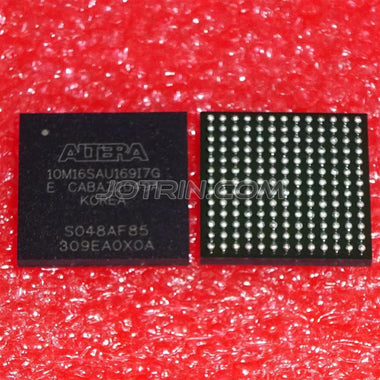
The 10M16SAU169I7G is a non-volatile, single-chip FPGA from Intel's (formerly Altera) MAX 10 family, fabricated on TSMC's 55 nm flash process. It integrates 16,000 logic elements, 549 Kbit of M9K embedded SRAM, dual on-die configuration flash images, user flash memory, 4 PLLs, and a 12-bit 1 MSPS SAR ADC — all within a compact 169-pin UBGA package. Rated for the industrial temperature range (−40 °C to +100 °C) at speed grade 7, the 10M16SAU169I7G delivers instant-on boot in under 10 ms from a single 3.3 V supply, eliminating external configuration memory and reducing BOM cost for harsh-environment industrial control, communications, IoT edge, and mixed-signal applications.
Overview and Part Number Decoding
The 10M16SAU169I7G belongs to the Intel MAX 10 product line — the industry's first single-chip, non-volatile FPGA family. Unlike SRAM-based FPGAs such as Xilinx Spartan-7 or Intel Cyclone V that require external SPI flash for configuration bitstream storage, MAX 10 devices store up to two complete configuration images in on-die flash memory. This architecture enables instant-on operation within milliseconds of power-up and supports fail-safe remote field updates via the Remote System Upgrade (RSU) IP core — without any external EPCQ or SPI NOR flash on the BOM.
A key differentiator of the “SA” variant is the integrated 12-bit, 1 MSPS SAR ADC with up to 6 external analog input channels and an internal temperature sensor. This on-chip ADC eliminates the need for an external ADC IC, saving board space, reducing BOM cost, and simplifying routing in mixed-signal designs such as sensor acquisition, power monitoring, and industrial control.
The “I7G” suffix designates this as the industrial-grade variant, qualified for operation from −40 °C to +100 °C. This makes the 10M16SAU169I7G suitable for outdoor, automotive-adjacent, and factory-floor deployments where commercial-grade parts (0 °C to +85 °C) cannot meet the environmental requirements.
The part number encodes the following attributes:
- 10M16 — MAX 10 family, 16,000 logic elements
- SA — Single-supply, Analog variant (internal 1.2 V regulator + integrated 12-bit ADC)
- U169 — 169-pin Ultra-thin Fine-pitch Ball Grid Array (UBGA), 11 × 11 mm
- I7 — Industrial temperature range (−40 °C to +100 °C), speed grade 7
- G — Green / RoHS / Pb-free compliant
The “SA” designation distinguishes this variant from the “SC” (single-supply, compact) variants that omit the analog-to-digital converter. In the SC variant, the analog input pins become general-purpose digital I/O or LVDS channels instead. The device is fully supported by Intel Quartus Prime Lite Edition, which is free to download and requires no license file. For current stock and pricing, check 10M16SAU169I7G availability on WWDParts.
Specifications and Parameter Table
| Parameter | Value |
|---|---|
| Manufacturer | Intel (Altera) |
| Product Family | MAX 10 |
| Part Number | 10M16SAU169I7G |
| Logic Elements (LEs) | 16,000 |
| Logic Array Blocks (LABs) | 1,000 (16 LEs per LAB) |
| M9K Embedded Memory Blocks | 60 |
| Total Embedded SRAM | 549 Kbit (562,176 bits) |
| Phase-Locked Loops (PLLs) | 4 (4 output counters each) |
| User Flash Memory (UFM) | 2,368 Kbit |
| Configuration Flash Memory | Dual-image internal flash (instant-on, <10 ms boot) |
| Integrated ADC | 1 × 12-bit SAR ADC, 1 MSPS, up to 6 analog channels + temperature sensor |
| User I/O Pins (U169 package) | 130 |
| I/O Banks | 8 |
| Global Clock Networks | 20 |
| Maximum LVDS Differential Pairs | 22 |
| I/O Standards Supported | 3.3 V / 2.5 V / 1.8 V / 1.5 V / 1.0 V LVTTL/LVCMOS, LVDS, SSTL, HSTL, HSUL |
| External Memory Interfaces | DDR2 SDRAM, DDR3 SDRAM, LPDDR2, SRAM |
| Core Voltage (VCC) | 1.2 V (internally regulated from 3.3 V) |
| External Supply (VCCA / VCCIO) | 3.3 V single rail (2.85–3.465 V) |
| Process Technology | 55 nm (TSMC) |
| Package | 169-UBGA (11 × 11 mm body, 0.8 mm pitch) |
| Operating Temperature | −40 °C to +100 °C (Industrial) |
| Speed Grade | 7 |
| FPGA Bitstream Security | Yes (AES-128 encryption) |
| Mounting Style | SMD / SMT (BGA) |
| RoHS Compliant | Yes (Pb-free) |
| Lifecycle Status | Active (2026) |
Architecture and Block Diagram
The MAX 10 FPGA architecture is organized around a fabric of configurable logic, embedded memory, and DSP resources interconnected by a hierarchical routing network with 20 global clock networks. The 10M16SAU169I7G integrates six core building blocks:
- 16,000 Logic Elements (LEs): Each LE contains a 4-input look-up table (LUT), a programmable register with synchronous load and asynchronous clear, carry chain logic, and register feedback. LEs are grouped into 1,000 Logic Array Blocks (LABs) of 16 LEs each, with dedicated local interconnect enabling fast intra-LAB routing at minimal skew.
- 60 M9K Memory Blocks (549 Kbit): Each 9,216-bit block (including parity) is configurable as single-port RAM, simple dual-port RAM, true dual-port RAM, ROM, or FIFO buffer. Supports data widths from ×1 to ×36 with byte-enable control.
- 4 PLLs: On-chip phase-locked loops provide clock synthesis, multiplication (up to ×512), division, and dynamic phase shifting. Input frequency range spans 5 MHz to 472.5 MHz with up to 4 independent output clocks per PLL, each with lock detect and dynamic reconfiguration.
- 12-bit SAR ADC (1 MSPS): The integrated analog-to-digital converter supports up to 6 external single-ended analog input channels plus an internal temperature sensor and internal voltage reference. The ADC delivers 12-bit resolution at 1 million samples per second, suitable for power rail monitoring, temperature sensing, and low-frequency sensor acquisition without external ADC ICs.
- Dual Configuration Flash + 2,368 Kbit UFM: Two on-die configuration images enable fail-safe remote updates via the RSU IP core. The User Flash Memory stores calibration constants, serial numbers, or firmware data non-volatilely, accessible at runtime through the UFM IP core or Avalon-MM interface.
- External Memory Interface: Supports DDR3, DDR2, LPDDR2, and SRAM interfaces, enabling high-bandwidth data buffering for video, communications, and data-acquisition applications.

Figure 1: Intel MAX 10 FPGA family architecture — configurable logic fabric, embedded memory columns, PLLs, user flash, integrated ADC, and I/O ring. The 10M16SAU169I7G implements this architecture with 16K LEs, 60 M9K blocks, 4 PLLs, and a 12-bit SAR ADC.
Pinout, Package, and PCB Layout
The 10M16SAU169I7G is housed in a 169-pin UBGA (Ultra-thin Fine-pitch Ball Grid Array) with a body size of 11 mm × 11 mm and 0.8 mm ball pitch. The compact UBGA package provides 130 user I/O pins organized across 8 I/O banks, each with an independent VCCIO supply rail for mixed-voltage interfacing. The small form factor makes it ideal for space-constrained embedded systems, handheld devices, and high-density board designs.
Key pinout and layout considerations:
- VCCIO Banks: Each I/O bank supports independent VCCIO. For the “SA” single-supply variant, all VCCIO pins are typically tied to 3.3 V. Mixed-voltage designs can set individual banks to 2.5 V, 1.8 V, 1.5 V, or 1.0 V for direct interfacing to external ICs.
- ADC Analog Input Pins: The “SA” variant dedicates specific balls to analog input channels. These pins require appropriate analog filtering (100 nF capacitor to AGND) and must be routed away from high-speed digital traces to minimize noise coupling.
- JTAG Pins (TCK, TDI, TDO, TMS): Dedicated configuration and boundary-scan pins. Apply 10 kΩ pull-up resistors on TDI and TMS, even when JTAG is unused in production — these pins must not float.
- BGA Landing Pads: Use NSMD (Non-Solder Mask Defined) pads for 0.8 mm pitch BGA. Recommended pad diameter is 0.4 mm with 0.15 mm solder mask opening. Dog-bone via fanout with 0.25 mm drill vias is required for inner-row balls.
- Power / Ground: All VCC and GND balls must be connected. Place 100 nF MLCC decoupling capacitors as close as possible to each power ball, plus a 10 µF bulk capacitor per supply rail.
- LVDS Pairs: Up to 22 true differential LVDS pairs are available. Route with 100 Ω differential impedance, matched-length, on inner PCB layers.

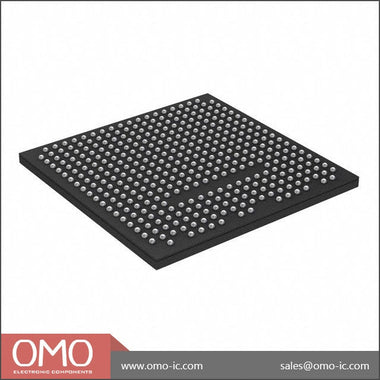
Figure 2: Intel MAX 10 FPGA in UBGA-169 package — 11 × 11 mm body, 0.8 mm ball pitch. The 10M16SAU169I7G provides 130 user I/O in this compact BGA form factor for industrial-temperature applications.
Application Circuits and Design Guidelines
The 10M16SAU169I7G targets systems requiring instant-on, non-volatile programmable logic with integrated analog sensing, industrial temperature tolerance, and minimal external component count. Typical application domains include:
- Industrial Automation: Motor drive encoder interfaces, PLC I/O expansion modules, sensor aggregation hubs, and protocol bridging (SPI ↔ UART, I2C ↔ parallel bus). The instant-on capability ensures deterministic control outputs within milliseconds of power-up, while the integrated ADC monitors temperature and supply voltages without additional ICs. The industrial temperature rating ensures reliable operation in factory-floor environments.
- Communications Equipment: Small-cell baseband glue logic, Ethernet MAC-to-PHY bridging, CPRI/OBSAI framing, and multi-protocol serial conversion. The DDR3 memory interface supports high-bandwidth data buffering for packet processing applications.
- Board Management Controllers: Voltage rail power sequencing, system health monitoring (temperature, current via the on-chip ADC), fan speed control, and watchdog supervision. The dual-image flash enables safe firmware updates in the field.
- Defense and Aerospace: Rugged embedded systems, avionics I/O concentrators, and radar signal pre-processing. The −40 °C to +100 °C range covers MIL-TEMP-adjacent requirements, and AES-128 bitstream encryption protects IP in deployed systems.
Power Supply Design: The “SA” single-supply variant requires only a single 3.3 V rail (2.85–3.465 V). The internal 1.2 V core regulator draws approximately 80–250 mA depending on logic utilization and clock frequency. The ADC block requires a clean VREFH analog reference supply (typically tied to VCCA 3.3 V through an LC filter).
PCB Layout Best Practices:
- Use a 4-layer minimum stackup (signal–ground–power–signal) with dedicated power and ground planes
- For 0.8 mm pitch BGA, use dog-bone fanout with 0.25 mm laser-drilled vias; consider via-in-pad for the highest density
- Route clock signals on inner layers with 50 Ω controlled impedance; use 100 Ω differential for LVDS pairs
- Keep PLL input clock trace lengths under 50 mm with length-matched output clock routing
- Isolate the ADC analog input traces from digital signals; use a split analog ground plane near the ADC pins tied to the digital ground at a single point
- Tie MSEL[0] to GND for internal configuration; the device boots in under 10 ms from power-up
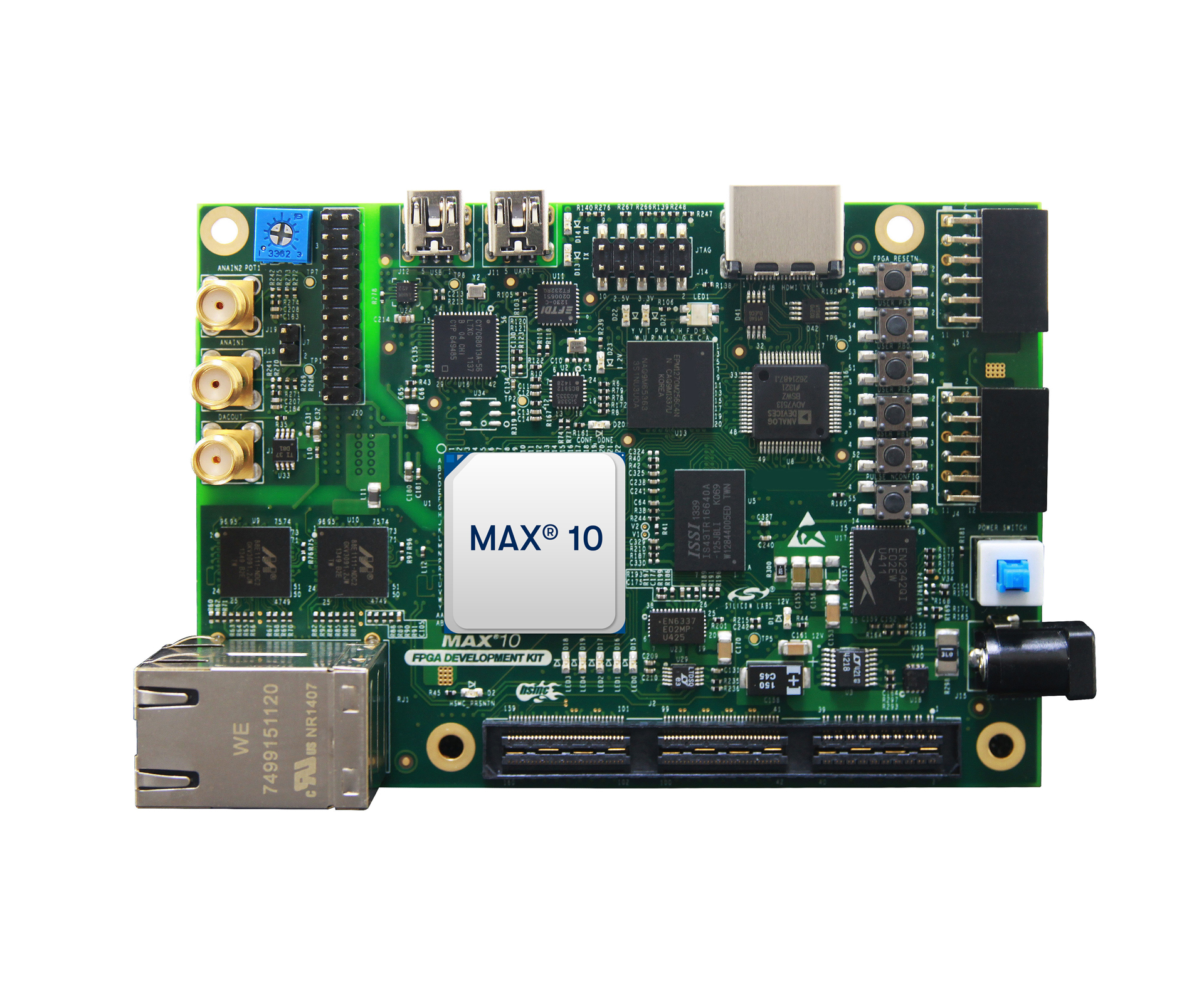
Figure 3: Intel MAX 10 FPGA Development Kit — a reference application platform for the MAX 10 family featuring power supply section, USB-Blaster JTAG programming, expansion headers, and peripheral connectivity for prototyping designs targeting the 10M16SAU169I7G.
Equivalents, Cross-Reference, and Lifecycle
The 10M16SAU169I7G carries an Active lifecycle status as of 2026 and is broadly stocked by major distributors including Digi-Key, Mouser, Arrow, and LCSC.
Pin-compatible alternatives within the MAX 10 family (U169 package):
- 10M16SAU169C8G — Commercial temperature variant (0 °C to +85 °C), speed grade 8. Same pinout, higher clock speed for non-industrial applications.
- 10M16SCU169I7G — The “SC” compact variant in the same UBGA-169 package. Pin-compatible drop-in that omits the ADC; analog pins become additional digital I/O.
- 10M08SAU169C8G — Same package, SA analog variant with 8,000 LEs. Pin-compatible cost-down option for designs needing less logic density.
Cross-vendor alternatives:
- Lattice MachXO3LF-6900 (LCMXO3LF-6900C-5BG256C): Comparable logic density with integrated flash. Non-volatile, instant-on architecture similar to MAX 10. Requires Lattice Diamond; different pinout.
- Lattice iCE40UP5K: Ultra-low-power alternative for simpler designs. Fewer logic resources but excellent for battery-powered applications.
To check real-time stock, pricing, or request a quote, upload your BOM to WWDParts for fast processing.
Video: Getting Started with Intel MAX 10 FPGA Development
Video: Getting started with Intel MAX 10 FPGA development using Quartus Prime — workflow applicable to the 10M16SAU169I7G.
Related technical guides on WWDParts:
- 10M08SAE144C8G: Datasheet, Pinout, Block Diagram & Application Guide
- 10M04SCE144C8G: Datasheet, Pinout, Block Diagram & Application Guide
- EP4CE15F23C8N: Datasheet, Pinout, Block Diagram & Application Guide
Frequently Asked Questions (FAQ)
What is the difference between 10M16SAU169I7G and 10M16SAU169C8G?
The primary differences are temperature range and speed grade. The 10M16SAU169I7G is the industrial variant rated for −40 °C to +100 °C at speed grade 7, while the 10M16SAU169C8G is the commercial variant rated for 0 °C to +85 °C at the faster speed grade 8. Both share the same UBGA-169 pinout, 16,000 LEs, and integrated ADC. Choose the I7G for harsh-environment deployments requiring extended temperature operation; use the C8G for benign-environment applications where higher clock speed matters more.
Does the 10M16SAU169I7G include an integrated ADC?
Yes. The “SA” (Single-supply, Analog) variant includes a 12-bit, 1 MSPS SAR ADC with up to 6 external single-ended analog input channels and an internal temperature sensor. The ADC supports both single-conversion and free-running modes and is accessible through the Modular ADC IP core in Quartus Prime. For designs that do not require analog conversion, the pin-compatible “SC” variant omits the ADC and repurposes analog pins as digital I/O.
What development tools and software are required for the 10M16SAU169I7G?
Intel Quartus Prime Lite Edition (free, no license required) fully supports all MAX 10 devices for design entry, synthesis, place-and-route, and timing analysis. A USB-Blaster or USB-Blaster II JTAG cable is needed for programming and SignalTap debugging. The Quartus package includes Platform Designer (formerly Qsys) for system integration, the Modular ADC IP core for configuring the on-chip ADC, and ModelSim-Intel FPGA Starter Edition for RTL simulation.
How fast does the 10M16SAU169I7G boot after power-on?
MAX 10 devices with internal configuration flash complete initialization and become fully operational in under 10 milliseconds after all supply voltages reach valid levels. This instant-on capability is essential for power sequencing controllers, safety interlocks, and applications where I/O pins must reach a known, deterministic state immediately at startup — before external processors finish their own boot sequences.
What external memory interfaces does the 10M16SAU169I7G support?
The 10M16SAU169I7G supports DDR3 SDRAM, DDR2 SDRAM, LPDDR2, and SRAM external memory interfaces through dedicated I/O pins with calibrated on-chip termination (OCT). The External Memory Interface Toolkit in Quartus Prime provides automated timing closure and calibration for these interfaces. DDR3 support enables high-bandwidth data buffering for video processing, packet buffering, and data acquisition applications.
Can I use the 10M16SAU169I7G for remote field updates?
Yes. The dual-image on-chip configuration flash supports the Remote System Upgrade (RSU) IP core, enabling safe over-the-air or over-network FPGA reconfiguration. The device stores two complete configuration images: a factory image and an application image. If a remote update fails or the new image is corrupted, the device automatically falls back to the factory image on the next power cycle, ensuring the system is never bricked. This fail-safe mechanism is critical for deployed industrial equipment, remote sensors, and IoT edge devices.