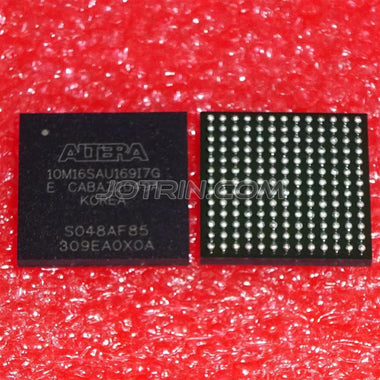
10M16SAU169I7G Datasheet, Pinout & Specifications – Intel (Altera) MAX 10 FPGA
The 10M16SAU169I7G is a non-volatile FPGA from the Intel (Altera) MAX 10 family, built on 55 nm flash process technology. Offering 16,000 logic elements, integrated analog-to-digital conversion, and dual configuration flash in a compact UBGA-169 package, it is widely adopted in industrial IoT, motor control, and embedded vision applications. This guide covers its key specifications, pinout, block diagram, and typical application circuits.
Table of Contents
- 1. Overview of the 10M16SAU169I7G
- 2. Key Specifications & Parameters
- 3. Block Diagram
- 4. Pinout & Package Information
- 5. Application Circuit & Design Tips
- 6. Frequently Asked Questions (FAQ)
1. Overview of the 10M16SAU169I7G
The MAX 10 device family bridges the gap between CPLDs and low-cost FPGAs by integrating user flash memory and an analog-to-digital converter (ADC) on a single chip. The 10M16SAU169I7G variant ships in an 11 × 11 mm UBGA-169 package with industrial-grade temperature support (–40 °C to +100 °C), making it suitable for harsh-environment deployments. It is supported by Intel Quartus Prime Lite Edition, which is available at no cost.
Looking for other MAX 10 parts? Browse our selection of Altera / Intel FPGAs or check the wwdparts Engineering Blog for more design guides.
2. Key Specifications & Parameters
| Parameter | Value |
|---|---|
| Part Number | 10M16SAU169I7G |
| Manufacturer | Intel (Altera) |
| Family | MAX 10 (10M16) |
| Logic Elements (LEs) | 16,000 |
| Logic Array Blocks (LABs) | 1,000 |
| Embedded Memory (M9K) | 549 Kb (562,176 bits) |
| User Flash Memory (UFM) | Built-in |
| 18 × 18 Embedded Multipliers | 45 |
| PLLs | 4 |
| Analog-to-Digital Converter | Yes – 1 ADC block (up to 17 channels, 12-bit) |
| Maximum User I/O | 130 (U169 package) |
| Maximum LVDS Pairs | 22 |
| External Memory Interface | DDR3, DDR2, LPDDR2, SRAM |
| Core Voltage | 1.2 V |
| I/O Voltage | 1.0 V – 3.3 V |
| Process Technology | 55 nm Flash |
| Package | UBGA-169 (11 × 11 mm) |
| Temperature Range | –40 °C to +100 °C (Industrial) |
| Speed Grade | 7 (Slowest) |
| RoHS / Lead-Free | Yes (Green / "G" suffix) |
3. Block Diagram
The block diagram below illustrates the major functional blocks of the MAX 10 FPGA development platform, including the configuration flash, user flash, ADC, PLLs, and I/O banks.
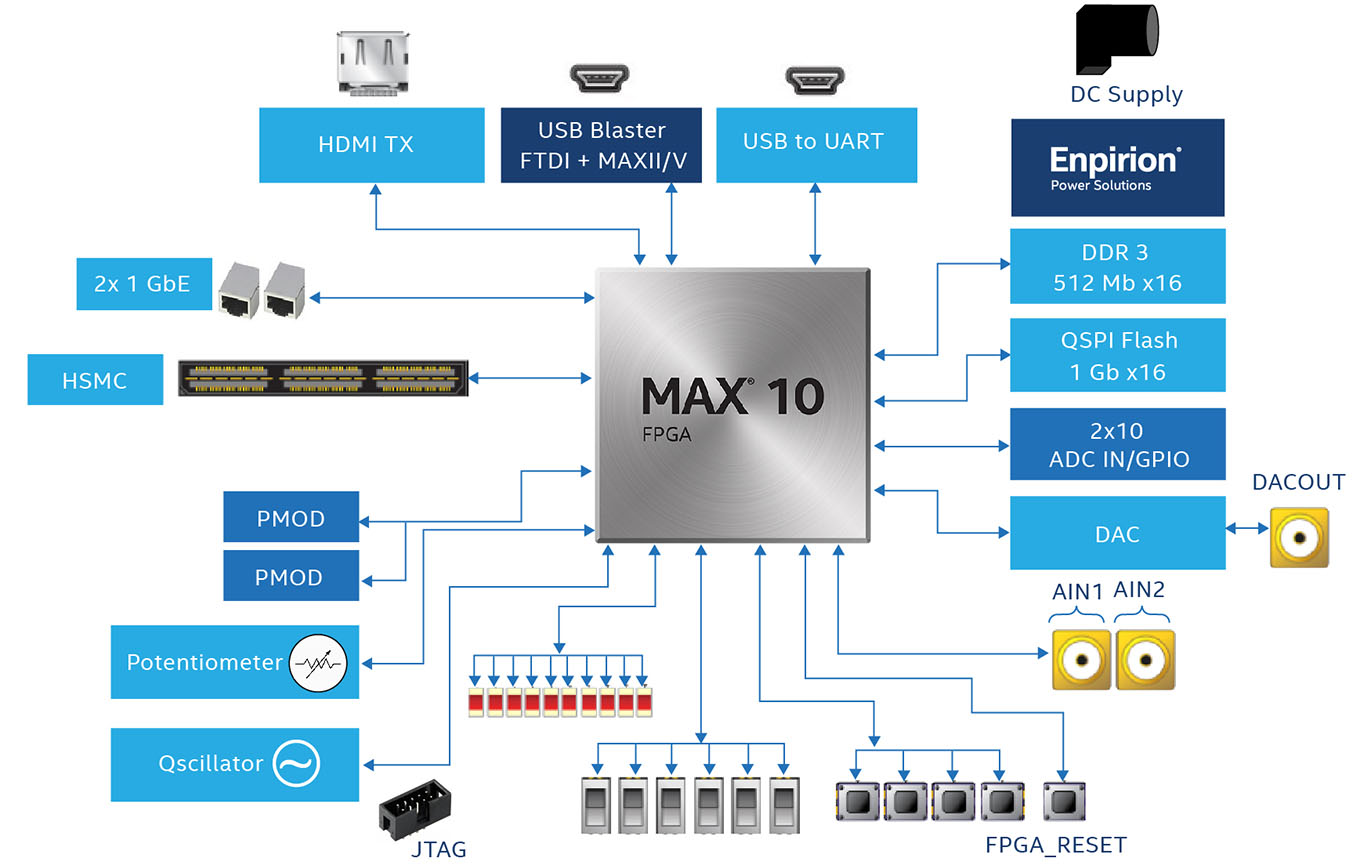
Key architectural highlights include instant-on capability via internal configuration flash and single-chip integration of the ADC, eliminating external components in mixed-signal designs.
4. Pinout & Package Information
The 10M16SAU169I7G uses a 169-ball UBGA package (U169) with a 0.8 mm ball pitch. Below is a representative image of the BGA package.

I/O banks support a wide range of standards including LVTTL, LVCMOS (1.0–3.3 V), SSTL, HSTL, LVDS, and RSDS. Refer to the official MAX 10 FPGA Pin Connection Guidelines for complete bank-to-pin mapping. You can also find compatible connectors and accessories in our full component catalog.
5. Application Circuit & Design Tips
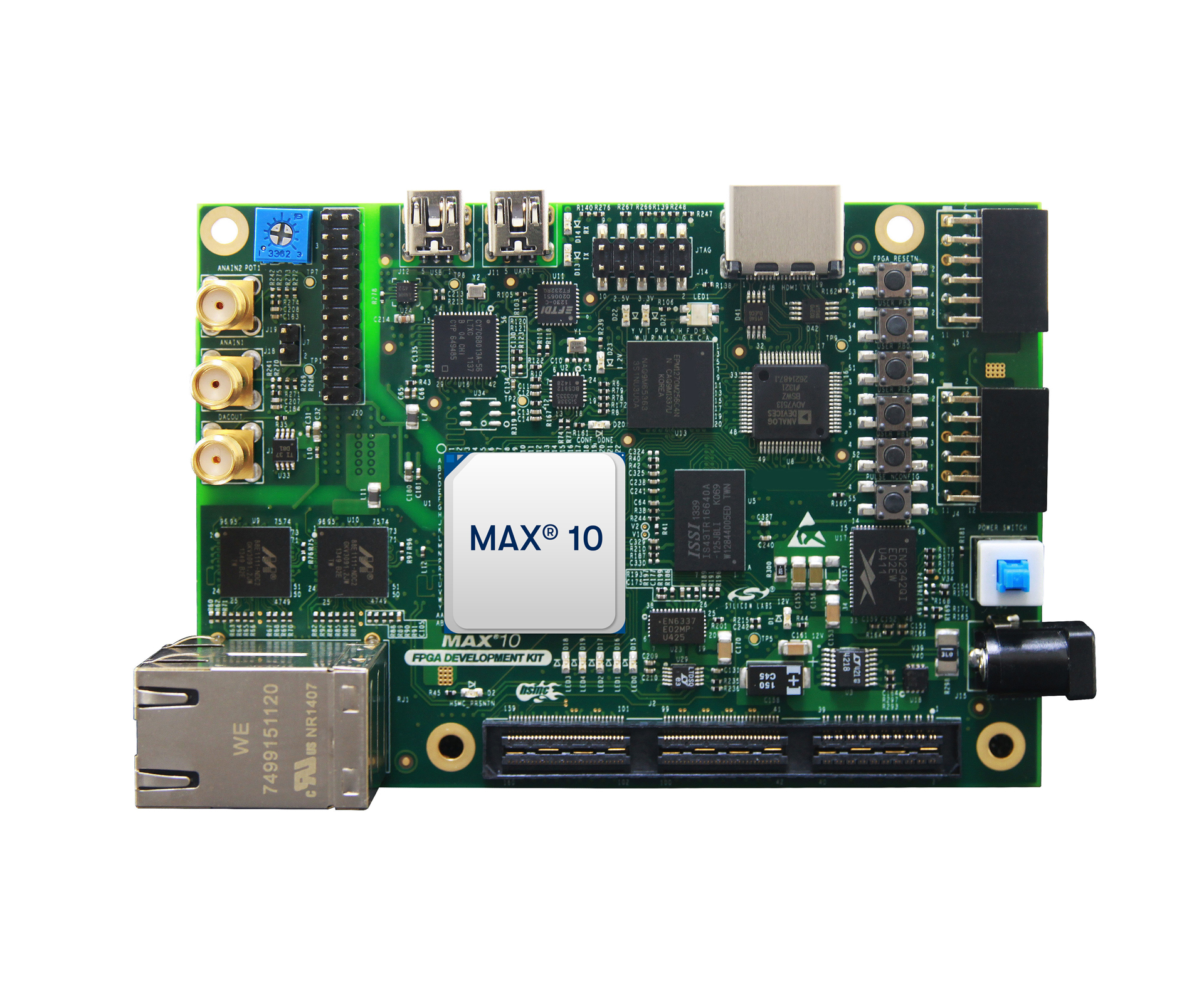
The image below shows the MAX 10 FPGA Development Kit, a reference design platform that demonstrates a typical application circuit for devices in the 10M16 family.
Design tips:
- Use the internal ADC for temperature monitoring or sensor acquisition to reduce BOM cost.
- Leverage dual configuration flash for remote field updates with fail-safe fallback.
- Place decoupling capacitors (100 nF ceramic + 10 µF bulk) close to each VCC pin for clean power delivery.
- For DDR3 interfaces, follow Intel's EMIF Toolkit constraints to ensure signal integrity.
Video Tutorial
6. Frequently Asked Questions (FAQ)
Q1: What is the difference between 10M16SAU169I7G and 10M16SAU169C8G?
The "I7" suffix denotes industrial temperature range (–40 °C to +100 °C) with speed grade 7, while "C8" indicates commercial temperature range (0 °C to +85 °C) with speed grade 8. Choose the I7G variant for applications exposed to extreme temperatures.
Q2: Does the 10M16SAU169I7G require an external configuration memory?
No. MAX 10 FPGAs feature internal configuration flash, enabling instant-on operation without an external EPROM or flash device. This also simplifies PCB layout and reduces component count.
Q3: How many ADC channels are available?
The device includes one ADC block supporting up to 17 analog input channels at 12-bit resolution with a maximum sample rate of 1 MSPS. The ADC can be used for temperature sensing, voltage monitoring, or external analog signal acquisition.
Q4: What software do I need to program the 10M16SAU169I7G?
Intel Quartus Prime Lite Edition (free) fully supports MAX 10 devices. It includes the Platform Designer (formerly Qsys) for system integration, the Nios II soft processor IP, and the Signal Tap logic analyzer for on-chip debugging.
Q5: Can the 10M16SAU169I7G interface with DDR3 memory?
Yes. The MAX 10 family supports DDR3, DDR2, and LPDDR2 external memory interfaces through its hard memory controller. Use the Intel EMIF IP core to configure timing parameters and calibration automatically.
Q6: What is the maximum operating frequency of the 10M16SAU169I7G?
The achievable frequency depends on the design complexity. Typical designs reach 200–300 MHz internal clock speeds. The speed grade 7 is the slowest option in the MAX 10 lineup; for higher performance, consider speed grade 6 variants.