1. 10M04SCE144C8G Overview
The 10M04SCE144C8G is a non-volatile FPGA from the Intel (Altera) MAX 10 family, built on a 55 nm flash process. Offering 4,000 logic elements in the compact 144-EQFP package, it delivers instant-on capability without an external configuration device. The "SC" designation indicates a single-supply, compact variant—ideal for cost-sensitive edge applications where board space is limited. With an internal flash-based configuration store, the 10M04SCE144C8G powers up in milliseconds, making it an excellent fit for industrial control, motor drives, sensor aggregation, and communication bridges.
As part of the MAX 10 family, this device supports dual configuration images for remote field updates, user flash memory (UFM) for on-chip data storage, and a rich set of I/O standards. Its 55 nm technology strikes a practical balance between performance, power consumption, and cost—positioning the 10M04SCE144C8G as a mainstream choice for designers who need programmable logic without the complexity of SRAM-based FPGAs.
Looking for related Intel MAX 10 FPGAs? Check out our guide on the 10M16SAU169I7G Intel MAX 10 FPGA, which offers 16,000 logic elements in the U169 package for higher-density designs.
2. Key Specifications & Parameters
| Parameter | Value |
|---|---|
| Manufacturer | Intel (formerly Altera) |
| Family | MAX 10 (10M04) |
| Device Variant | SC – Single-Supply, Compact |
| Logic Elements (LEs) | 4,000 |
| M9K Memory Blocks | 21 |
| Embedded Memory | 189 Kb |
| 18 × 18 Multipliers | 16 |
| PLLs | 2 |
| User I/O Pins (E144) | 101 |
| ADC Blocks | 0 (Compact variant) |
| User Flash Memory (UFM) | Up to 736 Kb |
| Internal Configuration | Dual-boot flash (CFM) |
| Package | 144-EQFP (20 × 20 mm, exposed pad) |
| Process Technology | 55 nm Flash |
| Core Supply Voltage | 1.2 V (1.15 V – 1.25 V) |
| I/O Voltage | 1.0 V – 3.3 V |
| Speed Grade | 8 (Commercial) |
| Operating Temperature | 0 °C to +85 °C |
| I/O Standards | LVTTL, LVCMOS, SSTL, HSTL, LVDS, RSDS, Mini-LVDS |
| RoHS Compliant | Yes (Pb-free) |
3. Block Diagram & Architecture
The MAX 10 architecture organizes logic resources into Logic Array Blocks (LABs), each containing 16 logic elements. The 10M04SCE144C8G provides 250 LABs alongside 21 M9K embedded memory blocks and 16 embedded 18 × 18 multipliers for DSP-class operations. Two PLLs deliver flexible clock management with frequency synthesis, phase shifting, and spread-spectrum clocking.
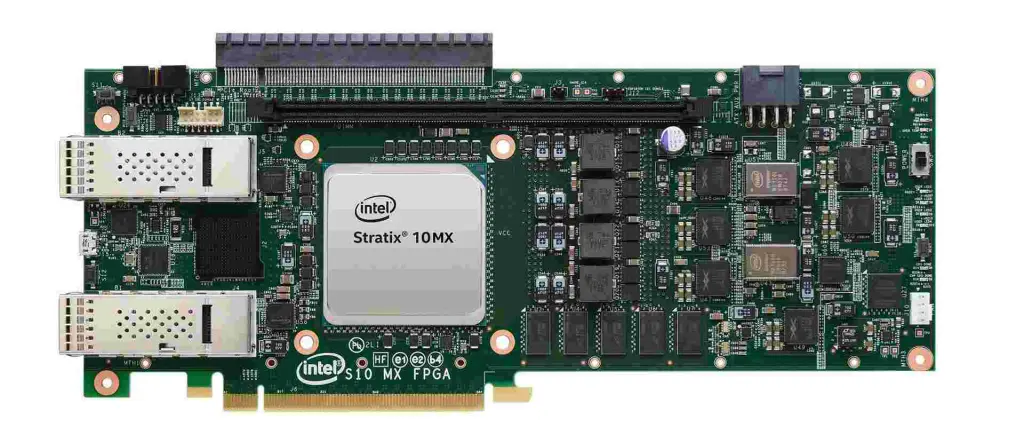
A key differentiator of the MAX 10 family is its integrated configuration flash memory (CFM). Unlike SRAM-based FPGAs that require external boot flash, the 10M04SCE144C8G stores up to two configuration images internally, enabling dual-boot and remote system upgrade without additional components. The user flash memory (UFM) block provides non-volatile on-chip storage for calibration data, encryption keys, or application parameters.
4. Pinout & Package Information
The 10M04SCE144C8G uses the 144-pin EQFP package measuring 20 × 20 mm with a 0.5 mm lead pitch and an exposed thermal pad on the underside for improved heat dissipation. Of the 144 pins, 101 are available as general-purpose user I/O, organized across multiple I/O banks that independently support different voltage standards from 1.0 V to 3.3 V LVCMOS.

The EQFP-144 package supports standard SMT assembly and is compatible with both reflow and wave soldering. Pin assignments are fully documented in Intel's MAX 10 Pin Connection Guidelines, and designers can use the Quartus Prime Pin Planner for interactive pin assignment and I/O standard verification.
For projects requiring a different form factor, consider the XC7A35T-1CPG236C Artix-7 FPGA in a smaller 236-pin BGA package, or explore higher pin-count options in our XC7A100T-1CSG324C guide.
5. Application Circuits & Design Guide
The 10M04SCE144C8G is well suited for a wide range of embedded applications where instant-on, single-chip programmable logic is required:
- Industrial I/O Expansion: Interface bridging between SPI, I²C, UART, and parallel buses in PLC and factory-automation systems.
- Motor Control: PWM generation, encoder interfaces, and real-time control loops for BLDC and stepper motors.
- Sensor Aggregation: Collecting data from multiple sensor nodes and performing local pre-processing before forwarding to an MCU or SoC.
- Communication Bridges: Protocol conversion (e.g., LVDS to CMOS, SPI to Ethernet PHY MII) with deterministic latency.
- Display & LED Control: Driving LED panels, seven-segment multiplexing, and small LCD interfaces.

Development boards such as the Arrow BeMicro MAX 10, Terasic DE10-Lite, and the official Intel MAX 10 FPGA Development Kit provide ready-made platforms for rapid prototyping with the 10M04 device family. Intel's Quartus Prime Lite Edition (free) fully supports the 10M04SCE144C8G, including synthesis, place-and-route, timing analysis, and the on-chip SignalTap Logic Analyzer.
Video Tutorial: Getting Started with Intel MAX 10 FPGA
6. Frequently Asked Questions
What is the difference between 10M04SCE144C8G and 10M04SAE144C8G?
The "SC" variant (10M04SCE144C8G) is the single-supply compact version without an on-chip analog-to-digital converter (ADC). The "SA" variant (10M04SAE144C8G) is the single-supply analog version that includes a 12-bit, up to 18-channel ADC block. If your design requires analog signal acquisition, choose the SA variant; otherwise, the SC variant offers the same logic resources at a lower cost.
Does the 10M04SCE144C8G require an external configuration flash?
No. The MAX 10 family integrates configuration flash memory (CFM) on-chip, enabling instant-on operation without any external configuration device. The 10M04SCE144C8G supports dual configuration images for safe remote field updates via the Internal Configuration scheme.
What software do I need to program the 10M04SCE144C8G?
Intel's Quartus Prime Lite Edition (free, no license required) fully supports the MAX 10 device family including the 10M04SCE144C8G. It provides HDL synthesis (Verilog/VHDL), place-and-route, timing analysis, the Pin Planner, and the SignalTap II Logic Analyzer for on-chip debugging.
How many user I/O pins does the 10M04SCE144C8G have?
In the 144-EQFP package, the 10M04SCE144C8G provides 101 user I/O pins. These pins are distributed across multiple I/O banks and support a wide range of single-ended and differential I/O standards from 1.0 V to 3.3 V, including LVTTL, LVCMOS, SSTL, HSTL, and LVDS.
What is the operating temperature range of the 10M04SCE144C8G?
The "C8G" suffix indicates a commercial-grade device with a junction temperature range of 0 °C to +85 °C. For extended temperature applications (-40 °C to +100 °C), look for the industrial-grade "I" suffix variants such as 10M04SCE144I7G.
Can the 10M04SCE144C8G be used for DSP applications?
Yes. The 10M04SCE144C8G includes 16 embedded 18 × 18 multipliers and 189 Kb of M9K embedded memory, which can implement FIR filters, small FFTs, and other DSP functions. For larger DSP workloads, consider higher-density MAX 10 devices such as the 10M16 or 10M50, or migrate to the Cyclone V FPGA family.