XC7A100T-1CSG324C Application Guide: From Datasheet to Working Circuit
When designing a real-time industrial machine vision system, the central processing element must handle immense data throughput with deterministic latency. The Xilinx XC7A100T-1CSG324C is an ideal candidate for this role, acting as the brain that acquires high-speed image data from a sensor, performs complex image signal processing (ISP) and analysis in its fabric, and drives a video output. Its balance of logic resources, DSP slices, and flexible I/O allows it to manage the entire pipeline from sensor-to-screen within a single, cost-effective device, avoiding the complexities of multi-chip solutions.

Table of Contents
Application Context: Where XC7A100T-1CSG324C Fits in the System
In a modern industrial inspection system, the goal is to identify defects on a production line moving at high speed. This requires capturing, processing, and analyzing images in real-time. The XC7A100T-1CSG324C serves as the central processing hub, orchestrating the entire data flow. Let's consider a system block diagram where this FPGA is the core component.
1. Image Acquisition: The system starts with a high-resolution CMOS image sensor. These sensors often output data over a MIPI CSI-2 or a parallel LVDS interface. The XC7A100T's high-performance SelectIO banks are configured to receive this data. For MIPI, the I/O pins can be configured as LVDS receivers to implement a D-PHY physical layer. A soft IP core, instantiated in the FPGA logic, then decodes the CSI-2 protocol packets to reconstruct the raw Bayer image frames.
2. Image Signal Processing (ISP) Pipeline: Raw sensor data is not visually appealing or suitable for analysis. The FPGA implements a custom ISP pipeline. This pipeline, built from logic cells and DSP slices, performs a series of operations in a streaming fashion:
- Debayering: Converts the raw Bayer pattern into a full-color RGB image. This requires interpolating color values, a task well-suited for the FPGA's parallel processing capabilities.
- Color Correction & Gamma Correction: Adjusts the image's color and brightness to match a target profile, often using 3x3 matrices implemented efficiently in the 240 available DSP slices.
- Noise Reduction: Implements 2D filters to reduce sensor noise, again leveraging DSP slices for multiply-accumulate (MAC) operations.
3. Frame Buffering: The processed image frames must be stored temporarily. The XC7A100T interfaces with an external DDR3/DDR3L SDRAM chip. The Xilinx Memory Interface Generator (MIG) IP core is used to create a reliable, high-bandwidth memory controller. This allows the system to buffer multiple frames, enabling more complex frame-to-frame analysis and decoupling the input and output video rates.
4. Analysis and Feature Extraction: With the clean, processed image in DDR3 memory, the FPGA's primary task begins: defect detection. This can range from simple blob detection and thresholding to more advanced algorithms like Canny edge detection or even running a lightweight convolutional neural network (CNN) for object classification. The XC7A100T's 101,440 logic cells and 240 DSP slices provide the resources to accelerate these algorithms far beyond what a traditional CPU could achieve at this power and cost point.
5. Video Output: For system monitoring and setup, the processed video stream, often with defect overlays, is sent to a display. The FPGA generates the necessary timing signals and outputs video data. This can be done by implementing a DVI/HDMI encoder in logic, using the I/O pins configured for TMDS signaling to directly drive an HDMI connector.
6. System Control: A Xilinx MicroBlaze soft-core processor is often instantiated within the FPGA fabric. This processor handles non-real-time tasks such as communicating with a host PC over Ethernet or UART, managing system configuration, and controlling the ISP parameters, offloading the main data path from control-plane overhead.
In this architecture, the XC7A100T-1CSG324C is not just a component; it is the system. It replaces what would have previously required a dedicated image processor, a separate microcontroller, and significant glue logic.
Core Specifications for This Application
The following specifications from the official Xilinx Artix-7 datasheets (DS180, DS181) are critical for the machine vision application described above.
| Parameter | Value | Application Relevance |
|---|---|---|
| Logic Cells | 101,440 | Provides the fundamental building blocks for the ISP pipeline, memory controller logic, video output generation, and control logic. This density is sufficient for a complex, multi-stage pipeline. |
| CLB LUTs | 15,850 | The Look-Up Tables are the core of the programmable logic, used to implement combinatorial functions like pixel processing logic, state machines, and address decoders. |
| DSP Slices (18x25 MACs) | 240 | Absolutely critical for accelerating the math-intensive parts of the application, such as FIR filters for noise reduction, color correction matrices, and convolutional layers in a neural network. |
| Block RAM (36Kb blocks) | 135 (4,860 Kb total) | Used for creating line buffers within the ISP pipeline, FIFOs for clock domain crossing, and local data storage for the MicroBlaze processor. Line buffers are essential for 2D filtering operations. |
| Maximum User I/O | 210 (in CSG324 package) | Determines the number of external connections. This count is sufficient to interface with a parallel image sensor, a 16-bit DDR3 memory interface, an HDMI output, and various control/status signals. |
| MMCMs / PLLs | 6 / 6 | The Mixed-Mode Clock Managers and Phase-Locked Loops are vital for generating the multiple, precise, low-jitter clock domains required: one for the sensor interface, one for the DDR3 memory, one for the internal processing pipeline, and one for the video pixel clock. |
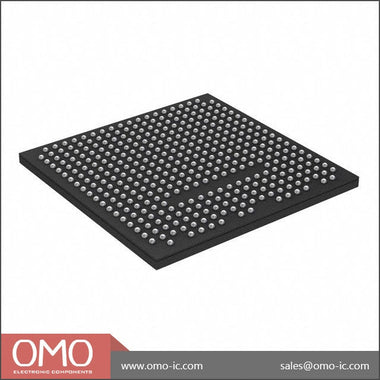
| Package | CSG324 (15x15mm BGA) | A compact Ball Grid Array package that enables a dense PCB layout. The 0.8mm pitch requires careful PCB design and manufacturing but is standard for this class of device. |
Reference Circuit and Component Selection
A successful design with the XC7A100T-1CSG324C hinges on a robust supporting circuit, particularly for power, configuration, and clocking. A schematic is more than just connecting lines; it's about ensuring signal and power integrity.
Power Delivery Network (PDN): The Artix-7 FPGA requires several distinct power rails.
- VCCINT (1.0V): The core voltage for the internal logic. This is the highest current rail and requires a high-efficiency switching regulator capable of fast transient response. A multiphase buck converter is often used.
- VCCAUX (1.8V): Powers auxiliary internal logic, including JTAG and clock management tiles. This is a lower current rail but still critical for stability.
- VCCO (1.2V to 3.3V): Powers the I/O banks. Each bank can have a different VCCO, allowing the FPGA to interface with multiple logic standards simultaneously. For our machine vision system, we might have one bank at 1.5V for the DDR3L interface, another at 2.5V for an LVDS sensor interface, and a third at 3.3V for general-purpose I/O and the HDMI TMDS output.
- VCCBRAM (1.0V): Power for the Block RAM. This is typically connected to the same rail as VCCINT.
Configuration: For a production system, the FPGA needs to load its configuration bitstream from non-volatile memory on power-up. The most common method is using a Quad-SPI (QSPI) NOR flash memory chip. A 128Mb or 256Mb flash chip (e.g., from Micron or Winbond) is typically sufficient. The FPGA's dedicated configuration pins (MOSI, MISO, SCLK, CS) are connected to the flash. A JTAG header should always be included on the board for debugging and initial programming during development, but the QSPI flash enables standalone operation.
Clocking: The system requires several precise clocks. While the FPGA has excellent internal MMCMs, it needs a clean, low-jitter external source. A dedicated clock synthesizer IC (e.g., from Silicon Labs or Renesas) is a better choice than a simple crystal oscillator. This IC can provide multiple outputs: a 200MHz differential clock for the DDR3 system clock, a 50MHz single-ended clock for general logic, and the pixel clock for the image sensor. These should be routed as controlled-impedance differential pairs (for differential clocks) to the dedicated clock-capable input pins on the FPGA.
DDR3 Interface: Interfacing with DDR3 SDRAM requires strict layout rules. The address, command, and data lines must be length-matched to within tight tolerances. The traces must have a controlled impedance (typically 50-ohm single-ended, 100-ohm differential for clocks/strobes). The Xilinx MIG tool provides pin-out suggestions that simplify this layout task. For a complete portfolio of FPGAs suitable for such demanding tasks, you can Browse Artix-7 Series to find the perfect fit for your logic and I/O requirements.
Design Pitfalls and How to Avoid Them
Designing with a high-performance FPGA like the XC7A100T can be complex. Here are some common pitfalls hardware engineers encounter and how to mitigate them.
| Common Mistake | Symptom | Fix |
|---|---|---|
| Ignoring I/O Bank Rules | FPGA fails to program, or specific I/O pins do not function. Vivado may throw DRC errors during implementation. For example, trying to use an LVDS_25 standard in a bank powered by VCCO=3.3V. | Plan I/O assignments early using the Vivado I/O Planner. Group interfaces with the same voltage standard into the same bank. Carefully read the "SelectIO Resources User Guide" (UG471) for the specific rules of each bank type (High-Range vs. High-Performance). |
| Inadequate Power Decoupling | System is unstable, experiences random resets, or has data corruption in high-speed interfaces like DDR3. The issues may be temperature or voltage dependent. | Follow the decoupling capacitor recommendations in the "7 Series FPGAs PCB Design Guide" (UG483) religiously. Use a PDN analysis tool (like HyperLynx) to simulate the impedance of your power rails. Place capacitors as close to the BGA pins as possible, using multiple small vias per capacitor pad. |
| Poor Clocking Strategy | Vivado fails to meet timing constraints (setup/hold violations). The system exhibits jitter-sensitive errors, such as bit errors on a serial link or display flickering. | Use dedicated global clock input pins (GC inputs) for all major system clocks. Use internal MMCMs/PLLs to synthesize new clock frequencies and de-skew clocks. Avoid routing clocks through general-purpose logic fabric ("gated clocks") as this introduces significant delay and jitter. |
| Incorrect Configuration Mode Pin Settings | The FPGA does not boot from the QSPI flash on power-up. The DONE pin never goes high. | The M[2:0] mode pins must be tied to specific logic levels (via pull-up/pull-down resistors) to select the desired boot mode (e.g., Master SPI). Double-check these settings against the "7 Series FPGAs Configuration User Guide" (UG470). |
A recurring theme in these pitfalls is the failure to consult the Xilinx documentation early in the design process. The User Guides (UGs) are not just reference material; they are essential design manuals. For example, the I/O banking rules are strict and non-negotiable. An entire PCB spin can be wasted by placing a 1.8V interface in a bank that needs to be powered at 3.3V for another interface. Similarly, power and clocking are not areas to cut corners. The cost of a few extra capacitors or a better clock generator is trivial compared to the cost of debugging an unstable system and respinning the board.
Performance Optimization Tips
Once the basic circuit is functional, the next step is to optimize for performance, reliability, and efficiency.
Thermal Management: The XC7A100T-1CSG324C can dissipate several watts of power, depending on the logic utilization, frequency, and I/O toggle rates. The CSG324 package has a thermal pad on the bottom that should be soldered to a large ground plane on the PCB with an array of thermal vias. For high-performance designs, a heatsink is often necessary. The FPGA includes an on-chip temperature sensor accessible via the XADC (Xilinx Analog-to-Digital Converter) block. Monitor this temperature in your firmware to implement thermal throttling or trigger a fan if necessary. Use the Xilinx Power Estimator spreadsheet to get an early idea of thermal dissipation and plan accordingly.
Signal Integrity: For high-speed interfaces like DDR3 or LVDS, signal integrity is paramount. Use a PCB layout tool with a built-in field solver to ensure your trace impedances are correct (e.g., 50Ω single-ended, 100Ω differential). Keep high-speed traces short and on a single layer if possible, referencing an uninterrupted ground plane. Use smooth, curved traces instead of sharp 90-degree bends. Pay attention to via design, as they introduce impedance discontinuities; use ground-stitched vias around high-speed signal vias to maintain a clear return path.
Power Efficiency: While the Artix-7 family is designed for low power consumption, firmware design choices have a huge impact. Use clock gating (enabled by default in Vivado synthesis) to automatically shut off clocks to unused portions of the logic. When writing HDL, be mindful of creating logic that toggles unnecessarily. For example, ensure that data bus values don't change unless new, valid data is present. The Vivado "Report Power" tool can analyze your post-implementation design and highlight high-power nets and modules, guiding your optimization efforts.
Related Components and Accessories
A successful FPGA design relies on a well-chosen ecosystem of supporting components. For the XC7A100T-1CSG324C, consider the following:
- Power Management: For the multiple rails required, consider integrated PMICs (Power Management ICs) designed for FPGAs, such as those from the Texas Instruments TPS series or Analog Devices' Power by Linear™ family. These can simplify the PDN design by combining multiple regulators into a single chip.
- Configuration Memory: A reliable QSPI NOR Flash is essential for boot-up. The Micron MT25Q series or Winbond W25Q series are industry standards and are well-supported by Xilinx's tools. A capacity of 128Mb or 256Mb is a safe choice.
- DDR3/DDR3L Memory: For the frame buffer, a single x16 DDR3L chip like Micron's MT41K series is a common choice. Ensure the speed grade of the memory is compatible with the speed supported by the FPGA's memory controller.
- Clock Generation: To provide clean, low-jitter clocks, use a dedicated clock synthesizer. The Silicon Labs Si5351 or Renesas VersaClock series are flexible options that can generate all required clock frequencies from a single crystal reference.
- Connectors: For interfacing, high-quality connectors are a must. For the HDMI output, a standard surface-mount HDMI connector is needed. For camera inputs or expansion, high-density connectors from Samtec are a popular choice in the FPGA development community.
Procuring all these components from a reliable source is crucial for production. To ensure you have access to genuine parts for your build, you can Check XC7A100T-1CSG324C Inventory & Pricing and source the necessary supporting ICs for your bill of materials.
Video Demonstration
Frequently Asked Questions (XC7A100T-1CSG324C FAQ)
How do I interface a MIPI CSI-2 camera sensor with the XC7A100T-1CSG324C?
You can interface a MIPI CSI-2 sensor by using the Artix-7's high-performance (HP) I/O banks. The physical layer (D-PHY) uses differential signaling that can be implemented with the LVDS I/O standard in the FPGA. You will need to instantiate a soft IP core (available from Xilinx or third parties) in the fabric to handle the CSI-2 protocol decoding, lane management, and packet reconstruction. Careful PCB layout is required to maintain the 100-ohm differential impedance for the MIPI data and clock lanes.
What kind of DDR memory is best for the XC7A100T in a video application?
The XC7A100T supports DDR2, DDR3, and LPDDR2 memory interfaces. For most new video processing designs, DDR3 or DDR3L is the recommended choice due to its balance of bandwidth, cost, and availability. Use the Xilinx Memory Interface Generator (MIG) IP in Vivado to generate a customized memory controller for your chosen memory part. The MIG tool will also provide a reference design, pinout, and layout guidelines which are critical to follow for a successful implementation.
Can the XC7A100T-1CSG324C run a soft-core processor like MicroBlaze?
Yes, absolutely. The XC7A100T has more than enough logic cells (101,440) and Block RAM to comfortably instantiate a 32-bit MicroBlaze soft-core processor. This is a common design pattern where the MicroBlaze handles control-plane tasks, such as configuring peripherals, running a lightweight OS, managing a network stack, or providing a user interface via UART. This leaves the parallel FPGA fabric free to focus on high-throughput data-plane tasks like the ISP pipeline.
What are the main power supply requirements for the XC7A100T?
The XC7A100T requires a multi-rail power solution. The three primary rails are VCCINT (1.0V for the core logic), VCCAUX (1.8V for auxiliary logic), and VCCO (variable, for I/O banks). Each I/O bank can be powered independently from 1.2V to 3.3V, depending on the I/O standard you need to support. A robust power delivery network with careful decoupling is critical, and you must use the Xilinx Power Estimator tool to calculate the current requirements for each rail for your specific design.
How do I program the XC7A100T-1CSG324C on my board?
There are two primary methods. For development and debugging, you use the JTAG interface. Your PCB should include a JTAG header connected to the FPGA's TDI, TDO, TMS, and TCK pins, which allows you to program the bitstream directly from the Vivado design suite. For a standalone production system, you program a non-volatile memory chip, typically a QSPI NOR flash, with the bitstream. On power-up, the FPGA (configured in Master SPI mode) will automatically read the bitstream from the flash and configure itself.