XC7Z030-1FBG676C Datasheet, Pinout, Equivalents, and Specs
The XC7Z030-1FBG676C is a System-on-Chip (SoC) from the Xilinx Zynq-7000 family, integrating a dual-core ARM Cortex-A9 processor with 28nm Artix-7 based programmable logic on a single die. This architecture enables hardware acceleration for software-defined systems, targeting applications in industrial control, automotive driver assistance, and embedded vision. The device provides a flexible platform for developing complex systems that require both high-performance processing and customizable hardware logic.
Table of Contents
What is the XC7Z030-1FBG676C?
The XC7Z030-1FBG676C is an all-programmable SoC that tightly couples a feature-rich Processing System (PS) with high-performance Programmable Logic (PL). The PS is built around a dual-core ARM Cortex-A9 MPCore processor, complete with on-chip memory, external memory interfaces, and a standard set of I/O peripherals. The PL section is equivalent to a Xilinx Artix-7 FPGA, providing a flexible fabric of logic cells, DSP slices, and block RAM for implementing custom hardware accelerators and peripherals. Communication between the PS and PL is facilitated by a high-bandwidth AXI4 interconnect, enabling efficient data exchange and system-level integration. This device is part of the broader Browse Zynq-7000 Series, which offers a scalable range of devices with varying logic densities and processing capabilities to suit different performance and cost requirements.

Pinout Configuration and Packaging
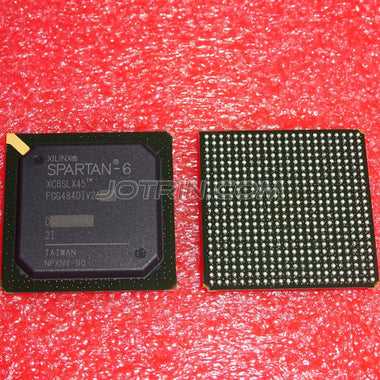
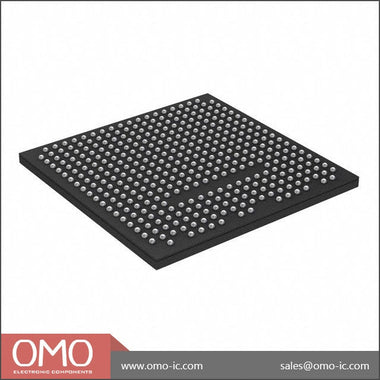
The XC7Z030-1FBG676C is offered in a 676-pin Fine-Pitch Ball Grid Array (FBG676) package with a 27x27 mm footprint and a 1.0 mm ball pitch. The pinout is meticulously organized to separate power, ground, and signal pins to ensure signal integrity and simplify PCB layout. The pins are divided into dedicated PS I/O for peripherals like Ethernet, USB, and memory controllers, and flexible PL I/O organized into several banks. Each PL I/O bank can be independently powered, supporting various I/O standards (e.g., LVCMOS, LVDS). Careful attention must be paid to the power delivery network and decoupling capacitor placement near the BGA footprint as specified in the official Xilinx documentation.
Core Architectural Features
- Processing System (PS): Features a dual-core ARM Cortex-A9 MPCore processor operating at up to 667 MHz. Each core includes a NEON media-processing engine and a floating-point unit (FPU), supported by L1 and L2 caches for high-performance software execution.
- Programmable Logic (PL): Based on the Artix-7 architecture, it provides 125K logic cells, 265K flip-flops, 900 DSP slices for signal processing, and 17.6 Mb of Block RAM (BRAM) for on-chip data storage.
- High-Bandwidth Interconnect: Multiple AXI4 (Advanced eXtensible Interface) ports connect the PS and PL, providing high-throughput, low-latency communication paths for memory-mapped peripherals and hardware accelerators.
- Integrated Peripherals: The PS includes a rich set of hard-IP peripherals, such as two Gigabit Ethernet MACs, two USB 2.0 OTG controllers, two CAN 2.0B controllers, UART, SPI, I2C, and a multi-protocol dynamic memory controller supporting DDR3, DDR3L, DDR2, and LPDDR2.
- Analog-to-Digital Converter (XADC): An on-chip dual 12-bit, 1 MSPS Analog-to-Digital Converter (XADC) with up to 17 analog inputs enables monitoring of on-chip sensors (temperature, voltage) and external analog signals.
Specifications Parameter Table
| Specification | Technical Details |
|---|---|
| Logic Cells | 125,000 |
| Look-Up Tables (LUTs) | 78,600 |
| DSP Slices | 900 |
| Block RAM | 17.6 Mb (17,920 Kb) |
| Max Processor Frequency | 667 MHz |
| Total I/O Pins | 350 (200 PL I/O, 150 PS MIO/EMIO) |
| Operating Temperature Range | 0°C to 85°C (Commercial Grade) |
XC7Z030-1FBG676C Equivalents, Cross Reference, and Lifecycle
The XC7Z030-1FBG676C is an active production component. When considering alternatives, engineers should look within the Zynq-7000 family for parts with the same FBG676 package. The XC7Z035 and XC7Z045 are available in the same package and offer increased programmable logic resources (more LUTs, DSP slices, and BRAM). While these are package-compatible, they are not direct drop-in replacements. Migrating a design requires recompiling the bitstream for the new target device and verifying timing closure, power consumption, and pin assignments. The speed grade (e.g., -1, -2, -3) also affects performance and must be matched or exceeded. For sourcing and availability verification, it is recommended to Check XC7Z030-1FBG676C Inventory & Pricing to ensure component lifecycle and stock status align with project timelines.
Typical Application & Circuit Considerations
The XC7Z030 is well-suited for applications requiring a blend of real-time control, data processing, and hardware acceleration. Common use cases include multi-axis motor control, machine vision systems, software-defined radio (SDR), and advanced driver-assistance systems (ADAS). In a typical application circuit, a robust power delivery network (PDN) is critical. The device has multiple power rails (VCCINT, VCCAUX, VCCO, VCCP, etc.) that require careful decoupling with low-ESR ceramic capacitors placed as close to the BGA balls as possible. The DDR3 memory interface requires precise impedance-controlled routing (typically 40-50Ω single-ended) and length-matching of data, address, and clock lines to ensure reliable operation at high speeds.
Video Demonstration
Frequently Asked Questions (XC7Z030-1FBG676C FAQ)
Q: What is the difference between the Processing System (PS) and Programmable Logic (PL) in the XC7Z030?
A: The Processing System (PS) is a hardened, application-grade subsystem centered around a dual-core ARM Cortex-A9 processor. It includes standard peripherals like memory controllers, Ethernet, and USB, and runs software independently. The Programmable Logic (PL) is a flexible FPGA fabric, similar to an Artix-7 FPGA, that can be configured to implement custom digital circuits, hardware accelerators, and specialized interfaces. The two are tightly integrated on the same silicon, allowing software in the PS to control and exchange data with custom hardware in the PL.
Q: How is data transferred between the ARM processor and the FPGA fabric?
A: Data transfer is primarily handled by the AMBA AXI4 interconnect. The Zynq-7000 architecture provides multiple AXI interfaces, including high-performance (HP) ports for high-bandwidth memory access from the PL, and general-purpose (GP) ports for register access and control. This allows logic in the PL to act as a master or slave, initiating transactions or responding to requests from the PS. Direct Memory Access (DMA) controllers can be implemented in either the PS or PL to facilitate efficient, high-speed data movement between memory and peripherals without CPU intervention.
Q: What are the primary power supply requirements for the XC7Z030-1FBG676C?
A: The device requires several distinct power rails. The core logic (VCCINT) typically runs at 1.0V. Auxiliary internal logic (VCCAUX) requires 1.8V. The I/O banks (VCCO) are flexible and can be powered from 1.2V to 3.3V depending on the I/O standard used. The PS also has its own set of power rails, including VCCP for the processor core and VCC_MIO/VCC_DDR for its peripherals and memory interface. A proper power-on sequence is required, which is typically managed by an external power management IC (PMIC) or sequencer.
Q: Can the XC7Z030 boot without an external processor or host?
A: Yes, the XC7Z030 is designed for standalone operation. The ARM Cortex-A9 processor within the PS acts as the master boot controller. On power-up, a boot ROM in the PS executes and loads the First Stage Bootloader (FSBL) from a non-volatile memory source such as a QSPI flash, NAND flash, or SD card. The FSBL then configures the PL with a bitstream and loads the operating system or bare-metal application into DDR memory for the processor to execute.
Q: What does the "-1FBG676C" suffix signify in the part number?
A: The suffix provides key information about the device's specific configuration. The "-1" indicates the lowest commercial speed grade, defining the maximum performance characteristics. "FBG676" specifies the package type: a 676-pin Fine-Pitch Ball Grid Array. The final "C" designates the temperature grade, indicating it is for commercial applications with an operating junction temperature range of 0°C to 85°C. Other options include "I" for industrial (-40°C to 100°C) and "E" for extended (-0°C to 100°C).

Alan Carter
Senior Hardware Engineer & Component Specialist
Alan has over 15 years of expertise in embedded systems design, FPGA architecture, and global semiconductor supply chains. He specializes in component cross-referencing, lifecycle management, and helping OEMs navigate supply shortages.