XC7Z010-1CLG400I Application Guide: From Datasheet to Working Circuit
When designing an embedded vision system for industrial automation, such as a high-speed product inspection line, the challenge is to balance real-time image processing with complex decision-making and network communication. The Xilinx XC7Z010-1CLG400I System-on-Chip (SoC) is purpose-built for this scenario. It integrates a dual-core ARM Cortex-A9 processor with Artix-7 class programmable logic, allowing it to acquire and pre-process high-framerate video in the fabric while simultaneously running advanced analytics and a TCP/IP stack on the processor.

Table of Contents
Application Context: Where XC7Z010-1CLG400I Fits in the System
In a typical Automated Optical Inspection (AOI) system, the XC7Z010-1CLG400I serves as the central brain. Let's consider a block diagram for a smart camera designed to inspect labels on bottles moving along a conveyor belt. The goal is to detect defects like missing labels, incorrect positioning, or printing errors in real-time.
At the heart of the system is the Zynq-7000 SoC. It interfaces with several key subsystems:
- Image Sensor: A CMOS image sensor captures frames of the bottles. This sensor connects to the Zynq's Programmable Logic (PL) section via a high-speed interface like MIPI CSI-2 or parallel LVDS. The PL is ideal for deserializing this raw data stream because it can be configured to handle the precise, high-frequency timing required, a task that would burden a general-purpose processor.
- Programmable Logic (PL) Pipeline: Inside the PL fabric, we implement a real-time image processing pipeline. This pipeline might consist of a Bayer filter for color conversion, a 2D FIR filter for image sharpening or smoothing, and an edge detection block (e.g., Sobel operator). These operations are performed on the pixel stream as it arrives from the sensor, without the latency of storing the entire frame in memory first. The PL's parallel architecture means these steps can happen simultaneously, achieving throughputs impossible with a sequential CPU.
- Processing System (PS): The pre-processed image data (or metadata like edge coordinates) is then passed from the PL to the Processing System (PS) via the high-bandwidth AXI interconnect. The dual-core ARM Cortex-A9 processor, running a Linux distribution or a Real-Time Operating System (RTOS), takes over. The PS executes more complex, non-deterministic algorithms. For our example, this could be blob analysis to identify the label's location, Optical Character Recognition (OCR) to read text, or a machine learning model to classify defects.
- Memory and Storage: The PS relies on an external DDR3 SDRAM chip for its main memory. This is where the operating system, application code, and full image frames (if needed for analysis) reside. A QSPI flash memory chip is used for non-volatile storage, holding the bootloader, Linux kernel, and the PL bitstream. An SD card slot can also be included for easy firmware updates in the field.
- Communication and I/O: The PS handles all external communication. An integrated Gigabit Ethernet MAC is connected to an external PHY chip, allowing the AOI system to send inspection results (pass/fail, defect images, statistics) to a central factory control server. A UART interface provides a debug console for development. General-purpose I/O (GPIO) pins, controlled by either the PS or PL, can be used to trigger a rejection mechanism (like an air jet to push a defective bottle off the line) or to synchronize with the conveyor belt's encoder.
This partitioning strategy leverages the strengths of both parts of the SoC. The PL handles the rigid, high-throughput, parallel tasks of image acquisition and pre-processing. The PS provides the flexibility of a software environment for complex algorithms, network stacks, file systems, and user interfaces. The XC7Z010-1CLG400I, being the smallest device in the Zynq-7000 family, is a cost-effective choice for this type of distributed workload where the PL requirements are moderate but the need for a powerful processing core is absolute.
Core Specifications for This Application
The following specifications from the official Xilinx datasheet are critical for designing the AOI smart camera system.
| Parameter | Value | Application Relevance |
|---|---|---|
| Processing System (PS) | Dual-core ARM Cortex-A9 MPCore | Provides the computational power to run Linux/RTOS, complex vision algorithms (OCR, ML), and the network stack for factory integration. |
| Max PS Frequency | 667 MHz (-1 Speed Grade) | Determines the execution speed of the software application. A higher frequency reduces latency in decision-making after an image is processed. |
| Logic Cells | 28K | The fundamental resource for building the custom logic pipeline in the PL. Sufficient for image sensor interfacing, color space conversion, and basic filtering. |
| DSP Slices | 80 | Hardware multipliers crucial for accelerating signal processing tasks. Essential for implementing FIR filters or FFTs in the image processing chain efficiently. |
| Block RAM | 240 Kb | On-chip memory used for line buffers, FIFOs between processing stages, and temporary storage within the PL, reducing reliance on external DDR. |
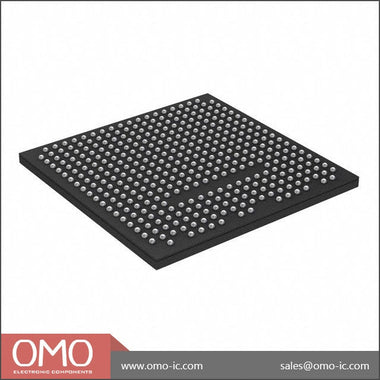
| Package | 400-pin Chip Scale BGA (CLG400) | A compact package suitable for small form-factor cameras. Requires advanced PCB design and manufacturing capabilities (e.g., microvias). |
| Temperature Grade | Industrial (-40°C to 100°C Junction) | Ensures reliable operation in harsh factory environments with wide temperature fluctuations. The '-1CLG400I' suffix denotes this grade. |
| I/O Voltage Support | 1.2V to 3.3V | Flexible I/O banks allow direct connection to a wide range of peripherals, including image sensors, PHYs, and memory, without external level shifters. |
Reference Circuit and Component Selection
Designing a board around the XC7Z010-1CLG400I requires careful attention to several critical support circuits. A robust design is not just about connecting pins; it's about ensuring power integrity, stable clocking, and reliable memory interfaces.
Power Subsystem: The Zynq-7000 architecture has multiple power domains that must be serviced correctly. Key rails include VCCINT (core logic), VCCBRAM (Block RAM), VCCAUX (auxiliary logic), VCCP (PS internal logic), and multiple VCCO rails for the I/O banks. Critically, these rails have a specific power-on and power-off sequence requirement detailed in the datasheet (DS187). Failure to follow this sequence can lead to latch-up or permanent damage. For a production design, using a dedicated Power Management IC (PMIC) like those from Analog Devices or Texas Instruments is highly recommended. These PMICs are designed for FPGAs and integrate multiple buck regulators and a sequencer into a single chip, simplifying the design and reducing board space. For prototyping, a discrete solution using multiple regulators and a dedicated power sequencer IC is feasible but more complex.
Clocking: The Processing System requires a stable clock source, typically a 33.333 MHz or 50 MHz crystal oscillator connected to the `PS_CLK` input. This clock is used by the internal PLLs to generate the various clock frequencies for the ARM cores, DDR controller, and peripheral interfaces. A low-jitter oscillator is paramount for system stability. The Programmable Logic can be clocked from the PS via internal routing or from its own dedicated clock inputs. For our AOI application, a separate, precise oscillator might be needed for the image sensor interface (e.g., a 27 MHz oscillator for a specific sensor pixel clock).
DDR Memory Interface: The PS's performance is tightly coupled to its DDR3 memory interface. The XC7Z010 supports DDR3/DDR3L memory. The connection between the SoC and the DDR3 chip(s) is a high-speed, source-synchronous interface that demands meticulous PCB layout. All data, address, and control lines must be impedance-controlled (typically 40-50 Ohms single-ended) and length-matched to within tight tolerances (e.g., +/- 5 mils) to ensure signal integrity and prevent timing skew. A 4- or 6-layer PCB with dedicated power and ground planes is a minimum requirement.
Boot and Configuration: The Zynq device must be configured at power-up. The boot source is selected by strapping a few Mode (MIO) pins to specific logic levels. Common boot options include a QSPI flash chip, an SD card, or JTAG for development. For a robust embedded system like our smart camera, booting from an on-board QSPI flash is the standard choice. The boot process involves the on-chip BootROM loading a First Stage Bootloader (FSBL) from the QSPI flash into the On-Chip Memory (OCM). The FSBL then configures the PL with its bitstream and loads the main application (e.g., U-Boot and the Linux kernel) into the external DDR memory. The entire Browse Zynq-7000 Series offers this flexible boot architecture.
Design Pitfalls and How to Avoid Them
Even experienced engineers can encounter issues when working with complex SoCs like the Zynq-7000. Here are some common pitfalls and how to steer clear of them.
| Common Mistake | Symptom | Fix |
|---|---|---|
| Incorrect Power Sequencing | Device fails to boot, draws excessive current, or is permanently damaged. JTAG chain may not be detected. | Strictly follow the power-on/off sequence specified in the Zynq-7000 DC and AC Switching Characteristics datasheet (DS187). Use a dedicated PMIC or a power sequencer IC. |
| Poor DDR3 Layout | System boots intermittently, crashes randomly under load, or experiences data corruption. Memory tests fail. | Follow Xilinx User Guide UG933 for Zynq-7000 PCB Design. Ensure controlled impedance, precise length matching for all signal groups, and proper termination. Run SI simulations. |
| Incorrect Boot Mode Pin Configuration | The device does not boot from the intended source (e.g., tries to boot from JTAG instead of QSPI). Nothing appears on the UART console. | Carefully check the MIO[8:2] pin connections against the boot mode settings table in the Technical Reference Manual (TRM, UG585). Ensure pull-up/pull-down resistors are correct. |
| Insufficient Decoupling | System instability, timing failures, high-frequency noise on power rails. Can be hard to diagnose. | Place a dense array of decoupling capacitors (e.g., 0.1µF, 1µF) as close as possible to every VCC and GND pin of the BGA, using the shortest possible traces and vias. Follow the reference design recommendations. |
Beyond these specific points, a general pitfall is underestimating the complexity of the BGA package. The CLG400 is a 0.8mm pitch BGA. This requires a PCB fabricator capable of handling fine lines/spaces and potentially via-in-pad or microvias to route all the necessary signals from the inner balls. During assembly, precise solder paste application and a controlled reflow profile are essential for avoiding shorts or open connections. X-ray inspection is highly recommended to verify the integrity of the solder joints under the package.
Performance Optimization Tips
Once the basic circuit is functional, the focus shifts to optimizing performance, power, and reliability.
Thermal Management: The XC7Z010-1CLG400I's power consumption depends heavily on the utilization of the PS cores and the PL fabric. In our AOI application, with both CPU cores running and a significant portion of the PL active, thermal dissipation is a key concern. The CLG400 package includes a central ground pad that also functions as a thermal pad. This pad must be soldered to a large copper area on the PCB, which should be stitched with numerous thermal vias to inner ground planes or a copper area on the bottom of the board. For high-performance applications, a heatsink attached to the top of the package or the PCB is often necessary to keep the junction temperature below the 100°C maximum for the industrial grade part. The internal XADC block can be used to monitor the on-chip die temperature, allowing the software to throttle performance or activate a cooling fan if necessary.
EMI Reduction: A high-speed digital system like this is a significant source of electromagnetic interference (EMI). A solid ground plane is the most effective shield. Use a multi-layer PCB stack-up (6 layers or more is common) with at least one solid, uninterrupted ground plane. All high-speed signals should be routed as microstrip or stripline traces with the ground plane as a reference. Ensure all power rails are thoroughly decoupled at the SoC pins and at the input of every voltage regulator. Using ferrite beads on power inputs can help filter out high-frequency noise from external sources.
Signal Integrity: For interfaces like DDR3 and Gigabit Ethernet (RGMII/SGMII), maintaining signal integrity is non-negotiable. Beyond the impedance and length matching already discussed, pay attention to routing topology. For the DDR address/command bus, a "fly-by" topology is preferred over a "T-branch". Minimize the use of vias on high-speed traces, as each via introduces an impedance discontinuity. When vias are necessary, ensure they have adjacent ground stitching vias to provide a continuous return path for the signal current.
Related Components and Accessories
A successful XC7Z010-1CLG400I design relies on a well-chosen ecosystem of supporting components. For the power subsystem, consider a PMIC such as the Analog Devices ADP5014, which is specifically designed to power Xilinx 7-series devices and includes the necessary sequencing. For DDR3 memory, a common choice is a 16-bit wide chip like Micron's MT41K256M16. For boot flash, a 256Mbit or 512Mbit QSPI NOR flash from manufacturers like Micron (N25Q series) or Cypress/Infineon (S25FL series) is a standard option. To implement the Gigabit Ethernet port, an external PHY is required. The Microchip KSZ9031RNX is a popular choice that supports the RGMII interface and is well-supported by Linux drivers. Finally, for debugging and initial programming, a JTAG programmer compatible with the Xilinx toolchain, such as the Digilent JTAG-HS2 or a Platform Cable USB II, is essential. When sourcing these parts, it's crucial to verify availability and lead times. You can Check XC7Z010-1CLG400I Inventory & Pricing to ensure your project timeline is not impacted.
Video Demonstration
Frequently Asked Questions (XC7Z010-1CLG400I FAQ)
How do I interface a high-speed camera sensor with the XC7Z010-1CLG400I?
The best approach is to connect the sensor to the Programmable Logic (PL) I/O pins. For parallel interfaces like CMOS or LVDS, you can directly map the data, clock, and sync signals to the PL's I/O banks. For serial interfaces like MIPI CSI-2, you need to use the PL's high-speed I/O resources to implement a D-PHY receiver. Xilinx provides IP cores that can handle the low-level deserialization and protocol decoding, presenting a simple AXI-Stream interface to your custom processing logic.
What's the best way to partition tasks between the ARM processor and the FPGA fabric for a machine vision application?
A good rule of thumb is to use the PL (FPGA fabric) for tasks that are massively parallel, repetitive, and have high-throughput requirements. This includes image sensor interfacing, color space conversion, filtering, and edge detection. Use the PS (ARM processor) for tasks that require complex decision-making, state management, or standard software stacks. Examples include running the TCP/IP stack, file systems, high-level vision algorithms like OCR or blob analysis, and managing the overall system state.
What are the power supply requirements for the XC7Z010-1CLG400I in an industrial design?
The XC7Z010 requires multiple voltage rails, including VCCINT (core), VCCAUX, VCCP, VCCBRAM, and VCCO for I/O. These rails must be powered up and down in a specific sequence outlined in the datasheet to prevent damage. For an industrial design, it is highly recommended to use a single Power Management IC (PMIC) that is designed for FPGAs, as it integrates the necessary regulators and sequencer, ensuring a robust and reliable power solution in a compact footprint.
Can I run a full operating system like Linux on the XC7Z010-1CLG400I?
Yes, absolutely. The dual-core ARM Cortex-A9 processor is more than capable of running a full Linux distribution. Xilinx provides the PetaLinux Tools, a complete embedded Linux development kit that simplifies the process of building a custom Linux system for Zynq devices. Running Linux gives you access to a vast ecosystem of software, including drivers for peripherals like Ethernet and USB, robust networking stacks, file systems, and a familiar development environment.
How do I handle the BGA package during PCB assembly and prototyping?
The 400-pin CLG400 BGA package requires an advanced PCB manufacturing and assembly process. For prototyping, it's often best to start with a pre-built development board like the Digilent Zybo Z7 or Avnet MicroZed to validate your software and PL design. When designing your own PCB, you must work with a fabricator that can handle the required fine pitch and via technology. During assembly, use a stencil for precise solder paste application and a multi-zone reflow oven with a carefully controlled thermal profile. X-ray inspection after assembly is critical to ensure there are no solder bridges or open connections underneath the package.

Alan Carter
Senior Hardware Engineer & Component Specialist
Alan has over 15 years of expertise in embedded systems design, FPGA architecture, and global semiconductor supply chains. He specializes in component cross-referencing, lifecycle management, and helping OEMs navigate supply shortages.