XC7K325T-1FFG900C Datasheet, Pinout, Equivalents, and Specs
The XC7K325T-1FFG900C is a high-performance Field-Programmable Gate Array (FPGA) from the Xilinx (now AMD) Kintex-7 family. It is engineered to deliver an optimal balance of price-performance, logic density, and low power consumption, making it a cornerstone for a wide array of demanding applications. This device solves the critical engineering challenge of implementing complex digital logic, high-throughput signal processing, and high-speed serial connectivity in a single, reconfigurable chip, thereby reducing board space, system cost, and time-to-market for next-generation electronic systems.

Table of Contents
What is the XC7K325T-1FFG900C?
The XC7K325T-1FFG900C is a member of the Kintex-7 FPGA family, which Xilinx positions as its "best price-performance/watt" offering within the broader 7 Series portfolio. Manufactured on a 28nm process technology, this device represents a significant leap forward in performance and power efficiency compared to previous generations. The part number itself provides a wealth of information: XC7K denotes the Kintex-7 family, 325T indicates the device size and logic capacity, -1 is the speed grade (the slowest commercial grade), FFG900 specifies the package type (a 900-pin fine-pitch BGA), and C signifies the commercial temperature range (0°C to 85°C junction temperature).
At its core, the XC7K325T-1FFG900C is a vast sea of reconfigurable logic resources. According to the official Xilinx DS182 datasheet, it contains 326,080 logic cells, organized into 50,950 Configurable Logic Blocks (CLBs). Each CLB is built around advanced 6-input Look-Up Tables (LUTs), providing a powerful and flexible fabric for implementing custom digital circuits. This substantial logic density allows engineers to integrate functions that would otherwise require multiple ASICs or ASSPs.
Beyond general-purpose logic, the device is heavily fortified with specialized hardware blocks to accelerate common functions. It includes 840 dedicated DSP slices (DSP48E1), which are essential for high-throughput digital signal processing tasks like FIR filtering, FFTs, and complex mathematical operations. For data storage, it offers a total of 16,740 Kb of Block RAM, which can be configured in various widths and depths to serve as on-chip memory, FIFOs, or buffers. A key feature for modern systems is its high-speed serial connectivity. The XC7K325T-1FFG900C is equipped with 16 GTX transceivers, each capable of running at data rates up to 12.5 Gb/s. These transceivers are the foundation for implementing standard protocols such as PCI Express (Gen1/Gen2), 10 Gigabit Ethernet, Serial ATA (SATA), and DisplayPort, enabling high-bandwidth communication with other system components. This integration of logic, processing, memory, and high-speed I/O makes the device a versatile system-on-chip platform for a multitude of applications.
Pinout Configuration and Packaging
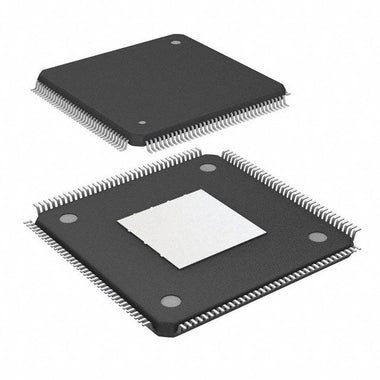
The XC7K325T-1FFG900C is housed in an FFG900 package, which is a 900-pin fine-pitch ball grid array (BGA). This package measures 31mm x 31mm and features a 1.0mm ball pitch, a standard for high-density FPGAs that balances routability and PCB manufacturing complexity. Due to the reconfigurable nature of FPGAs, a static pinout diagram is less meaningful than for a fixed-function IC. The function of most pins, particularly the general-purpose user I/O, is defined by the engineer during the hardware design process using the Xilinx Vivado Design Suite.
The 900 pins can be categorized into several critical groups:
- User I/O Pins: The device provides up to 500 user I/O pins. These are organized into I/O banks, each with its own VCCO power rail. This architecture allows different banks to interface with external components using different I/O standards (e.g., 3.3V LVCMOS, 1.8V HSTL, or 2.5V LVDS) on the same chip, providing immense system-level flexibility.
- High-Speed Serial Transceiver Pins (GTX): These are dedicated differential pairs for the 16 GTX transceivers. They require careful impedance-controlled routing on the PCB to maintain signal integrity at multi-gigabit speeds.
- Power and Ground Pins: A significant portion of the 900 pins are dedicated to power (VCCINT, VCCAUX, VCCO, MGT supplies) and ground (GND). This extensive power delivery network is crucial for maintaining stable voltages and providing low-impedance return paths for high-frequency signals, ensuring reliable operation.
- Configuration Pins: This group includes the JTAG interface pins (TCK, TMS, TDI, TDO) for programming and debugging, as well as mode pins (M[2:0]) that determine how the FPGA loads its configuration bitstream upon power-up (e.g., from an external QSPI flash memory or via a processor).
- Special-Purpose Pins: This includes clock inputs, XADC analog inputs, and other dedicated function pins.
Proper pin assignment and PCB layout are paramount for a successful design using the XC7K325T-1FFG900C. Engineers must carefully plan I/O bank usage, power distribution, and high-speed routing in accordance with Xilinx's design guidelines to achieve full performance.
Core Architectural Features
- Advanced 28nm Logic Fabric: The device is built on a 28nm process and features a high-performance logic architecture based on 6-input Look-Up Tables (LUTs) with integrated flip-flops. This structure is more efficient than older 4-input LUTs, allowing for the implementation of more complex combinatorial logic per resource, leading to better device utilization and higher performance.
- High-Speed GTX Transceivers: It integrates 16 multi-gigabit transceivers (GTX), each supporting data rates up to 12.5 Gb/s. These transceivers are highly configurable and include features like equalization (CTLE, DFE) to overcome channel losses, making them suitable for robust implementation of protocols like PCIe Gen2, 10Gb Ethernet (XAUI, 10GBASE-KR), CPRI, and Serial RapidIO.
- Dedicated DSP Slices (DSP48E1): The XC7K325T-1FFG900C contains 840 DSP48E1 slices. Each slice features a 25x18 multiplier, a 48-bit accumulator, and a pre-adder. These dedicated hardware blocks enable massive parallel processing for computationally intensive signal processing algorithms, offloading the general logic fabric and achieving performance far beyond what a CPU could offer.
- Flexible Block RAM and FIFO: The device includes 16,740 Kb of dual-port Block RAM. These 36 Kb blocks can be split into two independent 18 Kb RAMs, configured with various data widths, or used as built-in FIFOs. This flexible, high-bandwidth on-chip memory is critical for buffering data between processing stages and interfacing with external memory.
- Integrated Mixed-Signal (XADC): An on-chip dual 12-bit, 1 MSPS Analog-to-Digital Converter (XADC) provides mixed-signal capabilities. It can be used to monitor the FPGA's internal die temperature and power supply voltages for system health monitoring, or it can be used to digitize up to 17 external analog input channels, reducing the need for external monitoring components.
Specifications Parameter Table
| Specification | Technical Details |
|---|---|
| Logic Cells | 326,080 |
| CLB Slices | 50,950 |
| Total Block RAM | 16,740 Kb |
| DSP Slices | 840 |
| GTX Transceivers | 16 transceivers, with data rates up to 12.5 Gb/s |
| Maximum User I/O | 500 |
| Core Voltage (VCCINT) | 1.0V (Nominal) |
| Junction Temperature Range | 0°C to 85°C (Commercial Grade) |
XC7K325T-1FFG900C Equivalents, Cross Reference & Lifecycle
The XC7K325T-1FFG900C is part of a mature yet active product family. As of this writing, the Kintex-7 series is in "Active" production by AMD/Xilinx, ensuring its availability for new designs and long-term production needs. Finding a direct, 100% drop-in replacement for an FPGA is rare due to their complex nature.
Intra-Family Variants: Within the Kintex-7 family, other devices offer different resource counts. For example, the XC7K160T offers fewer resources for more cost-sensitive applications, while the XC7K410T provides more logic, DSP, and memory. These are not pin-compatible and require a redesign but allow for scaling a product line on a common architecture.
Speed and Temperature Grades: A part like the XC7K325T-2FFG900I is a potential replacement. The "-2" indicates a faster speed grade, and the "I" denotes an industrial temperature range (-40°C to 100°C). This part is pin-compatible and could be used in place of the "-1C" version, provided the design is re-analyzed for timing, as faster parts can sometimes introduce hold time violations. It is generally a safer upgrade path than downgrading speed.
Cross-Competitor Alternatives: An alternative from a competitor, such as an Intel (formerly Altera) Arria V or Cyclone 10 GX device, would not be a drop-in replacement. While they may offer similar logic density and transceiver counts, the underlying architecture, IP blocks, and design software (Intel Quartus vs. Xilinx Vivado) are completely different. Migrating a design would require a full engineering porting effort, including rewriting HDL code, re-implementing IP, and a complete re-verification cycle.
For procurement and lifecycle planning, it is always best to verify current stock and lead times. You can Check XC7K325T-1FFG900C Inventory & Pricing for the most up-to-date information.
Typical Applications & Circuit Considerations
The XC7K325T-1FFG900C's blend of high-speed logic, DSP, and serial I/O makes it suitable for a diverse range of applications that require significant data processing and movement.
Typical Applications:
- 4G/5G Wireless Radio: Used in Remote Radio Heads (RRH) for implementing the digital front-end (DFE), including digital up/down conversion, crest factor reduction (CFR), and pre-distortion (DPD) algorithms. The numerous DSP slices and high-speed CPRI/JESD204B interfaces via GTX transceivers are critical.
- Medical Imaging: In systems like ultrasound, CT scanners, and MRI, this FPGA can perform real-time image processing, reconstruction, and filtering. Its massive parallelism is ideal for beamforming and other computationally intensive tasks.
- Aerospace & Defense: Ideal for software-defined radio (SDR), radar/sonar signal processing, and secure communications. The reconfigurability is valuable for adapting to new waveforms and threats.
- Broadcast & Pro A/V: Powers video switchers, routers, and processing equipment, handling multiple streams of high-definition video, format conversions, and real-time effects.
- Industrial Automation: Used in high-performance machine vision systems, multi-axis motor control, and industrial networking gateways.
Circuit Design Considerations:
Successfully designing a PCB for the XC7K325T-1FFG900C requires meticulous attention to detail, particularly in power and signal integrity.
Power Delivery Network (PDN): The FPGA requires multiple power rails, including the 1.0V core voltage (VCCINT), 1.8V auxiliary voltage (VCCAUX), programmable I/O voltages (VCCO), and several specific voltages for the GTX transceivers. The PDN must be designed for very low impedance to handle the high transient current demands of the FPGA. This involves using multiple power planes and a dense array of decoupling capacitors placed as close as possible to the BGA balls, following the recommendations in the Xilinx UG483 user guide.
High-Speed Routing: The GTX transceiver traces must be routed as impedance-controlled differential pairs (typically 100Ω). Care must be taken to minimize discontinuities from vias, connectors, and layer transitions. Length matching within pairs is critical. Similarly, interfaces to DDR memory require precise length and impedance matching.
Configuration and Boot: A common configuration method is to use an external QSPI flash memory to store the FPGA's bitstream. The MODE pins must be set correctly with pull-up/pull-down resistors to select this boot mode on power-up. The design must also ensure the configuration clock (CCLK) signal is clean.
Engineers looking to leverage the power of this architecture can Browse Kintex-7 Series to find the optimal device for their specific system requirements.
Video Demonstration
Frequently Asked Questions (XC7K325T-1FFG900C FAQ)
What is the difference between XC7K325T-1FFG900C and XC7K325T-2FFG900I?
The key differences are in the speed grade and temperature rating. The "-1" in XC7K325T-1FFG900C denotes the slowest commercial speed grade, while "-2" is a faster grade, meaning it can support higher clock frequencies. The "C" indicates a commercial temperature range (0°C to 85°C junction), whereas the "I" in XC7K325T-2FFG900I signifies an industrial range (-40°C to 100°C junction), making it suitable for harsher environments.
What software is used to program the XC7K325T-1FFG900C?
The XC7K325T-1FFG900C is programmed using the AMD-Xilinx Vivado Design Suite. This is a comprehensive software tool for synthesis, place-and-route, timing analysis, and bitstream generation. It supports hardware description languages like VHDL and Verilog and also offers high-level synthesis (HLS) capabilities for C/C++ based design.
How much power does the XC7K325T-1FFG900C consume?
Power consumption is highly application-dependent and cannot be stated as a single number. It is a function of the logic utilization, signal activity (toggle rates), clock frequencies, and I/O usage. To get an accurate estimate, engineers must use the Xilinx Power Estimator (XPE) spreadsheet early in the design cycle and the Vivado Power Analysis tools later for more precise figures based on the implemented design.
Is the XC7K325T-1FFG900C a direct replacement for a Spartan-7 device?
No, it is not a direct replacement. The Kintex-7 and Spartan-7 families target different application segments. Kintex-7, including the XC7K325T, is optimized for the best price-performance and features high-speed transceivers and large amounts of DSP and logic resources. Spartan-7 is designed for cost-sensitive, I/O-intensive applications and lacks the high-end features of Kintex-7. They are not pin-compatible and have vastly different resource sets.
What are the main power supply rails for the XC7K325T-1FFG900C?
A typical design requires several key power rails. The most critical are VCCINT (1.0V nominal for the internal logic core), VCCAUX (1.8V for auxiliary internal logic), and VCCO (for the I/O banks, which can range from 1.2V to 3.3V depending on the I/O standard). Additionally, the GTX transceivers require their own dedicated supplies, typically MGTAVCC (1.0V) and MGTAVTT (1.2V), which demand very clean, low-noise power.