XC7K325T-1FFG900C Datasheet, Pinout, Equivalents, and Specs
The Xilinx XC7K325T-1FFG900C is a high-performance Field-Programmable Gate Array (FPGA) from the Kintex-7 family, built on a 28nm process technology. It is engineered to provide a balanced combination of logic density, signal processing capability, I/O bandwidth, and power efficiency. This device is a workhorse for a wide range of applications that require significant parallel processing and high-speed connectivity without the higher power consumption and cost associated with the top-tier Virtex series. For design teams, it solves the challenge of implementing complex digital systems with demanding performance metrics in a cost-effective and reconfigurable platform.

Table of Contents
What is the XC7K325T-1FFG900C?
The XC7K325T-1FFG900C is a specific member of the AMD-Xilinx Kintex-7 FPGA family. As an FPGA, it is a semiconductor device containing a matrix of configurable logic blocks (CLBs) and programmable interconnects. Unlike a fixed-function processor or ASIC, an FPGA's internal circuitry can be reconfigured by a hardware engineer after manufacturing to implement virtually any digital logic function. The Kintex-7 family is positioned in the middle of the 7-series portfolio, offering a substantial performance uplift from the lower-cost Artix-7 family while consuming less power than the higher-end Virtex-7 family.
Architecturally, the XC7K325T is built on Xilinx's 28nm process technology, which was a significant node for achieving a new level of performance-per-watt. The internal fabric is composed of several key resource types. The primary resource is the vast array of logic cells, which in this device number 326,080. These are grouped into CLBs, each containing 6-input look-up tables (LUTs) and flip-flops, providing the fundamental building blocks for combinatorial and sequential logic. This high logic count allows for the implementation of very complex state machines, control logic, and custom data processing pipelines.
Beyond general-purpose logic, the XC7K325T integrates specialized hardware blocks to accelerate common functions. It contains 840 DSP48E1 slices, which are dedicated digital signal processing engines. Each slice includes a 25x18 multiplier, an accumulator, and a pre-adder, making them exceptionally efficient for implementing FIR filters, FFTs, and other computationally intensive DSP algorithms. For on-chip memory, the device provides a total of 16,740 Kb of Block RAM (BRAM), organized in flexible 36 Kb blocks that can be configured as dual-port RAM, FIFOs, or ROM. This distributed memory is critical for buffering data between processing stages. For high-speed serial communication, the device is equipped with 16 GTX transceivers, capable of operating at line rates suitable for protocols like PCI Express, 10 Gigabit Ethernet, and Serial RapidIO.
Pinout Configuration and Packaging
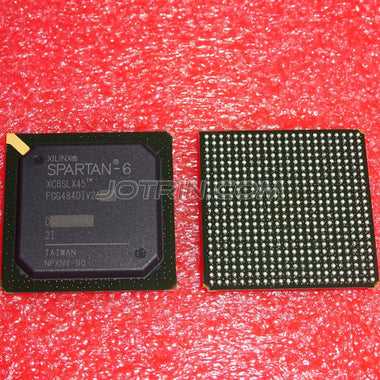
The XC7K325T-1FFG900C is supplied in an FFG900 package. This is a 900-pin, 31x31 mm Fine-Pitch Ball Grid Array (BGA) with a 1.0mm ball pitch. This high-density package is necessary to accommodate the large number of user I/O, high-speed transceiver channels, and the extensive power and ground connections required by the device.
A complete pinout diagram for a 900-ball BGA is extremely dense and not practical to display in a document. Hardware engineers must use the Xilinx Vivado Design Suite for accurate pin planning and assignment. The software provides an interactive view of the package, allowing designers to assign signals to physical pins while adhering to banking rules, I/O standards, and signal integrity constraints.
Key pin types on the FFG900 package include:
- User I/O Pins: A large number of pins are available for general-purpose I/O, supporting a wide variety of signaling standards (LVCMOS, LVDS, SSTL, HSTL). These are organized into I/O banks, each with its own VCCO power supply pin, allowing different banks to operate at different voltage levels.
- GTX Transceiver Pins: These are dedicated differential pairs for the high-speed serial transceivers (TXP/TXN, RXP/RXN). They require careful routing on the PCB with controlled impedance.
- Power and Ground Pins (VCCINT, VCCAUX, VCCO, GND, etc.): A significant percentage of the balls are dedicated to providing a stable power distribution network (PDN) and a low-impedance ground reference. Proper connection and decoupling of these pins are critical for device operation.
- Configuration Pins: A set of dedicated pins (e.g., M0, M1, M2, PROG_B, DONE, TCK, TDI, TDO, TMS) are used to control the device's configuration process, selecting the boot mode (e.g., Master SPI, JTAG) and monitoring its status.
- Clock Input Pins: Dedicated pins designed to receive external clock signals with low jitter. These are typically routed to the on-chip Clock Management Tiles (CMTs).
PCB layout for the FFG900 package is a non-trivial task, often requiring a multi-layer board (typically 8 layers or more) to successfully route all signals, especially for BGA escape routing and routing the high-speed differential pairs from the GTX transceivers.
Core Architectural Features
- Advanced Logic Fabric: The device is built around Configurable Logic Blocks (CLBs) that contain two slices. Each slice features four 6-input Look-Up Tables (LUTs) for implementing combinatorial logic and eight storage elements (flip-flops or latches). This 6-input LUT architecture improves logic density and performance compared to previous 4-input LUT structures.
- DSP48E1 Slices: It integrates a large number of dedicated DSP slices. Each DSP48E1 slice contains a 25x18 two's complement multiplier, a 48-bit accumulator, and a pre-adder. These hard-IP blocks provide a highly efficient, low-power method for implementing signal processing functions, far exceeding the performance of implementing such functions in general-purpose logic.
- High-Speed GTX Transceivers: The XC7K325T includes 16 multi-gigabit serial transceivers. These GTX transceivers support a wide range of protocols and data rates up to 12.5 Gb/s, enabling direct connection to high-speed interfaces like PCIe Gen1/Gen2, SFP+, XAUI, and 10GBASE-KR without external PHY components.
- Flexible Clock Management: The device features multiple Clock Management Tiles (CMTs). Each CMT contains one Mixed-Mode Clock Manager (MMCM) and one Phase-Locked Loop (PLL). These blocks provide robust capabilities for clock synthesis, jitter filtering, frequency multiplication/division, and phase shifting, which are essential for managing complex clocking domains in a system-on-chip design.
- Integrated Block RAM: It provides a substantial amount of on-chip memory in the form of 36 Kb Block RAMs (BRAMs). These are true dual-port memory blocks that can be configured in various widths and depths, or as FIFOs. This on-chip memory is crucial for buffering data, implementing processor caches, and storing coefficients for DSP algorithms.
Specifications Parameter Table
The following table details key specifications for the XC7K325T-1FFG900C variant. These values are derived from the official Xilinx Kintex-7 datasheets and are essential for system design and component selection.
| Specification | Technical Details |
|---|---|
| FPGA Family | Kintex-7 |
| Logic Cells | 326,080 |
| CLB LUTs | 203,800 |
| Total Block RAM | 16,740 Kb |
| Number of DSP Slices | 840 |
| GTX Transceivers | 16 (up to 12.5 Gb/s) |
| Maximum User I/O | 500 |
| Core Voltage (VCCINT) | 1.0V (Nominal) |
| Package | FFG900 (31x31 mm, 900-ball BGA) |
| Speed Grade | -1 (Commercial Grade, Slowest Performance) |
| Temperature Grade | C (Commercial, 0°C to 85°C Junction Temperature) |
XC7K325T-1FFG900C Equivalents, Cross Reference & Lifecycle
The XC7K325T-1FFG900C is an active production device from AMD-Xilinx. Finding a direct, "drop-in" equivalent for a complex FPGA is generally not feasible due to the proprietary nature of internal architectures and development toolchains.
Within the Kintex-7 family, designers can consider other devices for scaling a design up or down:
- XC7K160T-1FFG900C: A smaller device in the same family and package. It offers fewer logic cells, DSP slices, and BRAM. This could be a cost-reduction path if a design's resource utilization is low on the XC7K325T. However, it is not pin-compatible for all I/O due to die differences, requiring a board layout review.
- XC7K410T-1FFG900C: A larger device in the same family and package. It provides more logic resources and is a potential upgrade path if a design runs out of resources on the XC7K325T. Again, pin migration must be carefully verified using Xilinx tools.
Cross-referencing to a competitor's device, such as an Intel (formerly Altera) Cyclone 10 GX or Arria V, is a major engineering effort. It requires a complete porting of the HDL code, re-constraining the design for the new timing model, re-implementing any vendor-specific IP cores, and a full redesign of the PCB. The choice between FPGA vendors is typically made at the beginning of a project based on architectural features, IP availability, and toolchain familiarity. For procurement and sourcing, it is essential to verify current stock levels and lead times. You can Check XC7K325T-1FFG900C Inventory & Pricing to get the latest availability information.
Typical Applications & Circuit Considerations
The XC7K325T-1FFG900C's blend of high-density logic, DSP performance, and high-speed serial I/O makes it suitable for a wide array of demanding applications:
- Wireless Communications: Used in 4G/5G base station remote radio heads (RRH) and baseband units (BBU) for implementing digital front-end (DFE) functions like digital up/down conversion, crest factor reduction (CFR), and digital pre-distortion (DPD).
- Broadcast and Video: Ideal for professional video routers, switchers, and processing equipment. It can handle multiple streams of high-definition video, performing tasks like encoding/decoding, scaling, and compositing in real-time.
- Aerospace and Defense: Employed in software-defined radio (SDR), radar/sonar signal processing, and secure communications due to its reconfigurability and high-performance signal processing capabilities.
- Medical Imaging: The massive parallelism of the DSP slices is well-suited for ultrasound beamforming and image reconstruction in medical diagnostic equipment.
- Test and Measurement: Used as the core processing engine in arbitrary waveform generators, logic analyzers, and protocol analyzers that require flexible, high-throughput data handling.
Circuit Design Considerations:
Successfully integrating the XC7K325T-1FFG900C into a system requires careful attention to PCB design. The Power Distribution Network (PDN) is paramount. The device requires multiple power rails, including the 1.0V core voltage (VCCINT), 1.8V auxiliary voltage (VCCAUX), various I/O bank voltages (VCCO), and dedicated supplies for the GTX transceivers. Each supply must be properly sequenced during power-up and power-down, and extensive decoupling capacitance must be placed as close as possible to the BGA balls to provide a low-impedance path for transient currents. Signal integrity is another major concern. The GTX transceiver differential pairs must be routed with tightly controlled 100-ohm impedance and length-matching. The PCB stackup must be designed in collaboration with a fabrication house to ensure impedance targets are met. Finally, a reliable configuration solution, typically a dedicated SPI flash memory, must be included to store the FPGA's configuration bitstream.
Engineers looking to implement these types of systems can explore the full range of available devices to find the optimal fit for their specific resource and performance needs. You can Browse Kintex-7 Series to compare different members of the family.
Video Demonstration
Frequently Asked Questions (XC7K325T-1FFG900C FAQ)
What does the part number XC7K325T-1FFG900C mean?
The part number is a code that describes the device's characteristics. 'XC' indicates a Xilinx Commercial device. 'K' stands for the Kintex family. '325T' specifies the device size and resources within the family. '-1' is the speed grade, which indicates the performance level (-1 is the slowest commercial grade). 'FFG900' describes the package: a 900-ball, lead-free, fine-pitch BGA. 'C' denotes the commercial temperature grade, which supports a junction temperature range of 0°C to 85°C.
What software tools are used to program the XC7K325T-1FFG900C?
The primary software tool for designing with the XC7K325T-1FFG900C is the AMD-Xilinx Vivado Design Suite. This is a comprehensive integrated development environment (IDE) that includes tools for HDL synthesis, simulation, implementation (place and route), static timing analysis, and bitstream generation. For debugging, engineers use the Vivado Logic Analyzer and hardware debuggers connected via a JTAG interface.
What are the main power supply rails for this FPGA?
The XC7K325T-1FFG900C requires several independent power supply rails for proper operation. The most critical are VCCINT (1.0V nominal) for the internal core logic, VCCAUX (1.8V nominal) for auxiliary internal logic, and VCCO for the I/O banks (variable, e.g., 1.8V, 2.5V, 3.3V, depending on the I/O standard). Additionally, the GTX transceivers require their own dedicated analog and digital supplies (MGTAVCC, MGTAVTT) to ensure low-noise operation.
Is the XC7K325T-1FFG900C suitable for PCIe applications?
Yes, it is very suitable for PCI Express applications. The device includes integrated blocks for PCIe that work in conjunction with the GTX transceivers to implement a compliant endpoint or root port. The XC7K325T can support up to PCIe Gen2 x8, making it a common choice for custom accelerator cards, data acquisition boards, and other peripherals that connect to a host system over the PCIe bus.
What is the difference between a '-1', '-2', and '-3' speed grade?
The speed grade indicates the maximum performance capability of the FPGA. A higher speed grade number signifies a faster device. For example, a '-3' speed grade device is the fastest, followed by '-2', and then '-1' is the slowest commercial grade. Faster speed grades can meet more aggressive timing constraints (i.e., run at higher clock frequencies) but typically come at a higher cost. The specific timing parameters for each speed grade are detailed in the Xilinx datasheets.

Alan Carter
Senior Hardware Engineer & Component Specialist
Alan has over 15 years of expertise in embedded systems design, FPGA architecture, and global semiconductor supply chains. He specializes in component cross-referencing, lifecycle management, and helping OEMs navigate supply shortages.