The Xilinx XC7A200T-2FBG484I is a high-performance Field-Programmable Gate Array (FPGA) from the Artix-7 family, engineered to deliver a potent combination of logic density, signal processing capability, and low power consumption. It solves the critical engineering challenge of implementing complex digital logic and high-speed interfaces in cost-sensitive, power-constrained applications. By leveraging Xilinx's 28nm process technology, this device provides substantial resources for tasks ranging from advanced video processing and industrial networking to software-defined radio and aerospace control systems, all within a compact and thermally manageable package.
Table of Contents
What is the XC7A200T-2FBG484I?
The XC7A200T-2FBG484I is a specific device within the AMD-Xilinx Artix-7 family of FPGAs. To understand its capabilities, it's helpful to decode the part number:
- XC7A: Denotes the Artix-7 family, which is optimized for the best performance-per-watt and a balance of cost and features.
- 200T: Represents the device size and resource count. The '200' indicates it's one of the largest devices in the Artix-7 family, offering a substantial amount of logic resources. The 'T' signifies the presence of high-speed GTP transceivers.
- -2: This is the speed grade. A '-2' speed grade offers a good balance of performance and power. Higher numbers (like -3) indicate faster performance, while lower numbers (like -1) are slower but more power-efficient.
- FBG484: Describes the package. This is a 484-pin Fine-Pitch Ball Grid Array (FBG) with a 1.0mm ball pitch.
- I: Specifies the temperature grade. 'I' stands for Industrial, with a supported junction temperature range of -40°C to 100°C, making it suitable for non-climate-controlled environments.
At its core, the XC7A200T-2FBG484I is built on a 28nm High-K Metal Gate (HKMG) process. This advanced semiconductor process is key to its low static and dynamic power consumption, a critical factor for battery-powered or thermally constrained systems. The internal architecture is a rich fabric of programmable logic resources. The fundamental building block is the Configurable Logic Block (CLB), which contains 6-input Look-Up Tables (LUTs) and storage elements (flip-flops). This 6-input LUT structure is a significant improvement over older 4-input LUT architectures, allowing more logic to be implemented per LUT, leading to better device utilization and performance.
Beyond general-purpose logic, the device is heavily equipped with specialized hardware blocks. It contains a large number of DSP48E1 slices, which are dedicated hardware blocks for digital signal processing. Each slice includes a 25x18 multiplier, a 48-bit accumulator, and a pre-adder, capable of high-speed arithmetic operations essential for filters, FFTs, and other signal processing algorithms. It also features a significant amount of Block RAM (BRAM), organized in 36Kb blocks that can be configured for various data widths and depths, serving as on-chip memory for data buffering and algorithm state. For clocking, multiple Mixed-Mode Clock Managers (MMCMs) and Phase-Locked Loops (PLLs) provide sophisticated clock synthesis, jitter filtering, and deskew capabilities, which are vital for managing complex, multi-clock domain systems.
Pinout Configuration and Packaging
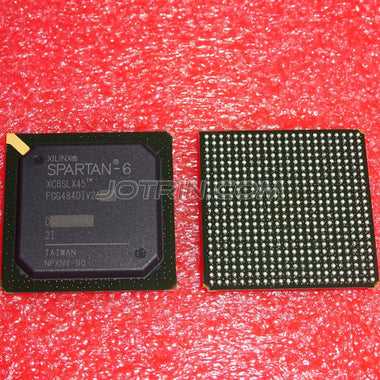
The XC7A200T-2FBG484I is offered in the FBG484 package, a 23x23mm Fine-Pitch Ball Grid Array with 484 solder balls arranged in a grid on the underside. The 1.0mm pitch is standard and manageable for most modern PCB manufacturing processes. Out of the 484 total pins, a significant number are dedicated to user I/O, power, and ground, with the remainder used for special-purpose functions.
A detailed pinout analysis requires the official Xilinx documentation for the specific device and package combination, as pin functions can be multiplexed. However, the pins can be broadly categorized as follows:
- Power and Ground Pins: These are the most critical pins for device operation. Multiple pins are dedicated to each voltage rail to provide a low-inductance path. Key rails include VCCINT (core logic), VCCAUX (auxiliary logic), VCCO (I/O banks), and dedicated supplies for the GTP transceivers (MGTAVCC, MGTAVTT). Proper decoupling on these pins is non-negotiable for stable operation.
- User I/O Pins: These are general-purpose pins that can be configured to support a wide range of I/O standards like LVCMOS, LVDS, HSTL, and SSTL. They are organized into I/O banks, with each bank having its own VCCO supply pin. This allows different banks to interface with components at different voltage levels (e.g., one bank at 1.8V, another at 3.3V).
- High-Speed Transceiver Pins: The device includes dedicated differential pin pairs for the GTP transceivers. These are used for implementing multi-gigabit serial protocols like PCI Express, Serial ATA, and Gigabit Ethernet. These pins require meticulous PCB layout with controlled impedance and minimal discontinuities.
- Configuration Pins: A set of dedicated pins (e.g., MODE pins, PROGRAM_B, DONE, INIT_B) are used to load the configuration bitstream into the FPGA upon power-up or command. The MODE pins select the configuration method, such as Master SPI from an external flash chip.
Due to the complexity and sheer number of pins, designers must rely on the Vivado Design Suite tools and the official device pinout files provided by Xilinx. These tools help manage pin assignments, run design rule checks, and generate reports to ensure a valid and functional pinout for the target application.
Core Architectural Features
- Advanced Logic Fabric: The device is built around a high-density fabric of Configurable Logic Blocks (CLBs). Each CLB contains two slices, and each slice is equipped with four 6-input LUTs (which can also function as dual 5-input LUTs), eight flip-flops, multiplexers, and fast carry-chain logic. This architecture provides a powerful and flexible foundation for implementing a vast range of digital circuits.
- High-Performance DSP Slices (DSP48E1): The XC7A200T-2FBG484I is equipped with 740 dedicated DSP48E1 slices. Each slice can perform a 25x18 multiplication and 48-bit accumulation in a single clock cycle at high frequencies. These are essential for accelerating DSP algorithms in applications like wireless communication, medical imaging, and high-frequency trading, offloading the work from the general-purpose logic fabric.
- Flexible Block RAM and FIFO: The device contains over 13 Megabits of total Block RAM, organized as 36 Kb blocks. These blocks are true dual-port memories and can be configured in various aspect ratios (e.g., 32Kx1, 1Kx36). They can also be configured as built-in FIFOs, which simplifies the design of data buffering and clock domain crossing circuits.
- Sophisticated Clock Management (MMCM/PLL): It features multiple Mixed-Mode Clock Managers (MMCMs) and Phase-Locked Loops (PLLs). These blocks are critical for robust clocking strategies. They can be used for clock synthesis (frequency multiplication/division), jitter attenuation, phase shifting, and deskewing clock nets across the chip, ensuring reliable timing for high-performance designs.
- Integrated GTP Transceivers: The 'T' in the part number signifies the inclusion of high-speed serial transceivers. The XC7A200T has 8 GTP transceivers, each capable of running at data rates up to 6.6 Gb/s. This integrated functionality is crucial for implementing standard high-speed protocols like PCI Express (Gen1/Gen2), SATA, SGMII, and XAUI without the need for external PHY chips, reducing board space and system cost.
Specifications Parameter Table
| Specification | Technical Details |
|---|---|
| Logic Cells | 215,360 |
| LUTs (Look-Up Tables) | 134,600 |
| CLB Flip-Flops | 269,200 |
| Total Block RAM | 13,140 Kb |
| DSP Slices (DSP48E1) | 740 |
| GTP Transceivers (up to 6.6 Gb/s) | 8 |
| Maximum User I/O | 285 (in FBG484 package) |
| Core Voltage (VCCINT) | 1.0V (Nominal) |
| Temperature Grade (Junction) | Industrial (-40°C to 100°C) |
XC7A200T-2FBG484I Equivalents, Cross Reference & Lifecycle
The XC7A200T-2FBG484I is an active, in-production component from AMD-Xilinx and is recommended for new designs. Finding a direct, 100% pin-compatible "equivalent" from a different manufacturer (like Intel/Altera or Lattice) is not feasible due to proprietary architectures, software tools, and pinouts. Cross-referencing in the FPGA world is typically done within the same product family.
Possible alternatives for design consideration include:
- Different Speed/Temp Grades: If the application does not require industrial temperature range, the commercial grade version (XC7A200T-2FBG484C) could be a more cost-effective option. If performance is more critical than cost, the faster -3 speed grade (XC7A200T-3FBG484I) could be evaluated, though this will come with higher power consumption.
- Smaller Family Members: If a design utilizing the XC7A200T has significant unused resources, migrating down to a smaller, pin-compatible device like the XC7A100T (in the same FBG484 package) could yield substantial cost savings. This requires careful analysis of resource utilization reports from the Vivado tool.
- Larger Family Members: There are no larger devices within the Artix-7 family. If more resources are needed, the next logical step is to migrate to the Kintex-7 family, which offers more logic, memory, DSP slices, and faster transceivers, though this would necessitate a complete redesign of the PCB.
When selecting an FPGA, it is crucial to finalize the resource requirements before committing to a specific part number. For the latest availability and volume pricing, it's always best to Check XC7A200T-2FBG484I Inventory & Pricing with a trusted distributor.
Typical Applications & Circuit Considerations
The XC7A200T-2FBG484I's blend of high logic density, numerous DSP slices, and gigabit transceivers makes it a versatile choice for a wide array of mid-range applications that demand significant processing power without the high cost and power budget of high-end FPGAs.
Typical Applications Include:
- Machine Vision: Implementing multi-sensor image acquisition pipelines, real-time image pre-processing (e.g., filtering, color space conversion), and interfacing with Camera Link, CoaXPress, or GigE Vision standards.
- Software-Defined Radio (SDR): Building digital front-ends, implementing modulation/demodulation schemes, channel filtering, and fast Fourier transforms (FFTs) for communications systems.
- Industrial Automation: High-axis motor control loops, complex PLC logic, and industrial networking gateways (e.g., EtherCAT, Profinet) that require deterministic, low-latency response.
- Medical Imaging: Portable ultrasound beamforming, data acquisition for CT/PET scanners, and real-time video processing for endoscopy.
- Broadcast and Pro A/V: Video routing, format conversion, and multi-stream video processing engines.
Circuit Design Considerations:
Successfully integrating the XC7A200T-2FBG484I requires careful attention to the PCB design.
Power Delivery Network (PDN): This is arguably the most critical aspect. The FPGA requires multiple, stable, and low-noise voltage rails (VCCINT, VCCAUX, VCCO, MGTAVCC, etc.). A robust PDN design involves using power planes, not just traces, for these rails. Extensive decoupling is mandatory, with a combination of bulk capacitors (e.g., 10-100uF tantalums) near the voltage regulator and an array of low-ESL ceramic capacitors (e.g., 0.1uF, 0.01uF) placed as close as possible to the BGA package, ideally on the underside of the board directly beneath the device. The Xilinx Power Estimator (XPE) spreadsheet should be used early in the design cycle to estimate current draw and plan the PDN and thermal solution accordingly.
Configuration and Booting: The FPGA's configuration is volatile and must be loaded from an external non-volatile memory, typically a Quad-SPI flash chip. The PCB layout for these traces must be clean, as noise on the configuration lines can cause boot failures.
Signal and Layout Integrity: For the GTP transceivers, differential pair routing must adhere to strict impedance control (typically 100 ohms differential). Length matching within pairs and minimizing vias is crucial. For high-speed memory interfaces like DDR3, trace length matching between the FPGA and DRAM is also a strict requirement. The entire Browse Artix-7 Series is designed for these kinds of high-performance interfaces, but they only work if the PCB is designed correctly.
Video Demonstration
Frequently Asked Questions (XC7A200T-2FBG484I FAQ)
What does the part number XC7A200T-2FBG484I signify?
The part number is a code that details the device's specifications. "XC7A" identifies it as part of the Artix-7 family. "200T" indicates the relative size and logic capacity, with 'T' confirming the presence of high-speed GTP transceivers. The "-2" is the speed grade, defining its performance characteristics. "FBG484" describes the 484-pin fine-pitch BGA package. Finally, "I" denotes the industrial temperature grade, rated for a junction temperature of -40°C to 100°C.
What software is used to program the XC7A200T-2FBG484I?
The primary software suite for designing with and programming the XC7A200T-2FBG484I is the AMD-Xilinx Vivado Design Suite. This comprehensive tool includes everything needed for the development flow: HDL synthesis, simulation, implementation (place and route), static timing analysis, and bitstream generation. The free Vivado ML Standard Edition supports the Artix-7 family, making it accessible for all users.
What are the main power supply rails I need to provide for this FPGA?
The XC7A200T-2FBG484I requires several key power rails for operation. The most important are VCCINT (1.0V for the core logic), VCCAUX (1.8V for auxiliary internal logic), and VCCO for the I/O banks (variable, e.g., 1.8V, 2.5V, or 3.3V, depending on the I/O standard). Additionally, the GTP transceivers require their own dedicated supplies, MGTAVCC (1.0V) and MGTAVTT (1.2V), which need to be particularly clean and well-isolated.
Can this FPGA run a soft-core processor?
Yes, absolutely. The XC7A200T-2FBG484I has more than enough logic resources to instantiate one or more 32-bit MicroBlaze soft-core processors. This allows designers to create a full System-on-Chip (SoC) solution, combining custom hardware accelerators in the FPGA fabric with software running on the MicroBlaze processor for control, communication, and system management tasks. The Vivado IP Integrator tool simplifies the process of building such systems.
What is the difference between the Artix-7 and Kintex-7 families?
Both are 7-series FPGAs from Xilinx, but they target different application tiers. The Artix-7 family, including the XC7A200T, is optimized for the lowest power consumption and cost, making it ideal for high-volume, cost-sensitive applications. The Kintex-7 family is a step up, offering higher performance, more logic and DSP resources, and faster serial transceivers (GTX/GTH). Kintex-7 is aimed at more demanding applications that require greater performance than Artix-7 can provide, but at a lower price point than the high-end Virtex-7 family.

Alan Carter
Senior Hardware Engineer & Component Specialist
Alan has over 15 years of expertise in embedded systems design, FPGA architecture, and global semiconductor supply chains. He specializes in component cross-referencing, lifecycle management, and helping OEMs navigate supply shortages.