XC7K325T-1FFG900C Datasheet, Pinout, Equivalents, and Specs
The XC7K325T-1FFG900C is a high-performance Field-Programmable Gate Array (FPGA) from the Xilinx (now AMD) Kintex-7 family. It is engineered to deliver a balanced combination of high-end logic density, significant digital signal processing (DSP) capability, and high-speed serial connectivity at a cost-effective price point. This device solves the critical engineering challenge of integrating complex logic, high-throughput data processing, and multiple I/O standards onto a single chip, making it an ideal choice for applications in communications, broadcast video, medical imaging, and aerospace.

Table of Contents
What is the XC7K325T-1FFG900C?
The XC7K325T-1FFG900C is a member of the Kintex-7 family, which represents the mid-range offering in Xilinx's 7-series portfolio, positioned between the cost-optimized Artix-7 and the ultra-high-performance Virtex-7 families. Manufactured on a 28nm process technology, this FPGA provides a significant leap in performance-per-watt compared to previous generations. This process node allows for a dense integration of logic resources while managing static and dynamic power consumption effectively.
At its core, the architecture of the XC7K325T is built upon a matrix of Configurable Logic Blocks (CLBs). Each CLB contains two logic slices (SliceL or SliceM), and each slice is equipped with four 6-input Look-Up Tables (LUTs), eight flip-flops, and dedicated carry-chain logic. These 6-input LUTs are a key feature, as they can be configured as two 5-input LUTs with shared inputs, providing a high degree of logic flexibility and density. This structure is highly efficient for implementing complex combinatorial logic and state machines.
For data-intensive and algorithm-heavy applications, the device is heavily fortified with dedicated hardware blocks. It includes a substantial number of 36 Kb Block RAMs (BRAMs), which can be configured as two independent 18 Kb blocks. These true dual-port memories are essential for buffering data, implementing large FIFOs, and creating on-chip data storage. Complementing the BRAMs are the powerful DSP48E1 slices. Each slice contains a 25x18 multiplier, a 48-bit accumulator, and a pre-adder, enabling high-throughput, fixed-point arithmetic operations critical for filters, FFTs, and other signal processing algorithms. The XC7K325T integrates 840 of these DSP slices, providing massive parallel processing power.
Connectivity is another cornerstone of the Kintex-7 architecture. The XC7K325T-1FFG900C features 16 GTX high-speed serial transceivers, each capable of running at data rates up to 12.5 Gb/s. These are essential for implementing standard protocols like PCI Express, Serial ATA (SATA), Aurora, and 10 Gigabit Ethernet. Clock management is handled by multiple Clock Management Tiles (CMTs), each containing a Mixed-Mode Clock Manager (MMCM) and a Phase-Locked Loop (PLL). These blocks provide robust capabilities for clock synthesis, deskewing, and jitter filtering, which are fundamental for maintaining signal integrity in complex, high-speed digital systems.
Pinout Configuration and Packaging
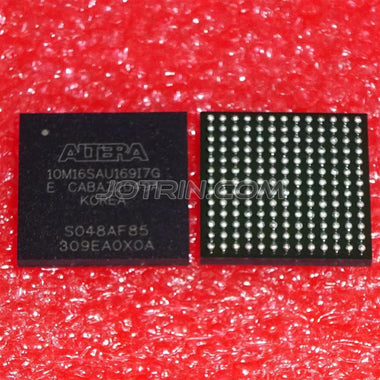
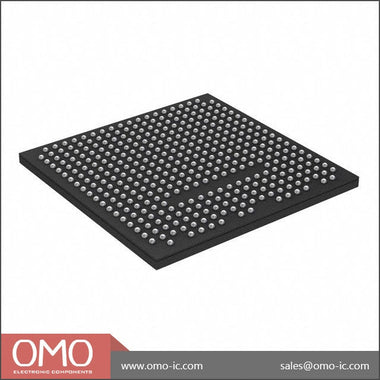
The XC7K325T-1FFG900C is offered in the FFG900 package, a 900-ball, 31x31 mm fine-pitch ball grid array (BGA) with a 1.00 mm ball pitch. This package provides a high I/O-to-logic ratio, but its density demands careful PCB design and fabrication. As a senior engineer, my first step in any design using this part is a thorough review of the pinout file and user guide (UG475 for 7-series packaging and pinouts).
The 900 pins are broadly categorized:
- Power and Ground Pins: A significant portion of the pins are dedicated to power and ground to ensure a stable Power Delivery Network (PDN). These include VCCINT (1.0V core logic), VCCAUX (1.8V auxiliary internal logic), VCCO (I/O banks, voltage is user-configurable from 1.2V to 3.3V), and dedicated supplies for the GTX transceivers like MGTAVCC and MGTAVTT. Proper decoupling with a mix of bulk and high-frequency ceramic capacitors at each pin is non-negotiable.
- User I/O Pins: The device provides up to 500 user I/O pins, organized into banks. Each bank has its own VCCO supply, allowing for interfacing with multiple logic standards simultaneously. Xilinx's SelectIO technology supports a wide range of single-ended (e.g., LVCMOS, HSTL) and differential (e.g., LVDS, TMDS) standards.
- High-Speed Serial Transceiver Pins (GTX): These are dedicated differential pairs (MGT[R/T]XP/N) for the 16 GTX transceivers. PCB layout for these traces requires strict impedance control (typically 100-ohm differential), length matching, and careful routing to avoid stubs and discontinuities.
- Configuration Pins: A dedicated set of pins controls the FPGA's boot-up process. These include the MODE pins (M[2:0]) to select the configuration mode (e.g., Master SPI, JTAG), PROG_B (program), DONE (configuration complete), and INIT_B (initialization status). These pins are critical for system bring-up and debug.
- JTAG Pins: The standard Test Access Port pins (TCK, TMS, TDI, TDO) are present for boundary-scan testing, programming via the Vivado Hardware Manager, and in-system debugging with tools like the ChipScope Pro / Vivado Logic Analyzer.
The FFG900 package requires a multi-layer PCB, typically 10 layers or more, to effectively route all signals and power planes, especially when utilizing the high-speed transceivers and wide memory interfaces.
Core Architectural Features
- Advanced 28nm Logic Fabric: Features 326,080 logic cells arranged in CLBs with 6-input LUTs and eight flip-flops per slice. This structure provides high logic density and flexibility, enabling the implementation of complex digital circuits with efficient resource utilization.
- High-Throughput DSP Slices: Integrates 840 DSP48E1 slices, each with a 25x18 multiplier, a 48-bit accumulator, and a pattern detector. This dedicated hardware is optimized for high-performance filtering, Fourier transforms, and other computationally intensive DSP tasks, offloading the general logic fabric.
- High-Speed Serial Connectivity: Equipped with 16 GTX transceivers supporting line rates up to 12.5 Gb/s. This enables native implementation of high-bandwidth protocols such as PCIe Gen1/Gen2, 10G Ethernet (XAUI/RXAUI), SRIO, and Aurora, crucial for modern communication and data processing systems.
- Flexible Memory Hierarchy: Provides a total of 16,740 Kb of Block RAM. These 36 Kb blocks can be configured as dual 18 Kb RAMs, simple dual-port RAM, or FIFO buffers. This is complemented by LUTs that can be configured as distributed RAM for smaller, faster memory access.
- Sophisticated Clock Management: Includes multiple Clock Management Tiles (CMTs), each featuring an MMCM and a PLL. These blocks offer precise clock synthesis, jitter reduction, frequency multiplication/division, and phase shifting, ensuring robust clocking for the entire system, from the core logic to high-speed I/O.
Specifications Parameter Table
| Specification | Technical Details |
|---|---|
| Logic Cells | 326,080 |
| Number of Slices | 50,950 |
| DSP Slices (DSP48E1) | 840 |
| Block RAM (36 Kb each) | 465 blocks (16,740 Kb total) |
| GTX Transceivers | 16 (up to 12.5 Gb/s) |
| Maximum User I/O | 500 |
| Core Voltage (VCCINT) | 1.0V (Nominal) |
| Package | FFG900 (31x31 mm, 1.0mm pitch) |
XC7K325T-1FFG900C Equivalents, Cross Reference & Lifecycle
The XC7K325T-1FFG900C is an active production device from AMD/Xilinx, but as with any component, long-term project planning should involve confirming lifecycle status directly with distributors. You can Check XC7K325T-1FFG900C Inventory & Pricing for current availability.
Finding a "drop-in" equivalent for an FPGA is practically impossible due to the complexity of internal routing, resource placement, and pin functions. However, there are migration paths and functional alternatives:
- Within the Kintex-7 Family: For designs that require more logic, DSP, or BRAM resources, the XC7K410T-1FFG900C is a potential migration path. It is offered in the same FFG900 package and provides a significant increase in resources. While many I/O pins are compatible, dedicated pins for resources like clocking and additional transceivers will differ. A thorough pin migration check using the Vivado tool is mandatory before considering this swap. Conversely, the XC7K160T in the FFG900 package offers a lower-cost option if the design's resource utilization is low.
- Competing Families: A functional alternative from a competing manufacturer would be a device from the Intel (formerly Altera) Arria V GX or Arria 10 GX series. These FPGAs offer a similar blend of logic, DSP, and transceiver performance. However, switching to a different manufacturer requires a complete design port, including code changes (VHDL/Verilog may be portable, but IP cores are not), a new synthesis and place-and-route flow with a different toolchain (Quartus Prime), and a complete hardware redesign of the PCB. This is a major engineering effort and not a simple cross-reference.
Typical Applications & Circuit Considerations
The XC7K325T's blend of features makes it a workhorse in numerous demanding fields. Its parallel processing capability is a natural fit for applications requiring real-time data manipulation.
Key Application Areas:
- Broadcast and Pro A/V: Used in video switchers, routers, and processing engines for real-time 4K video format conversion, color correction, and multi-viewer applications. The GTX transceivers are ideal for SDI interfaces.
- Aerospace & Defense: Deployed in software-defined radio (SDR), radar/sonar beamforming, and secure communication systems where the DSP slices can implement complex modulation/demodulation schemes.
- Medical Imaging: Powers the image reconstruction pipelines in ultrasound, CT, and MRI systems, where the high DSP and memory bandwidth are critical for processing vast amounts of sensor data.
- Wired and Wireless Communications: Serves as a core component in LTE/5G baseband units, network interface cards (NICs), and packet processing hardware, handling data plane functions at line rate.
- Test and Measurement: Forms the heart of high-speed oscilloscopes, logic analyzers, and protocol analyzers, capturing and analyzing data via its fast I/O and transceivers.
Critical Circuit Considerations for the Hardware Engineer:
Power Delivery Network (PDN): This is the most critical aspect of a successful Kintex-7 design. The core voltage (VCCINT) requires a very low-impedance supply to handle the high transient currents drawn by the logic fabric. A multi-phase switching regulator is often necessary. The datasheet specifies a strict power-on sequence (typically VCCINT, then VCCBRAM, then VCCAUX/VCCO) that must be followed to prevent damage to the device. Extensive use of high-quality ceramic decoupling capacitors (0.1uF, 0.01uF) placed directly under the BGA package is essential, along with bulk capacitance on each rail.
PCB Layout and Thermal Management: The 1.0mm pitch FFG900 package requires advanced PCB capabilities, including tight trace/space rules and potentially via-in-pad technology for proper BGA fanout. High-speed differential pairs for the GTX transceivers must be routed with controlled 100-ohm differential impedance, with intra-pair and inter-pair length matching. The XC7K325T can dissipate significant power, especially when the DSP slices and transceivers are heavily used. The package includes a thermal pad that should be connected to a large ground plane with an array of thermal vias. A heatsink, often with forced airflow, is typically required to keep the junction temperature within the commercial operating range (0°C to 85°C Tj). Failure to manage thermals will lead to performance throttling and potential long-term reliability issues. You can explore the full range of devices for these applications when you Browse Kintex-7 Series.
Video Demonstration
Frequently Asked Questions (XC7K325T-1FFG900C FAQ)
What does the part number XC7K325T-1FFG900C mean?
The part number is a code that describes the device's specifications. 'XC' indicates a commercial-grade Xilinx part. '7K' denotes the Kintex-7 family. '325T' specifies the device size and resources, with approximately 325K logic cells. The '-1' is the speed grade, where -1 is the slowest (and lowest power) commercial grade. 'FFG' describes the lead-free, flip-chip BGA package. '900' is the pin count. Finally, 'C' indicates the commercial temperature range (0°C to 85°C junction temperature).
What software is used to program the XC7K325T-1FFG900C?
The XC7K325T-1FFG900C and all other 7-series devices are programmed using the AMD-Xilinx Vivado Design Suite. This modern toolset supports the entire design flow, including HDL synthesis, simulation, implementation (place and route), static timing analysis, and bitstream generation. It is important to note that the older Xilinx ISE Design Suite does not support 7-series FPGAs, so migrating to Vivado is a requirement for using this part.
What is the difference between Kintex-7, Virtex-7, and Artix-7?
These three families make up the Xilinx 7-series portfolio, each targeting a different market segment. Artix-7 is optimized for the lowest cost and power consumption, ideal for small form-factor, power-sensitive applications. Virtex-7 represents the highest end, offering the maximum logic density, I/O count, and performance for the most demanding applications. The Kintex-7 family, including the XC7K325T, sits in the middle, providing the best price-to-performance ratio with substantial logic, DSP, and transceiver capabilities for mid- to high-range systems.
What are the power supply requirements for the XC7K325T-1FFG900C?
This FPGA requires multiple power rails for proper operation. The main supplies are VCCINT (1.0V for the core logic), VCCAUX (1.8V for auxiliary logic), and VCCO for the I/O banks, which can range from 1.2V to 3.3V depending on the I/O standard. Additionally, the GTX transceivers require their own dedicated supplies (MGTAVCC at 1.0V and MGTAVTT at 1.2V). It is critical to follow the power-on sequencing specified in the datasheet to avoid damaging the device.
Are there any pin-compatible upgrades for the XC7K325T-1FFG900C?
Yes, within the same FFG900 package, the XC7K410T offers a significant increase in logic cells, BRAM, and DSP slices. This provides a potential upgrade path for designs that become resource-constrained. However, while many general-purpose I/O pins are compatible, dedicated pins for additional resources like transceivers or clocking will not align. A detailed pin migration analysis using the Vivado tools is an essential step to verify compatibility for your specific design before committing to a board spin.