XC7K325T-1FFG900C Application Guide: From Datasheet to Working Circuit
When designing a high-performance data acquisition (DAQ) system for applications like medical imaging or advanced test and measurement, the central processing unit must handle immense parallel data streams with low latency. The Xilinx Kintex-7 XC7K325T-1FFG900C is purpose-built for this challenge. In such a system, it acts as the core, aggregating data from multiple high-speed Analog-to-Digital Converters (ADCs), performing real-time digital signal processing (DSP) like filtering and FFTs, and streaming the processed results over a high-bandwidth interface like PCI Express or 10 Gigabit Ethernet.

Table of Contents
Application Context: Where XC7K325T-1FFG900C Fits in the System
In a modern multi-channel DAQ system, the XC7K325T-1FFG900C serves as the digital processing heart. Imagine a block diagram for a high-frequency ultrasound imaging front-end. The system starts with an array of transducer elements, each feeding an analog front-end (AFE) and a high-speed ADC, perhaps sampling at over 100 MSPS with 12 or 14-bit resolution. The digital outputs from 8, 16, or even more ADCs are streamed into the FPGA.
This is where the XC7K325T-1FFG900C excels. Its 500 user I/O pins in the FFG900 package provide ample connectivity for multiple parallel LVDS interfaces from the ADCs. Inside the FPGA fabric, the incoming data streams are first deserialized using the built-in ISERDES primitives. This parallel data, now available within the FPGA, is routed to the DSP blocks. The XC7K325T contains a substantial number of DSP48E1 slices, which are critical for implementing the real-time processing required for beamforming, filtering, and decimation. These are not general-purpose logic but hardened, power-efficient blocks capable of high-speed multiply-accumulate (MAC) operations, forming the foundation of FIR filters, FFTs, and complex mathematical functions.
As data is processed, it needs to be buffered. The FPGA's distributed and block RAM (BRAM) resources are used for this. The 16,720 Kb of BRAM in the XC7K325T-1FFG900C is essential for creating FIFOs and circular buffers that manage the data flow between processing stages and prevent data loss. For more extensive data buffering, such as storing an entire image frame, the FPGA's fabric can implement a DDR3 memory controller to interface with external SDRAM chips, leveraging the high pin count for a wide memory bus.
Finally, the processed, valuable data must be sent to a host computer or storage system for analysis and display. The XC7K325T-1FFG900C integrates multiple high-speed serial transceivers (GTX). These can be configured to implement standard protocols like PCI Express (e.g., a Gen2 x8 link for direct connection to a host motherboard) or high-speed Ethernet (e.g., 10GbE for networked systems). This integrated capability eliminates the need for external PHY chips for these protocols, simplifying the board design and reducing the bill of materials (BOM). A MicroBlaze soft-core processor can also be instantiated within the FPGA fabric to manage overall system configuration, control, and communication with the host over the high-speed link.
Core Specifications for This Application
For our high-performance DAQ system application, the following specifications from the official Xilinx datasheets are paramount. These numbers dictate the system's capabilities in terms of channel count, processing power, and data throughput.
| Parameter | Value | Application Relevance |
|---|---|---|
| Logic Cells | 326,080 | Defines the capacity for control logic, data path routing, state machines, and implementing memory controllers or custom protocol logic. |
| DSP Slices (DSP48E1) | 840 | The core resource for real-time signal processing. Essential for implementing FIR filters, FFTs, and other mathematical operations on the incoming ADC data streams. |
| Total Block RAM | 16,720 Kb | Crucial for creating on-chip data buffers (FIFOs) between processing stages, preventing bottlenecks and enabling efficient data flow management. |
| GTX Transceivers | 8 | Enables high-bandwidth data offload to a host system. Can be configured for up to a PCI Express Gen2 x8 link or multiple 10GbE ports. |
| Max User I/O | 500 | Provides the physical connectivity required to interface with a large number of parallel ADCs, external DDR memory, configuration flash, and system management peripherals. |
| Speed Grade | -1 | Indicates a specific performance level for commercial temperature grade parts. This determines the maximum achievable clock frequencies for the fabric logic and internal blocks. |
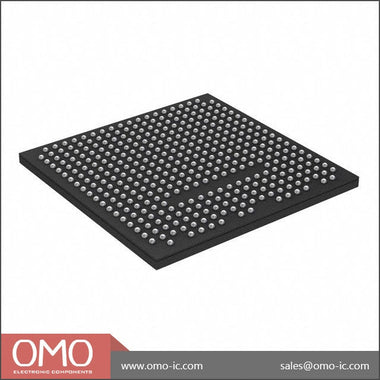
| Package | FFG900 | A 900-pin fine-pitch BGA package. The high pin count is necessary for the I/O capacity, but it also dictates stringent PCB layout and manufacturing requirements. |
Reference Circuit and Component Selection
Designing a stable and reliable board around the XC7K325T-1FFG900C requires meticulous attention to several key areas, particularly power delivery, clocking, and configuration. A simplified reference design is not just about connecting pins; it's about creating a robust ecosystem for the FPGA to operate within.
Power Delivery Network (PDN): The Kintex-7 family requires multiple voltage rails: VCCINT (core logic), VCCAUX (auxiliary logic), VCCO (I/O banks), and several rails for the GTX transceivers (VCCMGTAVCC, VCCMGTAVTT). A common mistake is underestimating the complexity of this. For a production design, use a dedicated power management IC (PMIC) or a set of high-efficiency switching regulators. For example, the VCCINT rail, which draws the most current, requires a multi-phase buck converter capable of a fast transient response. Each rail must be heavily decoupled. The design should feature a dense array of multi-value ceramic capacitors (e.g., 10nF, 100nF, 1µF, 10µF) placed on the backside of the PCB directly under the BGA footprint, with dedicated vias connecting them to the power and ground planes. The Xilinx Power Estimator (XPE) spreadsheet is an indispensable tool for calculating current requirements for each rail based on your specific design utilization.
Configuration and Booting: While JTAG is used for debugging, the production boot method is typically Master SPI mode using a Quad-SPI (QSPI) flash memory chip. The FPGA's MODE pins (M[2:0]) must be set correctly with pull-up/pull-down resistors to select this mode on power-up. A reliable QSPI flash device, such as a Micron MT25Q series chip, should be used to store the FPGA bitstream. Ensure the clock line (CCLK) to the flash is clean and properly routed. The total size of the bitstream for the XC7K325T can be significant, so select a flash device with sufficient capacity (e.g., 256Mb or 512Mb).
Clocking Strategy: The FPGA requires several high-quality clock sources. A primary system clock (e.g., 100MHz or 200MHz) is needed for the fabric logic. More importantly, the GTX transceivers require a very low-jitter reference clock (typically <1 ps RMS jitter) for reliable high-speed operation. Do not use a simple crystal oscillator for the GTX reference. Instead, use a dedicated clock generator IC like a Silicon Labs Si5338 or an IDT VersaClock part. This allows you to generate multiple, clean clock outputs from a single crystal reference, providing clocks for the GTX transceivers, the FPGA fabric, and potentially the external DDR3 memory controller.
External Memory: For buffering large data sets, an external DDR3/DDR3L memory interface is common. This is one of the most challenging aspects of the PCB layout. The data, address, and control lines must be routed with strict length-matching rules, both within byte lanes and across the entire interface. Impedance must be tightly controlled (e.g., 40-ohm single-ended, 80-ohm differential). The Xilinx Memory Interface Generator (MIG) tool within Vivado provides the controller IP and detailed guidance on layout. When selecting components, you can Browse Kintex-7 Series and their associated reference designs to find compatible memory chips and layout examples.
Design Pitfalls and How to Avoid Them
Many projects using powerful FPGAs like the XC7K325T stumble not on the digital logic design, but on the hardware implementation. Here are common pitfalls and how to steer clear of them.
| Common Mistake | Symptom | Fix |
|---|---|---|
| Improper Power-On Sequencing | Device fails to configure; potential for permanent damage due to latch-up conditions. JTAG chain may not be detected. | Strictly follow the power-on sequence specified in the Kintex-7 datasheet (DS182). Typically VCCINT, then VCCAUX, then VCCO. Use a power sequencer IC or a PMIC with programmable sequencing. |
| Inadequate Power Decoupling | Unstable operation, random logic errors, failing to meet timing closure, high bit error rate on serial links, especially under heavy load. | Use a Power Delivery Network (PDN) simulation tool. Follow Xilinx's PCB design guidelines (UG476) religiously. Place low-ESR decoupling capacitors as close as possible to the BGA balls for every power pin. |
| Noisy GTX Reference Clock | Serial links (PCIe, 10GbE) fail to train or have an unacceptably high bit error rate (BER). Eye diagrams look closed. | Use a dedicated low-jitter clock synthesizer. Power the clock chip from a clean, filtered analog supply. Route the differential clock pair with tight impedance control and shield it from noisy digital signals. |
| Incorrect Configuration Pin Strapping | FPGA does not boot from the intended configuration memory (e.g., SPI flash). It may fall back to a default mode like JTAG slave. | Triple-check the pull-up/pull-down resistors on all MODE pins and other configuration-related pins against the 7 Series FPGAs Configuration User Guide (UG470). These are often overlooked. |
| Ignoring Thermal Management | FPGA performance throttles; timing failures occur as temperature rises. In extreme cases, the device shuts down or is permanently damaged. | Use the Xilinx Power Estimator (XPE) early in the design phase. Plan for a heatsink and adequate airflow based on the estimated power dissipation. Do not treat thermal management as an afterthought. |
Avoiding these pitfalls comes down to a simple principle: treat the FPGA as a complex analog system, not just a digital component. The high-speed interfaces and massive current demands mean that principles of power integrity, signal integrity, and thermal engineering are just as important as the Verilog or VHDL code running inside. Reading the user guides and application notes provided by Xilinx is not optional; it is a critical part of the design process. A schematic review focused specifically on power, clocking, and configuration against these documents can save weeks of painful board debug.
Performance Optimization Tips
Once the basic circuit is functional, optimization focuses on reliability and extracting maximum performance. For the XC7K325T-1FFG900C, this involves a multi-faceted approach.
Thermal Management: This is arguably the most critical physical optimization. The power consumption of the XC7K325T, especially when using many DSP slices and GTX transceivers, can easily exceed 10-20W. The FFG900 package has a thermal pad, but this is insufficient on its own. A properly selected heatsink with thermal interface material (TIM) is mandatory for most performance-oriented applications. The choice of heatsink depends on the system's airflow (natural convection vs. forced air). Use the thermal data in the datasheet (Theta-JA, Theta-JC) along with your XPE power estimation to calculate the required thermal resistance of the heatsink. Ensure your PCB layout includes mounting holes for the heatsink and that there is sufficient clearance around the FPGA.
Signal Integrity (SI): For interfaces running above a few hundred MHz, such as DDR3 or LVDS from ADCs, SI is paramount. Use a PCB stack-up that allows for controlled impedance routing (e.g., microstrip or stripline). Ensure all high-speed signals have a continuous, uninterrupted ground reference plane beneath them to control return currents. For differential pairs, maintain tight coupling and length-match them to within tight tolerances (e.g., +/- 1mm). Run SI simulations using tools like HyperLynx or from within the EDA suite to verify signal quality (eye diagrams, crosstalk) before fabricating the PCB.
EMI Reduction: An FPGA board with multiple high-speed clocks and switching power supplies is a potent source of electromagnetic interference (EMI). To mitigate this and pass compliance testing (FCC, CE), follow best practices: use solid ground and power planes, ensure the PDN is low-impedance across a wide frequency range, use source-series termination on high-speed single-ended signals where appropriate, and consider adding shielding cans over particularly noisy sections like switching regulators.
Timing Closure in Vivado: In-system performance is also a function of the FPGA implementation. To help the tools meet your performance goals, follow good HDL coding practices, such as pipelining long combinatorial paths. Use the Vivado tools to their full potential: provide accurate clock constraints in your XDC file, use floorplanning to place related logic blocks physically close to each other, and analyze the timing reports to identify and fix critical paths.
Related Components and Accessories
A successful XC7K325T-1FFG900C design relies on a well-chosen set of supporting components. Here are some categories and examples of parts that pair well with this FPGA.
Power Management: For the multiple rails required, consider integrated PMICs designed for FPGAs or a suite of discrete regulators. Parts like the Texas Instruments TPS546C23 or Analog Devices' Power by Linear LTC388x series offer high efficiency, proper sequencing control, and monitoring capabilities via PMBus, which is invaluable for system health monitoring.
Clock Generation: To provide the low-jitter reference clocks for the GTX transceivers, look at clock synthesizers like the Silicon Labs Si534x/Si538x family or the Renesas (formerly IDT) 8T series. These devices can synthesize multiple frequency outputs from a single crystal, cleaning up jitter and providing the clocking tree for the entire board.
Configuration Memory: A reliable Quad-SPI NOR Flash is essential for booting. The Micron MT25Q series or the Winbond W25Q series are industry standards, offering the required density (256Mb or 512Mb is a safe choice) and performance for fast FPGA configuration.
External Memory: If your application requires large data buffers, a DDR3 or DDR3L SDRAM is necessary. Components from Micron (MT41K series) or Samsung are widely supported by the Xilinx Memory Interface Generator (MIG) tool, which simplifies the integration process. Always check the supported parts list for the MIG version you are using. Once your BOM is finalized, you can Check XC7K325T-1FFG900C Inventory & Pricing along with these complementary parts to plan your procurement.
Video Demonstration
Frequently Asked Questions (XC7K325T-1FFG900C FAQ)
What are the primary power supply considerations for the XC7K325T-1FFG900C?
The XC7K325T-1FFG900C requires a carefully designed Power Delivery Network (PDN) with multiple voltage rails. The key rails are VCCINT (core voltage), VCCAUX, VCCO for I/O banks, and specific rails for the MGT (GTX transceivers). It's critical to follow the power-on sequencing specified in the datasheet (DS182) to prevent device damage. Use a power sequencer or a PMIC, and perform a thorough power estimation using the Xilinx Power Estimator (XPE) to size your regulators and thermal solution correctly.
How do I choose between using the GTX transceivers for PCIe vs. 10Gb Ethernet in my design?
The choice depends entirely on your system architecture's data egress requirements. If the FPGA is on a card plugging into a host PC motherboard, PCI Express is the standard, providing low-latency, high-throughput access to the host's memory. The XC7K325T-1FFG900C can support up to a Gen2 x8 link. If the device is a standalone network appliance or needs to communicate with other equipment over a standard network, 10Gb Ethernet is the better choice. The Vivado design suite provides integrated IP cores for both protocols, but they consume different logic resources and have different clocking requirements.
What is the purpose of the DSP48E1 slices in the XC7K325T-1FFG900C and when should I use them?
The DSP48E1 slices are hardened, power-efficient blocks designed for digital signal processing tasks. Each slice contains a pre-adder, a 25x18 multiplier, and an accumulator. You should use them whenever your design requires arithmetic-intensive operations like filtering (FIR, IIR), Fourier transforms (FFT), or correlations. Implementing these functions in DSP slices is vastly more efficient in terms of speed, power, and area compared to using general-purpose FPGA logic (LUTs).
What are the best practices for configuring the XC7K325T-1FFG900C in a production environment?
For production, the most common and robust method is Master SPI mode. This involves connecting the FPGA to a Quad-SPI (QSPI) NOR flash chip that stores the configuration bitstream. Ensure the MODE pins are strapped correctly with external pull-up/down resistors to select this boot mode. Use a reliable, sufficiently large flash chip and include error detection mechanisms in your system, such as a watchdog timer managed by a MicroBlaze processor that can trigger a reconfiguration if the system hangs.
How can I estimate the power consumption and thermal requirements for my XC7K325T-1FFG900C design?
The official Xilinx Power Estimator (XPE) spreadsheet is the authoritative tool for this. You must input detailed information about your design, including resource utilization (number of LUTs, DSPs, BRAMs), clock frequencies, I/O standards, and toggle rates. The XPE provides a detailed breakdown of power consumption by rail and a total power estimate. This estimate is crucial for designing the power supply regulators and selecting an appropriate thermal solution (heatsink and airflow) to keep the device within its operating temperature limits.