XC7K325T-1FFG900C Application Guide: From Datasheet to Working Circuit
When designing a high-channel-count data acquisition (DAQ) system for applications like medical imaging or advanced physics experiments, the central processing unit must handle immense parallel data streams with low latency. The Xilinx XC7K325T-1FFG900C is an ideal candidate for this role, serving as the core of the signal processing engine. It bridges the gap between high-speed analog-to-digital converters (ADCs) and a host processing system, performing critical real-time tasks like digital filtering, decimation, and data packetization before the information is sent upstream for analysis.

Table of Contents
Application Context: Where XC7K325T-1FFG900C Fits in the System
In a modern multi-channel DAQ system, the XC7K325T-1FFG900C acts as the central hub for data aggregation and pre-processing. Imagine a system block diagram where multiple high-speed ADCs are sampling analog signals. These ADCs often use a JESD204B or similar high-speed serial interface to output data, which is a perfect match for the FPGA's capabilities. The XC7K325T-1FFG900C, with its 16 GTX transceivers, can directly interface with up to 16 of these serial lanes, or a smaller number of multi-lane ADCs.
Once the raw data enters the FPGA fabric via the GTX receivers, a carefully designed processing pipeline takes over. This pipeline, implemented in HDL, leverages the device's architectural resources. The first stage might involve data deserialization and lane alignment. Following this, the data streams are fed into a parallel array of digital filters, implemented using the 840 dedicated DSP48E1 slices. These slices are highly efficient for multiply-accumulate (MAC) operations, which are the foundation of FIR or IIR filters used for noise reduction and signal conditioning. The DSP slices can also be configured to perform Fast Fourier Transforms (FFTs) for frequency-domain analysis in real-time.
After filtering and processing, the data rate is often reduced (decimation), making it more manageable. The processed data is then temporarily stored in the FPGA's distributed or Block RAM (BRAM). The XC7K325T provides a substantial 16,020 Kb of BRAM, which is crucial for buffering data bursts and handling mismatches between the processing rate and the output interface bandwidth. From the BRAM, a memory controller state machine can format the data into packets, adding headers and timestamps. These packets are then written to a larger external DDR3 memory for deeper buffering, a task handled by the FPGA's integrated memory controller blocks. Finally, a PCI Express (PCIe) Gen2 x8 core, also implemented within the FPGA fabric, provides a high-bandwidth link to a host computer or single-board computer (SBC) for final storage, analysis, and visualization. The FFG900 package provides 500 user I/O pins, offering ample connectivity for control signals, status indicators, and other system peripherals beyond the primary data path.
Core Specifications for This Application
| Parameter | Value | Application Relevance |
|---|---|---|
| Logic Cells | 326,080 | Provides ample resources for implementing complex control logic, data path routing, PCIe core, and memory controllers. |
| DSP Slices (DSP48E1) | 840 | Critical for implementing high-throughput, parallel digital filters, FFTs, and other signal processing algorithms required by the DAQ system. |
| Block RAM (Total Kb) | 16,020 | Essential for creating deep FIFOs and data buffers to manage data flow between the high-speed input, processing pipeline, and slower output interfaces. |
| GTX Transceivers | 16 | Enables direct, high-bandwidth connection to multiple ADCs using serial interfaces like JESD204B, LVDS, or custom protocols. |
| GTX Line Rate (Max) | Up to 12.5 Gb/s | Supports the data rates of modern, high-resolution, high-speed ADCs, ensuring no data is lost at the acquisition front-end. |
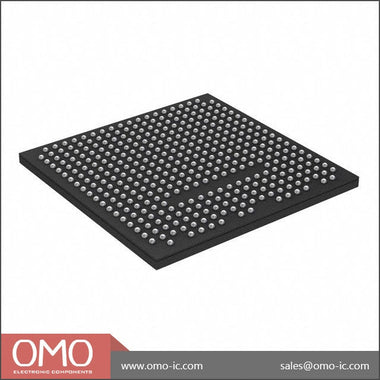
| Package | FFG900 | A 900-pin fine-pitch BGA that provides a high I/O count (500 user I/Os) and a good thermal path for heat dissipation. |
| Speed Grade | -1 (Commercial) | Represents the slowest commercial speed grade, offering the lowest cost point while still providing significant performance for many DAQ applications. |
| Core Voltage (VCCINT) | 1.0V (Nominal) | Defines the primary power rail requirement. Its low voltage helps manage power consumption, but requires a carefully designed power delivery network. |
Reference Circuit and Component Selection
Designing a stable and reliable board around the XC7K325T-1FFG900C requires meticulous attention to several key circuit blocks, primarily power, configuration, and clocking.
Power Delivery Network (PDN): The FPGA requires multiple voltage rails. The most critical is the 1.0V core voltage (VCCINT), which can draw significant current with high transients. A multi-phase switching regulator is recommended for VCCINT to provide a high-current, low-ripple supply with fast transient response. The 1.8V auxiliary rail (VCCAUX) and I/O rails (VCCO) can often be supplied by simpler single-phase buck converters. The GTX transceivers have their own sensitive analog rails, MGTAVCC (1.0V) and MGTAVTT (1.2V), which should be powered by low-noise LDOs or filtered switching regulators to ensure signal integrity. Decoupling is non-negotiable. A dense array of ceramic capacitors (e.g., 0.1µF, 1µF, 10µF) must be placed on the backside of the PCB directly under the BGA, following the recommendations in Xilinx's UG483 PCB Design Guide. Power sequencing is also critical; the VCCINT, VCCAUX, and VCCO rails must be powered up in the sequence specified in the datasheet to prevent damage.
Configuration and JTAG: For development and production, a combination of JTAG and a non-volatile configuration method is standard. A JTAG header should be included for debugging with a Xilinx Platform Cable USB. For standalone operation, a Master SPI configuration mode is common. This requires an external SPI flash memory device (e.g., a 256Mb or 512Mb device from Micron or Winbond) connected to the dedicated configuration pins. Pull-up/pull-down resistors on the MODE pins (M[2:0]) are required to select the SPI boot mode.
Clocking: The quality of the clock signals directly impacts system performance. For the GTX transceivers, a dedicated low-jitter differential oscillator (e.g., 125 MHz or 156.25 MHz) is required. This clock should be routed via a short, impedance-controlled differential pair to the dedicated MGTREFCLK pins. The FPGA fabric clock can be supplied by a separate, less stringent oscillator. The internal Mixed-Mode Clock Managers (MMCMs) and Phase-Locked Loops (PLLs) within the FPGA are then used to synthesize the various clock frequencies needed for the logic, memory controllers, and processing pipelines. When selecting components, it's wise to Browse Kintex-7 Series documentation to ensure compatibility and leverage reference designs.
Design Pitfalls and How to Avoid Them
| Common Mistake | Symptom | Fix |
|---|---|---|
| Inadequate Power Decoupling | FPGA fails to configure; logic errors appear under heavy processing load; system crashes randomly. | Strictly follow the Xilinx UG483 guide for capacitor quantity, values, and placement. Use a PDN simulation tool to verify impedance targets are met. |
| Incorrect GTX Trace Routing | High bit-error rate (BER) on serial links; JESD204B or PCIe link fails to train or is unstable. | Maintain 100-ohm differential impedance (or as specified). Keep traces short, length-match pairs, minimize vias, and use back-drilling on thick boards to remove stubs. |
| Ignoring Power Sequencing | FPGA is permanently damaged upon first power-up; excessive current draw on one rail. | Implement a power sequencer IC or use regulators with enable pins controlled by a CPLD/microcontroller to enforce the VCCINT -> VCCAUX -> VCCO sequence. |
| Missing or Incorrect I/O Constraints | Timing closure failures in Vivado; signal integrity issues like crosstalk and reflections on parallel buses (e.g., DDR3). | Create a comprehensive constraints file (.xdc) that specifies pin locations, I/O standards (e.g., LVCMOS18, HSTL), drive strengths, and slew rates for all used pins. |
Avoiding these pitfalls begins in the schematic capture phase. Double-check all power and configuration pin connections against the datasheet and reference designs. During layout, pay fanatical attention to the high-speed interfaces. The DDR3 interface is just as sensitive as the GTX links; trace lengths for data, address, and clock groups must be matched within tight tolerances. Use your CAD tool's constraint manager to enforce these rules. Finally, run all available design rule checks (DRCs) before sending the board for fabrication. A small mistake here can lead to a very expensive and time-consuming board re-spin.
Performance Optimization Tips
Extracting maximum performance from the XC7K325T-1FFG900C involves a holistic approach covering thermal, power, and signal integrity aspects.
Thermal Management: The power consumed by the FPGA, especially when the DSP slices and GTX transceivers are heavily utilized, is converted into heat. The FFG900 package has a thermal pad to conduct heat away from the die. A heatsink is almost always necessary. Use thermal simulation software early in the design process to estimate the junction temperature based on power estimates from the Vivado Report Power tool. Select a heatsink and fan combination that keeps the junction temperature well below the maximum specified in the datasheet (e.g., 85°C for commercial grade) with adequate margin. The choice of Thermal Interface Material (TIM) between the FPGA and heatsink is also critical for efficient heat transfer.
Power Optimization: While providing clean power is paramount, reducing consumption is equally important. Use the Vivado power analysis tools to identify high-power modules in your design. Employ fine-grained clock gating in your HDL code to automatically shut off clocks to modules that are idle. If parts of the logic are only used intermittently, consider using logic-level power gating, though this is a more advanced technique. Choosing the lowest possible VCCO voltage for I/O banks that supports your interfacing components can also yield significant power savings.
Signal Integrity for GTX Transceivers: The GTX transceivers include powerful equalization features to combat signal degradation over long traces or cables. The transmitter has configurable pre-emphasis and post-emphasis, while the receiver has a Decision Feedback Equalizer (DFE). While the auto-tuning features of the IP core work well, for challenging channels, you may need to manually tune these settings. Running channel simulations using IBIS-AMI models in a tool like HyperLynx or SiSoft QCD can help you find the optimal settings before hardware is even available.
Related Components and Accessories
A successful XC7K325T-1FFG900C design relies on a well-chosen ecosystem of supporting components. For power management, consider multi-rail PMICs from Analog Devices or Texas Instruments that are specifically designed to meet the sequencing and rail requirements of Xilinx 7-series FPGAs. For the DDR3 memory interface, a 64-bit wide interface using four 16-bit wide DDR3L chips is a common configuration, offering a good balance of bandwidth and layout complexity. Clock generation can be handled by versatile clock synthesizers like the Silicon Labs Si534x series, which can generate multiple low-jitter clock outputs from a single crystal reference. For configuration, a Quad-SPI flash memory from Winbond (W25Q series) or Micron (MT25Q series) in the 256Mb to 1Gb range is a standard choice. Finally, ensure you have a reliable source for the FPGA itself. You can Check XC7K325T-1FFG900C Inventory & Pricing to secure parts for your prototype and production runs.
Video Demonstration
Frequently Asked Questions (XC7K325T-1FFG900C FAQ)
What are the primary power rails for the XC7K325T-1FFG900C and what are their typical voltages?
The XC7K325T-1FFG900C requires several key power rails. The main core voltage is VCCINT at 1.0V, which powers the internal logic. The auxiliary voltage, VCCAUX, is 1.8V and powers internal resources like the clock management tiles. The I/O banks are powered by VCCO, which can range from 1.2V to 3.3V depending on the I/O standard used. Finally, the high-speed GTX transceivers require their own clean power: MGTAVCC at 1.0V and MGTAVTT at 1.2V.
How do I choose the right configuration memory for the XC7K325T?
The size of the required configuration memory depends on the size of the bitstream file generated by Vivado. The uncompressed bitstream for the XC7K325T is approximately 101 Mbits. Therefore, a 128Mb SPI flash is the absolute minimum, but it is highly recommended to use a 256Mb or 512Mb flash. This provides space for storing multiple bitstreams (for fallback or field updates) and other non-volatile data for your application.
What is the purpose of the 840 DSP slices in a data acquisition application?
The 840 DSP48E1 slices are dedicated hardware blocks optimized for arithmetic operations, primarily multiplication and addition. In a DAQ system, they are used to build highly parallel and power-efficient signal processing chains. Common uses include implementing FIR filters for noise removal, IIR filters for signal shaping, FFTs for spectral analysis, and correlators for pattern detection, all operating at line rate without consuming general-purpose logic fabric.
Can the GTX transceivers on the XC7K325T-1FFG900C interface directly with a 10G Ethernet SFP+ module?
Yes, absolutely. The GTX transceivers support line rates up to 12.5 Gb/s, which is more than sufficient for the 10.3125 Gb/s rate required for 10G Ethernet (10GBASE-R). You would instantiate a 10G/25G Ethernet Subsystem IP core from the Xilinx catalog in your Vivado project. This core handles the PCS/PMA layers of the Ethernet standard, and you would connect its serial I/O to the GTX transceiver pins, which are then routed to an SFP+ cage on your PCB.
What are the key PCB layout considerations for the DDR3 memory interface?
The DDR3 interface is a high-speed parallel bus that requires careful layout. The most critical rule is length matching: all data lines (DQ), data strobes (DQS), and mask lines (DM) within a byte group must be matched to within a very tight tolerance (e.g., +/- 5 mils). The address, command, and control lines should be matched as a group to the clock lines. Additionally, maintain controlled impedance for all traces (typically 40-50 ohms single-ended) and provide a solid, uninterrupted reference plane underneath the traces to ensure signal integrity.