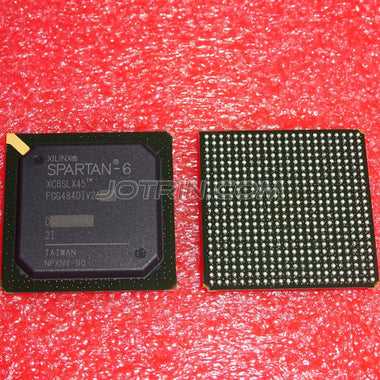
When designing a multi-camera industrial machine vision system, the processing hub must aggregate, synchronize, and analyze several high-bandwidth video streams in real-time. The Xilinx Artix-7 XC7A200T-2FBG484I is an excellent candidate for this central processing role. It offers a substantial amount of logic, dedicated DSP resources for image processing algorithms, and high-speed transceivers to interface with both modern camera sensors and downstream processing units or networks.
Table of Contents
Application Context: Where XC7A200T-2FBG484I Fits in the System
In our target application, a high-speed automated optical inspection (AOI) system for PCB manufacturing, the XC7A200T-2FBG484I acts as the central brain. The system employs four 5-megapixel machine vision cameras, each outputting data over a MIPI CSI-2 interface. The FPGA's role is to capture these four independent streams, perform real-time image processing, and then send the results to a host computer for final analysis and logging.
Here is a breakdown of the system's data flow and the FPGA's responsibilities:
- Data Ingest: The four camera modules connect directly to the FPGA's I/O banks. We use the Artix-7's high-performance SelectIO capabilities to implement four separate MIPI CSI-2 D-PHY receivers. The flexibility of FPGA I/O allows us to handle the differential signaling (LP and HS modes) and clock recovery required by the MIPI standard. The XC7A200T provides enough I/O pins in its 484-pin BGA package to accommodate all four cameras plus other system peripherals.
- Frame Buffering: As frames arrive from the cameras, they are written into an external DDR3 SDRAM module. The XC7A200T contains a hardened memory controller block, which simplifies the interface design. The FPGA logic manages four separate DMA (Direct Memory Access) engines, one for each camera, to write incoming pixel data into distinct regions of the DDR3 memory. This buffering is crucial for handling variations in data arrival and for giving the processing pipeline access to full frames.
-
Image Processing Pipeline: This is where the core value of the FPGA is realized. A custom pipeline, implemented in the FPGA's logic fabric, reads frames from the DDR3 buffer. The pipeline performs several tasks in parallel:
- Demosaicing: Converting the raw Bayer-pattern data from the sensors into full-color RGB images.
- Lens Distortion Correction: Applying a pre-calibrated warp to each image to correct for optical aberrations.
- Image Alignment: Using feature detection to precisely align the images from all four cameras to a common reference.
- Difference Imaging: Subtracting the aligned image from a "golden" reference image of a perfect PCB to highlight potential defects.
- Data Egress: After processing, the results (typically a list of defect coordinates and corresponding image snippets) need to be sent to a host PC. The XC7A200T-2FBG484I is equipped with 16 GTP transceivers capable of running at up to 6.6 Gb/s. We utilize four of these transceivers to implement a PCI Express Gen2 x4 endpoint. This provides a high-bandwidth, low-latency link to the host system, allowing for rapid transfer of results and enabling the host software to provide immediate feedback to the manufacturing line operator.
In this block diagram, the XC7A200T is not just a component; it is the system's architectural centerpiece, connecting the physical world (cameras) to the computational domain (processing pipeline) and the host interface (PCIe).
Core Specifications for This Application
The selection of the XC7A200T-2FBG484I is driven by specific datasheet parameters that map directly to the requirements of our multi-camera machine vision application. The '-2' speed grade and 'I' industrial temperature range ensure robust performance under demanding factory floor conditions.
| Parameter | Value | Application Relevance |
|---|---|---|
| Logic Cells | 215,360 | Provides ample resources for implementing the complex, parallel image processing pipeline, including demosaicing, distortion correction, and alignment logic. |
| DSP48E1 Slices | 740 | Crucial for accelerating the math-intensive parts of the vision algorithm, such as FIR filters, convolutions for feature detection, and geometric transformations. |
| Block RAM (Kb) | 13,140 | Used for on-chip data buffering, such as line buffers for 2D filters and FIFOs between pipeline stages, reducing reliance on external memory access. |
| GTP Transceivers | 16 (up to 6.6 Gb/s) | Enables high-bandwidth data egress. In this design, they are used to implement a PCIe Gen2 x4 link to the host PC for fast results transfer. |
| Total I/O | 285 | Sufficient I/O to connect four MIPI camera interfaces, a wide DDR3 memory bus, configuration flash, and other system-level control and status signals. |
| Memory Controller Block | Yes (MIG) | Includes a hardened block and associated wizard (Memory Interface Generator) that drastically simplifies the design and layout of the high-speed DDR3 interface. |
Reference Circuit and Component Selection
A successful FPGA design is as much about the surrounding circuit as it is about the HDL code. The XC7A200T-2FBG484I, being a high-performance device, requires careful attention to its support circuitry, particularly power, configuration, and clocking.
Power Delivery Network (PDN): The Artix-7 family requires several distinct voltage rails. A robust PDN is non-negotiable.
- VCCINT (1.0V): This is the core voltage for the FPGA logic. It has the highest current demand and fast transient requirements. A high-efficiency multi-phase switching regulator (buck converter) is mandatory. A part like the Texas Instruments TPS546C23 is a good choice, capable of delivering the necessary current with a fast transient response. Placement of decoupling capacitors (a mix of 10uF, 1uF, and 100nF) directly under the BGA package on the PCB's reverse side is critical.
- VCCAUX (1.8V): Powers auxiliary internal logic, including JTAG and configuration circuits. A smaller, 1A-2A buck converter is usually sufficient.
- VCCO (1.2V to 3.3V): Powers the I/O banks. The voltage is determined by the I/O standard you need to interface with. In our design, we have banks powered at 1.8V for the MIPI D-PHY interface and 1.5V for the DDR3 interface. Using separate regulators for each VCCO bank prevents noise from one interface coupling to another.
- Transceiver Power (MGTAVCC, MGTAVTT): The GTP transceivers have their own dedicated, noise-sensitive power rails (typically 1.0V and 1.2V). It is best practice to power these with low-noise LDOs, which are themselves fed from a clean, pre-regulated supply. This isolation is key to achieving low bit-error rates on the high-speed serial links.
Power sequencing is also critical. The Xilinx datasheets (DS181) specify the required power-on sequence (typically VCCINT, then VCCAUX, then VCCO). Modern PMICs (Power Management ICs) or sequencers can manage this automatically.
Configuration and Clocking:
- Configuration: For a production system, the Master SPI configuration mode is standard. A high-density QSPI NOR Flash (e.g., a 256Mb or 512Mb part from Micron or Winbond) is connected to the dedicated configuration pins. This flash stores the FPGA's bitstream, which is loaded automatically on power-up. The JTAG interface should always be brought out to a header for debugging, even if it's not the primary configuration method.
- Clocking: The FPGA requires a stable, low-jitter clock source. For our design, we need a system clock for the logic (e.g., 100MHz), a reference clock for the DDR3 PHY, and a reference clock for the PCIe GTP transceivers (100MHz). A programmable clock generator IC, such as a Silicon Labs Si5338, is an excellent choice. It can generate multiple, frequency-independent, low-jitter outputs from a single, inexpensive crystal, simplifying the BOM and PCB layout.
The entire Artix-7 family shares these fundamental design requirements, making the knowledge gained on one project easily transferable. To see other options within this powerful series, you can Browse Artix-7 Series for parts with different logic densities or package options.
Design Pitfalls and How to Avoid Them
Even experienced engineers can fall into common traps when designing with large FPGAs. Here are some issues specific to a device like the XC7A200T and how to prevent them.
| Common Mistake | Symptom | Fix |
|---|---|---|
| Inadequate Decoupling on VCCINT | System works at low clock speeds but becomes unstable or fails timing closure as utilization/frequency increases. Random reboots under heavy processing load. | Follow Xilinx's decoupling capacitor guidelines (Xilinx UG475) religiously. Use a PDN simulation tool (like HyperLynx) to verify impedance profiles. Place low-ESR ceramic caps as close to the BGA balls as physically possible, using multiple vias per capacitor pad. |
| Incorrect I/O Pin Planning | Timing closure failures for high-speed interfaces (like DDR3 or MIPI). Inability to route the design in Vivado. Excessive layer count on PCB. | Use the Vivado I/O Planning tool *before* starting PCB layout. Group related interface pins (e.g., all DDR3 data/address/control) in the same I/O bank. Pay attention to clock-capable (CC) pins for clock inputs and ensure high-speed interfaces are placed in banks adjacent to their required resources (e.g., MIG controller). |
| Ignoring Power Sequencing | FPGA fails to configure (DONE pin stays low). In extreme cases, permanent damage to the device due to latch-up. | Implement the manufacturer-specified power-on sequence (VCCINT -> VCCAUX -> VCCO). Use a dedicated power sequencer IC or a CPLD/microcontroller to control the enable pins of your voltage regulators. Verify the sequence and ramp times with an oscilloscope during board bring-up. |
| Poor GTP Transceiver Layout | High bit-error rate (BER) on PCIe or other serial links. Link training fails intermittently or not at all. | Route differential pairs with tightly controlled 100-ohm impedance. Keep pairs short, symmetrical, and on a single PCB layer where possible. Avoid sharp bends and minimize vias. Ensure a solid, unbroken reference ground plane beneath the traces. Place the reference clock source close to the MGTREFCLK pins. |
A recurring theme in these pitfalls is the underestimation of second-order effects in high-speed digital design. What works for a simple microcontroller will not work for a multi-gigabit FPGA. The key takeaway is to treat the PCB design as an integral part of the system, not an afterthought. Investing time in pre-layout simulation and careful planning using the tools provided by Xilinx (Vivado) and EDA vendors will save weeks of painful debugging during board bring-up. Always start a design by thoroughly reading the relevant user guides, especially the PCB Design Guide for the specific FPGA family.
Performance Optimization Tips
Once the basic circuit is functional, the focus shifts to optimizing for performance, thermal management, and reliability.
Thermal Management: The XC7A200T can dissipate significant power, especially when the DSP slices and GTP transceivers are heavily utilized.
- Estimation: Use the Vivado Power Estimator (VPE) spreadsheet early in the design cycle and the Vivado Power Analysis tools after implementation. This provides a realistic estimate of power consumption, which is essential for selecting a thermal solution.
- Heatsinking: For a design like our machine vision system, a heatsink is not optional; it's required. The FBG484 package has a heat slug on top. A heatsink should be attached using a high-quality thermal interface material (TIM). The size of the heatsink will depend on the power estimate and the system's ambient temperature and airflow.
- PCB Design: Use a generous number of thermal vias under the FPGA's central ground pad to conduct heat to the inner ground planes and the other side of the board. This allows the PCB itself to act as a heat spreader.
Signal Integrity and EMI:
- Impedance Control: Work with your PCB fabricator to ensure tight control over trace impedance, especially for the 50-ohm single-ended and 100-ohm differential pairs required by DDR3 and GTP interfaces. Incorrect impedance is a primary cause of signal reflections and failed links.
- Crosstalk Mitigation: Maintain adequate spacing between high-speed traces. Use ground planes to isolate different types of signals. Route sensitive analog signals (like those for the clock generator) away from high-speed digital buses.
- EMI Reduction: Ensure a continuous, low-impedance ground path for all return currents. Use a solid ground plane and avoid splits under high-speed traces. Add ferrite beads on power entry points to the board to filter out high-frequency noise. Proper I/O bank power supply filtering is also crucial.
Related Components and Accessories
A successful XC7A200T-2FBG484I implementation relies on a well-chosen ecosystem of supporting components. Here are some parts that are frequently used alongside this FPGA in demanding applications:
- DDR3L SDRAM: For frame buffering, a part like the Micron MT41K256M16TW-107 is a common choice. Its x16 data width matches well with the Artix-7's memory controller capabilities, and the 'L' variant (1.35V) helps reduce overall power consumption.
- QSPI Flash: For storing the bitstream, a device like the Winbond W25Q256JV is a reliable option. Its 256Mbit capacity is more than enough for the XC7A200T's bitstream, with room for a "golden" fallback image or other system data.
- Clock Generator: The Silicon Labs Si5338 is a versatile choice, capable of generating the multiple clock domains needed for the FPGA fabric, DDR3 interface, and GTP transceivers from a single crystal reference.
- Power Regulators: For the core rail, a multi-phase buck controller from Analog Devices (Power by Linear) or Texas Instruments provides the necessary current and transient response. For the sensitive analog rails, LDOs like the ADM7150 offer excellent noise performance.
Procuring all these components from a reliable source is critical to avoid counterfeit parts and ensure a smooth production run. Once your BOM is finalized, you can Check XC7A200T-2FBG484I Inventory & Pricing to secure the central component of your design.
Video Demonstration
Frequently Asked Questions (XC7A200T-2FBG484I FAQ)
How do I correctly power the XC7A200T-2FBG484I?
Powering this FPGA requires a multi-rail approach with careful sequencing. You will need separate supplies for the core logic (VCCINT at 1.0V), auxiliary logic (VCCAUX at 1.8V), I/O banks (VCCO, voltage varies), and transceiver rails (MGTAVCC, MGTAVTT). It is critical to use high-quality switching regulators for the high-current rails and low-noise LDOs for the sensitive transceiver supplies. Always follow the power-on sequence specified in the datasheet (DS181) to prevent device damage.
What is the best way to configure this FPGA in a production system?
For production, the most common and reliable method is Master SPI configuration. This involves connecting a QSPI NOR Flash memory chip to the FPGA's dedicated configuration pins. On power-up, the FPGA automatically reads its configuration data (the bitstream) from the flash. While JTAG is essential for development and debugging, it is not practical for configuration in a final product that needs to boot automatically.
Can the XC7A200T-2FBG484I handle 4K video processing?
Yes, but with careful design. A 4K (3840x2160) stream at 30 fps requires a pixel clock of around 250 MHz and a data rate of about 6 Gbps. The XC7A200T's GTP transceivers can handle this data rate for ingest (e.g., from a 6G-SDI or DisplayPort source). However, processing a full 4K frame in real-time will heavily tax the device's 215k logic cells and 740 DSP slices. It is suitable for tasks like color space conversion or simple filtering, but more complex algorithms like full-frame 4K encoding might require a larger device or a more optimized, line-based processing approach.
What are the key layout considerations for the DDR3 interface?
The DDR3 interface is a high-speed, source-synchronous parallel bus that demands a meticulous layout. The most critical rules are impedance control and length matching. All data (DQ), strobe (DQS), and address/control traces must be routed with controlled impedance (e.g., 40-50 ohms single-ended, specified by the MIG tool). Within each byte group, the DQ and DQS traces must be length-matched to within a few millimeters. The clock traces must also be carefully routed and matched to the address/control group. Using the pinouts and layout guidelines generated by the Xilinx Memory Interface Generator (MIG) is strongly recommended.
How do I estimate power consumption and select a heatsink?
Xilinx provides the Vivado Power Estimator (VPE), an Excel-based tool, for early power estimation. You input your design's resource usage (logic, DSPs, BRAM), clock frequencies, and toggle rates to get a rough power budget. After you have a synthesized or implemented design in Vivado, you can use the more accurate "Report Power" tool. Based on this power dissipation number and your system's ambient temperature and airflow, you can calculate the required thermal resistance (C/W) for a heatsink to keep the FPGA's junction temperature below its maximum rating (100°C for industrial grade).