XC6SLX45-2FGG484I Datasheet, Pinout, Equivalents, and Specs
The XC6SLX45-2FGG484I is a Field-Programmable Gate Array (FPGA) from the Xilinx Spartan-6 family, engineered for low-cost, high-volume applications requiring a balance of logic, memory, and digital signal processing (DSP) capabilities. Built on a mature 45nm low-power copper process, this device integrates a substantial number of logic cells, block RAM, and dedicated DSP slices. Its industrial temperature grading and versatile I/O make it suitable for robust systems in industrial control, automotive electronics, and communication infrastructure.
Table of Contents
What is the XC6SLX45-2FGG484I?
The XC6SLX45-2FGG484I is a specific member of the Xilinx Spartan-6 LX series, which is optimized for logic-intensive designs. The part number decodes as follows: XC6S (Spartan-6 Family), LX45 (Logic-Optimized, size 45), -2 (Speed Grade), FGG484 (Package Type), and I (Industrial Temperature Range). This FPGA provides a fabric of reconfigurable logic blocks, enabling engineers to implement custom digital circuits tailored to their specific application needs. It is not a microprocessor with a fixed instruction set; rather, its hardware functionality is defined by a configuration bitstream loaded at power-up, typically from an external non-volatile memory like a SPI flash PROM.
The internal architecture is built around Configurable Logic Blocks (CLBs). Each CLB in the Spartan-6 family contains two slices, and each slice is equipped with four 6-input Look-Up Tables (LUTs), eight flip-flops/latches, and dedicated arithmetic carry logic. The XC6SLX45 contains 6,822 slices, translating to 43,661 equivalent logic cells. The use of 6-input LUTs is a significant feature, as it allows for the implementation of more complex combinatorial logic functions per resource compared to older 4-input LUT architectures, leading to higher logic density and improved performance.
Beyond general-purpose logic, the device integrates specialized hardware blocks to efficiently handle common tasks. It includes 2,088 Kbits of distributed Block RAM, organized as 58 blocks of 36 Kbits each. These are true dual-port memories that can be configured in various width and depth combinations, serving as FIFOs, data buffers, or processor memory. For computationally intensive tasks, the XC6SLX45 incorporates 58 dedicated DSP48A1 slices. Each DSP slice contains a high-speed 18x18 multiplier, a pre-adder, and a 48-bit accumulator, ideal for implementing digital filters, Fast Fourier Transforms (FFTs), and other signal processing algorithms without consuming valuable logic fabric. Clocking is managed by four Clock Management Tiles (CMTs), each containing a Digital Clock Manager (DCM) and a Phase-Locked Loop (PLL) for precise clock synthesis, jitter reduction, and skew control.

Pinout Configuration and Packaging
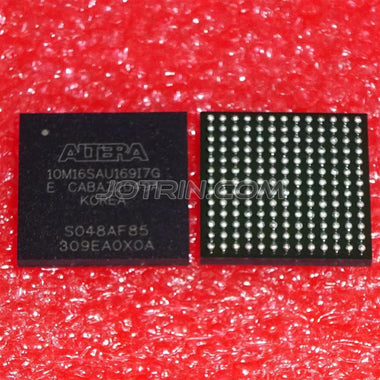
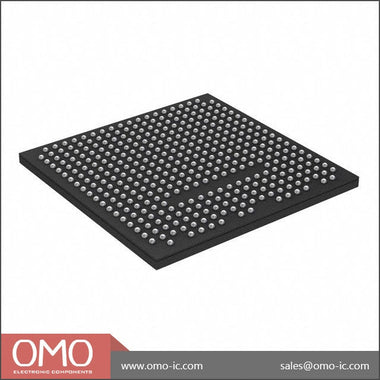
The XC6SLX45-2FGG484I is supplied in an FGG484 package, which is a 484-pin Fine-Pitch Ball Grid Array (BGA) with a 23x23 grid and a 1.0mm ball pitch. This package provides a high pin count in a relatively small footprint, suitable for space-constrained PCB designs. The 484 balls are categorized into several functional groups critical for system integration.
The majority of pins are designated as User I/O, with up to 358 available in this package. These I/Os are organized into banks, and each bank's output voltage (VCCO) can be set independently, allowing the FPGA to interface directly with multiple logic standards (e.g., 3.3V LVCMOS, 2.5V LVCMOS, 1.8V HSTL) simultaneously. The I/O blocks support a wide range of single-ended and differential signaling standards, such as LVDS, for high-speed data transfer.
Power delivery is critical and is managed through dedicated power and ground pins. These include VCCINT for the internal core logic (nominally 1.2V), VCCAUX for auxiliary internal logic like JTAG and configuration circuits, and multiple VCCO pins for the I/O banks. A robust distribution of GND pins is provided to ensure a low-inductance return path for signals and power, which is essential for maintaining signal integrity and stable operation.
Configuration pins are used to load the functional bitstream into the FPGA. This includes the JTAG interface pins (TDI, TDO, TCK, TMS) for debugging and programming, mode pins (M0, M1, M2) to select the configuration source (e.g., Master SPI, Slave Serial), and status pins like DONE and INIT_B. Finally, dedicated clock input pins (GCLK) are connected to the global clock network to distribute high-fanout, low-skew clock signals throughout the device.
Core Architectural Features
- Advanced Logic Fabric: The architecture is based on 6-input Look-Up Tables (LUTs) with dual outputs, providing a significant advantage in logic density and performance over previous generations. This allows for more complex combinatorial functions to be implemented within a single logic element, reducing logic levels and improving timing paths.
- Integrated Block RAM and Memory Controllers: Features 2,088 Kbits of true dual-port Block RAM, configurable in 36 Kbit blocks. Additionally, the device includes hardened Multi-port Memory Controllers (MPMC) that support DDR, DDR2, DDR3, and LPDDR memory interfaces, offloading the complex task of memory control from the logic fabric and guaranteeing performance.
- High-Performance DSP48A1 Slices: Contains 58 dedicated DSP slices, each featuring a high-speed 18x18 multiplier, a 48-bit accumulator, and a pre-adder. These blocks are optimized for implementing high-throughput arithmetic operations essential for digital signal processing, communications, and video processing applications.
- Flexible Clock Management Tiles (CMTs): Includes four CMTs, each with a Digital Clock Manager (DCM) and a Phase-Locked Loop (PLL). These provide sophisticated clocking capabilities, including frequency synthesis, clock de-skew, jitter filtering, and phase shifting, which are fundamental for designing reliable, high-speed synchronous systems.
- SelectIO Technology with Power-On Reset: The I/O blocks support over 30 different single-ended and differential standards with individually programmable slew rates and drive strengths. The device also features a robust power-on-reset (POR) circuit that ensures the FPGA and its I/Os are in a known, safe state during power-up, simplifying system-level initialization.
Specifications Parameter Table
| Specification | Technical Details |
|---|---|
| Part Number | XC6SLX45-2FGG484I |
| FPGA Family | Spartan-6 LX |
| Logic Cells | 43,661 |
| Number of Slices | 6,822 |
| Total Block RAM | 2,088 Kbits (58 blocks of 36Kb) |
| DSP48A1 Slices | 58 |
| Maximum User I/O | 358 |
| Package / Case | 484-FBGA (Fine-Pitch Ball Grid Array), 23x23 |
| Core Voltage (VCCINT) | 1.14V to 1.26V (1.2V Nominal) |
| Operating Temperature Range | -40°C to 100°C (Junction Temperature) |
| Speed Grade | -2 |
XC6SLX45-2FGG484I Equivalents, Cross Reference & Lifecycle
The Spartan-6 family is considered a mature product line. While still in active production and suitable for existing designs or applications with long lifecycle requirements, it is not recommended for new designs, for which Xilinx (now AMD) promotes its 7-series (Artix-7, Kintex-7) or newer families. However, due to its widespread adoption, the XC6SLX45 remains a relevant component.
Direct, drop-in equivalents from other manufacturers do not exist due to the proprietary nature of FPGA architectures and configuration bitstreams. However, pin-compatible alternatives exist within the same Xilinx family:
- XC6SLX45-3FGG484I: This is a pin-compatible part in the same package and temperature grade but with a faster (-3) speed grade. It can be used as a replacement for the -2 grade part, as it meets or exceeds all timing specifications, but may come at a different price point.
- XC6SLX45-2FGG484C: This is the commercial temperature grade (0°C to 85°C) version. It is pin-compatible and functionally identical but is only qualified for a narrower operating temperature range. It is not a suitable replacement in applications that require the full industrial range.
When considering alternatives, it is critical to verify the speed and temperature grade requirements of the specific application. For availability and sourcing of this specific part, you can Check XC6SLX45-2FGG484I Inventory & Pricing.
Typical Applications & Circuit Considerations
The XC6SLX45-2FGG484I's combination of logic density, DSP capability, and robust I/O makes it highly suitable for a variety of embedded systems. Its industrial temperature rating further extends its use into harsh environments.
Common Applications:
- Industrial Automation: Used as the core of Programmable Logic Controllers (PLCs), for high-speed motor control algorithms (leveraging DSP slices for field-oriented control), and in machine vision systems for real-time image pre-processing and filtering.
- Automotive Systems: Deployed in infotainment head units for graphics acceleration and display control, in Advanced Driver-Assistance Systems (ADAS) for sensor data aggregation and fusion, and as gateways for bridging different in-vehicle networks like CAN, LIN, and Ethernet.
- Video and Broadcast: Implements custom video pipelines for format conversion, scaling, deinterlacing, and overlaying graphics. The abundant Block RAM is ideal for video frame buffering.
- Communications and Networking: Used for custom protocol implementation, packet inspection and filtering in small-cell base stations, and as a flexible logic interface in wired communication equipment.
Circuit Design Considerations:
Proper implementation of the XC6SLX45 requires careful attention to PCB design. The Power Distribution Network (PDN) is paramount. The core voltage (VCCINT) and auxiliary voltage (VCCAUX) require a stable, low-noise supply. Each VCCO bank must also be properly powered. A multi-layer PCB with dedicated power and ground planes is standard practice. High-frequency decoupling capacitors (typically 0.1µF and 0.01µF ceramic capacitors) must be placed as close as possible to every power pin of the BGA package to supply transient current demands and minimize voltage droop.
For configuration, an external non-volatile memory, such as a SPI flash chip, is required to store the FPGA's bitstream. The connections between the FPGA's configuration pins and the flash memory should be short and direct. Signal integrity is another key concern, especially for high-speed interfaces like DDR memory or LVDS links. These require controlled-impedance traces on the PCB, and trace lengths should be matched for differential pairs and parallel buses to avoid timing skew. The entire Browse Spartan-6 Series offers a range of devices, but these design principles apply universally.
Video Demonstration
Frequently Asked Questions (XC6SLX45-2FGG484I FAQ)
Q: What is the difference between the 'LX' and 'LXT' variants in the Spartan-6 family?
A: The primary difference lies in their high-speed connectivity features. The 'LX' variants, like the XC6SLX45, are logic-optimized and do not contain high-speed serial transceivers. The 'LXT' variants, on the other hand, integrate one or more GTP (GigaBit Transceiver) blocks, which are dedicated hardware for implementing serial protocols like PCI Express, Serial ATA, and Gigabit Ethernet. Therefore, if your design requires multi-gigabit serial I/O, an LXT part would be necessary; for general-purpose logic, DSP, and parallel I/O, the LX series is the appropriate choice.
Q: What development tools are required to program the XC6SLX45-2FGG484I?
A: The Spartan-6 family is supported by the Xilinx ISE Design Suite, specifically version 14.7, which is the final release for this architecture. It is important to note that Spartan-6 devices are not supported by the newer Vivado Design Suite. The development flow involves writing hardware description code in VHDL or Verilog, followed by synthesis, implementation (place and route), and bitstream generation within ISE. The generated bitstream is then programmed onto the device using a JTAG programmer, such as the Xilinx Platform Cable USB II.
Q: How is the '-2' speed grade defined for this device?
A: The speed grade is a relative measure of the device's performance, indicating the maximum operational frequencies and minimum timing delays. For Spartan-6, a higher number indicates a faster part, with '-3' being the fastest and '-2' being the standard grade. The speed grade directly impacts parameters like the maximum clock frequency for the DSP slices, the toggle rate of I/O pins, and the propagation delay through the logic fabric. Engineers must select a speed grade that meets the timing requirements of their design, which is determined through static timing analysis in the ISE software.
Q: Can the I/O banks on the XC6SLX45 be powered at different voltages?
A: Yes, this is a key feature of the SelectIO technology. The FGG484 package partitions the user I/O pins into several distinct banks. Each bank has its own power supply pin (VCCO), which can be powered independently at different voltages (e.g., 1.8V, 2.5V, or 3.3V). This allows the FPGA to create a seamless interface between multiple components in a system that operate on different logic voltage standards, eliminating the need for external voltage-level translator ICs and simplifying board design.
Q: What is the primary function of the DSP48A1 slices in this FPGA?
A: The DSP48A1 slices are hardened, dedicated hardware blocks designed for high-performance digital signal processing. Their primary function is to execute multiply-accumulate (MAC) operations with high speed and efficiency. Implementing these functions in dedicated hardware is significantly faster and more power-efficient than using the general-purpose logic fabric (LUTs). This makes them indispensable for applications involving filtering (FIR, IIR), transformations (FFT), and other complex arithmetic common in communications, audio, and video processing systems.

Alan Carter
Senior Hardware Engineer & Component Specialist
Alan has over 15 years of expertise in embedded systems design, FPGA architecture, and global semiconductor supply chains. He specializes in component cross-referencing, lifecycle management, and helping OEMs navigate supply shortages.