LFE5U-25F-8BG381C Datasheet, Pinout, Equivalents, and Specs
The LFE5U-25F-8BG381C is a Field-Programmable Gate Array (FPGA) from Lattice Semiconductor's ECP5 family, designed to provide a low-power, high-functionality solution for a variety of connectivity and acceleration tasks. This specific component features 24K Logic Elements (LEs), integrated SERDES channels for high-speed serial communication, and a flexible I/O architecture within a 381-ball BGA package. It is optimized for applications requiring high-bandwidth interfaces like Gigabit Ethernet, PCI Express, and high-resolution video in a compact and cost-effective form factor.
Table of Contents
What is the LFE5U-25F-8BG381C?
The LFE5U-25F-8BG381C is a member of the ECP5 family of FPGAs, specifically engineered to address the needs of high-volume, cost-sensitive markets that require significant I/O bandwidth and signal processing capabilities. The part number itself provides a detailed summary of its configuration: LFE5 denotes the Lattice ECP5 family; U indicates the presence of high-speed SERDES transceivers; 25 specifies a logic density of approximately 25K (24K actual) Logic Elements; F represents the standard power consumption profile; 8 is the fastest speed grade available for this family; BG381 refers to the 381-ball Fine Pitch BGA package; and C indicates a commercial operating temperature range (0°C to 85°C junction temperature).
The core architecture is built upon a fabric of Programmable Function Units (PFUs), which contain the fundamental building blocks of the FPGA: four-input Look-Up Tables (LUT4s) and registers. These PFUs are arranged in a two-dimensional array, interconnected by a hierarchical routing network. This structure allows for the implementation of complex combinatorial and sequential logic. The LFE5U-25F-8BG381C contains 24,000 LUTs and an equal number of registers, providing a substantial logic resource for digital designs.
Beyond the general-purpose logic fabric, this device integrates specialized hardware blocks to accelerate common functions and improve efficiency. It includes 56 Digital Signal Processing (DSP) slices, each capable of performing operations like multiplication, accumulation, and arithmetic functions. These are critical for applications involving filtering, FFTs, and other signal processing algorithms, offloading these tasks from the LUT fabric for higher performance and lower power consumption. For on-chip data storage, the device provides 1,008 Kbits of Embedded Block RAM (EBR), which can be configured in various widths and depths to serve as FIFOs, caches, or processor memory. Additionally, the architecture supports distributed RAM implementation using the LUTs themselves for smaller, localized memory requirements. The key differentiator for the 'U' variant is the inclusion of four SERDES channels, each capable of data rates up to 3.2 Gbps, enabling direct implementation of serial protocols like PCI Express (Gen 1), Gigabit Ethernet (SGMII), and CPRI.

Pinout Configuration and Packaging
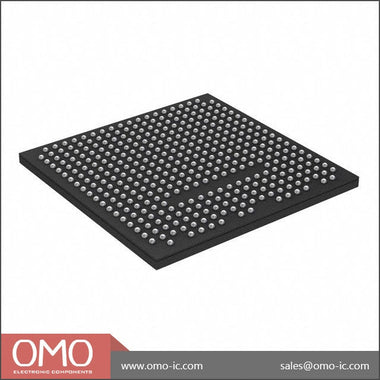
The LFE5U-25F-8BG381C is supplied in a 381-ball Fine Pitch Ball Grid Array (fpBGA) package, designated as BG381. This package features a 19x19 ball grid with a 1.0 mm ball pitch, providing a balance between high I/O density and manufacturability on standard PCB fabrication processes. The physical dimensions are 19 mm x 19 mm. This package is critical for routing the high number of I/O signals and maintaining signal integrity for high-speed interfaces.
The pinout is organized into multiple I/O banks, each with its own independent power supply pin (VCCIO). This allows different banks to interface with external components operating at different voltage levels (e.g., 1.8V, 2.5V, 3.3V LVCMOS). The device features up to 197 user I/Os, which are highly configurable through Lattice's sysIO technology to support a wide range of single-ended and differential signaling standards like LVCMOS, LVTTL, LVDS, and subLVDS.
Key pin categories include:
- User I/O Pins: General-purpose inputs and outputs organized into banks.
- Power and Ground Pins (VCC, VCCAUX, VCCIO, GND): A significant number of balls are dedicated to power and ground to ensure a stable Power Distribution Network (PDN) and minimize noise. Proper decoupling for each power rail is essential.
- SERDES Pins: Dedicated differential pairs for high-speed serial transmit (TX) and receive (RX) channels. These require careful impedance-controlled routing on the PCB.
- Dedicated Clock Inputs (PCLK): High-performance inputs designed to receive system clocks with minimal jitter.
- Configuration Pins: Pins for programming the FPGA's configuration memory. This includes the JTAG interface (TCK, TMS, TDI, TDO) for debugging and programming, as well as pins for master/slave SPI configuration from an external flash memory.
- Special Function Pins: Pins like PROGRAMN (to initiate reconfiguration) and DONE (to indicate successful configuration).
Designers must consult the official Lattice pinout file for the BG381 package to ensure correct connections for power, configuration, and high-speed interfaces during schematic capture and PCB layout.
Core Architectural Features
- High-Speed SERDES Transceivers: The device integrates four SERDES channels, each supporting data rates up to 3.2 Gbps. These transceivers include built-in Physical Coding Sublayer (PCS) and Physical Medium Attachment (PMA) blocks, enabling native implementation of protocols such as PCI Express Gen 1.1, SGMII/GbE, XAUI, CPRI, and JESD204B without external PHY components.
- Enhanced DSP Slices: It contains 56 DSP slices, which are hardened IP blocks optimized for high-performance signal processing. Each slice can be configured as a multiplier (18x18), multiply-accumulator (MAC), or arithmetic logic unit (ALU), significantly accelerating algorithms used in wireless communication, machine vision, and audio/video processing.
- Flexible sysIO™ Technology: The programmable I/O supports a wide array of interface standards, including LVCMOS (3.3/2.5/1.8/1.5/1.2V), LVTTL, LVDS, subLVDS, and LVPECL. Each I/O buffer is configurable for drive strength, slew rate, and pull-up/pull-down resistors, providing the flexibility to interface with a diverse range of external devices.
- Distributed and Embedded Memory: The architecture includes 1,008 Kbits of Embedded Block RAM (EBR) that can be configured as single-port, dual-port, or FIFO memory. In addition to EBR, the LUTs within the logic fabric can be configured as small, fast distributed RAM, providing granular memory resources close to the logic that needs them.
- Advanced Clocking Resources: The device features multiple Phase-Locked Loops (PLLs) and Delay-Locked Loops (DLLs) for robust clock management. These resources provide capabilities for clock synthesis, frequency multiplication/division, phase shifting, and de-skewing, which are essential for managing complex timing domains within a system-on-chip design.
Specifications Parameter Table
| Specification | Technical Details |
|---|---|
| Logic Elements (LEs) / LUTs | 24K / 24,000 |
| DSP Slices (18x18 Multipliers) | 56 |
| Embedded Block RAM (EBR) | 1,008 Kbits |
| SERDES Channels | 4 channels @ up to 3.2 Gbps |
| Maximum User I/O | 197 |
| Core Voltage (VCC) | 1.2V |
| Package | 381-ball Fine Pitch BGA (19x19mm, 1.0mm pitch) |
| Operating Temperature Range (Junction) | Commercial Grade: 0°C to 85°C |
LFE5U-25F-8BG381C Equivalents, Cross Reference & Lifecycle
The LFE5U-25F-8BG381C is currently in an active production lifecycle status. When considering equivalents or alternatives, engineers should evaluate other devices within the Lattice ECP5 family that share the same BG381 package. This approach allows for design scalability without requiring a complete PCB redesign.
Directly compatible alternatives include:
- Logic Density Variants: For designs requiring fewer logic resources, the LFE5U-12F-8BG381C (12K LEs) is a pin-compatible option. For more complex designs, the LFE5U-45F-8BG381C (44K LEs) offers nearly double the logic, DSP, and memory resources in the same footprint.
- Speed Grade Variants: The '-8' in the part number indicates the fastest speed grade. If timing constraints are less critical, a lower-cost, slower speed grade like the LFE5U-25F-7BG381C or LFE5U-25F-6BG381C could be used, provided timing analysis confirms design closure.
- Temperature Grade Variants: For applications in harsher environments, the industrial grade equivalent, LFE5U-25F-8BG381I, offers an extended junction temperature range of -40°C to 100°C.
It is critical to verify pin-for-pin compatibility using the official Lattice documentation, as some dedicated function pins may differ between density variants. When migrating a design, a full timing and resource utilization analysis must be performed in the Lattice Diamond software environment. For procurement and long-term availability planning, it is advisable to Check LFE5U-25F-8BG381C Inventory & Pricing to assess current market stock and lead times.
Typical Applications & Circuit Considerations
The LFE5U-25F-8BG381C is engineered for applications that bridge connectivity standards, aggregate data streams, or perform low-latency signal processing. Its combination of SERDES, DSP blocks, and flexible logic makes it suitable for a wide range of system-level functions.
Common applications include:
- Video and Display Interfacing: Acting as a bridge between different video standards, such as converting MIPI CSI-2 from an image sensor to LVDS for a display panel, or driving multiple displays from a single video source. The DSP slices can be used for real-time image processing tasks like color space conversion or scaling.
- Industrial Automation and Control: Implementing industrial Ethernet protocols like EtherCAT or PROFINET, performing motor control algorithms using the DSP slices for high-speed PWM generation, and aggregating data from multiple sensors.
- Communications Infrastructure: Used in small cell base stations, remote radio heads, and wireless backhaul equipment for control plane processing, data path management, and implementing CPRI interfaces.
- Machine Vision Systems: Interfacing with high-speed industrial cameras and performing pre-processing on the image data stream before it is sent to a host processor. The SERDES can be used for Camera Link or CoaXPress interfaces.
From a circuit design perspective, several considerations are critical for successful implementation. The Power Distribution Network (PDN) is paramount. The core voltage (VCC), auxiliary voltage (VCCAUX), and I/O voltages (VCCIO) must be supplied by low-noise power sources. A robust decoupling strategy is required, with a combination of bulk capacitors (e.g., 10-100µF) near the voltage regulators and high-frequency ceramic capacitors (e.g., 0.1µF, 0.01µF) placed as close as possible to the FPGA's power and ground balls. For the high-speed SERDES channels, controlled-impedance differential routing (typically 100 ohms) is mandatory. PCB stack-up design should ensure a solid reference ground plane beneath these traces to minimize crosstalk and maintain signal integrity. Finally, thermal management should be considered; while the device is low-power, high-utilization designs may require a heatsink or airflow to keep the junction temperature within the specified commercial range. For projects requiring different logic densities or SERDES configurations, engineers can Browse ECP5 Series to find the optimal component for their specific requirements.
Video Demonstration
Frequently Asked Questions (LFE5U-25F-8BG381C FAQ)
Q: What configuration modes are supported by the LFE5U-25F-8BG381C?
A: The device supports several configuration modes to load the bitstream into its SRAM-based logic cells. The most common mode is Master SPI, where the FPGA acts as the master and reads its configuration data from an external SPI flash memory upon power-up. It also supports Slave SPI, where an external processor or microcontroller pushes the bitstream to the FPGA. For debugging and prototyping, the JTAG (IEEE 1149.1) interface is always available for direct programming from a host computer using a JTAG programmer.
Q: What is the maximum data rate of the SERDES channels on this device?
A: The SERDES (Serializer/Deserializer) channels on the LFE5U-25F-8BG381C are specified to operate at data rates up to 3.2 Gbps per channel. This performance enables the implementation of various high-speed serial protocols directly within the FPGA fabric. Supported standards include PCI Express (PCIe) 1.1, Serial Gigabit Media-Independent Interface (SGMII) for Gigabit Ethernet, and the Common Public Radio Interface (CPRI), among others.
Q: How can I estimate the power consumption for my design using this FPGA?
A: Accurate power estimation is critical and should be performed using the Lattice Diamond software suite, which includes the Power Calculator tool. This tool allows you to input detailed information about your design, such as logic utilization, toggle rates, memory usage, I/O standards, and SERDES channel activity. The calculator provides a detailed breakdown of static (leakage) and dynamic power consumption for each power rail, enabling you to design an appropriate power delivery and thermal management solution.
Q: What are the primary differences between the ECP5 and ECP5-5G families?
A: The primary differentiator between the standard ECP5 family (like this device) and the ECP5-5G family is the performance of the SERDES channels. While the standard ECP5 SERDES supports data rates up to 3.2 Gbps, the ECP5-5G family is enhanced to support 5G protocols with SERDES rates up to 5 Gbps. The ECP5-5G family is specifically targeted at applications requiring higher bandwidth, such as interfacing with 5G-compliant components or implementing higher-speed communication protocols, while the standard ECP5 is optimized for cost-sensitive, high-volume applications with slightly lower bandwidth needs.
Q: Which I/O standards are supported by the sysIO blocks?
A: The sysIO blocks in the LFE5U-25F-8BG381C are highly flexible and support a wide range of single-ended and differential I/O standards. Single-ended standards include various LVCMOS levels (3.3V, 2.5V, 1.8V, 1.5V, 1.2V) and LVTTL. For high-speed or noise-immune signaling, it supports differential standards such as LVDS, subLVDS, LVPECL, and Bus-LVDS (BLVDS). This versatility allows the FPGA to directly interface with a vast ecosystem of processors, memory chips, sensors, and other peripherals without the need for external level-shifting or translation logic.