LFE5U-45F-8BG381C Datasheet, Pinout, Equivalents, and Specs
The LFE5U-45F-8BG381C is a high-performance, mid-range Field Programmable Gate Array (FPGA) developed by Lattice Semiconductor as part of the ECP5 family. Engineered for low-power, small-form-factor applications, this device provides 44,000 logic elements (LUTs) and robust digital signal processing (DSP) capabilities. It is packaged in a compact 381-ball caBGA footprint, making it highly suitable for edge computing, industrial control, and video bridging applications where board space and thermal dissipation are critical constraints.
Table of Contents
What is the LFE5U-45F-8BG381C?
The LFE5U-45F-8BG381C is a logic-optimized FPGA belonging to the Lattice ECP5 series. The "LFE5U" prefix designates this as a standard logic device without embedded multi-gigabit SERDES transceivers, focusing instead on maximizing general-purpose I/O, logic density, and DSP performance at a lower cost and power threshold. The "45F" indicates a logic capacity of approximately 44,000 Look-Up Tables (LUTs) and a core operating voltage of 1.1V. The "-8" denotes the highest commercial speed grade available for this architecture, ensuring minimal propagation delay and maximum clock frequencies for demanding synchronous designs. Finally, "BG381C" specifies a 381-ball Chip Array Ball Grid Array (caBGA) package operating within the commercial temperature range of 0°C to 85°C.
At the core of the LFE5U-45F-8BG381C architecture is the Programmable Function Unit (PFU). The routing matrix interconnects these PFUs, which are arranged in a two-dimensional grid. Each PFU contains four interconnected slices, and each slice is equipped with two 4-input LUTs (LUT4) and two registers. This granular architecture allows for highly efficient mapping of complex combinatorial logic and state machines. Furthermore, the device integrates a sophisticated sysMEM™ architecture, providing 108 blocks of 18 Kb Embedded Block RAM (EBR), totaling 1,944 Kbits of fast, dual-port memory. This is supplemented by distributed RAM implemented within the PFU slices for smaller, localized memory requirements.
For arithmetic-intensive operations, the LFE5U-45F-8BG381C features the sysDSP™ architecture. It includes 72 dedicated 18x18-bit multipliers that can be cascaded to support 36x36-bit operations or split into 9x9-bit operations. These DSP slices are optimized for implementing Finite Impulse Response (FIR) filters, Fast Fourier Transforms (FFTs), and complex Multiply-Accumulate (MAC) functions required in machine learning inference and video processing. Clock management is handled by four advanced sysCLOCK™ Phase Locked Loops (PLLs), which provide frequency synthesis, dynamic phase shifting, and duty cycle adjustment to ensure precise timing closure across the FPGA's internal clock domains and external interfaces.

Pinout Configuration and Packaging
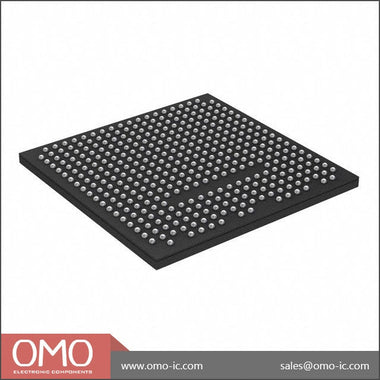
The LFE5U-45F-8BG381C is housed in a 381-ball caBGA (Chip Array Ball Grid Array) package. This package measures 17.0 mm by 17.0 mm with a ball pitch of 0.8 mm. The 0.8 mm pitch strikes an optimal balance between high I/O density and PCB manufacturability, allowing hardware engineers to route signals using standard multi-layer PCB fabrication processes without requiring ultra-expensive microvia technology.
The device provides 197 user-accessible I/O pins, which are segmented into multiple independent sysI/O™ banks. Each bank features its own dedicated VCCIO power supply pin, allowing the FPGA to interface simultaneously with different external logic levels. The sysI/O buffers are highly programmable, supporting a wide array of single-ended and differential signaling standards. Supported standards include LVCMOS (3.3V, 2.5V, 1.8V, 1.5V, 1.2V), LVTTL, LVDS, Bus-LVDS, MLVDS, and subLVDS. Furthermore, specific I/O banks are optimized for high-speed differential interfaces, including soft MIPI D-PHY support for camera and display bridging.
Critical pin categories on the LFE5U-45F-8BG381C include:
- Power Pins: VCC (1.1V core logic), VCCAUX (2.5V auxiliary power for JTAG and internal regulators), and VCCIO (variable per bank, 1.2V to 3.3V).
- Configuration Pins: Dedicated pins for the sysCONFIG interface, supporting Master SPI, Slave SPI, and parallel configuration modes. The PROGRAMN, INITN, and DONE pins are critical for monitoring the boot sequence.
- JTAG Pins: TCK, TMS, TDI, and TDO for boundary-scan testing and in-system programming (ISP).
- Clock Inputs: Dedicated Primary Clock (PCLK) and Edge Clock (ECLK) input pins optimized for low-skew routing directly to the internal PLLs and clock distribution networks.
- VREF Pins: Voltage reference inputs required for pseudo-differential signaling standards such as SSTL and HSTL, commonly used in DDR memory interfaces.
Core Architectural Features
- High-Density Logic Matrix: Contains 44,000 LUT4 equivalents organized into Programmable Function Units (PFUs), optimized for efficient logic synthesis, state machine implementation, and distributed memory allocation.
- sysDSP™ Processing Blocks: Integrates 72 dedicated 18x18 multipliers with 54-bit accumulators. The architecture supports dynamic operation mode switching and cascading for wide-operand arithmetic, ideal for edge AI and signal processing.
- sysMEM™ Embedded Block RAM: Features 1,944 Kbits of true dual-port Embedded Block RAM (EBR) capable of operating at high frequencies. Each 18 Kb block supports variable port widths and programmable FIFO logic.
- Flexible sysI/O™ Architecture: Provides 197 programmable I/O pins with adjustable drive strength, slew rate control, and on-chip termination (OCT). Supports high-speed differential standards including LVDS and soft MIPI D-PHY.
- Advanced Clock Management: Equipped with 4 sysCLOCK PLLs offering fractional-N synthesis, dynamic phase adjustment, and low-jitter clock distribution networks to support complex, multi-domain synchronous designs.
Specifications Parameter Table
| Specification | Technical Details |
|---|---|
| Manufacturer | Lattice Semiconductor |
| Product Family | ECP5 (Logic-Optimized, No SERDES) |
| Logic Elements (LUTs) | 44,000 |
| Embedded Memory (EBR) | 1,944 Kbits (108 blocks of 18 Kb) |
| DSP Slices (18x18 Multipliers) | 72 |
| Maximum User I/O | 197 |
| Core Operating Voltage (VCC) | 1.1V (Nominal) |
| Speed Grade | -8 (Highest Commercial Performance) |
| Package / Case | 381-caBGA (17.0 x 17.0 mm, 0.8 mm pitch) |
| Operating Temperature Range | 0°C to +85°C (Commercial) |
LFE5U-45F-8BG381C Equivalents, Cross Reference & Lifecycle
The LFE5U-45F-8BG381C is currently in an active lifecycle status, with Lattice Semiconductor providing long-term support for the ECP5 family. For applications requiring different environmental tolerances, the LFE5U-45F-8BG381I serves as the direct industrial-grade equivalent, offering an extended operating temperature range of -40°C to +100°C while maintaining exact pin-to-pin compatibility.
Engineers looking to scale their designs can utilize pin-compatible alternatives within the same 381-caBGA footprint. The LFE5U-25F-8BG381C provides a lower-cost, lower-density option (24K LUTs) for cost-reduced product variants. Conversely, the LFE5U-85F-8BG381C offers an upgrade path to 84K LUTs for designs requiring additional logic or DSP resources without necessitating a PCB redesign. When sourcing components or evaluating supply chain options, engineers should Check LFE5U-45F-8BG381C Inventory & Pricing to ensure availability for production runs.
Typical Applications & Circuit Considerations
The LFE5U-45F-8BG381C is engineered for system-level applications that demand high computational throughput within a constrained power envelope. Typical use cases include industrial motor control, where the FPGA handles multi-axis field-oriented control (FOC) algorithms with microsecond latency. In the broadcast and machine vision sectors, the device is frequently deployed as a video bridge, converting between MIPI D-PHY, LVDS, and parallel RGB interfaces. Additionally, it is a popular choice for edge AI inference, utilizing the Lattice sensAI™ stack to implement quantized neural networks directly in hardware.
Power Supply and Sequencing: Reliable operation of the ECP5 architecture requires strict adherence to power supply sequencing guidelines. The core voltage (VCC) must be supplied with a stable 1.1V, followed by the auxiliary voltage (VCCAUX) at 2.5V, and finally the I/O bank voltages (VCCIO). Monotonic ramp rates are critical to prevent latch-up conditions and ensure the internal Power-On Reset (POR) circuitry initializes the device correctly. A robust Power Distribution Network (PDN) is mandatory. Engineers must place high-frequency ceramic decoupling capacitors (e.g., 0.1µF and 0.01µF in 0402 or 0201 packages) directly beneath the BGA vias on the opposite side of the PCB to minimize parasitic inductance.
PCB Layout Guidelines: Routing the 381-ball caBGA requires a multi-layer PCB, typically 6 to 8 layers, to accommodate signal escape routing, dedicated solid ground planes, and split power planes. High-speed differential signals, such as LVDS or MIPI, must be routed with tightly controlled differential impedance (typically 100 ohms). Intra-pair and inter-pair length matching is essential to minimize skew. Furthermore, the thermal pad or thermal vias under the BGA should be connected to internal copper planes to facilitate heat dissipation, as the thermal resistance (Theta JA) dictates the maximum ambient operating temperature based on the logic utilization. To explore other devices in this family for varying system requirements, Browse ECP5 Series.
Video Demonstration
Frequently Asked Questions (LFE5U-45F-8BG381C FAQ)
Q: What is the difference between the LFE5U and LFE5UM series in the ECP5 family?
A: The LFE5U series, including the LFE5U-45F-8BG381C, is optimized for general-purpose logic and DSP applications without embedded SERDES transceivers. In contrast, the LFE5UM and LFE5UM5G series include integrated multi-gigabit SERDES channels for high-speed serial communications like PCIe or Gigabit Ethernet. Engineers choose the LFE5U when high logic density and low cost are prioritized over high-speed serial I/O.
Q: How does the -8 speed grade impact the performance of the LFE5U-45F-8BG381C?
A: The -8 designation represents the highest commercial speed grade available for the Lattice ECP5 family. This allows the internal logic, DSP slices, and embedded block RAM to operate at maximum clock frequencies, reducing propagation delays across the routing matrix. It is particularly beneficial for high-bandwidth video processing and high-frequency DSP algorithms where strict timing closure is critical.
Q: What are the power supply sequencing requirements for this FPGA?
A: Proper power-up sequencing is required to prevent excessive inrush current and ensure reliable initialization. Typically, the core voltage (VCC) at 1.1V should be powered first, followed by the auxiliary voltage (VCCAUX) at 2.5V, and finally the I/O bank voltages (VCCIO). The power supplies must ramp monotonically within the specified timeframes outlined in the Lattice ECP5 datasheet to ensure the internal Power-On Reset (POR) circuit triggers correctly.
Q: Can the LFE5U-45F-8BG381C interface directly with MIPI D-PHY image sensors?
A: Yes, the ECP5 architecture includes programmable I/O buffers that support soft MIPI D-PHY interfaces. By utilizing specific external resistor networks and the FPGA's high-speed LVDS/subLVDS I/O capabilities, it can receive or transmit MIPI CSI-2 or DSI signals. This makes the device highly suitable for bridging applications in machine vision, AR/VR headsets, and embedded camera systems.
Q: What configuration modes are supported by the LFE5U-45F-8BG381C?
A: The device supports multiple configuration modes, including Master SPI, Slave SPI, JTAG, and Slave Parallel (sysCONFIG) interfaces. Master SPI is the most common for standalone operation, allowing the FPGA to boot directly from an external standard SPI flash memory upon power-up. The JTAG interface is typically reserved for boundary-scan testing, debugging, and initial programming during the hardware prototyping phase.