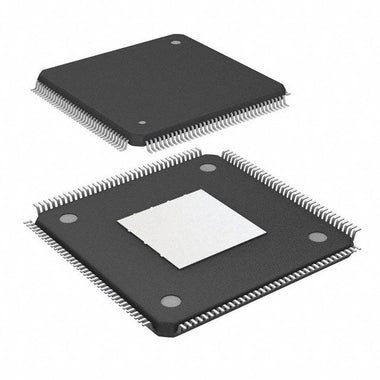
The MPF300T-FCG1152E is a mid-density Field-Programmable Gate Array (FPGA) from Microchip's PolarFire family, engineered for applications requiring a balance of low power consumption, high security, and reliable performance. Built on a 28nm SONOS non-volatile process, this device integrates a substantial logic fabric with high-speed transceivers, DSP blocks, and RAM. Its architecture is optimized for thermally constrained environments and systems where data security and operational integrity are critical design parameters.
Table of Contents
What is the MPF300T-FCG1152E?
The MPF300T-FCG1152E is a member of the PolarFire FPGA series, designed to address the market's need for cost-optimized, low-power, mid-range density FPGAs. Unlike traditional SRAM-based FPGAs that require an external configuration memory and exhibit high static power consumption, the MPF300T-FCG1152E utilizes a 28nm Silicon-Oxide-Nitride-Oxide-Silicon (SONOS) non-volatile process. This fundamental architectural choice provides several key advantages: it eliminates the inrush current typical during configuration, significantly reduces static leakage power, and enables "instant-on" performance. The non-volatile nature also inherently enhances design security, as the configuration bitstream is stored within the device's flash cells, making it less susceptible to unauthorized read-back or tampering.
The internal fabric of the MPF300T-FCG1152E is composed of 300,752 Logic Elements (LEs). Each LE consists of a 4-input Look-Up Table (LUT) and a D-type flip-flop, providing the fundamental building block for implementing combinatorial and sequential logic. For computationally intensive tasks, the device integrates 930 dedicated 18x18 Math Blocks, each capable of performing multiplication, multiply-accumulate (MACC), or multiply-add operations. These blocks are critical for digital signal processing (DSP) algorithms such as FIR filters, FFTs, and correlators. Distributed memory resources include 21 Mbits of total RAM, organized into dual-port Large SRAM (LSRAM) blocks (18 Kb) and Micro SRAM (uSRAM) blocks, offering flexibility for data buffering and storage. The device also features a robust clocking architecture with multiple Phase-Locked Loops (PLLs) and clock management resources to support complex timing domains within a system-on-chip design.
Connectivity is a primary strength of the MPF300T-FCG1152E. It is equipped with 16 high-speed transceiver lanes, each capable of operating at data rates up to 12.7 Gbps. These transceivers are highly configurable and support a wide range of serial protocols, including PCI Express (PCIe) Gen1/Gen2, 10 Gigabit Ethernet (XAUI/10GBASE-KR), JESD204B, and Serial RapidIO. Additionally, the device provides up to 512 general-purpose I/O pins, which can be configured to support various single-ended and differential signaling standards such as LVCMOS, LVDS, HSTL, and SSTL, enabling seamless interfacing with processors, memory (DDR3/DDR4), and other peripherals.

Pinout Configuration and Packaging
The MPF300T-FCG1152E is offered in the FCG1152 package, a 1152-ball, Flip-Chip, Fine-Pitch Ball Grid Array (FCBGA). This package measures 35mm x 35mm with a 1.0mm ball pitch, providing a high I/O density suitable for complex board designs. The pinout is meticulously planned to optimize signal integrity for high-speed interfaces while ensuring robust power delivery. The package allocates a significant number of pins to power (VCC, VCCAUX, VCCIO) and ground (GND) to create a low-impedance power distribution network (PDN), which is critical for minimizing simultaneous switching noise and ensuring stable operation of the core logic and I/O banks.
The 1152 pins are functionally categorized into several groups. A large portion is dedicated to user I/O, organized into banks, where each bank can be powered by a separate VCCIO supply to support different I/O voltage standards. The pinout includes dedicated pins for the 16 high-speed transceiver channels, with differential pairs for transmit (TX) and receive (RX) data. These pins are strategically placed for direct routing to edge connectors or other high-speed components to minimize trace length and discontinuities. Dedicated clock input pins are provided for connecting to external oscillators, feeding the global clocking network and PLLs. Additionally, there are specific pins for JTAG programming and debug (TCK, TMS, TDI, TDO), device configuration mode selection, and access to the on-chip security functions. Careful adherence to the pinout guidelines in the Microchip documentation is essential during PCB layout, particularly regarding power plane design, decoupling capacitor placement, and controlled impedance routing for differential pairs.
Core Architectural Features
- Low-Power Non-Volatile Fabric: Utilizes a 28nm SONOS flash-based process, resulting in up to 50% lower total power consumption compared to equivalent SRAM-based FPGAs. This architecture provides zero inrush current and instant-on capability, eliminating the need for external configuration memory.
- High-Speed Serial Transceivers: Features 16 integrated transceiver lanes, each supporting data rates from 250 Mbps to 12.7 Gbps. These transceivers include dedicated Physical Medium Attachment (PMA) and Physical Coding Sublayer (PCS) blocks, supporting protocols like PCIe 2.0, JESD204B, Interlaken, CPRI, and 10GbE.
- Comprehensive Security Suite: Incorporates a hardened crypto processor with a true random number generator (TRNG), physically unclonable function (PUF), and countermeasures against Differential Power Analysis (DPA). This enables secure boot, encrypted bitstream loading, and protection of intellectual property.
- DSP and Memory Resources: Equipped with 930 high-performance 18x18 Math Blocks with a 48-bit accumulator, optimized for signal processing applications. The device also contains over 21 Mbits of configurable on-chip RAM, including 18 Kb LSRAM blocks and smaller uSRAM blocks for flexible data handling.
- Flexible I/O and Clocking Network: Provides up to 512 user I/Os supporting a wide array of standards, including DDR3/4 and LPDDR3 memory interfaces. The robust clocking network contains multiple PLLs and clock synthesis blocks, enabling the management of complex, multi-clock domain designs with precision.
Specifications Parameter Table
| Specification | Technical Details |
|---|---|
| Logic Elements (LEs) | 300,752 |
| 4-Input LUTs | 300,752 |
| 18x18 Math Blocks (DSP) | 930 |
| Total RAM | 21,024 kbits |
| 12.7G Transceivers | 16 |
| Maximum User I/O | 512 |
| Package Type | FCG1152 (35x35 mm, 1.0mm pitch) |
| Core Voltage (VCC) | 1.0 V |
MPF300T-FCG1152E Equivalents, Cross Reference & Lifecycle
The MPF300T-FCG1152E is an active production device with a stable lifecycle status. When considering alternatives, engineers should primarily look within the PolarFire family for devices that share the same package footprint. For designs that require lower logic density but must maintain the FCG1152 package for board compatibility, the MPF200T-FCG1152E is a viable option. Conversely, if a design requires more logic resources, DSP blocks, or memory, the MPF500T-FCG1152E offers a migration path upwards in the same package. It is critical to note that while these devices are pin-compatible from a package perspective (especially for power and ground), the user I/O and transceiver pin assignments will differ. A direct drop-in replacement is not possible; the design must be re-targeted, re-compiled, and re-verified for the new device using Microchip's Libero SoC Design Suite. Check MPF300T-FCG1152E Inventory & Pricing for current stock levels and procurement options.
Typical Applications & Circuit Considerations
The MPF300T-FCG1152E's combination of low power, security, and mid-range density makes it suitable for a wide range of applications across various industries. In communications and networking, it is used for wireline access, wireless infrastructure, and smart optical modules where it can perform packet processing, traffic management, and implement custom interface bridging. Its hardened security features make it an excellent choice for secure communication systems, defense applications, and hardware root-of-trust implementations. In the industrial sector, the device is deployed in machine vision systems, industrial control, and robotics, where its DSP blocks can execute real-time image processing algorithms and its deterministic I/O can manage precise motor control loops.
From a circuit design perspective, successful implementation requires careful attention to the power delivery network (PDN) and high-speed signal integrity. The FCG1152 package requires a multi-layer PCB, typically 10 layers or more, to accommodate the dense BGA breakout and provide solid power and ground planes. Each power rail (VCC, VCCAUX, VCCIOs, transceiver supplies) must be decoupled with a combination of bulk and high-frequency ceramic capacitors placed as close as possible to the BGA balls. For the 12.7 Gbps transceivers, designers must use controlled impedance routing (typically 100-ohm differential) with precise trace length matching and minimal use of vias to preserve signal quality. A robust thermal management strategy, potentially including a heatsink and airflow, is also necessary to dissipate heat and ensure the device operates within its specified temperature range, especially when the logic and transceivers are heavily utilized. Engineers developing systems with these requirements can explore other devices in the family. Browse PolarFire Series for a full selection of densities and packages.
Video Demonstration
Frequently Asked Questions (MPF300T-FCG1152E FAQ)
Q: How does the MPF300T-FCG1152E achieve its low power consumption?
A: The device's low power profile is primarily due to its 28nm SONOS non-volatile process technology. Unlike SRAM-based FPGAs that constantly leak current to hold their configuration, the flash-based cells in PolarFire FPGAs have near-zero static leakage. This dramatically reduces static power consumption, which is often the dominant power component in idle or low-activity states. Additionally, the architecture is optimized for low dynamic power through fine-grained clock gating and other power-aware design features within the Libero SoC software.
Q: What programming and configuration methods are supported for this device?
A: The MPF300T-FCG1152E supports several configuration methods. The primary method is via the standard IEEE 1149.1 JTAG interface, which is used for in-system programming and debugging with a programmer like the FlashPro. It also supports SPI slave mode for configuration from a host processor. Because it is a non-volatile device, it retains its configuration through power cycles and is "instant-on," meaning the logic is active immediately after power-up stabilization without a lengthy configuration sequence.
Q: What are the key security features of the PolarFire architecture?
A: The PolarFire architecture integrates a comprehensive suite of security features to protect intellectual property and prevent system tampering. It includes a physically unclonable function (PUF) for secure key generation and storage, a CRI-licensed DPA-safe crypto processor for secure bitstream authentication and decryption, and a true random number generator (TRNG). These features enable a secure boot process, prevent cloning and reverse engineering, and protect against side-channel attacks, making it suitable for high-assurance systems.
Q: Can the transceivers in the MPF300T-FCG1152E support PCIe Gen 3?
A: No, the transceivers in the MPF300T-FCG1152E are rated for a maximum data rate of 12.7 Gbps. While this comfortably supports PCI Express (PCIe) Gen 1 (2.5 GT/s) and Gen 2 (5.0 GT/s), it does not meet the 8.0 GT/s data rate required for PCIe Gen 3. For applications requiring PCIe Gen 3 or higher data rates, designers should consider Microchip's PolarFire SoC or other FPGA families specifically designed with higher-speed transceivers.
Q: What is the primary difference between the logic elements in PolarFire FPGAs and those in competing architectures?
A: The fundamental logic element in the MPF300T-FCG1152E is a 4-input LUT paired with a D-type flip-flop. While many competing mid-range FPGAs have moved to 6-input LUTs, the choice of a 4-input LUT architecture in PolarFire is a deliberate design trade-off. It provides a more granular fabric, which can lead to higher logic utilization and efficiency for certain types of designs, and contributes to the device's overall power and cost optimization. The Libero SoC synthesis engine is highly optimized to map logic efficiently onto this 4-input LUT structure.

Alan Carter
Senior Hardware Engineer & Component Specialist
Alan has over 15 years of expertise in embedded systems design, FPGA architecture, and global semiconductor supply chains. He specializes in component cross-referencing, lifecycle management, and helping OEMs navigate supply shortages.