The MPF100T-FCG484E is a mid-density Field-Programmable Gate Array (FPGA) from Microchip's PolarFire family, engineered to solve the critical design challenge of delivering significant computational capability within a stringent power budget. It targets applications where static power consumption, security, and reliability are paramount. By leveraging a non-volatile flash-based architecture, this device provides an optimal balance of performance and low power, making it a compelling choice for next-generation systems in industrial, communications, and defense sectors that cannot tolerate the high quiescent current of traditional SRAM-based FPGAs.
Table of Contents
What is the MPF100T-FCG484E?
The Microchip MPF100T-FCG484E is a member of the PolarFire FPGA family, a line of devices built on a 28nm SONOS (Silicon-Oxide-Nitride-Oxide-Silicon) non-volatile process technology. This fundamental choice of process technology is the key differentiator from mainstream SRAM-based FPGAs. While SRAM-based devices offer high density, they suffer from high static (leakage) current and require an external configuration memory device, which adds to boot time, system cost, and potential security vulnerabilities. The MPF100T-FCG484E, being flash-based, holds its configuration data in non-volatile memory cells, resulting in exceptionally low static power consumption and "instant-on" performance upon power-up.
Internally, the FPGA fabric is constructed from a sea of 4-input Look-Up Tables (LUTs) with associated D-type flip-flops, which Microchip terms Logic Elements (LEs). The MPF100T variant contains approximately 109,000 of these LEs, providing a substantial amount of programmable logic for complex digital designs. The architecture also includes a significant amount of distributed memory resources. These are composed of two main types: Large SRAM (LSRAM) blocks, which are larger, more efficient memory arrays, and Micro SRAM (uSRAM) blocks, which are smaller and distributed throughout the fabric for more localized data storage. This hierarchical memory structure allows for efficient implementation of FIFOs, data buffers, and processor caches.
For computationally intensive tasks, the device integrates a generous number of hardened 18x18 DSP blocks, which can be configured as multipliers, multiply-accumulate (MAC) units, or other arithmetic functions. These dedicated hardware blocks perform signal processing tasks far more efficiently in terms of both speed and power than equivalent implementations in general-purpose logic.
The 'T' in the part number signifies the inclusion of high-speed transceivers. The MPF100T-FCG484E is equipped with eight transceiver lanes, each capable of operating at data rates up to 12.7 Gbps. These transceivers are essential for implementing modern high-speed serial interfaces such as PCI Express (PCIe), 10 Gigabit Ethernet, JESD204B, and Serial RapidIO. Each transceiver includes a Physical Medium Attachment (PMA) and a Physical Coding Sublayer (PCS), providing the necessary hardware to handle 8b/10b or 64b/66b encoding/decoding, clock and data recovery (CDR), and equalization, offloading these critical tasks from the FPGA fabric.
Pinout Configuration and Packaging
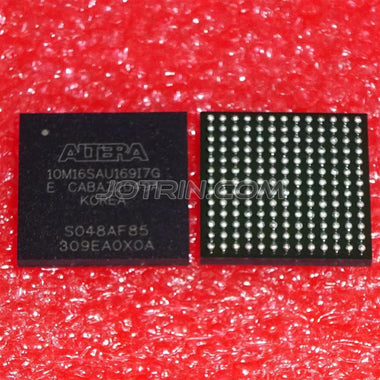
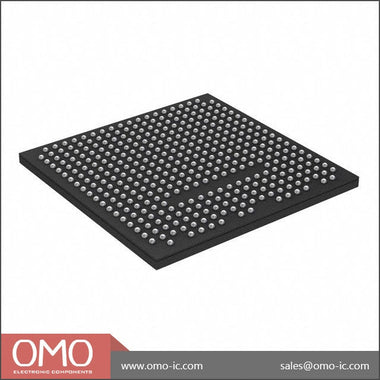
The MPF100T-FCG484E is offered in the FCG484 package, which is a 484-ball, 1.0 mm pitch, Fine-pitch Chip-scale BGA. This package measures 19 mm x 19 mm, providing a good balance between I/O count and PCB footprint. Out of the 484 balls, 242 are available as user I/O, offering ample connectivity for most mid-range applications.
The pinout is organized into multiple I/O banks, each with its own independent I/O voltage supply (VCCI). This allows the FPGA to interface with multiple logic standards simultaneously, such as 3.3V LVCMOS, 1.8V LVCMOS, and various differential standards like LVDS. Careful planning of pin assignments is crucial during the schematic design phase to ensure that components requiring the same I/O voltage are grouped into the same bank.
Key pins that require an engineer's attention include:
- Power Supply Pins: The device requires several distinct power rails. These include the core voltage (VCC), auxiliary voltage (VCC_AUX), SRAM voltage (VCC_SRAM), and dedicated supplies for the PLLs (VCC_PLL) and transceivers (VCC_TX/RX). Each of these must be properly decoupled with capacitors placed as close to the BGA balls as possible, following the recommendations in the "PolarFire FPGA Power-Up and Power-Down Sequencing" application note.
- JTAG Pins: TCK, TMS, TDI, TDO, and the optional TRST are used for boundary-scan testing and for programming the device via a JTAG interface using tools like FlashPro.
- Transceiver Pins: These are dedicated high-speed differential pairs (TXP/TXN, RXP/RXN) and require meticulous PCB layout with controlled 100-ohm differential impedance.
- Global Clock Inputs: These pins feed the FPGA's sophisticated clocking network, which includes multiple Phase-Locked Loops (PLLs) and regional clock buffers. Driving these with clean, low-jitter clock sources is essential for reliable system operation.
Due to the BGA package, a multi-layer PCB is mandatory. Routing all signals, especially the high-speed transceiver pairs and the dense I/O, typically requires a PCB with at least 8-10 layers. Proper via-in-pad or dog-bone fanout strategies are necessary to escape the inner balls of the BGA grid.
Core Architectural Features
- Low-Power, Non-Volatile SONOS Flash Fabric: The core architecture is built on a 28nm flash process, which eliminates the need for an external configuration PROM. This provides "instant-on" system availability, significantly reduces static power consumption compared to SRAM-based FPGAs, and makes the configuration memory inherently immune to Single Event Upsets (SEUs), enhancing reliability in high-altitude or radiation-prone environments.
- High-Speed Transceiver Block: Includes eight transceiver lanes supporting data rates from 250 Mbps to 12.7 Gbps. These blocks are highly configurable and support a wide range of serial protocols, featuring integrated clock and data recovery (CDR), equalization (CTLE, DFE), and hardened PCS logic for standards like PCIe Gen1/2 and 10G Ethernet KR.
- Robust Security Features: The device incorporates a suite of security measures to protect intellectual property (IP) and prevent unauthorized access. This includes a physically unclonable function (PUF) for key generation, a CRI-patented Differential Power Analysis (DPA) resistant crypto-processor, and secure bitstream programming with AES-256 and SHA-256 authentication.
- Rich DSP and Memory Resources: The MPF100T is equipped with 348 hardened 18x18 math blocks, which can be cascaded to form larger multipliers or DSP functions. These are complemented by over 7.5 Mbit of Large SRAM (LSRAM) and additional Micro SRAM (uSRAM) blocks, providing a flexible and efficient memory subsystem for data-intensive applications.
- Flexible Clocking and I/O: Features a comprehensive clocking network with multiple global and regional clock distribution networks, fed by on-chip PLLs. The 242 user I/Os are highly configurable, supporting a wide array of single-ended and differential I/O standards, with features like programmable slew rates and drive strengths to maintain signal integrity.
Specifications Parameter Table
| Specification | Technical Details |
|---|---|
| Logic Elements (4-input LUT + DFF) | 109K |
| 18 x 18 Math Blocks | 348 |
| Large SRAM (LSRAM) | 7,584 kbits |
| Micro SRAM (uSRAM) | 756 kbits |
| Number of Transceivers | 8 |
| Maximum Transceiver Data Rate | 12.7 Gbps |
| Total User I/O (FCG484 Package) | 242 |
| Operating Temperature Range (E-Grade) | 0°C to 85°C (Junction Temperature, TJ) |
| Core Voltage (VCC) | 1.0V Nominal |
MPF100T-FCG484E Equivalents, Cross Reference & Lifecycle
The MPF100T-FCG484E is currently in "Active" production status by Microchip, making it a suitable choice for new designs with long-term availability requirements. When considering alternatives, it's critical to understand that for FPGAs, a "drop-in replacement" is almost non-existent due to the need for design recompilation and timing verification.
Within the PolarFire family, a potential migration path or alternative could be a device from a different speed or temperature grade in the same package. For instance, the MPF100T-1FCG484E is a faster speed grade version of the same device. While pin-compatible, migrating a design to a different speed grade still requires a full re-synthesis, place-and-route, and static timing analysis to ensure the design meets timing constraints.
For designs that may need more logic resources in the future, the MPF200T-FCG484E offers roughly double the logic elements and DSP blocks in the same 484-ball package. Microchip often maintains pin-compatibility for devices within the same family and package, allowing for design scalability. However, designers must verify this using the official pinout files for both devices, as power pin requirements may differ. Any change, even to a pin-compatible larger device, mandates a complete design tool flow rerun.
Cross-referencing to competing families like Xilinx Artix-7/Kintex-7 or Intel Cyclone V/Arria V is a much more involved process. While these families may offer devices with similar logic counts and transceiver capabilities, the underlying architecture (SRAM vs. Flash), toolchains (Vivado/Quartus vs. Libero SoC), and IP cores are completely different. A cross-reference here implies a complete redesign and porting effort, not a simple replacement. For the most up-to-date stock and lead time information, it is best to Check MPF100T-FCG484E Inventory & Pricing.
Typical Applications & Circuit Considerations
The unique feature set of the MPF100T-FCG484E makes it an excellent fit for a variety of mid-range applications where power and security are not just afterthoughts, but primary design drivers.
In Industrial Automation, its instant-on capability is valuable for systems that need to be operational immediately upon power-up, such as safety-critical controllers or high-speed machine vision systems. The low static power reduces thermal load in sealed enclosures, while the high I/O count and DSP blocks are ideal for processing sensor data and driving multiple motor control loops.
For Communications Infrastructure, the device serves well in applications like smart optical modules, remote radio heads, and small cell base stations. The low power consumption is critical for thermally constrained modules and for reducing the overall operating expense (OPEX) of network deployments. The 12.7 Gbps transceivers are used to implement CPRI/OBSAI links, 10G Ethernet backhaul, and JESD204B interfaces to high-speed data converters.
In Aerospace and Defense, the inherent radiation tolerance of the flash-based configuration memory provides a significant reliability advantage over SRAM FPGAs. The robust security features, including DPA countermeasures and secure boot, are essential for protecting critical program data and preventing tampering in applications like secure communications, avionics, and smart munitions.
From a circuit design perspective, successful implementation hinges on a few key areas. The Power Delivery Network (PDN) is paramount. The 1.0V core voltage rail can draw significant dynamic current, requiring a low-impedance path with extensive decoupling. Careful power sequencing, as specified in the datasheet, is mandatory to prevent damage to the device. The PCB layout for the FCG484 package requires careful planning, especially for the high-speed transceiver differential pairs. These traces must have controlled 100-ohm impedance, be length-matched, and routed with smooth, sweeping bends to minimize reflections. Finally, a thermal management strategy is necessary. While static power is low, a design that heavily utilizes the DSPs and transceivers can generate considerable dynamic power. A thermal simulation should be performed, and thermal vias under the package's central ground pad are a minimum requirement to conduct heat into the PCB's ground planes. For high-performance designs, a heatsink may be required. Engineers looking to implement such systems can Browse PolarFire Series for a range of device options to fit their specific needs.
Video Demonstration
Frequently Asked Questions (MPF100T-FCG484E FAQ)
What is the main advantage of the MPF100T-FCG484E's flash-based architecture?
The primary advantage is the combination of low power, high reliability, and security. Unlike SRAM-based FPGAs that have high static leakage current, the SONOS flash process results in significantly lower static power consumption. This also means the device is "instant-on" as it doesn't need to load a configuration from an external memory. Furthermore, the flash configuration cells are inherently more resistant to radiation-induced Single Event Upsets (SEUs) than SRAM cells, enhancing system reliability.
What are the high-speed I/O capabilities of this FPGA?
The MPF100T-FCG484E is equipped with a powerful high-speed I/O subsystem. It features eight transceiver lanes, each capable of running up to 12.7 Gbps, which are used for implementing serial protocols like PCIe, 10G Ethernet, and JESD204B. In addition to the transceivers, it provides 242 general-purpose user I/O pins that support a wide range of single-ended and differential standards like LVCMOS and LVDS, making it versatile for interfacing with various external components.
Is the MPF100T-FCG484E suitable for security-critical applications?
Yes, it is exceptionally well-suited for security-critical applications. Microchip has integrated a hardened crypto-processor with countermeasures against Differential Power Analysis (DPA) attacks, a common side-channel attack vector. The device also supports secure boot, encrypted bitstream loading with AES-256, and a physically unclonable function (PUF) for secure key storage, providing a robust foundation for protecting intellectual property and system integrity.
What development tools are used to program the MPF100T-FCG484E?
The MPF100T-FCG484E is designed using Microchip's Libero SoC Design Suite. This is a comprehensive software toolset that guides the engineer through the entire FPGA design flow, including HDL synthesis, place-and-route, static timing analysis, power analysis, and programming file generation. For in-system programming and debugging, Microchip provides hardware programmers like the FlashPro series.
What does the 'E' in MPF100T-FCG484E signify?
The 'E' in the part number designates the device's operating temperature grade. It stands for the commercial temperature range, which specifies a junction temperature (TJ) range of 0°C to 85°C. For applications requiring a wider operating range, Microchip also offers an industrial grade version (indicated by an 'I'), which supports a junction temperature of -40°C to 100°C.