10M16SAU169I7G Datasheet, Pinout, and Specifications – Intel Altera MAX 10 FPGA
1. Overview of the 10M16SAU169I7G
The 10M16SAU169I7G is a non-volatile FPGA from Intel (formerly Altera) belonging to the MAX 10 device family. Built on a 55 nm process technology, this single-chip FPGA integrates flash-based configuration storage, eliminating the need for an external configuration device. The "SA" designation indicates a single-supply variant with an integrated analog-to-digital converter (ADC), making it ideal for cost-sensitive, space-constrained applications that require analog signal acquisition alongside programmable logic.
The MAX 10 family bridges the gap between CPLDs and FPGAs by offering instant-on capability, user flash memory, and dual ADC blocks — all in a compact, low-power package. The 10M16SAU169I7G specifically targets industrial-grade applications with its extended temperature range of –40 °C to +100 °C.
2. Key Specifications and Parameters
| Parameter | Value |
|---|---|
| Part Number | 10M16SAU169I7G |
| Manufacturer | Intel (Altera) |
| Device Family | MAX 10 |
| Logic Elements (LEs) | 16,000 |
| Logic Array Blocks (LABs) | 1,000 |
| Embedded Memory (M9K Blocks) | 549 Kb |
| Embedded 18×18 Multipliers | 46 |
| PLLs | 4 |
| User I/O Pins | 130 |
| Max LVDS Pairs | 22 |
| ADC Blocks | Dual 12-bit, 1 MSPS |
| User Flash Memory (UFM) | Yes |
| Internal Configuration | Dual-boot, flash-based |
| Core Voltage | 1.2 V |
| I/O Voltage Range | 1.0 V – 3.3 V |
| Process Technology | 55 nm |
| Package | UBGA-169 (11 × 11 mm) |
| Temperature Range | –40 °C to +100 °C (Industrial) |
| Speed Grade | 7 |
| RoHS / Lead-Free | Yes (G suffix) |
| Supported I/O Standards | LVTTL, LVCMOS, SSTL, HSTL, HSUL, PCI, LVDS |
| External Memory Interface | DDR2, DDR3, LPDDR2, SRAM |
3. Pinout and Package Information
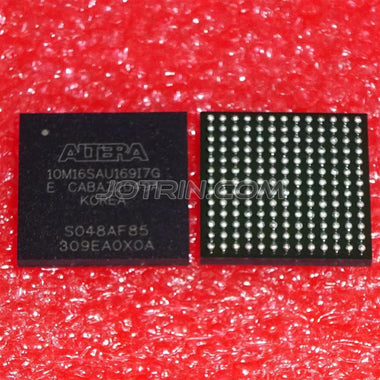
The 10M16SAU169I7G is packaged in a 169-ball UBGA (Ultra-thin Ball Grid Array) measuring 11 × 11 mm with a 0.8 mm ball pitch. This compact form factor is well-suited for portable and embedded designs where board space is at a premium. The device provides 130 general-purpose I/O pins organized across multiple I/O banks, each independently configurable for different voltage standards.
Key pin categories include dedicated clock inputs, JTAG programming pins (TCK, TMS, TDI, TDO), power supply pins (VCC, VCCIO, GND), and analog input channels for the integrated ADC. Intel provides pin-out files in PDF, XLS, and TXT formats through the Altera pin-out resource center.

Figure 1: 10M16SAU169I7G in UBGA-169 package
4. Architecture and Block Diagram
The MAX 10 architecture is built around a sea of configurable logic elements (LEs), each containing a four-input look-up table (LUT) and a programmable register. Sixteen LEs are grouped into a Logic Array Block (LAB). The 10M16 variant provides 1,000 LABs interconnected through a column- and row-based routing fabric.
Additional hard IP blocks include:
- M9K Embedded Memory: 549 Kb of SRAM organized in 9-Kbit blocks, supporting single-port, dual-port, and ROM modes.
- Embedded Multipliers: 46 dedicated 18×18-bit multiplier blocks for DSP-intensive applications.
- Dual 12-bit ADC: Two analog-to-digital converters with up to 18 analog input channels and 1 MSPS throughput — unique among FPGA families.
- Phase-Locked Loops (PLLs): Four PLLs for flexible clock management, multiplication, and phase shifting.
- User Flash Memory (UFM): Non-volatile storage for user data, coefficients, or intellectual property protection.

Figure 2: 10M16SAU169I7G schematic symbol showing functional blocks
5. Typical Applications and Design Resources
The combination of instant-on flash configuration, integrated ADC, and industrial-grade reliability makes the 10M16SAU169I7G well-suited for a wide range of applications:
- Industrial automation: Motor control, sensor hub aggregation, and real-time process monitoring.
- Communications: Protocol bridging, small-cell base stations, and I/O expansion.
- Automotive: Infotainment systems, ADAS preprocessing, and body electronics (qualified for extended temperature).
- Consumer electronics: Video processing, display panel timing controllers, and IoT edge computing.
- Medical devices: Portable diagnostics, patient monitors with integrated analog front-end.
Intel provides comprehensive design support through Quartus Prime Lite Edition (free download), along with reference designs, IP catalog, and the MAX 10 FPGA Development Kit. The development kit includes USB-Blaster programming, HDMI output, dual Gigabit Ethernet, and HSMC expansion for rapid prototyping.
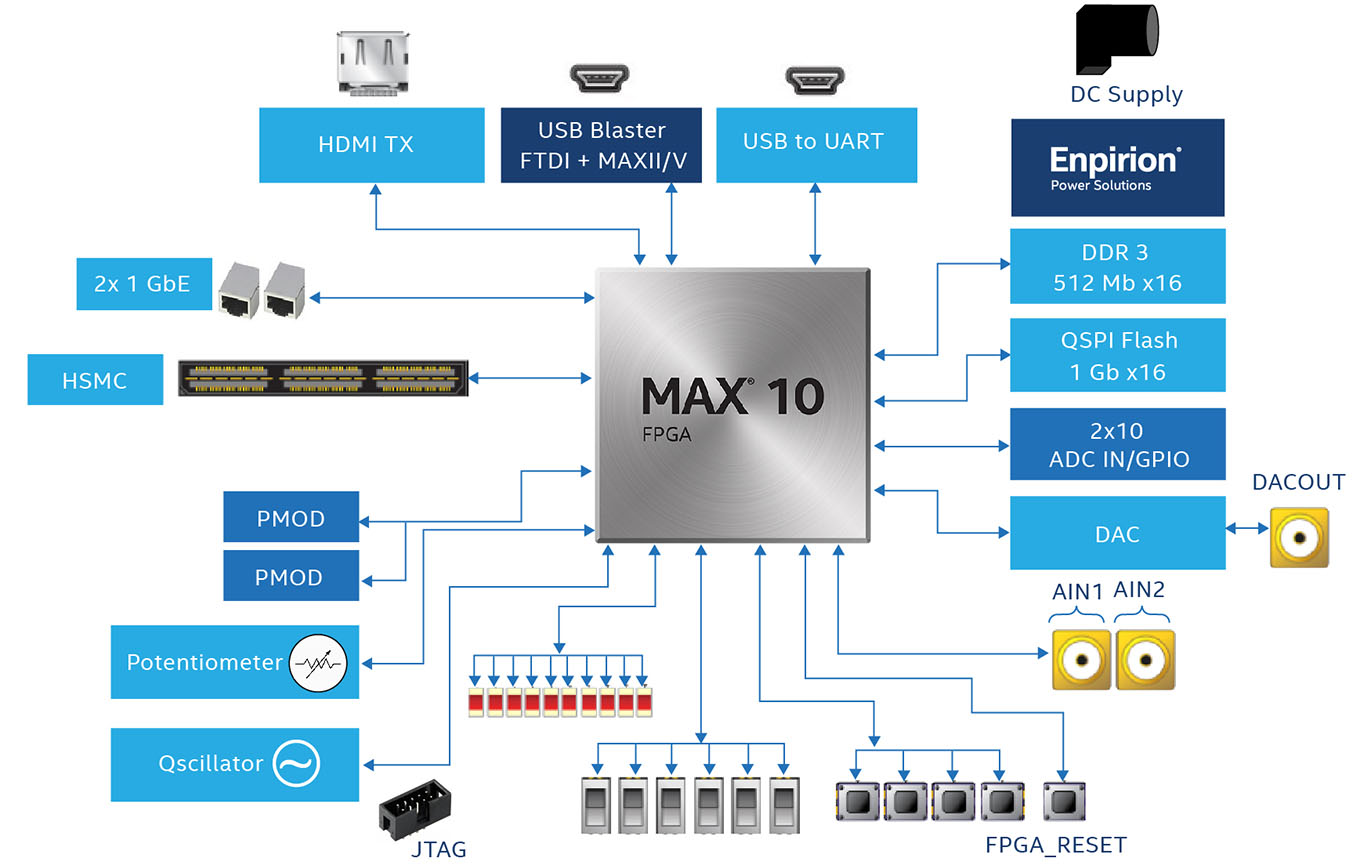
Figure 3: MAX 10 FPGA Development Kit block diagram — a reference platform for 10M16SAU169I7G evaluation
Explore more Intel Altera FPGA and CPLD devices at wwdparts:
Video: Getting Started with Intel MAX 10 FPGA
6. Frequently Asked Questions (FAQ)
Q1: What is the difference between the 10M16SAU169I7G and 10M16SCU169I7G?
The "SA" variant includes a dual analog-to-digital converter (ADC) block, while the "SC" variant does not have analog functionality. Both share the same logic resources, memory, and package. Choose the SA variant if your design requires on-chip analog signal acquisition.
Q2: Does the 10M16SAU169I7G require an external configuration memory?
No. MAX 10 devices integrate on-chip flash-based configuration memory with dual-boot capability. The FPGA configures itself from internal flash at power-up within milliseconds, eliminating the need for external EEPROM or flash devices.
Q3: What development tools support the 10M16SAU169I7G?
Intel's Quartus Prime Lite Edition (free) fully supports MAX 10 devices, including synthesis, place-and-route, timing analysis, and programming. The Nios II soft processor and Platform Designer (formerly Qsys) system integration tool are also available for SoC-style designs.
Q4: What is the maximum operating frequency of the 10M16SAU169I7G?
The achievable frequency depends on the design complexity and speed grade. With speed grade 7 (the lowest-cost option), typical register-to-register performance reaches approximately 250–300 MHz for simple logic paths. Higher speed grades (6 and 5) offer faster timing closure for demanding applications.
Q5: How many analog input channels does the 10M16SAU169I7G ADC support?
The device features two 12-bit successive-approximation ADC blocks, each capable of 1 MSPS. Together, they support up to 18 single-ended analog input channels (some shared with digital I/O), suitable for temperature sensing, voltage monitoring, and basic signal acquisition.
Q6: Is the 10M16SAU169I7G suitable for production use in industrial environments?
Yes. The "I" suffix denotes the industrial temperature grade (–40 °C to +100 °C), and the device is RoHS-compliant (lead-free, "G" suffix). Intel provides a long product lifecycle commitment for MAX 10 devices, making them suitable for industrial, medical, and automotive applications requiring extended availability.