MPF300T-FCG1152E Application Guide: From Datasheet to Working Circuit
When designing a secure, high-throughput industrial imaging system or a multi-protocol communications hub, system architects face the challenge of balancing performance, power consumption, and security. The Microchip MPF300T-FCG1152E PolarFire FPGA is engineered to address this specific trilemma. It provides a robust platform for aggregating high-speed data streams, performing real-time processing, and securing the data path, all within a power budget that is substantially lower than competing mid-range FPGAs. This guide will walk through a practical application, demonstrating how to leverage its features from initial specification to a working circuit design.
Table of Contents
Application Context: Where MPF300T-FCG1152E Fits in the System
Let's consider a common industrial automation scenario: a high-resolution machine vision system that needs to interface with multiple GigE Vision cameras and a host processing unit over PCI Express. The MPF300T-FCG1152E is an ideal central processing hub for this application. In this system, the FPGA's primary role is to act as a real-time data aggregator and pre-processor.
A block diagram for this system would place the MPF300T-FCG1152E at the very center. On one side, several of its high-speed transceiver lanes are configured as 2.5G or 5G Ethernet MAC/PHYs, connecting to SFP+ cages or Ethernet PHY chips for camera data ingress. On the other side, another set of transceivers are configured as a multi-lane PCI Express Gen2 endpoint, providing a high-bandwidth connection to a host CPU or an industrial PC.
The data flow is as follows:
- Raw image data streams from multiple cameras arrive over Ethernet. The FPGA's transceivers and logic fabric implement the Ethernet protocols to receive these packets.
- The data is buffered in the FPGA's internal LSRAM blocks. This is critical for handling packet jitter and ensuring no data is lost.
- The FPGA's logic fabric, utilizing its 300K logic elements and dedicated math blocks (DSPs), performs real-time image processing tasks. This could include color space conversion, defect detection algorithms, image stitching from multiple sensors, or data compression. Offloading these deterministic, parallelizable tasks from the host CPU is a major system benefit.
- The PolarFire architecture's hardened crypto processor can be used to encrypt the processed data stream on-the-fly, ensuring the integrity and confidentiality of sensitive inspection data before it is sent to the host system. This is a key differentiator for applications in medical imaging or high-value manufacturing.
- Finally, the processed (and optionally encrypted) data is packetized and transferred over the PCIe interface to the host system for further analysis, storage, or display.
In this role, the MPF300T-FCG1152E is not just a simple bridge; it is an active processing and security element. Its low static power is crucial for thermally constrained industrial enclosures, while its resistance to configuration upsets (due to its Flash-based architecture) provides the reliability needed on a factory floor. The large number of logic elements and memory blocks allows for sophisticated algorithms, and the generous count of 12.7 Gbps transceivers provides the I/O flexibility to connect to a wide variety of modern and legacy interfaces.
Core Specifications for This Application
For the machine vision aggregator application described, the following specifications of the MPF300T-FCG1152E are most critical. All values are sourced directly from the official Microchip PolarFire FPGA family datasheet.
| Parameter | Value | Application Relevance |
|---|---|---|
| Logic Elements (4-input LUT + DFF) | 300,544 | Provides ample logic resources for implementing multiple Ethernet MACs, a PCIe core, and a complex image processing pipeline simultaneously. |
| Transceiver (SERDES) Lanes | 16 | Enables multiple high-speed interfaces. For example, 8 lanes for a PCIe Gen2 x8 endpoint and 4 lanes for four 2.5G Ethernet ports, with lanes to spare. |
| Max Transceiver Rate | 12.7 Gbps | Offers future-proofing, allowing migration to higher-speed protocols like 10GbE or PCIe Gen3 if system requirements evolve. |
| Math Blocks (18x18 MACC) | 930 | Essential for accelerating DSP-intensive tasks in the image processing pipeline, such as FIR filters, FFTs, or matrix multiplication. |
| LSRAM (20 Kb Blocks) | 294 | Critical for creating deep packet buffers for the Ethernet interfaces and frame buffers for the image processing pipeline. |
| Crypto Processor | Hardened Core with DPA Countermeasures | Enables robust, high-performance encryption/authentication of the data stream without consuming valuable FPGA logic resources. |
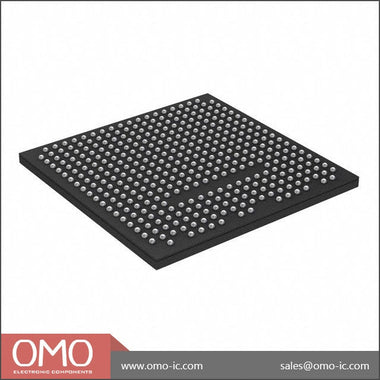
| Package | FCG1152 (1152-ball, 35x35mm, 1.0mm pitch) | A large but manageable BGA package. The 1.0mm pitch simplifies PCB layout and manufacturing compared to tighter-pitch alternatives. |
| Total Static Power (Typical) | Qualitatively Low (Flash-based) | Reduces cooling requirements and operating costs, a significant advantage in sealed industrial enclosures or fanless systems. Exact values are design-dependent. |
Reference Circuit and Component Selection
Designing the board-level circuitry around the MPF300T-FCG1152E requires careful attention to power, clocking, and configuration. A robust design here is non-negotiable for stable operation.
Power Delivery Network (PDN): The PolarFire FPGA requires several distinct power rails. The most critical are VCC (core logic), VCC_AUX (auxiliary functions and I/O), VDD25 (GPIO banks), and dedicated rails for the transceivers (VCC_PLLA, VCC_TX, etc.).
- Core Voltage (VCC): This rail powers the main logic fabric and typically requires a high-current, high-efficiency switching regulator capable of a fast transient response. A multi-phase buck converter is often a suitable choice to supply the significant current needed during full utilization.
- Auxiliary and I/O Voltages: VCC_AUX and VDD25 can often be supplied by smaller switching regulators or, if current requirements are low, by LDOs fed from a main system rail.
- Transceiver Power: The analog-sensitive transceiver power rails demand extremely low noise. It is standard practice to power these using dedicated LDOs to filter out noise from upstream switching converters. Pay close attention to the datasheet's power supply sequencing requirements to prevent damage during power-up and power-down.
- Decoupling: A dense array of decoupling capacitors (typically 0.1µF, 1µF, and 10µF) must be placed on the backside of the PCB directly under the FPGA BGA. This minimizes the inductance loop and provides the instantaneous charge required by the FPGA. Use a power integrity simulation tool to validate the PDN design.
Clocking: The quality of the reference clocks directly impacts the performance of the high-speed transceivers. For our machine vision application, we need at least one high-quality differential clock source. A 100 MHz or 156.25 MHz low-jitter differential oscillator is a common choice to feed the transceiver reference clock inputs. This clock source must have phase noise characteristics that meet the requirements for the desired protocol (e.g., PCIe or 10GbE). The main system clock for the FPGA fabric can be supplied by a separate, less stringent single-ended oscillator.
Configuration: As a Flash-based FPGA, the MPF300T-FCG1152E contains its own on-chip non-volatile configuration memory. However, it can also be programmed via an external SPI flash memory or through its JTAG interface. For production systems, an external SPI NOR flash is typically used to store the application bitstream. A 256 Mb or 512 Mb flash device is usually sufficient. The JTAG interface is essential for debugging during development and for boundary-scan testing during manufacturing. Ensure the JTAG header is accessible on your board. For a full portfolio of compatible devices, you can Browse PolarFire Series components and reference designs.
Design Pitfalls and How to Avoid Them
Many FPGA design projects are delayed by common, avoidable hardware mistakes. Here are some specific to the MPF300T-FCG1152E and its class of devices.
| Common Mistake | Symptom | Fix |
|---|---|---|
| Inadequate Power Decoupling | FPGA fails to configure reliably; random bit errors on high-speed links; system crashes under heavy load or at temperature extremes. | Strictly follow the datasheet and reference design for capacitor placement. Use a Power Integrity (PI) tool to simulate the PDN. Place capacitors on the PCB bottom side, directly under the BGA, with multiple vias per pad. |
| Noisy Transceiver Reference Clock | SERDES links fail to achieve lock; high Bit Error Rate (BER); intermittent link drops. | Use a dedicated, low-jitter differential oscillator (e.g., <0.5 ps RMS jitter). Power the oscillator and related PLLs with a clean, LDO-regulated supply. Route clock traces as short, impedance-controlled differential pairs. |
| Incorrect Power-Up Sequencing | FPGA is damaged permanently or enters an unknown state, drawing excessive current. | Consult the datasheet for the mandatory power rail sequencing. Implement sequencing using a dedicated power sequencer IC or by carefully orchestrating the 'Enable' signals of the various voltage regulators. |
| Ignoring Thermal Management | Reduced maximum performance; SERDES links become unstable as die temperature rises; long-term reliability is compromised. | Use the Libero SoC power estimation tool early in the design cycle. Perform a thermal simulation. Plan for a heatsink and/or adequate airflow based on the estimated power dissipation. |
Beyond the table, a critical pitfall is improper BGA breakout and routing. The 1152-pin FCG package requires a multi-layer PCB (typically 10-14 layers) for effective signal and power routing. Plan the escape routing strategy early. Use microvias or via-in-pad technology where necessary, especially for the inner rows of the BGA. Ensure that high-speed differential pairs are routed on inner layers with continuous reference planes and that their impedance is tightly controlled (e.g., 100 ohms differential) from the FPGA ball to the connector pin.
Performance Optimization Tips
Once the basic circuit is functional, several steps can be taken to optimize system performance, power, and reliability.
Thermal Management: The MPF300T-FCG1152E is power-efficient, but a 300K LE device running complex algorithms and high-speed I/O will still dissipate significant power. Use the Libero SoC Power Estimator tool with realistic activity factors to get a reliable power budget. Based on this, select an appropriate heatsink. The FCG1152 package is designed for a top-side heatsink. Ensure a good thermal interface material (TIM) is used between the FPGA lid and the heatsink. The FPGA also includes an on-chip thermal diode that can be connected to an external monitoring IC to provide real-time die temperature data, allowing the system to throttle performance or increase fan speed if necessary.
Power Optimization: Beyond hardware, significant power savings can be achieved in the RTL design. Use clock gating to shut down inactive logic blocks. Use the memory resources efficiently. Microchip's Libero toolchain includes features to analyze and report on power consumption, helping you identify power-hungry parts of your design. Also, explore the various low-power modes offered by the PolarFire architecture, which can dramatically reduce static power during idle periods.
Signal Integrity Tuning: For the high-speed SERDES transceivers, achieving optimal signal integrity over your specific PCB trace and connector is key. The PolarFire transceivers feature configurable transmit pre-emphasis and receive equalization (CTLE/DFE). Don't rely on default settings. Use a high-bandwidth oscilloscope to view the data eye at the receiver. Tweak the pre-emphasis and equalization settings in the Libero software to achieve the most "open" eye, maximizing your design's operating margin. For complex channels, use IBIS-AMI simulation models provided by Microchip to predict performance before fabricating the board.
Related Components and Accessories
A successful MPF300T-FCG1152E design relies on a well-chosen ecosystem of supporting components.
- Power Management: For the main rails, consider multi-phase digital power controllers from vendors like Infineon or Renesas. For the low-noise analog and transceiver rails, high-PSRR LDOs like the Analog Devices ADM715x series are excellent choices.
- Clocking: For the low-jitter reference clock, oscillators from SiTime (MEMS) or Crystek (Crystal) are industry standards. For more complex clocking trees, a clock generator/jitter attenuator IC like the Silicon Labs Si533x family can synthesize and distribute multiple required frequencies from a single crystal.
- Configuration Memory: A reliable SPI NOR Flash is required for boot-up. Devices from Micron (MT25Q series) or Winbond (W25Q series) are widely used and validated with Microchip FPGAs. - Connectors: For the PCIe interface, a standard edge connector from manufacturers like Amphenol or TE Connectivity is required. For the Ethernet ports in our example, SFP/SFP+ cages and connectors from Molex or TE Connectivity are the go-to solution.
Procuring all these components from a single, reliable source can streamline your supply chain. To begin your design, you can Check MPF300T-FCG1152E Inventory & Pricing and build a bill of materials with compatible parts.
Video Demonstration
Frequently Asked Questions (MPF300T-FCG1152E FAQ)
How do I properly power the MPF300T-FCG1152E?
Powering the MPF300T-FCG1152E requires a multi-rail power delivery network (PDN). You must supply the core logic (VCC), auxiliary circuits (VCC_AUX), I/O banks (VDD25), and several clean analog rails for the transceivers and PLLs. It is critical to follow the power-up sequencing specified in the datasheet to avoid damaging the device. Use a combination of high-efficiency switching regulators for the high-current core rail and low-noise LDOs for the sensitive analog rails.
What is the maximum data rate for the transceivers on this device?
According to the official Microchip datasheet, the transceivers on the MPF300T-FCG1152E support data rates up to 12.7 Gbps. This enables implementation of a wide range of standard and custom protocols. Common examples include PCI Express Gen 1/2/3, 10G Ethernet (10GBASE-R/KR), JESD204B, and Serial RapidIO.
Can I secure my design IP on the MPF300T-FCG1152E?
Yes, security is a cornerstone of the PolarFire architecture. The MPF300T-FCG1152E includes a hardened crypto processor that can handle encryption, authentication, and secure boot processes. It also features built-in countermeasures against Differential Power Analysis (DPA) attacks. Furthermore, you can encrypt the FPGA bitstream with AES-256 to protect your intellectual property from reverse engineering and cloning.
What software do I use to program the MPF300T-FCG1152E?
The exclusive design environment for all Microchip FPGAs, including the PolarFire family, is the Libero SoC Design Suite. This is a comprehensive tool that covers the entire design flow from RTL synthesis and simulation to place-and-route, timing analysis, power analysis, and bitstream generation. Microchip provides different license tiers, including a free version for smaller devices and evaluation.
What are the key considerations for PCB layout with the FCG1152 package?
The FCG1152 is a 1152-pin, 1.0mm pitch BGA, which requires careful PCB design. Key considerations include using a multi-layer board (10+ layers recommended), planning a BGA escape routing strategy early, and ensuring a robust power delivery network with decoupling capacitors placed directly under the BGA. For the high-speed SERDES signals, you must route them as 100-ohm impedance-controlled differential pairs with length matching and continuous reference planes to ensure signal integrity.

Alan Carter
Senior Hardware Engineer & Component Specialist
Alan has over 15 years of expertise in embedded systems design, FPGA architecture, and global semiconductor supply chains. He specializes in component cross-referencing, lifecycle management, and helping OEMs navigate supply shortages.