LCMXO2-7000HC-4TG144C Datasheet, Pinout, Equivalents, and Specs
The LCMXO2-7000HC-4TG144C from Lattice Semiconductor is a non-volatile, infinitely reconfigurable Programmable Logic Device (PLD) that belongs to the MachXO2 family. It is engineered to solve a wide array of system-level challenges, from simple glue logic and I/O expansion to more complex control plane functions and bus bridging. Its key distinction is the integration of Flash memory for configuration, which provides "instant-on" operation at power-up, eliminating the need for an external configuration PROM and enhancing system security and reliability.

Table of Contents
What is the LCMXO2-7000HC-4TG144C?
The LCMXO2-7000HC-4TG144C is a versatile field-programmable gate array (FPGA) that integrates a flexible logic fabric with non-volatile configuration memory, embedded memory, and hardened function blocks. It is designed as a low-cost, high-volume solution for a variety of "board management" tasks. The part number itself provides a wealth of information: LCMXO2 denotes the MachXO2 family, 7000 indicates the approximate number of logic cells (specifically, 6864 4-input Look-Up Tables), HC stands for the High-Performance/High-I/O variant, 4 is the speed grade (with lower numbers being faster), T signifies the TQFP package, G144 refers to the 144-pin count, and C indicates a commercial temperature grade.
At its core, the device's architecture is built around a fabric of Programmable Logic Cells (PLCs). Each PLC contains a 4-input LUT, a carry chain, and a register, allowing for the implementation of combinatorial and sequential logic. These PLCs are arranged in a 2D array, interconnected by a programmable routing network. This structure provides the flexibility to implement custom digital circuits tailored to a specific application.
The most significant architectural feature is its non-volatility. Unlike SRAM-based FPGAs that require an external boot PROM to load their configuration on every power cycle, the MachXO2 family stores its configuration bitstream in on-chip Flash memory. This results in a sub-millisecond power-up time, making the device "instant-on" and ready to control system sequencing and reset logic from the moment power is stable. This single-chip solution reduces bill-of-materials (BOM) cost, simplifies PCB layout, and improves system security by keeping the configuration IP internal to the device. The Flash is also re-programmable, allowing for in-field updates.
Beyond the basic logic fabric, the LCMXO2-7000HC integrates dedicated hardware blocks to offload common functions. These include Embedded Block RAM (EBR) for creating small memory buffers or FIFOs, and a User Flash Memory (UFM) block. The UFM is a separate Flash array accessible by the user logic, enabling non-volatile data logging, storage of calibration parameters, or even a small bootloader for a connected microprocessor. Furthermore, it contains hardened Embedded Function Blocks (EFBs) which provide pre-engineered implementations of I2C, SPI, and Timer/Counter peripherals. Using these EFBs saves valuable LUT resources and simplifies the design and verification process for these common interfaces.
Pinout Configuration and Packaging
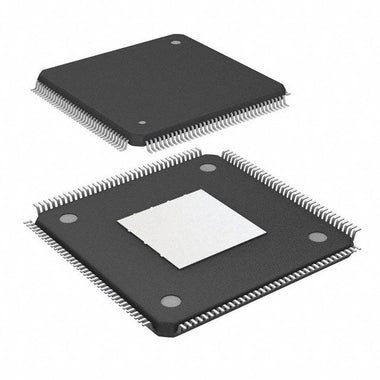
The LCMXO2-7000HC-4TG144C is offered in a 144-pin Thin Quad Flat Pack (TQFP) package. This leaded, surface-mount package is well-suited for cost-sensitive applications and allows for easier visual inspection of solder joints compared to BGA packages. The 144 pins are a mix of user I/O, dedicated power, ground, and configuration pins.
Key pin categories include:
- Power and Ground: Multiple VCC, VCCIO, and GND pins are distributed around the package. VCC (typically 1.2V) powers the internal logic core. VCCIO pins power the I/O banks and must be supplied with the voltage level required by the external devices they interface with (e.g., 3.3V, 2.5V, 1.8V). Proper decoupling with capacitors close to each power pin is critical for stable operation.
- User I/O: The device provides up to 114 general-purpose user I/O pins. These are organized into several I/O banks, with each bank having its own VCCIO supply. This allows the device to interface with multiple logic levels simultaneously, for example, connecting to a 3.3V microcontroller and a 1.8V sensor on the same chip. Each I/O is highly configurable and supports a wide range of standards like LVCMOS, LVTTL, SSTL, and HSTL.
- Configuration Pins: These pins manage the programming and configuration of the device. The primary interface is the JTAG port (TDI, TDO, TMS, TCK), which is used for in-system programming and debugging with tools like the Lattice Diamond Programmer. Other pins like PROGRAMN allow for triggering a reconfiguration from the on-chip Flash.
- Dedicated Clock Inputs: The device has dedicated global clock input pins (PCLKT/PCLKB) designed to drive the internal clock distribution networks with low skew and jitter. Using these pins for primary system clocks is a design best practice.
Engineers must consult the official Lattice datasheet and pinout files for the 144-TQFP package to determine the exact location of each I/O, power, and control pin. The flexibility of the I/O means that pin assignments are a critical part of the initial design phase, managed within the Lattice Diamond software environment.
Core Architectural Features
- Non-Volatile, Instant-On Configuration: The device integrates Flash configuration memory, allowing it to be live in under 1ms. This eliminates the cost and board space of an external configuration PROM, simplifies the power-up sequence, and secures the design bitstream within the chip. The configuration is re-programmable for field updates.
- Flexible Logic Fabric: It contains 6864 4-input Look-Up Tables (LUTs) which can be programmed to implement any combinatorial or sequential logic function. These LUTs can also be configured as 16x1 distributed RAM, shift registers, or ROM, providing granular memory resources throughout the design.
- Embedded Block RAM (EBR) and User Flash Memory (UFM): The device includes 240 Kbits of dedicated, true dual-port SRAM blocks (EBR) for efficient implementation of larger memory structures like FIFOs and data buffers. Additionally, a 256 Kbit User Flash Memory (UFM) block is available for non-volatile data storage, accessible from the user logic fabric.
- Hardened IP Blocks (EFB): The Embedded Function Block (EFB) contains hardened, pre-verified implementations of common peripherals. This includes one I2C core, one SPI core, and one Timer/Counter. Using these blocks saves significant logic resources and design time compared to implementing them in soft logic.
- Versatile and Programmable I/O: The device supports up to 114 user I/Os organized in banks, each with its own VCCIO. This enables multi-voltage bridging. The I/Os support a wide range of single-ended standards (LVCMOS/LVTTL), drive strength control, slew rate control, pull-up/pull-down resistors, and hot-socketing capabilities.
Specifications Parameter Table
| Specification | Technical Details |
|---|---|
| LUTs (4-Input) | 6864 |
| Embedded Block RAM (EBR) | 240 Kbits |
| User Flash Memory (UFM) | 256 Kbits |
| Maximum User I/O | 114 |
| Core Supply Voltage (VCC) | 1.14V to 1.26V (1.2V Nominal) |
| I/O Bank Supply Voltage (VCCIO) | 1.14V to 3.465V (Supports 1.2V, 1.5V, 1.8V, 2.5V, 3.3V standards) |
| Package Type | 144-pin Thin Quad Flat Pack (TQFP) |
| Operating Junction Temperature (Commercial) | 0°C to 85°C |
LCMXO2-7000HC-4TG144C Equivalents, Cross Reference & Lifecycle
The LCMXO2-7000HC-4TG144C is an active production device from Lattice Semiconductor. However, it's always prudent for procurement professionals and design engineers to verify the latest lifecycle status directly with the manufacturer or authorized distributors before committing to a new design.
When considering alternatives, the most direct path is to look within the MachXO2 family. A potential alternative could be a different speed grade or temperature range of the same device, such as the LCMXO2-7000HC-5TG144C (slower speed grade) or the LCMXO2-7000HC-4TG144I (industrial temperature range). These are often pin-compatible but require a timing analysis to ensure the design still meets performance requirements.
Another option is the low-power "ZE" variant, the LCMXO2-7000ZE-xTG144C. The ZE devices are optimized for static and dynamic power reduction but have different performance characteristics and may not be a drop-in replacement for an "HC" design. A full design port and re-verification would be necessary. Cross-referencing to a competing manufacturer's CPLD or small FPGA (e.g., from Xilinx/AMD or Intel/Altera) is a much more involved process, requiring a complete redesign of the logic, pinout, and power architecture. There are no direct, pin-for-pin compatible cross-family equivalents.
Before substituting any component, a thorough review of the respective datasheets is essential, paying close attention to timing parameters, I/O electrical characteristics, and power consumption. You can Check LCMXO2-7000HC-4TG144C Inventory & Pricing to assess current availability and sourcing options.
Typical Applications & Circuit Considerations
The LCMXO2-7000HC-4TG144C excels in a role often described as a "board management controller" or "system integration" device. Its combination of instant-on capability, flexible I/O, and embedded functions makes it ideal for tasks that must be active as soon as power is applied. Common applications include:
- Power Supply Sequencing and Monitoring: Using its fast power-up time, the MachXO2 can control the enable signals of multiple DC-DC converters and LDOs to ensure a specific power-up sequence required by processors, ASICs, and other complex ICs.
- I/O Expansion: A microprocessor with a limited number of GPIOs can use the MachXO2 to expand its I/O count, controlling dozens of LEDs, switches, or other simple peripherals via an SPI or I2C bus.
- Bus Bridging: The device can act as a protocol translator, for example, bridging a legacy parallel bus to a modern serial interface like SPI, or connecting two systems that use different I2C addresses or logic levels.
- Glue Logic: It can consolidate numerous smaller logic ICs (AND gates, OR gates, flip-flops, decoders) into a single chip, reducing BOM cost, simplifying the PCB, and increasing reliability.
- Video and Display Interfacing: For smaller displays, it can be used to generate timing signals, bridge between a processor's output and an LVDS transmitter, or perform simple image processing like color space conversion.
From a circuit design perspective, several considerations are key. The power delivery network is paramount. The 1.2V core voltage (VCC) requires a clean, stable supply, typically from a dedicated LDO or DC-DC converter. Each VCCIO bank must also be supplied with the appropriate voltage for its interface standard. A robust decoupling strategy, with 0.1uF and 10nF ceramic capacitors placed as close as possible to every VCC and VCCIO pin, is not optional; it is required for reliable operation. A solid ground plane in the PCB is essential to provide a low-impedance return path for all signals and power.
Clocking is another critical area. While the MachXO2 has an internal oscillator, for any performance-sensitive application, an external clock source connected to the dedicated global clock input pins should be used. This ensures a low-jitter clock is distributed efficiently across the entire logic fabric. For engineers looking to implement these types of solutions, it is beneficial to Browse MachXO2 Series to find the optimal density and package combination for their specific needs.
Video Demonstration
Frequently Asked Questions (LCMXO2-7000HC-4TG144C FAQ)
What makes the MachXO2 family different from a traditional SRAM-based FPGA?
The primary differentiator is its non-volatile architecture. The LCMXO2-7000HC-4TG144C uses on-chip Flash memory to store its configuration bitstream. This means it powers up instantly ("instant-on") without needing an external configuration PROM, unlike SRAM-based FPGAs which are volatile and must load their configuration from an external source on every power cycle. This single-chip solution reduces system cost, simplifies board layout, and enhances security by keeping the intellectual property internal to the device.
What software is used to program the LCMXO2-7000HC-4TG144C?
The LCMXO2-7000HC-4TG144C is designed using the Lattice Diamond software suite. This is a comprehensive IDE that supports the entire design flow, from HDL (VHDL/Verilog) entry and synthesis to place-and-route, timing analysis, and bitstream generation. The software also includes tools for programming the device in-system via a JTAG interface using a Lattice programming cable.
Can I use the internal Flash memory for user data storage?
Yes, you can. The device contains a dedicated block called the User Flash Memory (UFM), which is separate from the configuration Flash. The LCMXO2-7000HC has a 256 Kbit UFM block that can be read from and written to by the user logic implemented in the FPGA fabric. This is ideal for storing non-volatile data such as calibration coefficients, device serial numbers, or error logs.
What does the "HC" in the part number LCMXO2-7000HC-4TG144C signify?
The "HC" designation stands for "High-Performance." This variant of the MachXO2 family is optimized for higher speed and provides more I/O pins compared to its "ZE" (Zero Power) counterpart. While the "ZE" parts are designed for the lowest possible static power consumption, the "HC" parts offer better timing performance, making them more suitable for applications with faster clock speeds or more demanding interface requirements.
What are the power-up requirements for this device?
The MachXO2 family has flexible power-up sequencing requirements. According to the datasheet, you can either ramp the core voltage (VCC) and I/O voltage (VCCIO) simultaneously, or you can ramp VCCIO first, followed by VCC. The device is designed to be "instant-on," meaning it will load its configuration from the internal Flash and become operational in under a millisecond once power rails are stable. It's critical to ensure all power supplies are properly decoupled with capacitors close to the device pins.

Alan Carter
Senior Hardware Engineer & Component Specialist
Alan has over 15 years of expertise in embedded systems design, FPGA architecture, and global semiconductor supply chains. He specializes in component cross-referencing, lifecycle management, and helping OEMs navigate supply shortages.