LCMXO2-1200HC-4TG144C Application Guide: From Datasheet to Working Circuit
When designing a complex multi-rail embedded system, such as a video processing card or an industrial controller, managing the power-up sequence, system reset, and I/O expansion can become a significant challenge. A single, reliable component is often needed to orchestrate these critical "housekeeping" tasks. The Lattice LCMXO2-1200HC-4TG144C is frequently chosen for this role, providing a non-volatile, instant-on solution for system control, bridging, and glue logic, effectively acting as the central nervous system for the board's support functions.

Table of Contents
Application Context: Where LCMXO2-1200HC-4TG144C Fits in the System
In modern digital systems, the main processor or FPGA often requires a carefully managed environment to operate correctly. This is where the LCMXO2-1200HC-4TG144C excels as a system management controller. Consider a block diagram for a custom single-board computer (SBC) built around a powerful System-on-Chip (SoC). This SoC might require multiple voltage rails: 1.1V for the core, 1.5V for DDR3 memory, and 3.3V for general I/O. These rails must be enabled in a specific order and monitored for undervoltage conditions.
In this scenario, the LCMXO2-1200HC-4TG144C sits adjacent to the power management ICs (PMICs) or discrete regulators. Its I/O pins are connected to the 'Enable' pins of these regulators. At power-on, the MachXO2, being an "instant-on" device due to its non-volatile flash configuration, is the first intelligent component to become active. It executes a pre-programmed state machine that enables the power rails in the correct sequence with specified delays between each step. For example: enable 3.3V, wait 10ms, check 'Power Good' signal, enable 1.1V, wait 5ms, check 'Power Good', then enable 1.5V. After the sequence is complete, it asserts the main SoC's 'Power-On-Reset' pin, allowing the processor to boot safely.
Beyond power sequencing, the LCMXO2-1200HC-4TG144C serves as an I/O aggregator and level translator. The main SoC may have a limited number of GPIOs, or its I/Os might operate at a fixed voltage (e.g., 1.8V). The MachXO2, with its numerous user I/Os and multiple VCCIO banks, can solve this. It can interface with 3.3V I2C devices like temperature sensors, fan controllers, and EEPROMs using its hardened I2C core. It can then present this information to the main SoC over a single SPI or I2C bus that is level-shifted to the SoC's 1.8V domain. This bridging capability is a key function, saving board space and simplifying software drivers on the main processor. It also manages simple tasks like driving status LEDs, monitoring watchdog signals, and debouncing user input buttons, offloading these real-time, low-level tasks from the high-level operating system running on the SoC.
Core Specifications for This Application
| Parameter | Value | Application Relevance |
|---|---|---|
| Look-Up Tables (LUTs) | 1280 | Provides sufficient logic capacity for multiple state machines (power sequencing, reset logic), I/O multiplexing, and custom glue logic without resource constraints. |
| User I/O Pins | Up to 105 (in TG144 package) | A high I/O count allows the device to control numerous power rail enables, monitor power-good signals, drive status indicators, and interface with multiple peripherals simultaneously. |
| Non-Volatile Configuration | Internal Flash Memory | Crucial for "instant-on" capability. The device is operational at power-up to control sequencing before any other processor can boot, which is a primary requirement for a system controller. |
| VCCIO Banks | 8 independent banks | Enables true multi-voltage I/O support. This is essential for level shifting and directly interfacing between a 3.3V peripheral, a 2.5V bus, and a 1.8V SoC without external translator ICs. |
| Hardened I2C Core | One I2C block | Saves logic resources and simplifies design for interfacing with common system management bus (SMBus) or I2C peripherals like sensors, PMICs, and EEPROMs. |
| Internal Oscillator | Yes, with programmable frequency | Reduces the bill of materials (BOM) by eliminating the need for an external clock source for basic sequencing and control tasks, saving board space and cost. |
| Core Voltage (VCC) | 1.2V (Nominal) | The low core voltage contributes to lower static and dynamic power consumption, which is beneficial for overall system thermal and power budgets. |
| Hot-Socketing Support | Yes | I/Os remain high-impedance during power-up and power-down, preventing contention on shared buses and enabling safe insertion/removal of boards in a live system. |
Reference Circuit and Component Selection
A robust implementation of the LCMXO2-1200HC-4TG144C requires careful attention to its power delivery network, configuration interface, and I/O connections. While the device integrates many features, a few external components are necessary for stable operation.
Power Supply Design: The device has three types of power rails: VCC for the internal logic core (1.2V), VCCIO for the I/O banks (1.2V to 3.3V), and VCCJ for the JTAG and programming interface (typically 2.5V or 3.3V). Each power pin must have a dedicated high-frequency decoupling capacitor (e.g., 0.1µF or 0.01µF ceramic) placed as close as possible to the pin. It is also good practice to have bulk decoupling capacitors (e.g., 10µF) for each power rail, located near the device, to handle lower-frequency current demands. For a system management application, you might have VCC=1.2V, VCCJ=3.3V, VCCIO0/1=3.3V (for 5V-tolerant inputs and general I/O), and VCCIO2/3=1.8V (for interfacing with a modern SoC). This configuration highlights the flexibility of the I/O banks.
Configuration and JTAG: The JTAG port (TMS, TCK, TDI, TDO) is the primary method for in-system programming. These pins have internal pull-up or pull-down resistors, but for noisy environments or long trace lengths, external 1kΩ to 10kΩ pull-up (for TMS, TDI) and pull-down (for TCK) resistors are recommended to prevent spurious signals. The JTAG chain can be connected to a standard JTAG header on the PCB for connection to a Lattice programming cable. The PROGRAMN pin should be pulled high with a resistor to enable the device to load its configuration from internal flash at power-up.
I/O Connections: For the power sequencing application, I/O pins connected to regulator 'Enable' pins should be configured as push-pull outputs. Pins monitoring 'Power Good' signals should be configured as inputs, potentially with the internal pull-up or pull-down enabled to maintain a known state if the signal is disconnected. When using the hardened I2C core, the SDA and SCL pins require external pull-up resistors (e.g., 4.7kΩ) to the appropriate VCCIO voltage, as specified by the I2C standard. The entire Browse MachXO2 Series offers a range of I/O counts and logic densities, allowing designers to scale their choice based on system complexity.
Clocking: For many system control tasks, the internal oscillator is sufficient. It provides a clock for the sequencing state machine without any external components. If a more precise clock is needed, for example to generate a stable clock for an external peripheral, an external crystal oscillator can be connected to the PCLKT/PCLKC pin pairs, or a single-ended clock source can be fed into a standard I/O pin and routed internally to the on-chip PLLs for frequency synthesis.
Design Pitfalls and How to Avoid Them
| Common Mistake | Symptom | Fix |
|---|---|---|
| Incorrect Power Rail Sequencing | Device fails to configure, draws excessive current, or JTAG is unresponsive. I/O pins may be in an unknown state. | Follow the datasheet power-up sequence. VCC (core) and VCCJ must be powered before or at the same time as the VCCIO rails. Use a supervisor IC or a simple RC circuit to sequence the enables of your regulators. |
| Floating Unused I/O Pins | Increased static power consumption, susceptibility to noise, and potential for oscillations if the input buffer's threshold is crossed. | In the Lattice Diamond software, explicitly configure all unused I/O pins. A common practice is to set them as inputs with an internal pull-down resistor enabled, or as outputs driving low. |
| Violating VCCIO Bank Rules | I/O pins do not drive to the correct voltage levels, potential for back-powering a rail, or damage to the MachXO2 or connected ICs. | Group all I/Os by their required voltage standard. Connect all pins within a single I/O bank (e.g., Bank 0) to the same VCCIO supply. Double-check pin assignments against the package diagram. |
| Missing JTAG Pull Resistors | Intermittent JTAG programming failures, especially in a production environment or with longer programming cables. | While internal resistors exist, add external 4.7kΩ pull-up resistors on TMS and TDI, and a pull-down on TCK, placed close to the device pins for maximum noise immunity. |
Avoiding these common issues starts with a thorough review of the MachXO2 family datasheet and the "SysIO Usage Guide" from Lattice. The most critical of these is the power supply design. A poorly decoupled or incorrectly sequenced power network is the source of many hard-to-debug problems that manifest as unreliable device behavior. Simulating the power-up sequence and verifying it on the first prototype board is a crucial validation step. Similarly, treating unused I/O pins as an integral part of the design, rather than an afterthought, contributes to a robust and low-power final product. A disciplined approach to pin planning and VCCIO bank allocation early in the schematic capture phase will prevent time-consuming PCB revisions later.
Performance Optimization Tips
While a system management application is typically not performance-intensive, optimizing the design for power, EMI, and reliability is still important.
Power Consumption: Use the Lattice Power Calculator tool early in the design cycle. By providing estimated toggle rates for your I/O and internal logic, you can get a reasonable estimate of the device's power consumption. To minimize power, use the internal oscillator at the lowest frequency that meets your timing needs. In your HDL code, avoid unnecessary logic transitions and use clock gating techniques to disable parts of the design that are not actively in use. The LCMXO2-1200HC is a "High-Current" (HC) version, but you can still optimize for lower power by selecting the lowest effective drive strength on I/O pins that meets signal integrity requirements.
EMI Reduction: Fast-switching I/O pins are a primary source of electromagnetic interference. The MachXO2's sysIO buffers have programmable slew rates. For non-critical signals like LED drivers or reset lines, configure the slew rate to "SLOW" to reduce high-frequency harmonics and minimize EMI. A solid, unbroken ground plane in your PCB layout is the most effective way to reduce EMI. Ensure all high-frequency signal traces have a clear return path on the ground plane.
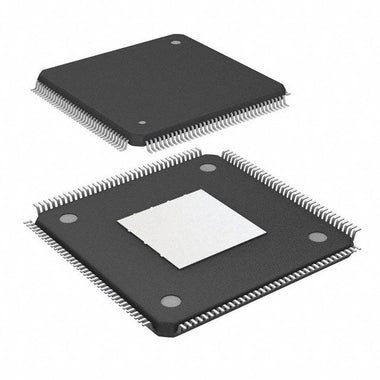
Thermal Management: For the 144-pin TQFP package, thermal dissipation is primarily through the PCB. The Power Calculator tool will provide a junction temperature estimate. If the device is running hot (e.g., many I/Os switching at high speed), ensure there is a sufficient copper area on the top and bottom layers connected to the ground pins. Using thermal vias under the device can help conduct heat to the ground plane, effectively turning your PCB into a heat sink.
Signal Integrity: For any interface faster than a few MHz (e.g., an SPI bus to an external flash), plan your trace routing carefully. Keep traces short, use controlled impedance if necessary, and consider series termination resistors (e.g., 33Ω) placed near the driver to dampen reflections, especially on the clock line. The programmable drive strength of the MachXO2 I/O can be tuned to match the trace impedance and improve signal quality.
Related Components and Accessories
To build a complete system around the LCMXO2-1200HC-4TG144C, several complementary components are required. For power, a combination of LDOs and switching regulators is often used. For instance, a 5V to 1.2V buck converter can efficiently generate the core voltage, while smaller LDOs can provide the 3.3V and 1.8V for the VCCIO rails. It's important to select regulators with 'Enable' pins that can be driven by the MachXO2's GPIOs.
A standard 2x5 or 2x7 0.1" pitch shrouded header is a common choice for the JTAG programming interface, providing a keyed connection for the programming cable. For the bill of materials, a good stock of multi-layer ceramic capacitors (MLCCs) in 0402 or 0603 packages (e.g., 0.01µF, 0.1µF, 1µF) is essential for decoupling. Likewise, a set of standard resistor values (1kΩ, 4.7kΩ, 10kΩ) will be needed for pull-ups and pull-downs. If you need to add user data storage beyond the MachXO2's internal flash, a simple 8-pin SOIC SPI flash memory IC is a common and effective companion part. When you are ready to move from design to procurement, you can Check LCMXO2-1200HC-4TG144C Inventory & Pricing to source the central component for your build.
Video Demonstration
Frequently Asked Questions (LCMXO2-1200HC-4TG144C FAQ)
How do I implement power-up sequencing with the LCMXO2-1200HC-4TG144C?
You can implement power-up sequencing by creating a state machine in VHDL or Verilog. The state machine uses internal counters to create delays between enabling different power rails. You connect the MachXO2's GPIO outputs to the 'Enable' pins of your voltage regulators. The instant-on nature of the device means this sequence begins as soon as the MachXO2 itself is powered, long before a main processor could boot.
Can this device level-shift between 3.3V and 1.8V logic?
Yes, this is a primary strength of the MachXO2 architecture. You can power one VCCIO bank (e.g., Bank 2) at 1.8V and another bank (e.g., Bank 0) at 3.3V. By routing a signal from an input pin in the 1.8V bank to an output pin in the 3.3V bank, you create a 1.8V to 3.3V level shifter. The reverse is also true, enabling seamless bidirectional communication between different voltage domains without external translator ICs.
What's the benefit of the internal flash memory in the MachXO2?
The internal, non-volatile flash memory provides "instant-on" operation. Unlike SRAM-based FPGAs that require an external configuration device and have a long boot time, the MachXO2 loads its configuration from internal flash almost instantly upon power-up. This is critical for system management applications where the device must be the first to become active to control power sequences and system resets.
Do I need an external crystal oscillator for the LCMXO2-1200HC-4TG144C?
Not necessarily. The device contains a trimmed, on-chip oscillator that is sufficient for many applications like power sequencing, I2C communication, and driving status LEDs. This reduces BOM cost and saves PCB space. You would only need an external crystal or oscillator if your application requires a higher-precision clock source or a frequency that cannot be generated by the internal oscillator and PLL combination.
How do I program the LCMXO2-1200HC-4TG144C on my PCB?
The device is programmed in-system via its standard IEEE 1149.1 JTAG interface (pins TDI, TDO, TCK, TMS). You would include a JTAG header on your PCB, which connects to a Lattice USB programming cable (e.g., HW-USBN-2B). Using the Lattice Diamond software, you can then directly program the internal flash memory with your compiled design file. This allows for easy prototyping, debugging, and firmware updates in the field.