EP4CE6E22I7N Application Guide: From Datasheet to Working Circuit
When designing a multi-axis motion control system for applications like CNC milling, 3D printing, or automated test equipment, the challenge lies in generating multiple, simultaneous, high-frequency pulse trains with minimal jitter. While a high-end microcontroller can struggle with this task for more than a couple of axes, the Altera EP4CE6E22I7N FPGA excels. Its parallel architecture allows it to function as a dedicated motion co-processor, offloading the real-time critical tasks of step/direction generation, quadrature encoder feedback processing, and hardware-level safety interlocking from a host MCU.

Table of Contents
Application Context: Where EP4CE6E22I7N Fits in the System
In a modern motion control system, the EP4CE6E22I7N acts as the central nervous system for real-time motor control, sitting between a high-level controller (like a PC or single-board computer) and the motor drive electronics. The system is typically partitioned to leverage the strengths of each component. A host microcontroller (MCU) or embedded Linux board handles non-real-time tasks such as user interface management, G-code parsing, and path planning. It sends high-level commands, such as "move X-axis 5000 steps at a rate of 200 kHz," to the FPGA via a standard communication bus like SPI or UART.
This is where the EP4CE6E22I7N takes over. Upon receiving a command, its internal logic, described in HDL (Verilog or VHDL), executes the task with hardware-defined timing and parallelism. For a 4-axis CNC machine, the FPGA would contain four independent instances of a "step generator" module. Each module is a state machine with a high-resolution counter that generates the precise STEP and DIRECTION signals required by the external stepper or servo motor drivers. Because these modules run in parallel, the performance of one axis is completely independent of the others, eliminating the software-induced jitter common in MCU-based solutions that rely on interrupts and loops.
Furthermore, the FPGA is responsible for closing the feedback loop. Quadrature encoder signals (A, B, and Index pulses) from each motor are fed directly into the FPGA's I/O pins. Dedicated HDL modules decode these signals to maintain an accurate, real-time position counter for each axis. This allows the system to detect stalls, missed steps, or external disturbances and either correct the position on the fly or flag an error to the host MCU. The FPGA's ability to process these fast, edge-sensitive signals simultaneously across all axes is a key advantage.
Safety is another critical function handled by the FPGA. Inputs from limit switches, emergency-stop buttons, and driver fault lines are wired directly to the EP4CE6E22I7N. The logic can be written to create a hardware-based interlock system that can disable the motor drivers within nanoseconds of a fault condition, far faster than an MCU could respond after an interrupt service routine is triggered and processed. This deterministic, low-latency response is paramount for machine and operator safety. In essence, the FPGA serves as a highly specialized, parallel-processing peripheral that transforms a general-purpose MCU into a powerful, real-time motion controller.
Core Specifications for This Application
| Parameter | Value | Application Relevance |
|---|---|---|
| Logic Elements (LEs) | 6,272 | Sufficient logic to implement multiple step generators, quadrature decoders, SPI/UART interfaces, and control state machines for a 4- to 6-axis system. |
| Total RAM bits | 276,480 | Useful for creating FIFOs to buffer commands from the host MCU, preventing data underruns and ensuring smooth motion. Can also be used for look-up tables for motion profiles. |
| Embedded 18x18 Multipliers | 15 | Enables implementation of digital signal processing (DSP) functions, such as S-curve acceleration/deceleration profiles or digital filters for noisy sensor inputs. |
| Phase-Locked Loops (PLLs) | 2 | Critical for taking a single, stable external clock source and synthesizing the multiple, high-frequency, phase-aligned clocks needed for the step generators and internal logic. |
| Maximum User I/O Pins | 92 | Provides ample connectivity for multiple motor drivers (Step/Dir/En), encoders (A/B/Z), limit switches, a host MCU interface, and other auxiliary functions. |
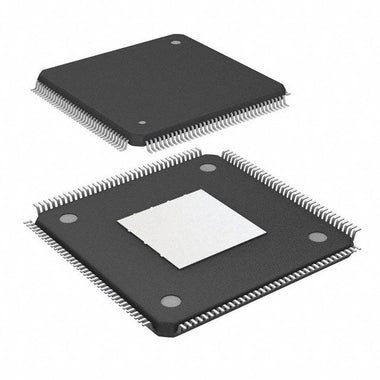
| Package | 144-Pin EQFP | A leaded package that is significantly easier to solder and inspect during prototyping and small-scale production compared to BGA packages. |
| Operating Temperature Range (Junction) | -40°C to 100°C (Industrial) | The 'I7' suffix denotes industrial grade, ensuring reliable operation in harsh factory environments where temperature fluctuations are common. |
| Core Voltage (VCCINT) | 1.2V | A standard low-voltage core for this process node, requiring a dedicated, stable voltage regulator. |
Reference Circuit and Component Selection
Designing a stable and reliable board for the EP4CE6E22I7N involves careful attention to power, clocking, and configuration. A minimal system for our motion control application requires several key external components.
Power Delivery Network: The Cyclone IV family requires multiple power rails. The EP4CE6E22I7N specifically needs a 1.2V core voltage (VCCINT), a 2.5V or 3.3V I/O voltage (VCCIO) for each bank, and a 2.5V supply for the PLL (VCCA). For a typical design, all VCCIO banks might be powered from a single 3.3V rail to interface with standard logic. It is critical to use separate regulators for VCCINT and VCCIO/VCCA. Low-noise LDOs or high-frequency switching regulators are suitable. Each power pin on the FPGA must have a dedicated high-frequency decoupling capacitor (typically 0.1µF) placed as close as possible to the pin, in addition to bulk capacitance (10µF - 47µF) for each power rail located near the device. The power-up sequence specified in the datasheet must be respected to avoid damaging the device; generally, VCCINT should ramp up first or simultaneously with VCCIO.
Configuration and JTAG: FPGAs are SRAM-based, meaning they require configuration from an external source on every power-up. The most common method is Active Serial (AS) mode, using an external serial configuration device like an Intel (formerly Altera) EPCS16. The MSEL[1:0] pins on the FPGA must be strapped with pull-up/pull-down resistors to select AS mode. The FPGA will then act as the master, clocking data out of the EPCS chip into its configuration memory. A 10-pin header for the JTAG interface (TCK, TMS, TDI, TDO) is essential for development and debugging. This allows you to program the FPGA directly from the Quartus Prime software via a USB-Blaster or similar programming cable, bypassing the configuration flash for rapid iteration.
Clocking: A stable clock source is non-negotiable. A standard 50 MHz canned crystal oscillator is a robust choice, feeding a dedicated global clock input pin on the FPGA. This 50 MHz clock can then be fed into one of the internal PLLs. The PLL can be configured using the Quartus software to generate, for example, a 100 MHz internal system clock for the state machines and a 25 MHz clock for the SPI interface, all phase-aligned and with low jitter. The clock trace on the PCB should be kept short, away from noisy signals, and properly routed to maintain signal integrity.
The entire Browse Cyclone IV Series offers a range of devices with varying logic densities, but the EP4CE6 is often the sweet spot for cost-sensitive control applications that still demand real-time performance.
Design Pitfalls and How to Avoid Them
| Common Mistake | Symptom | Fix |
|---|---|---|
| Insufficient Power Decoupling | FPGA fails to configure reliably; system behaves erratically or resets under load; timing failures. | Follow the datasheet's decoupling capacitor recommendations precisely. Use one 0.1µF ceramic capacitor per power pin pair, placed on the same side of the PCB as the FPGA and as close as possible. Add bulk tantalum or ceramic capacitors (10-100µF) for each power rail. |
| Incorrect Configuration Pin (MSEL) Strapping | FPGA does not attempt to configure from the flash memory after power-on. The CONF_DONE pin remains low. | Carefully read the "Configuration and Pin-Outs" chapter of the Cyclone IV handbook. For Active Serial (AS) x1 mode, ensure MSEL pins are set correctly (e.g., MSEL0=1, MSEL1=0) using appropriate pull-up/pull-down resistors (typically 1kΩ to 10kΩ). |
| Floating Unused I/O Pins | Increased power consumption, potential for I/O buffers to oscillate, causing noise and EMI. | Configure all unused I/O pins as outputs driving low in the Quartus project settings. This puts them in a known, low-power state. Do not leave them floating. |
| Ignoring I/O Bank Voltage Rules | Damage to the FPGA or connected peripherals. Inability to communicate with external devices. | Each I/O bank (a group of I/O pins) is powered by its own VCCIO pin. All pins in a bank must interface with logic at that VCCIO voltage. Never connect a 5V signal directly to a 3.3V-powered I/O bank without a proper level shifter. |
Beyond the table, a frequent oversight is neglecting the JTAG chain. If multiple FPGAs or CPLDs are on the same board, ensure the TDO of one device correctly feeds the TDI of the next, and that the programming software is configured for the multi-device chain. Another subtle issue is with the nCE (Chip Enable) pin on the FPGA. In many modes, this pin is not used and must be tied to ground. If left floating, the device may not configure. Always consult the specific configuration mode pin connection guidelines in the device handbook. Finally, pay close attention to the PCB layout around the oscillator and PLL power supply (VCCA), as noise in these areas can directly translate to jitter on all your generated clocks, undermining the primary reason for using an FPGA in a precision timing application.
Performance Optimization Tips
Thermal Management: The EP4CE6E22I7N in its 144-pin EQFP package has a thermal resistance that needs consideration, especially when operating near the upper end of its industrial temperature range or with high logic utilization. Use the Intel Power and Thermal Calculator tool early in the design phase to estimate power consumption. For designs pushing 80% utilization or running high-frequency logic, ensure adequate airflow. A simple but effective technique is to use a large ground plane on the PCB directly under the device, with thermal vias connecting to a ground plane on the opposite side, effectively using the board as a heat spreader. For more demanding scenarios, a small, stick-on heatsink can be applied to the top of the package.
EMI Reduction: FPGAs can be a source of significant electromagnetic interference due to fast-switching I/O. In the Quartus software, you can control the "Slew Rate" for each output pin. For non-critical signals like status LEDs or configuration lines, setting a slower slew rate can dramatically reduce high-frequency harmonics and EMI without impacting performance. For high-speed signals like motor step pulses, use the fastest slew rate but ensure the PCB trace is designed as a controlled impedance transmission line (e.g., 50-ohm microstrip) with proper termination to prevent reflections and ringing, which are also major sources of EMI.
HDL Design for Timing Closure: To get the maximum performance, adhere to synchronous design principles in your VHDL or Verilog code. Use a single main clock for all logic where possible, and properly handle clock domain crossings with FIFOs or handshaking logic. Utilize the TimeQuest Timing Analyzer tool in Quartus to identify critical paths (the longest logic delays between registers). If you have a timing violation, consider adding pipeline registers to break up long combinatorial paths into shorter stages that can run at a higher clock frequency. This is essential for achieving the multi-hundred kHz step rates required by high-performance motors.
Related Components and Accessories
A successful EP4CE6E22I7N design relies on a well-chosen ecosystem of supporting components. For power, consider using a combination of a switching regulator for efficiency on the main 3.3V rail, followed by low-noise LDOs like the Texas Instruments TPS7A85 series for the 1.2V VCCINT and 2.5V VCCA rails to ensure clean power for the core and PLLs. For configuration, the Intel (Altera) EPCS4, EPCS16, or compatible third-party serial flash devices from manufacturers like Micron or Winbond are standard choices. A high-quality 50 MHz crystal oscillator from a supplier such as Abracon or SiTime provides the heartbeat of the system. Finally, for development and production programming, an Intel USB-Blaster or a compatible Terasic USB Blaster is an indispensable tool. When sourcing these parts, it's crucial to ensure they meet the system's operational requirements. You can Check EP4CE6E22I7N Inventory & Pricing and find many of these complementary components from a single distributor to streamline your procurement process.
Video Demonstration
Frequently Asked Questions (EP4CE6E22I7N FAQ)
How do I power the EP4CE6E22I7N correctly?
The EP4CE6E22I7N requires multiple voltage rails for proper operation. You must provide a 1.2V supply for the core logic (VCCINT), a supply for the I/O banks (VCCIO), and a supply for the PLLs (VCCA). VCCIO can typically be 1.5V, 1.8V, 2.5V, or 3.3V, and must match the voltage of the external devices you are interfacing with. VCCA is typically 2.5V. It is critical to follow the datasheet's power-up sequence and provide thorough decoupling with 0.1µF capacitors at each power pin and larger bulk capacitors for each rail.
What kind of external memory is needed for configuration?
The EP4CE6E22I7N is an SRAM-based FPGA, so it loses its configuration when power is removed. You need a non-volatile memory chip to store the configuration file. The most common solution is to use a serial configuration device, such as an Intel (Altera) EPCS series flash memory chip (e.g., EPCS4 or EPCS16). The FPGA is set to Active Serial (AS) mode, where it acts as the master and automatically loads the configuration from the flash chip on power-up.
Can the EP4CE6E22I7N interface with 5V logic?
No, the I/O pins on the Cyclone IV E family are not 5V tolerant. Connecting a 5V signal directly to an I/O pin will likely damage the device over time. To interface with 5V logic, you must use an external level-shifting IC or a simple resistive voltage divider for inputs. For outputs from the FPGA to a 5V system, a buffer/level-translator like a 74HCT series logic gate is often used.
What is the maximum step frequency I can generate for a motor controller application?
The maximum frequency is not limited by the FPGA's I/O toggle rate but by your HDL design and the system clock. With a 50 MHz or 100 MHz internal clock, it is straightforward to design a step pulse generator capable of producing frequencies well into the megahertz range (e.g., 1-5 MHz). The practical limit is more often determined by the maximum input frequency of the external stepper motor driver, which is typically in the 200 kHz to 800 kHz range. The EP4CE6E22I7N can easily exceed the requirements of nearly all common motor drivers.
How do I program the EP4CE6E22I7N in-system?
There are two primary methods. For development, you use the JTAG interface (pins TCK, TMS, TDI, TDO) connected to a programming cable like an Intel USB-Blaster. This allows the Quartus software to directly configure the FPGA's SRAM, enabling rapid testing and debugging. For production, you program the external serial flash (e.g., EPCS) through the same JTAG chain; the Quartus programmer can send the data through the FPGA to the flash chip. Once the flash is programmed, the FPGA will automatically load its configuration from it on every subsequent power-on.