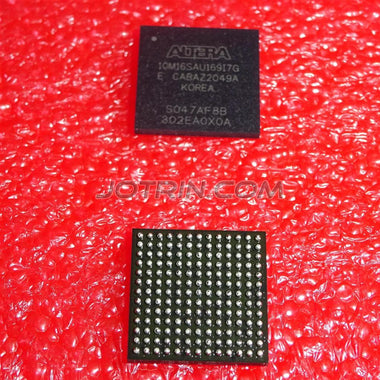
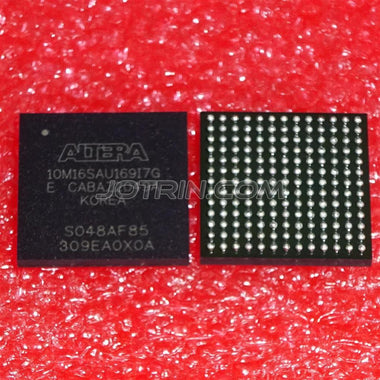
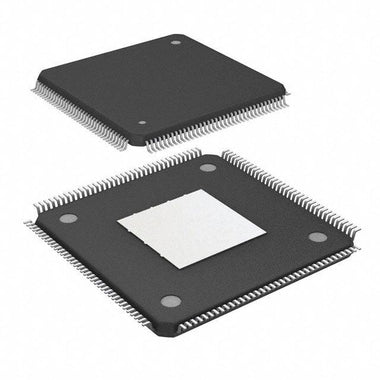
The LCMXO2-7000HC-4TG144C is a non-volatile Field-Programmable Gate Array (FPGA) from Lattice Semiconductor's MachXO2 family. It integrates 6864 four-input Look-Up Tables (LUTs), 240 kbits of Embedded Block RAM (EBR), and a flexible I/O structure within a 144-pin Thin Quad Flat Pack (TQFP) package. This device is engineered for low-power, "instant-on" system control and bridging applications, leveraging on-chip Flash memory for configuration, which eliminates the need for an external configuration PROM. Its architecture is optimized for functions such as power sequencing, I/O expansion, and interface bridging in a wide range of industrial, communications, and consumer electronics.
Table of Contents
What is the LCMXO2-7000HC-4TG144C?
The LCMXO2-7000HC-4TG144C is a programmable logic device (PLD) that combines the architectural features of a CPLD and an FPGA. It is built on a 65nm low-power process technology and features a 1.2V core voltage, denoted by the "HC" (High-Performance) in its part number. The core of the device is a programmable logic fabric composed of 6864 LUTs, which can be configured to implement complex combinatorial and sequential logic functions. This fabric is supplemented by distributed RAM and 240 kbits of dedicated Embedded Block RAM (EBR), providing on-chip memory for data buffering, state machines, and small processor implementations.
A defining characteristic of the MachXO2 family is its non-volatile configuration memory. The device contains an internal Flash block that stores the configuration bitmap. Upon power-up, the logic fabric is configured from this internal Flash in milliseconds, providing "instant-on" capability critical for system control tasks that must be active before a main processor boots. This architecture eliminates the external configuration memory device typically required by SRAM-based FPGAs, reducing board space, component count, and system cost. The internal Flash can be reprogrammed in-system via standard JTAG (IEEE 1532) or I2C interfaces, allowing for field updates.
In addition to the programmable logic, the LCMXO2-7000HC-4TG144C integrates several hardened function blocks to offload common tasks from the logic fabric. It includes two Phase-Locked Loops (PLLs) for clock synthesis, multiplication, division, and phase shifting, enabling robust clock management. The Embedded Function Block (EFB) contains hardened IP for I2C, SPI, and a timer/counter, which can be used without consuming valuable LUT resources. This combination of programmable logic, non-volatile memory, and hardened IP makes the device highly suitable for "glue logic" consolidation, power and thermal management, and bridging between disparate interfaces.

Pinout Configuration and Packaging
The LCMXO2-7000HC-4TG144C is offered in a 144-pin Thin Quad Flat Pack (TQFP) package, designated by "TG144" in the part number. This package has a body size of 20x20 mm with a 0.5 mm lead pitch, making it suitable for standard PCB manufacturing processes. The TQFP package provides a balance between pin density and ease of assembly, with leads that allow for visual inspection of solder joints. The package includes an exposed pad on the underside, which should be soldered to a ground plane on the PCB to ensure optimal thermal performance and signal integrity.
The 144 pins are organized into several I/O banks, each with a dedicated power supply pin (VCCIO). This multi-bank architecture allows the device to interface with multiple logic standards simultaneously. For example, one bank can be powered at 3.3V to interface with LVCMOS33 logic, while another can be powered at 1.8V for LVCMOS18 signals. The core logic operates from a separate 1.2V supply (VCC). Proper power supply decoupling with capacitors placed close to each VCC and VCCIO pin is critical for reliable operation. The pinout also includes dedicated pins for JTAG programming (TMS, TCK, TDI, TDO), configuration mode selection (PROGRAMN), and clock inputs for the PLLs. A significant portion of the pins are general-purpose I/O (GPIO), which can be configured to support a wide range of single-ended and differential I/O standards.
Core Architectural Features
- Non-Volatile, Instant-On Configuration: The device integrates on-chip Flash memory to store its configuration data. This enables system-level functions to be active within milliseconds of power-up, without the cost or board space of an external configuration PROM. The Flash is reprogrammable up to 100 times via JTAG or I2C.
- Flexible Logic Architecture: The core contains 6864 4-input LUTs that can be configured as logic, distributed RAM, or shift registers. This is complemented by 240 kbits of dedicated, true dual-port Embedded Block RAM (EBR) for more substantial data buffering needs.
- Embedded Function Block (EFB): The device includes a hardened block with pre-engineered functions, including a user-programmable I2C controller, an SPI controller, and a timer/counter. Using these hardened blocks frees up programmable logic resources for custom application logic and ensures predictable performance.
- Advanced I/O Support: The programmable I/O banks support a wide range of logic standards, including LVCMOS (3.3/2.5/1.8/1.5/1.2V), LVTTL, SSTL, and HSTL. Each I/O pin can be individually configured with features like pull-up/pull-down resistors, bus keepers, and programmable slew rates to optimize signal integrity.
- Integrated Clock Management: Two on-chip PLLs provide robust clock management capabilities. They can be used for frequency synthesis (multiplication and division), phase shifting, and clock de-skew, simplifying system clock tree design and reducing the need for external clocking components.
Specifications Parameter Table
| Specification | Technical Details |
|---|---|
| Logic Cells (LUTs) | 6864 |
| Embedded Block RAM (EBR) | 240 kbits |
| Distributed RAM | 54 kbits |
| Phase-Locked Loops (PLLs) | 2 |
| Maximum User I/O | 114 |
| Core Supply Voltage (VCC) | 1.14V to 1.26V (1.2V Nominal) |
| I/O Supply Voltage (VCCIO) | 1.14V to 3.465V |
| Package | 144-pin TQFP |
| Operating Temperature (Junction) | 0°C to 85°C (Commercial Grade) |
| Speed Grade | -4 |
LCMXO2-7000HC-4TG144C Equivalents, Cross Reference & Lifecycle
The LCMXO2-7000HC-4TG144C is an active production device from Lattice Semiconductor. When considering equivalents, engineers should primarily look within the MachXO2 family for parts that share the same package footprint. For instance, the LCMXO2-7000HE-4TG144C is a close alternative; the "HE" variant is optimized for higher I/O count and features, while the "HC" is optimized for logic capacity. While they share the same package, pin functions may differ, requiring careful review of the pinout files before direct replacement.
Other devices within the 7000-LUT density class but with different speed grades (e.g., -5 for faster performance) or temperature ranges (e.g., 'I' for industrial) are also available in the TG144 package. These are often pin-compatible, allowing for performance or environmental specification changes on the same PCB layout. For designs requiring more or fewer logic resources, other members of the MachXO2 family in the TG144 package, such as the LCMXO2-4000 or LCMXO2-1200, may be considered, but these are not drop-in replacements due to different die sizes and pinout assignments. Always verify pin compatibility using the official Lattice documentation before substitution. To verify current stock levels and pricing for this specific part, you can Check LCMXO2-7000HC-4TG144C Inventory & Pricing.
Typical Applications & Circuit Considerations
The LCMXO2-7000HC-4TG144C excels in system control, bridging, and logic integration roles where its instant-on, low-power, and non-volatile characteristics are advantageous. Common applications include:
- Power-Up Sequencing and Control: The instant-on nature allows the MachXO2 to control power supply enables, monitor power-good signals, and manage system resets from the moment power is applied, ensuring a stable startup sequence for complex SoCs and processors.
- I/O Expansion: For microcontrollers or processors with limited GPIO, the device can serve as a port expander, controlled via a simple I2C or SPI bus. Its flexible I/O banks can also perform voltage level translation between different parts of the system.
- Interface Bridging: The programmable logic is well-suited for protocol conversion, such as bridging a legacy parallel bus to a modern serial interface like SPI or I2C, or vice-versa. The EFB's hardened I2C and SPI controllers simplify these tasks.
- System Bus and "Glue Logic" Integration: The device can consolidate numerous discrete logic components (AND gates, flip-flops, decoders) into a single chip, reducing board area, simplifying inventory, and increasing system reliability.
When designing a PCB for the LCMXO2-7000HC-4TG144C, several considerations are critical. A solid ground plane is essential for signal integrity and thermal dissipation, particularly connected to the central exposed pad. Each VCC (core) and VCCIO (I/O bank) supply rail requires its own set of decoupling capacitors. A combination of a bulk capacitor (e.g., 10µF) and several smaller high-frequency capacitors (e.g., 0.1µF, 0.01µF) should be placed as close as possible to their respective power pins. The JTAG and configuration pins should have accessible test points or a header for programming and debugging. For high-speed I/O signals, trace impedance should be controlled and matched to the requirements of the specific I/O standard being used. The entire Browse MachXO2 Series offers a range of densities and packages to fit various system requirements.
Video Demonstration
Frequently Asked Questions (LCMXO2-7000HC-4TG144C FAQ)
Q: What is the primary difference between the MachXO2 'HC' and 'ZE' variants?
A: The primary difference lies in their intended application and power consumption profile. The 'HC' (High-Performance) variant, like the LCMXO2-7000HC, is optimized for logic capacity and performance with a 1.2V core voltage. The 'ZE' (Zero-Power) variant is designed for extremely low static power consumption, making it ideal for battery-powered or power-sensitive applications, but it typically offers a lower logic density and performance envelope compared to the HC models.
Q: Can the internal Flash memory of the LCMXO2-7000HC be used for user data storage?
A: Yes, in addition to the primary configuration Flash memory, the MachXO2 family features a dedicated block of User Flash Memory (UFM). This UFM block is separate from the configuration memory and can be accessed by the FPGA logic after configuration. It allows the device to store non-volatile user data such as serial numbers, calibration constants, or boot parameters, eliminating the need for a separate EEPROM in many systems.
Q: What I/O standards are supported by the LCMXO2-7000HC-4TG144C?
A: The device supports a wide range of single-ended I/O standards, enabled by its flexible I/O bank architecture where each bank can be powered by a different VCCIO voltage. Supported standards include LVCMOS (3.3V, 2.5V, 1.8V, 1.5V, 1.2V), LVTTL, and various stub-series terminated logic (SSTL) and high-speed transceiver logic (HSTL) standards for interfacing with memory like DDR. This flexibility allows it to directly interface with a multitude of other components without external level-shifting logic.
Q: How is the LCMXO2-7000HC programmed in-system?
A: The device supports multiple in-system programming (ISP) methods. The most common method is via the standard 4-wire JTAG (IEEE 1149.1) interface, which is used for both initial programming and debugging. Additionally, the device can be programmed via its I2C or SPI port, allowing a host microcontroller to update the FPGA's configuration in the field without requiring a dedicated JTAG programming cable.
Q: What is the purpose of the Embedded Function Block (EFB)?
A: The Embedded Function Block (EFB) is a hardened section of silicon within the MachXO2 device that contains pre-verified, commonly used peripherals. In the LCMXO2-7000HC, this includes an I2C controller, an SPI controller, and a timer/counter. By using these hardened blocks instead of implementing them in soft logic (LUTs), designers can save significant logic resources, achieve predictable timing performance, and reduce development time, as these functions are already validated by Lattice.

Alan Carter
Senior Hardware Engineer & Component Specialist
Alan has over 15 years of expertise in embedded systems design, FPGA architecture, and global semiconductor supply chains. He specializes in component cross-referencing, lifecycle management, and helping OEMs navigate supply shortages.