LCMXO2-1200HC-4TG144C Datasheet, Pinout, Equivalents, and Specs
The LCMXO2-1200HC-4TG144C is a highly integrated, non-volatile programmable logic device (PLD) belonging to the Lattice Semiconductor MachXO2 family. Engineered to bridge the architectural gap between traditional Complex Programmable Logic Devices (CPLDs) and low-density Field Programmable Gate Arrays (FPGAs), this component provides 1,280 Look-Up Tables (LUTs) alongside embedded hardened IP blocks. Utilizing a 130-nm embedded flash process technology, the device delivers instant-on functionality, deterministic timing, and robust I/O expansion capabilities, making it a foundational component for system control, power sequencing, and interface bridging in commercial-grade embedded hardware.
Table of Contents
What is the LCMXO2-1200HC-4TG144C?
The LCMXO2-1200HC-4TG144C is a non-volatile PLD that integrates a flexible logic fabric with embedded flash memory, static RAM, and hardened communication interfaces. At its core, the device relies on an SRAM-based logic architecture where the configuration bitstream is stored in an on-chip embedded flash memory block. Upon power-up, the device executes an internal transfer from the flash memory to the SRAM configuration cells in microseconds, achieving true "instant-on" capability without the need for an external boot PROM or microcontroller intervention.
The logic fabric is constructed from Programmable Functional Units (PFUs), which are interconnected via a hierarchical routing matrix. Each PFU contains four interconnected slices, and each slice is equipped with two 4-input Look-Up Tables (LUT4s) and two dedicated flip-flops. This granular architecture allows for efficient implementation of combinatorial logic, arithmetic functions (via dedicated carry-chain logic), and distributed RAM. The "1200" designation indicates a logic capacity of approximately 1,280 LUTs, providing sufficient density for complex state machines, protocol translation, and peripheral control.
The "HC" suffix in the part number denotes the High-Performance core variant of the MachXO2 family. Unlike the "ZE" (Zero Power) variants that operate at a 1.2V core voltage, the HC variant is designed to operate with a core voltage (VCC) of either 2.5V or 3.3V. This higher core voltage allows the device to achieve higher internal clock frequencies and shorter propagation delays. The "-4" indicates the standard commercial speed grade, balancing performance with thermal dissipation. Furthermore, the device incorporates hardened IP blocks, including an I2C controller, an SPI controller, and a Timer/Counter. By implementing these common functions in hard silicon rather than soft logic, the LCMXO2-1200HC-4TG144C frees up valuable LUT resources for custom user logic, thereby maximizing the effective density of the PLD.

Pinout Configuration and Packaging
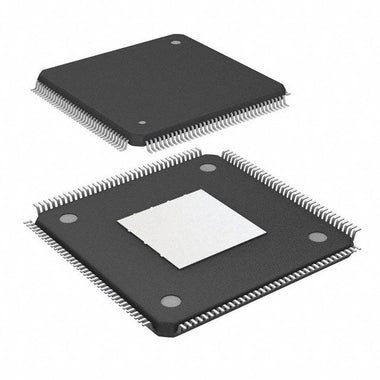
The LCMXO2-1200HC-4TG144C is housed in a 144-pin Thin Quad Flat Package (TQFP), designated by the "TG144" suffix. This package features a 20mm x 20mm body size with a 0.5mm lead pitch, providing a high pin-to-area ratio suitable for densely populated printed circuit boards (PCBs). Out of the 144 physical pins, the device provides up to 107 user-accessible I/O pins, which are distributed across four independent sysIO banks.
The sysIO architecture is a critical feature of the pinout. Each of the four banks (Bank 0 through Bank 3) has its own dedicated VCCIO power supply pin. This independence allows the LCMXO2-1200HC-4TG144C to act as a seamless voltage-level translator. For instance, Bank 0 can be powered at 3.3V to interface with legacy peripherals, while Bank 1 can be powered at 1.8V to communicate with a modern application processor. The I/O pins support a wide array of single-ended and differential signaling standards, including LVCMOS (3.3V, 2.5V, 1.8V, 1.5V, 1.2V), LVTTL, LVDS, MLVDS, and PCI.
In addition to user I/O, the pinout includes several critical dedicated and dual-purpose pins. The JTAG interface (TCK, TMS, TDI, TDO) is compliant with IEEE 1149.1 and is used for boundary-scan testing and device programming. Configuration pins such as PROGRAMN (active-low configuration reset), INITN (open-drain initialization indicator), and DONE (open-drain configuration completion indicator) are essential for managing the device's boot sequence. Global clock inputs (PCLK) are strategically placed to provide low-skew routing to the internal sysCLOCK PLLs and the primary clock distribution network.
Core Architectural Features
- sysMEM Embedded Block RAM (EBR): The device includes 64 Kbits of dedicated EBR, organized into 9-Kbit blocks. These blocks can be configured as single-port RAM, dual-port RAM, pseudo-dual-port RAM, or ROM, complete with built-in FIFO control logic and optional parity bits for data integrity.
- User Flash Memory (UFM): Alongside the configuration flash, the device provides 64 Kbits of non-volatile User Flash Memory. This sector is accessible via the hardened I2C/SPI interfaces or the internal WISHBONE bus, making it ideal for storing calibration coefficients, MAC addresses, or system initialization parameters.
- sysCLOCK Phase Locked Loops (PLLs): The architecture includes one analog PLL that supports frequency synthesis, clock multiplication/division, phase shifting, and duty cycle adjustments. This allows for precise synchronization of internal logic with external system clocks.
- Hardened Communication IP: To conserve programmable logic resources, the device features embedded hard IP for one I2C interface, one SPI interface, and one Timer/Counter block. These blocks operate independently of the LUT fabric and can be accessed via the internal WISHBONE routing.
- Flexible sysIO Buffers: The programmable I/O buffers feature adjustable drive strength (up to 16mA for certain standards), programmable slew rate control (fast/slow) to mitigate EMI, and optional internal pull-up, pull-down, or bus-keeper resistors, eliminating the need for external passive components in many designs.
Specifications Parameter Table
| Specification | Technical Details |
|---|---|
| Manufacturer | Lattice Semiconductor |
| Logic Elements / LUTs | 1,280 |
| Embedded Block RAM (EBR) | 64 Kbits |
| User Flash Memory (UFM) | 64 Kbits |
| Maximum User I/O | 107 |
| Core Operating Voltage (VCC) | 2.375V to 3.465V (Nominal 2.5V or 3.3V) |
| Speed Grade | -4 (Standard Commercial) |
| Package Type | 144-pin TQFP (20mm x 20mm, 0.5mm pitch) |
| Operating Temperature Range | 0°C to +85°C (Commercial Junction Temperature) |
LCMXO2-1200HC-4TG144C Equivalents, Cross Reference & Lifecycle
The LCMXO2-1200HC-4TG144C is currently in an active lifecycle phase and remains a recommended component for new commercial designs requiring low-density, non-volatile logic. Within the Lattice ecosystem, engineers seeking lower power consumption may consider the LCMXO2-1200ZE-1TG144C, which shares the same footprint and logic capacity but operates at a 1.2V core voltage for ultra-low static power. Conversely, if a design requires more logic resources but must maintain the same physical footprint, the LCMXO2-2000HC-4TG144C provides a drop-in, pin-compatible upgrade with 2,112 LUTs.
When cross-referencing against other manufacturers, the Intel (Altera) MAX 10 series (e.g., 10M02) and the AMD (Xilinx) Spartan-7 or older CoolRunner-II CPLDs serve similar architectural roles. However, direct pin-to-pin compatibility does not exist across different manufacturers due to proprietary routing and power architectures. Engineers transitioning from a competitor's architecture to the MachXO2 must redesign the PCB footprint and port the HDL code using Lattice Diamond design software. To verify current availability, lead times, and procurement options, Check LCMXO2-1200HC-4TG144C Inventory & Pricing.
Typical Applications & Circuit Considerations
The LCMXO2-1200HC-4TG144C is deployed extensively in system control and management applications. A primary use case is power supply sequencing and monitoring on complex motherboards or industrial control systems. The PLD monitors "Power Good" signals from various DC-DC converters and asserts enable signals in a strictly defined, deterministic sequence. Its instant-on nature ensures that the sequencing logic is fully operational before the rest of the board's components begin their power-up phases.
Another frequent application is interface bridging and I/O expansion. Modern microcontrollers and Application-Specific Integrated Circuits (ASICs) often lack a sufficient number of GPIOs or specific legacy interfaces. The LCMXO2-1200HC-4TG144C can act as an intelligent companion chip, translating high-speed SPI from a host processor into multiple independent I2C buses, UARTs, or custom parallel interfaces. The multi-voltage sysIO banks facilitate this by simultaneously handling 1.8V logic from the processor and 3.3V logic from peripheral sensors.
From a PCB design perspective, strict adherence to power distribution network (PDN) guidelines is required. The VCC and VCCIO pins must be bypassed with low-ESR ceramic decoupling capacitors. A standard recommendation is to place a 0.01µF and a 0.1µF capacitor as close as physically possible to each power pin pair, backed by a larger bulk capacitor (10µF to 47µF) at the power entry point of the PLD footprint. While the HC variant is tolerant of various power-up sequences between VCC and VCCIO, it is critical that VCC reaches its minimum monotonic threshold (2.375V) to ensure reliable initialization of the internal flash memory. For high-speed I/O routing, particularly when utilizing LVDS or fast-slew-rate single-ended signals, controlled impedance traces (typically 50Ω single-ended or 100Ω differential) must be maintained to prevent signal reflection and crosstalk. To explore other densities and package options within this architecture, Browse MachXO2 Series.
Video Demonstration
Frequently Asked Questions (LCMXO2-1200HC-4TG144C FAQ)
Q: What differentiates the HC variant from the ZE variant in the MachXO2 family?
A: The HC (High Performance) variant is designed to operate with a core voltage (VCC) of either 2.5V or 3.3V, providing faster internal logic performance and shorter propagation delays. In contrast, the ZE (Zero Power) variant operates at a strict 1.2V core voltage and is optimized for ultra-low static power consumption in battery-operated devices. While their power architectures differ, both variants share the identical underlying logic fabric and embedded IP features.
Q: How does the instant-on configuration process function in this PLD?
A: The LCMXO2-1200HC-4TG144C contains an internal non-volatile flash memory block that stores the user's configuration bitstream. Upon application of power, an internal state machine automatically transfers this bitstream from the flash memory into the volatile SRAM configuration cells. This transfer is completed in a matter of microseconds, allowing the device's I/O and logic to become fully operational before other system components have finished booting.
Q: Can the LCMXO2-1200HC-4TG144C drive differential signals such as LVDS?
A: Yes, the device supports differential signaling standards including LVDS, BLVDS, and MLVDS. However, true LVDS output drivers are typically restricted to specific sysIO banks (usually Bank 0 on MachXO2 devices), and the corresponding VCCIO must be set to 2.5V. For inputs, differential signals can be received on any bank provided the correct termination resistors are implemented and the input voltage tolerances are respected.
Q: What is the primary function of the User Flash Memory (UFM) block?
A: The UFM is a dedicated 64-Kbit sector of non-volatile flash memory available for user data storage, completely separate from the configuration bitstream memory. It is typically used to store system parameters, calibration coefficients, MAC addresses, or error logs. The UFM can be accessed dynamically during runtime via the internal WISHBONE bus or externally through the hardened I2C or SPI interfaces.
Q: What are the recommended JTAG termination practices for this device?
A: For reliable boundary-scan operations and in-system programming, the JTAG pins require specific termination. The TDI and TMS pins possess internal pull-up resistors, but adding external 10kΩ pull-ups to VCCIO is recommended for noisy environments. The TCK pin should be pulled down to ground via a 4.7kΩ resistor to prevent false clocking during power-up, and the TDO pin can be left floating if it is the last device in the JTAG chain.

Alan Carter
Senior Hardware Engineer & Component Specialist
Alan has over 15 years of expertise in embedded systems design, FPGA architecture, and global semiconductor supply chains. He specializes in component cross-referencing, lifecycle management, and helping OEMs navigate supply shortages.