Overview of the 10M16SAU169I7G MAX 10 FPGA
The 10M16SAU169I7G is a non-volatile FPGA from the Intel (formerly Altera) MAX 10 family. Built on a 55 nm flash process, this device integrates 16,000 logic elements, embedded analog-to-digital converters, and user flash memory into a compact UBGA-169 package. Its industrial-grade temperature range (−40 °C to +100 °C) and single-chip configuration make it ideal for cost-sensitive, space-constrained embedded systems that demand instant-on capability.
The MAX 10 family eliminates the need for external configuration devices by storing the FPGA bitstream in on-chip flash, reducing board area and BOM cost. With dual configuration images, remote field updates, and an integrated ADC, the 10M16SAU169I7G is well suited for industrial automation, motor control, IoT gateways, and sensor-interface applications.

Figure 1 — Intel MAX 10 FPGA architecture and block diagram overview.
Key Specifications and Parameters
| Parameter | Value |
|---|---|
| Part Number | 10M16SAU169I7G |
| Manufacturer | Intel / Altera |
| Family | MAX 10 (10M16) |
| Logic Elements (LEs) | 16,000 |
| Logic Array Blocks (LABs) | 1,000 |
| Embedded Memory (M9K) | 549 Kb (562,176 bits) |
| 18 × 18 Embedded Multipliers | 45 |
| Phase-Locked Loops (PLLs) | 4 |
| Analog-to-Digital Converter | 1 dual-ADC (up to 17 channels, 12-bit, 1 MSPS) |
| User Flash Memory (UFM) | 2,368 Kb |
| Maximum User I/O | 130 |
| Maximum LVDS Pairs | 22 |
| Package | UBGA-169 (11 × 11 mm, 0.8 mm pitch) |
| Core Voltage | 1.2 V |
| I/O Voltage | 1.0 V – 3.3 V (LVCMOS / LVTTL / SSTL / HSTL) |
| Speed Grade | 7 (slowest) |
| Temperature Grade | Industrial: −40 °C to +100 °C |
| Process Technology | 55 nm Flash |
| Configuration | Internal (dual boot images, no external config device) |
| External Memory Interface | DDR3, DDR2, LPDDR2 |
| RoHS / Lead-Free | Yes |
Pinout, Package, and Block Diagram
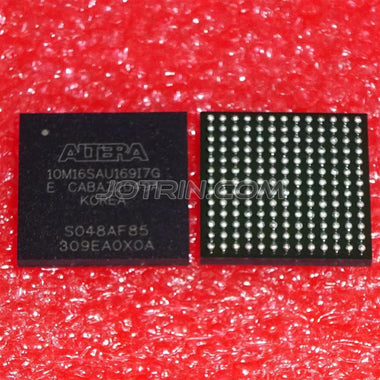
The 10M16SAU169I7G is housed in an 11 × 11 mm ultra-thin fine-pitch BGA package with 169 balls at 0.8 mm pitch. The U169 variant provides 130 general-purpose I/Os across eight I/O banks, supporting a broad range of single-ended and differential standards. The package's low profile (1.55 mm seated height) makes it suitable for height-restricted applications such as M.2 modules and thin-profile sensor nodes.

Figure 2 — MAX 10 FPGA in UBGA-169 package (U169, 11 × 11 mm).
Key pinout groups include dedicated clock inputs (CLK[0..3]), JTAG programming pins (TCK, TDI, TDO, TMS), analog input channels for the integrated ADC, and configurable I/O banks that support 3.3 V LVTTL, 2.5 V LVCMOS, 1.8 V, 1.5 V, and differential LVDS standards. For full pin assignments, refer to the official MAX 10 Pin-Out Files available from Intel.
Applications and Typical Circuits
The 10M16SAU169I7G is deployed across a wide range of embedded and industrial designs:
- Industrial automation: Motor drives, PLC I/O expansion, sensor fusion.
- Communications: Protocol bridging, small-cell base station control, fiber-optic transceivers.
- Consumer & IoT: Smart-home hubs, wearable sensor interfaces, edge-AI inference accelerators.
- Automotive: ADAS sensor pre-processing, display controllers, CAN/LIN gateway.
- Medical: Patient-monitoring front-ends, ultrasound signal conditioning.
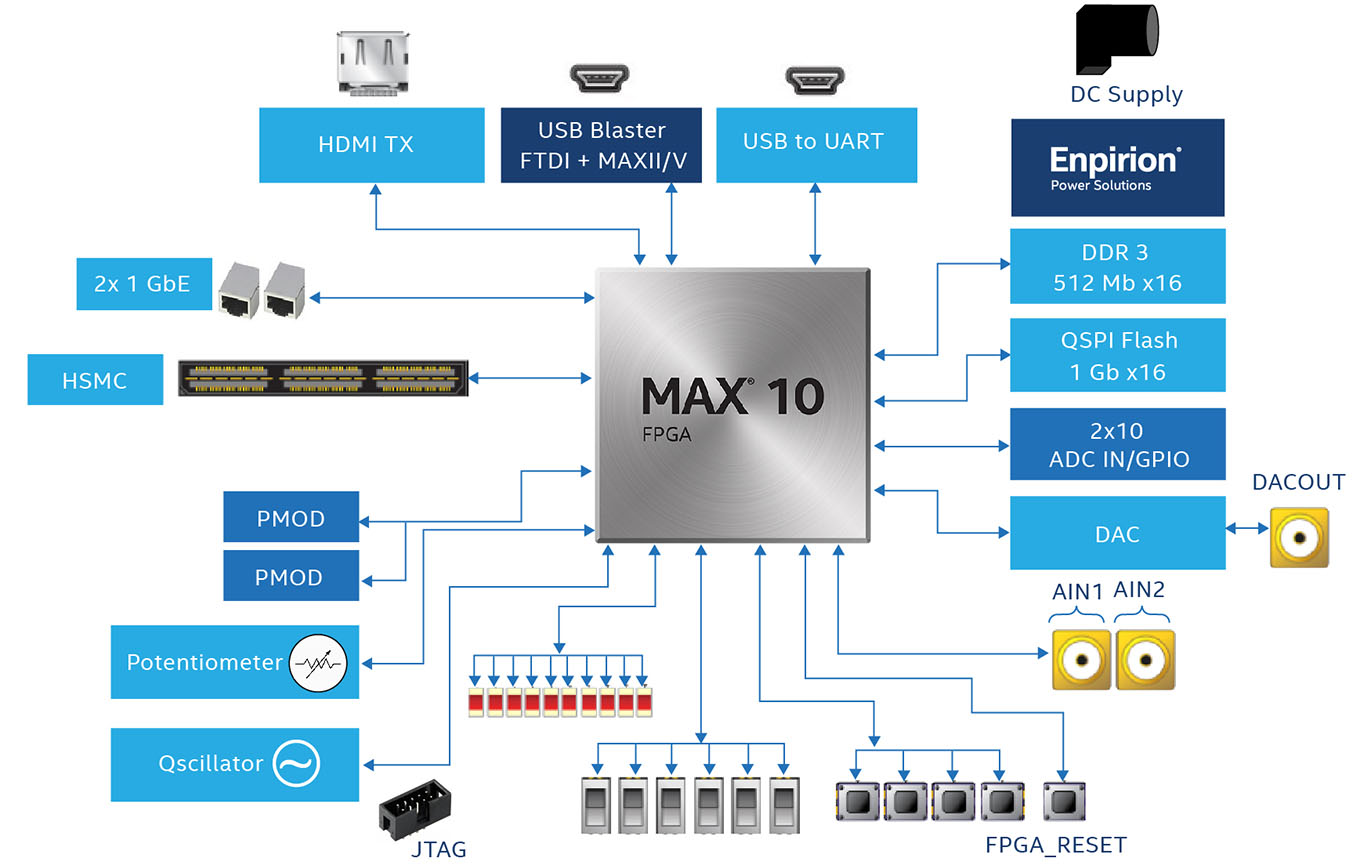
Figure 3 — MAX 10 FPGA Development Kit block diagram illustrating a typical application circuit with mixed-signal and digital interfaces.
A representative application pairs the 10M16SAU169I7G with a DDR3 SDRAM, an SPI flash for data logging, and the on-chip ADC to digitize external analog sensors. The instant-on capability of the internal configuration flash ensures the system is operational within milliseconds of power-up—critical for safety-related industrial and automotive applications.
Design Resources and Development Tools
Intel provides comprehensive tooling for the MAX 10 family:
- Quartus Prime Lite Edition — free FPGA design software with synthesis, place-and-route, and timing analysis.
- Platform Designer (Qsys) — system integration tool for building Nios II soft-processor and peripheral subsystems.
- ModelSim Intel FPGA Edition — RTL simulation and verification.
- MAX 10 FPGA Development Kit — evaluation board featuring the 10M50 device with Arduino headers, Ethernet, HDMI, and dual ADC SMA inputs.
- MAX 10 FPGA Evaluation Kit — low-cost evaluation board for rapid prototyping.
Video Tutorial
Video — Getting started with the Intel MAX 10 FPGA Evaluation Kit.
Related Parts on wwdparts.com
- 10M08SAU169I7G — MAX 10, 8K LE, UBGA-169
- 10M50DAF484C8G — MAX 10, 50K LE, FBGA-484
- 5CEBA4F23C8N — Cyclone V, 49K LE, FBGA-484
Frequently Asked Questions
What is the 10M16SAU169I7G?
The 10M16SAU169I7G is an Intel (Altera) MAX 10 non-volatile FPGA with 16,000 logic elements, an integrated 12-bit ADC, user flash memory, and internal configuration storage in a 169-ball UBGA package rated for the industrial temperature range (−40 °C to +100 °C).
Does the 10M16SAU169I7G require an external configuration device?
No. The MAX 10 family stores its configuration bitstream in on-chip flash memory, enabling instant-on operation without an external EEPROM or flash device. It supports dual configuration images for remote field updates.
What package is the 10M16SAU169I7G available in?
This device comes in a UBGA-169 (Ultra-thin Ball Grid Array) package measuring 11 × 11 mm with a 0.8 mm ball pitch and a maximum seated height of 1.55 mm, providing 130 user I/O pins.
What is the operating temperature range of the 10M16SAU169I7G?
The “I” suffix indicates an industrial temperature grade, supporting an operating junction temperature range of −40 °C to +100 °C, making it suitable for harsh-environment and outdoor deployments.
What design software is needed for the 10M16SAU169I7G?
Intel’s Quartus Prime Lite Edition (free) fully supports MAX 10 devices. It includes synthesis, place-and-route, timing analysis, the Platform Designer system-integration tool, and the Nios II soft-processor toolchain.
Does the 10M16SAU169I7G have an analog-to-digital converter?
Yes. It integrates a dual 12-bit SAR ADC capable of up to 1 MSPS, with up to 17 analog input channels. This on-chip ADC eliminates the need for an external ADC in many sensor-interface and mixed-signal applications.