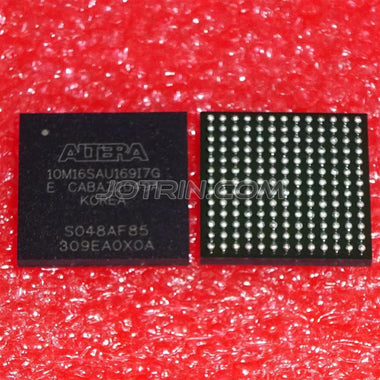
The 10M16SAU169I7G is an FPGA from Intel's (formerly Altera) MAX 10 family, fabricated on a 55 nm flash-based process with a 1.2 V core supply. It integrates 16,000 logic elements, 549 Kb of embedded M9K SRAM, 45 embedded 18×18 multipliers, 4 PLLs, and a dual-channel 12-bit ADC in a compact 169-pin UBGA package. With 130 user I/O pins and industrial-grade operation (-40 °C to +100 °C), the 10M16SAU169I7G targets single-chip embedded solutions in harsh-environment industrial, automotive-adjacent, and IoT edge-computing applications where integrated analog acquisition and instant-on non-volatile configuration are critical.
What Is the 10M16SAU169I7G?
The 10M16SAU169I7G belongs to the MAX 10 family — Intel's non-volatile, single-chip FPGA line launched in 2014. The part number decodes as follows: "10M16" indicates the 16,000-LE density variant, "S" denotes single-supply operation (3.3 V only, no separate analog VCC), "A" signifies the integrated analog block (dual ADC), "U169" identifies the 169-ball UBGA package, "I7" indicates industrial temperature range at speed grade 7, and "G" marks RoHS-compliant lead-free packaging.
Unlike conventional SRAM-based FPGAs that require external configuration memory, the MAX 10 architecture stores its bitstream in on-chip configuration flash memory (CFM). This enables instant-on operation — the device configures itself within milliseconds of power-up without any external ROM or processor intervention. Dual-image CFM supports remote field update with automatic fallback to a known-good image if an update fails, a critical safety feature for deployed industrial systems.
Internally, the 16,000 logic elements are organized into 1,000 Logic Array Blocks (LABs), each containing 16 adaptive LEs. Every LE includes a four-input look-up table (LUT), a programmable register, carry chain logic, and register chain connections. The 60 M9K embedded memory blocks provide 549 Kb of dual-port SRAM configurable as RAM, ROM, or FIFO. The 45 embedded 18×18 multipliers support DSP pipelines, and 4 PLLs deliver clock synthesis across 20 global clock networks. The on-chip dual 12-bit SAR ADC with up to 18 analog input channels rounds out the integration, enabling direct sensor acquisition without external converters.

Pinout Configuration and Packaging
The 10M16SAU169I7G is housed in a 169-ball UBGA (Ultra-thin Ball Grid Array) with an 11×11 mm body and 0.8 mm ball pitch. Of the 169 balls, 130 are available as user I/O pins distributed across 8 I/O banks. The compact BGA footprint and 1.0 mm maximum package height make this device suitable for space-constrained designs such as industrial I/O modules, sensor interface boards, and compact communication gateways.
Each I/O bank supports an independent VCCIO supply rail, enabling mixed-voltage interfacing within a single device. Supported single-ended I/O standards include 3.3 V / 2.5 V / 1.8 V / 1.5 V / 1.2 V LVCMOS and LVTTL. Differential I/O support includes LVDS, mini-LVDS, RSDS, and LVPECL. The device also supports SSTL-2, SSTL-18, SSTL-15, HSTL-18, HSTL-15, and HSUL-12 standards required for DDR2/DDR3 memory interfaces. Up to 22 LVDS transmit channels are available for high-speed serial communication.
Configuration is handled entirely on-chip via internal flash memory — no external configuration ROM is required. The JTAG port (TDI, TDO, TMS, TCK) provides programming access via USB Blaster II. The device supports dual-configuration-image storage for remote firmware update with automatic fallback. Dedicated analog input pins along one edge of the package connect to the internal dual ADC. The MSEL pins are internally set for internal configuration mode.

Specifications Parameter Table
| Specification | Technical Details |
|---|---|
| Device Family | MAX 10 (Intel / Altera) |
| Process Node | 55 nm flash-based CMOS |
| Logic Elements (LEs) | 16,000 |
| Logic Array Blocks (LABs) | 1,000 |
| M9K Memory Blocks | 60 |
| Total Embedded RAM | 549 Kb |
| Embedded 18×18 Multipliers | 45 |
| PLLs | 4 |
| Global Clock Networks | 20 |
| Analog-to-Digital Converter | Dual 12-bit SAR ADC, 1 MSPS per channel, up to 18 analog inputs |
| Internal Configuration Flash | Dual-image CFM (instant-on, remote update with fallback) |
| User Flash Memory (UFM) | Up to 829 Kb |
| User I/O Pins | 130 |
| I/O Banks | 8 |
| Max LVDS Channels | 22 |
| Package | 169-UBGA (11×11 mm, 0.8 mm pitch) |
| Core Voltage (VCCINT) | 1.2 V |
| I/O Voltage (VCCIO) | 1.2 V to 3.3 V (per bank) |
| Speed Grade | 7 (Industrial) |
| Operating Temperature | -40 °C to +100 °C |
| I/O Standards | LVTTL, LVCMOS, SSTL, HSTL, HSUL, LVDS, mini-LVDS, RSDS, LVPECL |
| External Memory Interfaces | DDR3, DDR2, LPDDR2, SRAM |
| Configuration Mode | Internal (on-chip flash), JTAG |
| RoHS Compliant | Yes (lead-free, "G" suffix) |
Typical Applications and Circuit Considerations
The 10M16SAU169I7G excels in single-chip embedded solutions that combine programmable logic with analog acquisition. The integrated dual ADC eliminates external analog front-end ICs in many industrial sensor applications — temperature monitoring, current sensing, pressure transduction, and vibration analysis can be handled directly by the FPGA. The 12-bit resolution at 1 MSPS provides sufficient dynamic range and bandwidth for most process-control loops.
A common application pattern uses a Nios II soft processor instantiated in the FPGA fabric alongside custom hardware accelerators. The Nios II runs firmware from on-chip user flash memory, communicating with the ADC through an Avalon-MM bus and driving external DDR3 SDRAM for data buffering. This architecture consolidates what traditionally required a separate MCU, external ADC, and configuration EEPROM into a single 11×11 mm package — reducing board area, BOM cost, and supply-chain risk.
For power supply design, the 10M16SAU169I7G requires a 1.2 V core rail (VCCINT) and bank-specific VCCIO rails at 1.2 V to 3.3 V. The single-supply "S" variant simplifies the power tree by using the same 3.3 V supply for analog circuitry that feeds the VCCIO banks, eliminating a separate 2.5 V analog supply. Decoupling recommendations follow standard BGA practice: 100 nF ceramic capacitors on each VCC/VCCIO pair plus 10 µF bulk capacitors per supply rail, placed within 5 mm of the package edge.

Looking for related Intel/Altera FPGA components? Browse our inventory of the 10M16SAU169C8G (commercial-grade variant), the EP4CE10E22C8N Cyclone IV E, or the higher-density 5CEBA4F23C8N Cyclone V for your next design.
Equivalents, Cross-Reference, and Lifecycle
The 10M16SAU169I7G is a current-production device with an active lifecycle status from Intel (Altera). Within the MAX 10 family, the closest pin-compatible alternatives in the U169 package include:
- 10M16SAU169C8G — Same logic resources and pinout, commercial temperature (0 °C to 85 °C), speed grade 8. A drop-in replacement when industrial temperature is not required.
- 10M08SAU169C8G — Lower-density variant (8,000 LEs, 378 Kb RAM, 36 multipliers) in the same U169 package. Pin-compatible for designs that fit within the reduced resources, offering a lower-cost option.
- 10M16SAU324I7G — Same 10M16 die in a larger 324-UBGA package, providing 246 user I/O pins for designs requiring more GPIO.
For cross-family migration, the Lattice MachXO3LF and Microchip PolarFire families offer non-volatile FPGA alternatives, though neither integrates an on-chip ADC at the 10M16's density level. The closest functional equivalent with integrated ADC is the Lattice CrossLink-NX family, though pinout migration requires a full redesign. Designers migrating from Xilinx (AMD) should consider that the MAX 10's integrated flash and ADC have no direct equivalent in the Spartan-7 family.
Frequently Asked Questions (FAQ)
What is the difference between 10M16SAU169I7G and 10M16SAU169C8G?
Both are MAX 10 10M16 FPGAs in the same 169-UBGA package with identical logic resources (16,000 LEs, 549 Kb RAM, 45 multipliers, 4 PLLs). The key differences are operating temperature and speed grade: the 10M16SAU169I7G is industrial-grade (-40 °C to +100 °C) at speed grade 7, while the 10M16SAU169C8G is commercial-grade (0 °C to 85 °C) at speed grade 8 (slower). Choose the I7G variant for harsh-environment or wide-temperature applications.
What development tools are required to program the 10M16SAU169I7G?
The 10M16SAU169I7G is programmed using Intel Quartus Prime Lite Edition, which is available as a free download with full MAX 10 device support. Design entry supports Verilog, VHDL, and schematic capture. A USB Blaster II JTAG programmer is required for configuration. The device features internal configuration flash memory, so no external EPCS configuration ROM is needed — the bitstream is stored on-chip and loads automatically at power-up.
Does the 10M16SAU169I7G include an analog-to-digital converter?
Yes. The 10M16SAU169I7G integrates a dual-channel 12-bit SAR ADC capable of up to 1 MSPS sampling rate per channel. Up to 18 analog input pins can be multiplexed across the two ADC cores. The ADC supports single-ended input voltages referenced to an external or internal voltage reference, and the conversion results are accessible through an Avalon-MM slave interface inside the FPGA fabric. This eliminates the need for external ADC chips in many sensor and monitoring applications.
What external memory interfaces does the 10M16SAU169I7G support?
The MAX 10 family supports DDR3, DDR2, LPDDR2, and SRAM external memory interfaces. The 10M16 device includes hard memory controller IP that simplifies DDR3 implementation at up to 300 MHz (600 Mbps). The U169 package provides sufficient DQ/DQS pins for 16-bit DDR3 interfaces. Quartus Prime includes the External Memory Interface Toolkit for automated calibration and timing closure of memory interfaces.
What is the internal flash memory capacity of the 10M16SAU169I7G?
The 10M16SAU169I7G includes internal flash memory divided into Configuration Flash Memory (CFM) and User Flash Memory (UFM). The CFM stores the FPGA configuration bitstream and supports dual-image configuration for remote update and fallback. The UFM provides up to 829 Kb of non-volatile storage accessible from the FPGA logic through an Avalon-MM interface, suitable for storing calibration data, encryption keys, application settings, or boot code for an embedded Nios II soft processor.
Can the 10M16SAU169I7G replace an external microcontroller in sensor applications?
In many cases, yes. The combination of 16,000 logic elements, integrated dual 12-bit ADC, user flash memory, and DDR3 memory controller allows the 10M16SAU169I7G to replace both an MCU and external ADC in sensor acquisition systems. A Nios II soft processor can be instantiated in the FPGA fabric to run firmware, while the on-chip ADC samples analog sensors directly. The internal flash stores the FPGA bitstream and application firmware, creating a single-chip solution for industrial monitoring, motor control feedback, and IoT edge processing.