10M16SAU169I7G Intel Altera MAX 10 FPGA: Datasheet, Pinout, Specifications & Application Guide
The 10M16SAU169I7G is a non-volatile FPGA from Intel (formerly Altera) belonging to the MAX 10 family. Built on 55nm flash technology, this device integrates 16,000 logic elements, embedded analog-to-digital converters (ADC), user flash memory, and instant-on configuration in a compact 169-ball UBGA package. It is ideal for industrial IoT, motor control, sensor aggregation, and embedded vision applications requiring reliable, low-power programmable logic.
1. 10M16SAU169I7G Overview & Key Features
The MAX 10 FPGA family is Intel/Altera's single-chip, non-volatile FPGA solution. The 10M16SAU169I7G variant delivers 16,000 logic elements with integrated flash memory for instant-on operation—no external configuration device is required. Key highlights include:
- Non-Volatile Architecture: Dual configuration flash allows secure remote updates with instant-on capability and fail-safe fallback.
- Integrated ADC: Up to two 12-bit SAR ADCs with up to 18 analog input channels, eliminating external ADC components.
- User Flash Memory: Integrated user flash memory (UFM) for storing application data, calibration constants, or firmware images.
- Low Power: 1.2V core with SmartVID technology and programmable power modes for battery-operated or power-sensitive designs.
- Industrial-Grade: The "I7G" suffix indicates industrial temperature range (-40°C to +100°C), speed grade 7, and green (RoHS/lead-free) compliance.
- Compact Package: 169-ball UBGA (11×11 mm) with 0.8 mm ball pitch, ideal for space-constrained PCB designs.
Whether you're building a sensor hub, a motor drive controller, or a protocol bridge, the 10M16SAU169I7G provides a robust, all-in-one programmable logic solution. Explore more FPGAs in our FPGA collection at wwdparts.
2. Technical Specifications & Parameters
| Parameter | Value |
|---|---|
| Part Number | 10M16SAU169I7G |
| Manufacturer | Intel (Altera) |
| Family | MAX 10 FPGA |
| Logic Elements (LEs) | 16,000 |
| Logic Array Blocks (LABs) | 1,000 |
| Embedded Memory (M9K) | 549 Kb (562,176 bits) |
| User Flash Memory (UFM) | Integrated (non-volatile) |
| 18×18 Embedded Multipliers | 45 |
| PLLs | 4 |
| ADC Blocks | 1 dual-ADC block (12-bit SAR) |
| Maximum User I/O (U169 package) | 130 |
| Maximum LVDS Pairs | 22 |
| External Memory Support | DDR3, DDR2, LPDDR2, SRAM |
| I/O Standards | 3.3V/3.0V LVTTL, 1.0–3.3V LVCMOS, SSTL, HSTL, LVDS, Mini-LVDS, RSDS, LVPECL, BLVDS, TMDS |
| Core Supply Voltage (VCC) | 1.2V |
| I/O Supply Voltage | 3.0V / 3.3V |
| Technology Node | 55 nm (flash-based) |
| Package | UBGA-169 (11×11 mm, 0.8 mm pitch) |
| Operating Temperature | -40°C to +100°C (Industrial) |
| Speed Grade | 7 |
| Mounting | SMD / SMT (BGA) |
| RoHS Compliant | Yes (Green / Lead-Free) |
| Configuration | Internal flash (instant-on), dual boot images |
Looking for compatible power management ICs for your MAX 10 design? Check our Power Management ICs catalog.
3. Block Diagram & Architecture
The MAX 10 architecture integrates programmable logic, embedded memory, DSP blocks, ADC, PLLs, and flash configuration memory onto a single die. The block diagram below illustrates the major functional blocks of the MAX 10 FPGA family:
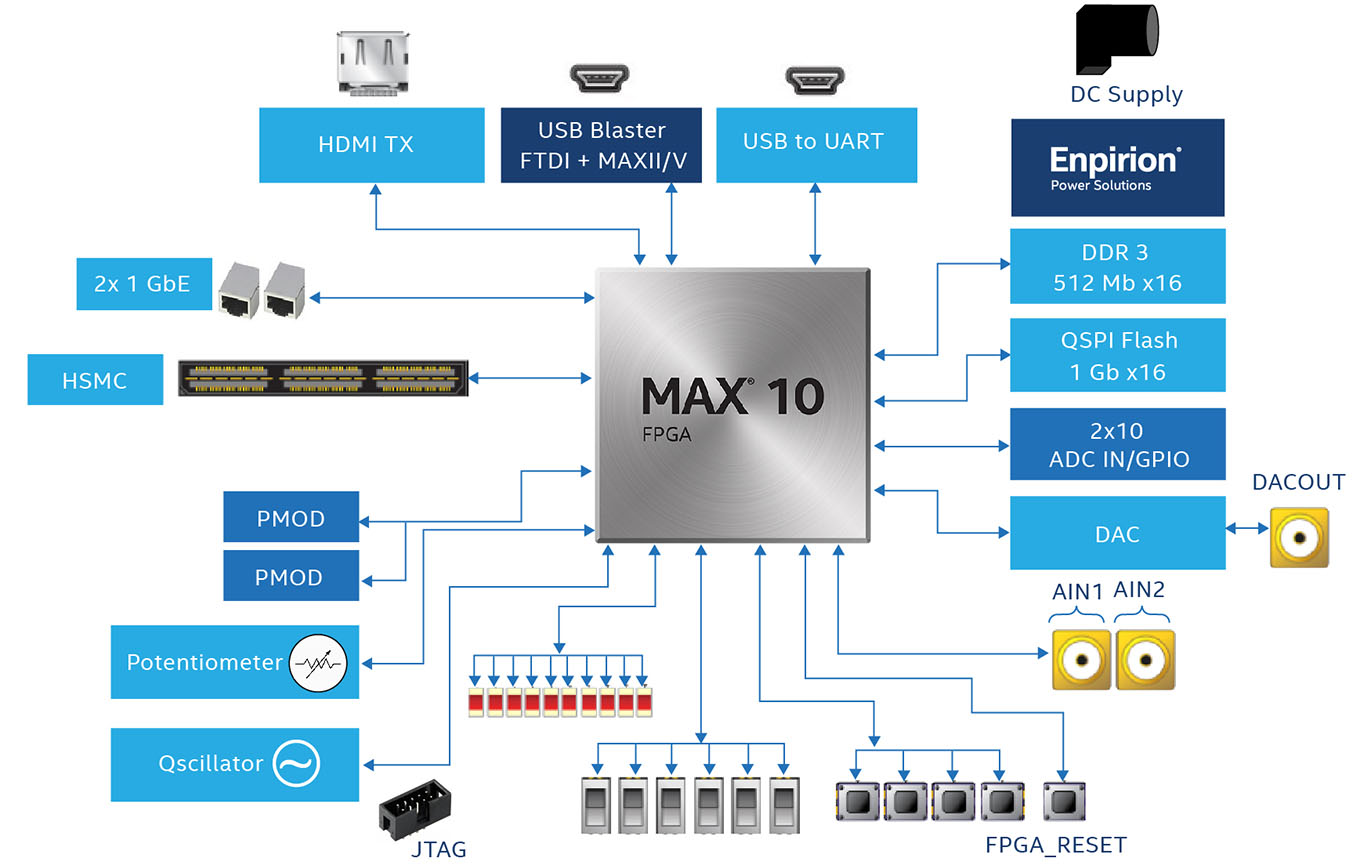
The core logic fabric consists of Logic Array Blocks (LABs), each containing Adaptive Logic Modules (ALMs). M9K embedded memory blocks provide high-bandwidth on-chip SRAM, while the integrated ADC block enables direct analog signal acquisition without external components. Four PLLs support flexible clock management with frequency synthesis and phase shifting.
4. Pinout, Package & Dimensions
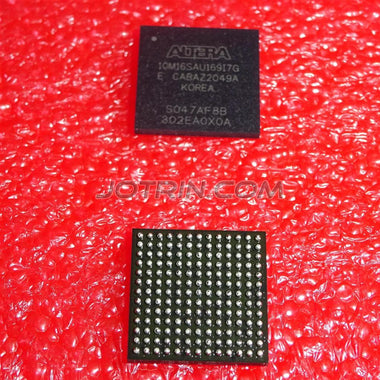
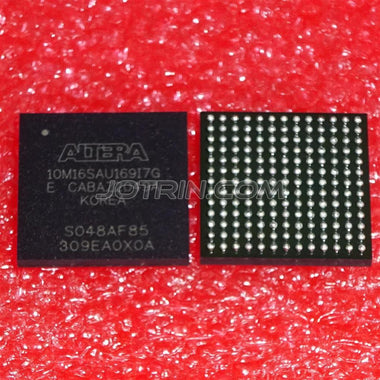
The 10M16SAU169I7G uses a 169-ball Ultra Fine-pitch BGA (UBGA) package with an 11×11 mm body and 0.8 mm ball pitch. This compact form factor is well-suited for area-constrained industrial and IoT designs. The package provides 130 user I/O pins with support for multiple I/O voltage banks.

Package highlights:
- Body Size: 11 × 11 × 1.55 mm (max seated height)
- Ball Count: 169 balls (13×13 array)
- Ball Pitch: 0.8 mm
- I/O Banks: Multiple I/O banks with independent VCCIO supply
- Dedicated Pins: JTAG, configuration, clock, and analog input pins
For detailed pin assignments and bank mapping, refer to the official MAX 10 FPGA Pin-Out Files available from the Intel FPGA download center.
5. Application Circuits & Design Resources
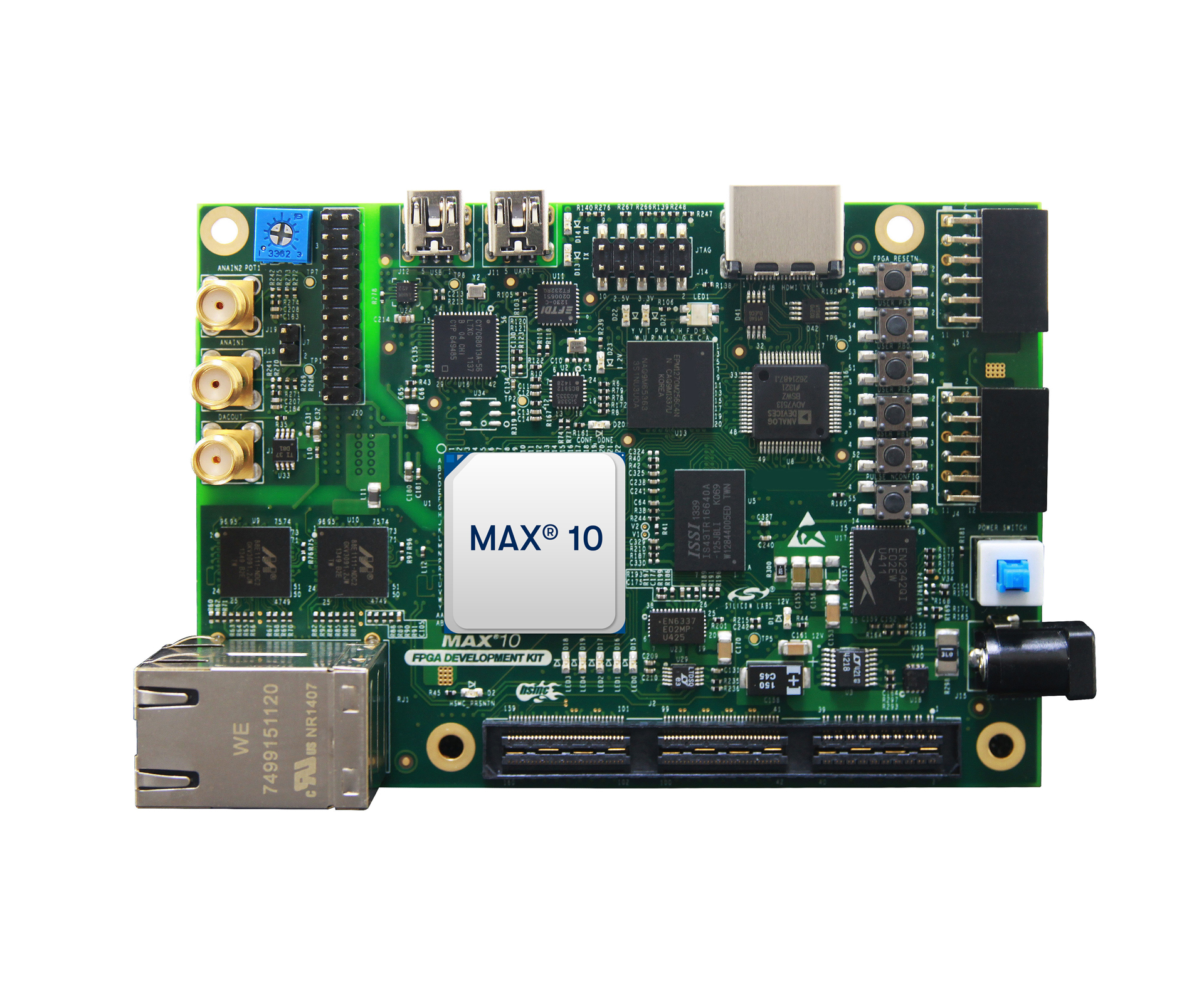
The MAX 10 FPGA family is designed for a wide range of embedded applications. The MAX 10 FPGA Development Kit provides a full-featured evaluation platform for prototyping designs using the 10M16 and other MAX 10 variants:
Common application areas include:
- Industrial IoT: Sensor fusion, protocol bridging (Modbus, CAN, SPI aggregation), and edge processing.
- Motor Control: PWM generation, encoder interfaces, and real-time control loops leveraging the integrated ADC.
- Embedded Vision: Image pre-processing, MIPI CSI-2 bridging, and display interface conversion.
- Communications: Custom protocol implementation, UART/SPI/I2C bridges, and data serialization/deserialization.
- Power Management: Sequencing, voltage monitoring, and system management controller functions using the ADC and user flash.
The development kit features on-board DDR3 memory, HSMC expansion connectors, Arduino headers, PMOD interfaces, and USB-Blaster II for JTAG programming. Quartus Prime Lite Edition (free) supports all MAX 10 devices.
Video Tutorial: Getting Started with MAX 10 FPGA
Find related development tools and programming accessories in our Development Tools section.
6. FAQ – 10M16SAU169I7G
What is the 10M16SAU169I7G and what family does it belong to?
The 10M16SAU169I7G is a non-volatile FPGA from Intel (formerly Altera) in the MAX 10 family. It features 16,000 logic elements, integrated flash configuration memory, a 12-bit ADC, and user flash memory in a compact 169-ball UBGA package. It is designed for industrial IoT, motor control, and embedded applications.
What is the operating temperature range of the 10M16SAU169I7G?
The 10M16SAU169I7G has an industrial operating temperature range of -40°C to +100°C. The "I" in the part number suffix denotes the industrial temperature grade, making it suitable for harsh environments and outdoor deployments.
Does the 10M16SAU169I7G require an external configuration memory?
No. The MAX 10 family features integrated flash configuration memory, enabling instant-on operation without any external configuration device (EEPROM or flash). The device supports dual configuration images for fail-safe remote updates.
What development software is needed for the 10M16SAU169I7G?
The 10M16SAU169I7G is fully supported by Intel Quartus Prime Lite Edition, which is free to download and use. It supports Verilog, VHDL, and schematic-based design entry, along with the Platform Designer (formerly Qsys) system integration tool and the Nios II soft processor.
What is the pin count and package type of the 10M16SAU169I7G?
The 10M16SAU169I7G comes in a 169-ball UBGA (Ultra Fine-pitch Ball Grid Array) package measuring 11×11 mm with a 0.8 mm ball pitch. It provides up to 130 user I/O pins across multiple independently powered I/O banks.
Can the 10M16SAU169I7G interface with DDR3 memory?
Yes. The MAX 10 10M16 supports external DDR3, DDR2, LPDDR2, and SRAM memory interfaces with hardened memory controller IP available in Quartus Prime. This enables high-bandwidth data buffering and frame storage for vision and signal processing applications.