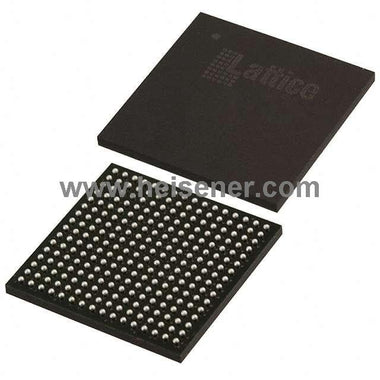
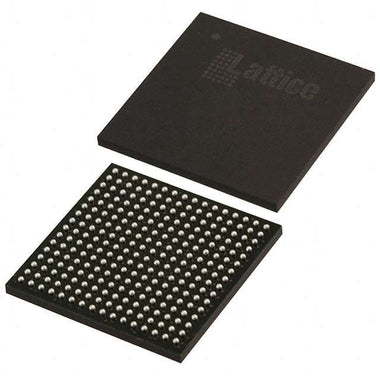
10M16SAU169C8G Datasheet, Specifications & Application Guide – Intel MAX 10 FPGA
Table of Contents
- 1. 10M16SAU169C8G Overview
- 2. Key Specifications & Parameters
- 3. Block Diagram & Architecture
- 4. Pinout & Package Information
- 5. Application Circuits & Development Boards
- 6. Frequently Asked Questions
1. 10M16SAU169C8G Overview
The 10M16SAU169C8G is a non-volatile FPGA from Intel's (formerly Altera) MAX 10 family. Built on a 55nm process node, this device integrates 16,000 logic elements, dual 12-bit ADCs, and internal configuration flash memory into a compact 169-UBGA package. Its single-chip, instant-on architecture eliminates the need for an external configuration device, reducing BOM cost and board space in embedded applications.
The MAX 10 family is purpose-built for system management, I/O expansion, communication control planes, and sensor-rich industrial designs. With support for Nios II soft-core processors, DDR3 memory interfaces, and user flash memory, the 10M16SAU169C8G bridges the gap between CPLDs and mid-range FPGAs, delivering flexibility without complexity.
2. Key Specifications & Parameters
| Parameter | Value |
|---|---|
| Part Number | 10M16SAU169C8G |
| Manufacturer | Intel (Altera) |
| Family | MAX 10 FPGA |
| Logic Elements (LEs) | 16,000 |
| Logic Array Blocks (LABs) | 1,000 |
| Embedded Memory (M9K) | 549 Kb (562,176 bits) |
| Embedded 18×18 Multipliers | 36 |
| PLLs | 4 |
| Global Clock Networks | Up to 20 |
| User I/O Pins | 130 (U169 package) |
| Max LVDS Pairs | 22 |
| ADC | Dual 12-bit, up to 1 MSPS |
| User Flash Memory (UFM) | Yes (Avalon-MM interface) |
| Internal Configuration Storage | Dual-boot flash |
| Package | 169-UBGA (11 × 11 mm) |
| Supply Voltage | 2.85 V – 3.465 V (3.3 V nominal) |
| Operating Temperature | 0 °C to 85 °C (Commercial) |
| Speed Grade | 8 |
| Process Technology | 55 nm |
| I/O Standards | 3.3 V LVTTL, 1.0–3.3 V LVCMOS, SSTL, HSTL, PCI |
| External Memory Support | DDR2, DDR3, LPDDR2, SRAM |
| RoHS / Lead-Free | Yes (suffix G) |
3. Block Diagram & Architecture
The 10M16SAU169C8G follows the standard MAX 10 architecture featuring an array of logic elements organized into LABs, surrounded by I/O elements, embedded memory columns, DSP blocks, and PLLs. The integrated dual-boot configuration flash allows remote firmware updates with a safe fallback image.
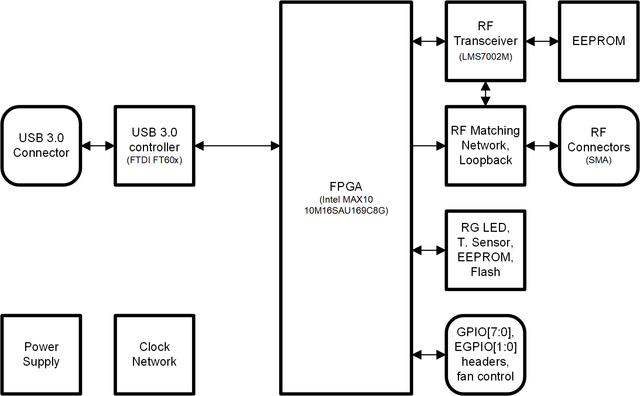
Figure 1: System block diagram of a design built around the Intel MAX 10 10M16SAU169C8G FPGA, illustrating the interconnections between the FPGA, RF transceiver, USB controller, and supporting peripherals.
4. Pinout & Package Information
The 10M16SAU169C8G is housed in a 169-ball UBGA package measuring 11 × 11 mm with a 0.8 mm ball pitch. Of the 169 balls, 130 are available as user I/O, organized across multiple I/O banks supporting a wide range of single-ended and differential signaling standards. The compact UBGA form factor makes it ideal for space-constrained applications such as portable SDR modules and IoT edge devices.

Figure 2: PCB footprint and ball map of the 10M16SAU169C8G in the 169-UBGA package.
5. Application Circuits & Development Boards
The 10M16SAU169C8G is widely adopted in real-world products. One of the most prominent designs is the LimeSDR Mini, an open-source software-defined radio platform that pairs this FPGA with the LMS7002M RF transceiver for full-duplex, continuous-frequency coverage from 10 MHz to 3.5 GHz. The FPGA handles digital signal routing, sample buffering, and USB 3.0 data streaming.
Other common application areas include industrial sensor fusion, motor control, building automation gateways, video bridging, and communication protocol conversion. The integrated ADC makes it especially suited for mixed-signal designs that need analog front-end processing without external ADC ICs.
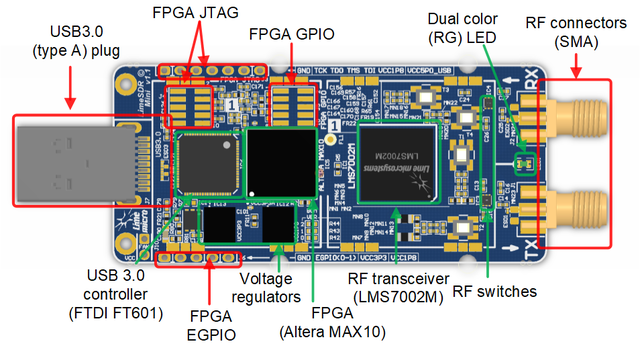
Figure 3: LimeSDR Mini v1.1 development board — a real-world application of the 10M16SAU169C8G MAX 10 FPGA in a software-defined radio design.
Video Tutorial: Getting Started with Intel MAX 10 FPGA
Watch: MAX 10 FPGA evaluation and development walkthrough using Intel Quartus Prime.
Related Components on wwdparts
- 10M08SAU169C8G – Intel MAX 10 FPGA (8K LEs, 169-UBGA)
- 10M16SAE144C8G – Intel MAX 10 FPGA (16K LEs, 144-EQFP)
- 10M50DAF484C7G – Intel MAX 10 FPGA (50K LEs, 484-FBGA)
6. Frequently Asked Questions
Q1: What is the difference between 10M16SAU169C8G and 10M16DAF484C8G?
Both contain 16,000 logic elements from the MAX 10 family, but the 10M16SAU169C8G uses a smaller 169-UBGA package with 130 user I/O, while the 10M16DAF484C8G uses a 484-FBGA package with up to 250 user I/O and additional ADC channels. Choose the U169 variant when board space is critical, and the F484 when you need more I/O or ADC inputs.
Q2: Does the 10M16SAU169C8G require an external configuration memory?
No. The MAX 10 family features on-chip dual configuration flash memory, allowing instant-on operation without any external EEPROM or flash device. This also supports dual-boot images for safe remote firmware updates.
Q3: What development software is needed for the 10M16SAU169C8G?
Intel Quartus Prime Lite Edition (free) fully supports MAX 10 devices. It includes synthesis, place-and-route, timing analysis, and the Platform Designer (Qsys) system integration tool. The Nios II Embedded Design Suite is also available for soft-processor designs.
Q4: Can the 10M16SAU169C8G interface with DDR3 SDRAM?
Yes. The MAX 10 family supports DDR3, DDR2, LPDDR2, and SRAM external memory interfaces. Intel provides the External Memory Interface (EMIF) IP core within Quartus Prime for easy DDR3 integration.
Q5: What is the analog-to-digital converter (ADC) capability?
The 10M16SAU169C8G includes dual 12-bit SAR ADCs with a maximum sampling rate of 1 MSPS per channel. These are accessible via a soft IP core and can monitor on-board temperature sensors, power rails, or external analog signals — eliminating the need for a separate ADC chip in many mixed-signal designs.
Q6: Is the 10M16SAU169C8G suitable for automotive or industrial temperature ranges?
The C8G suffix indicates the commercial temperature grade (0 °C to 85 °C). For industrial (−40 °C to 100 °C) applications, look for the 10M16SAU169I7G variant. Intel does not currently offer an automotive-grade (AEC-Q100) version of the MAX 10 in this package.