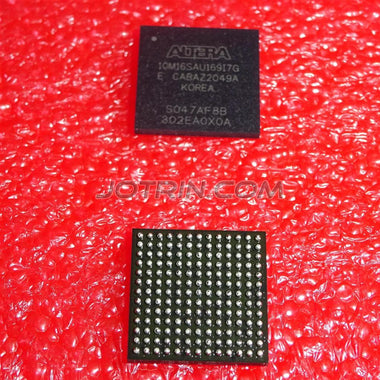
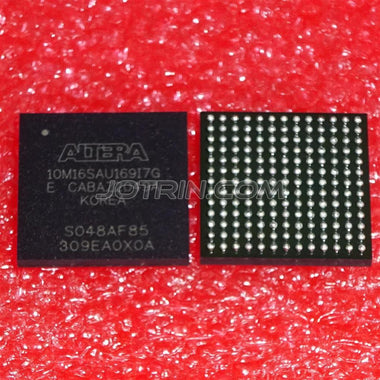
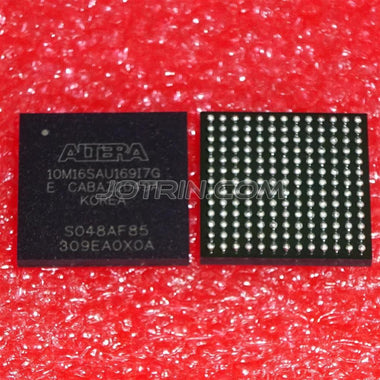
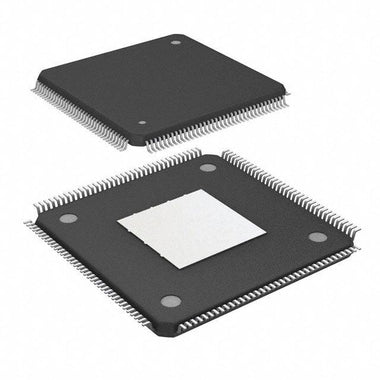
Request a Quote · 10M16SAU169I7G
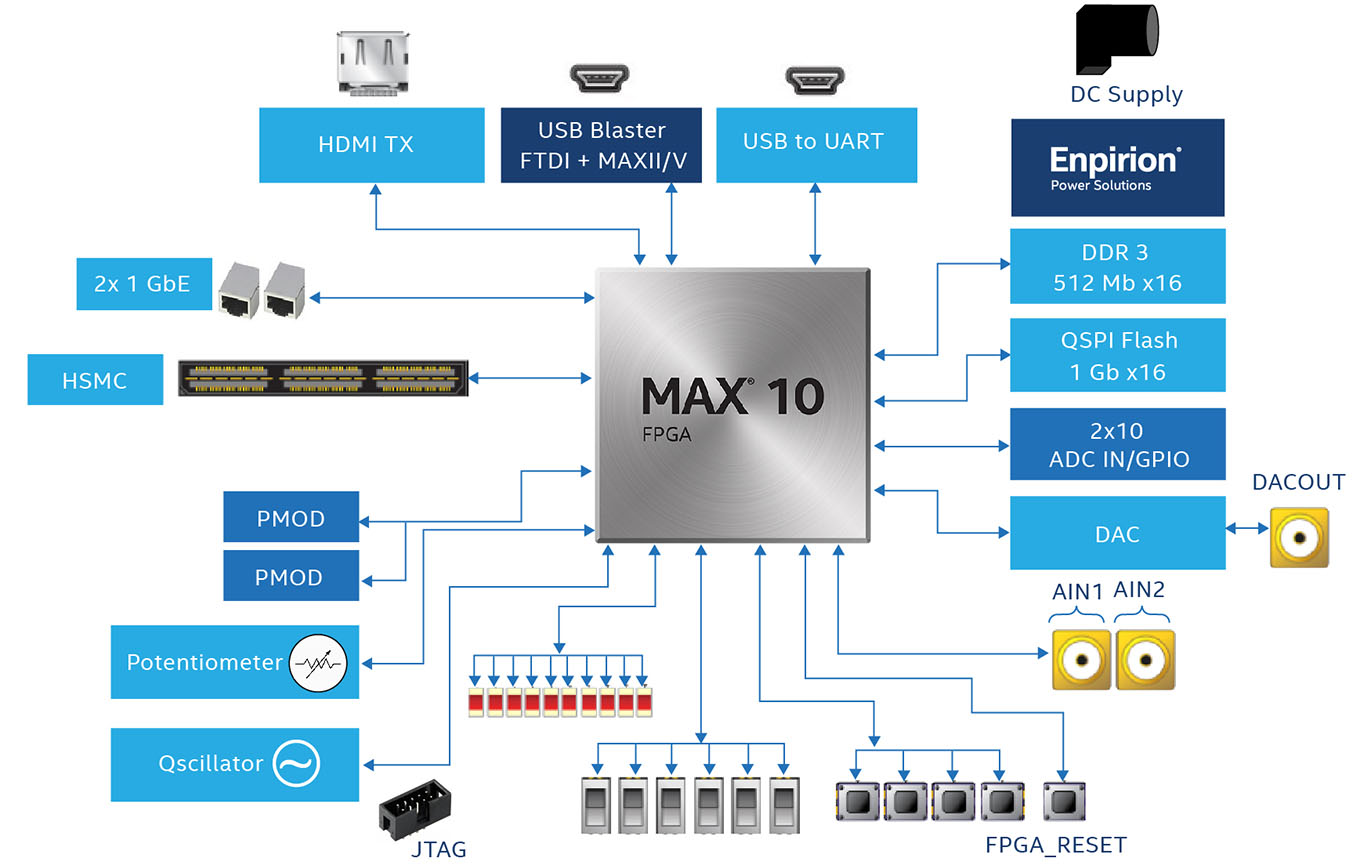
Intel MAX 10 FPGA Development Kit Block Diagram — Logic Elements, Embedded Memory, PLL, ADC, and External Interfaces (Source: Altera)
The 10M16SAU169I7G is a non-volatile FPGA from Intel’s (formerly Altera) MAX 10 family, built on a 55 nm process. Featuring 16,000 logic elements, 549 Kb of embedded memory, 45 embedded 18×18 multipliers, an integrated dual 12-bit ADC, and on-chip user flash memory, this device delivers instant-on functionality in a compact 169-ball UBGA package. Rated for an industrial temperature range of −40°C to +100°C, the 10M16SAU169I7G is designed for cost-sensitive industrial automation, motor control, sensor fusion, and embedded IoT applications that demand FPGA flexibility without external configuration memory.
Table of Contents
1. Overview and Core Features
The Intel MAX 10 family is the industry’s first single-chip, non-volatile FPGA with integrated dual-configuration flash. The 10M16SAU169I7G sits in the mid-range of the lineup, providing 16,000 logic elements organized into roughly 1,000 logic array blocks (LABs), each containing 16 adaptive logic modules. This architecture supports complex digital logic, finite state machines, Nios II soft-core processors, and custom peripheral controllers—all without an external configuration memory chip.
A key differentiator of the MAX 10 platform is the integrated analog-to-digital converter. The 10M16SAU169I7G includes dual 12-bit SAR ADCs (ADC1 and ADC2) capable of up to 1 MSPS with up to 18 analog input channels. This eliminates external analog front-end components for many sensor-interfacing applications, reducing BOM cost and board area. The device also provides up to 736 Kb of user flash memory (UFM) for in-system storage of calibration data, serial numbers, or small firmware images.
With 4 PLLs for flexible clock synthesis, 130 user I/O pins supporting LVTTL, LVCMOS (1.2 V to 3.3 V), and differential LVDS standards, plus DDR2/DDR3/LPDDR2 external memory interfaces, the 10M16SAU169I7G delivers a complete programmable system solution for motor drives, sensor hubs, industrial IoT gateways, and communications equipment.

10M16SAU169I7G UBGA-169 Package (11 mm × 11 mm) — 169-Ball Ultra FineLine BGA, 0.8 mm Ball Pitch (Source: FPGAkey)
2. Specifications and Parameter Table
| Parameter | Value |
|---|---|
| Manufacturer | Intel / Altera |
| Family | MAX 10 (Non-Volatile FPGA) |
| Logic Elements (LEs) | 16,000 |
| Logic Array Blocks (LABs) | 1,000 |
| Embedded Memory | 549 Kb (M9K blocks) |
| Embedded 18×18 Multipliers | 45 |
| Phase-Locked Loops (PLLs) | 4 |
| User I/O Pins | 130 (UBGA-169 package) |
| Maximum LVDS Pairs | 22 |
| Analog-to-Digital Converter | Dual 12-bit SAR ADC, up to 1 MSPS |
| User Flash Memory (UFM) | Up to 736 Kb |
| External Memory Support | DDR2, DDR3, LPDDR2, SRAM |
| I/O Standards | 3.3 V / 2.5 V / 1.8 V / 1.5 V / 1.2 V LVCMOS/LVTTL, LVDS, SSTL, HSTL |
| Core Voltage | 1.2 V |
| I/O Supply Voltage | 1.2 V to 3.3 V |
| Process Technology | 55 nm |
| Speed Grade | 7 (Slowest) |
| Package | UBGA-169 (11 mm × 11 mm, 0.8 mm pitch) |
| Operating Temperature | −40°C to +100°C (Industrial) |
| Configuration | Internal dual-boot flash (instant-on) |
| Bitstream Security | AES-128 encryption supported |
| RoHS Compliance | RoHS Compliant |
Looking for 10M16SAU169I7G Inventory?
Check our real-time stock levels, pricing, and volume discounts for global distribution.
Check 10M16SAU169I7G Stock3. Architecture, Pinout, and Application Circuit
The MAX 10 architecture is organized around a sea of logic array blocks surrounded by I/O elements, M9K embedded memory blocks, DSP multiplier blocks, and clock distribution networks. Each LAB contains 16 logic elements, where each LE includes a 4-input look-up table (LUT), a programmable register, and carry chain logic for efficient arithmetic. The 45 embedded 18×18 multipliers enable hardware-accelerated DSP operations—FIR/IIR filtering, FFT computation, and signal processing—without consuming general-purpose logic resources.
In the UBGA-169 package, the 10M16SAU169I7G provides 130 user I/O pins distributed across 8 I/O banks. Each bank can be independently powered at different voltage levels (1.2 V to 3.3 V), enabling seamless mixed-voltage interfacing. The device supports up to 22 LVDS differential pairs for high-speed serial links and offers dedicated pins for JTAG configuration, analog ADC inputs, and reference clock inputs.
A typical application circuit for the 10M16SAU169I7G requires a 1.2 V core supply (VCCINT), a 2.5 V analog supply (VCCA), and per-bank I/O supply rails. Intel recommends placing 0.1 µF and 10 µF decoupling capacitors close to each power pin, with unused I/O pins configured as inputs with internal pull-up resistors enabled. The dual-configuration flash supports a factory image plus an application image, enabling over-the-air firmware updates with safe fallback—critical for field-deployed industrial systems.
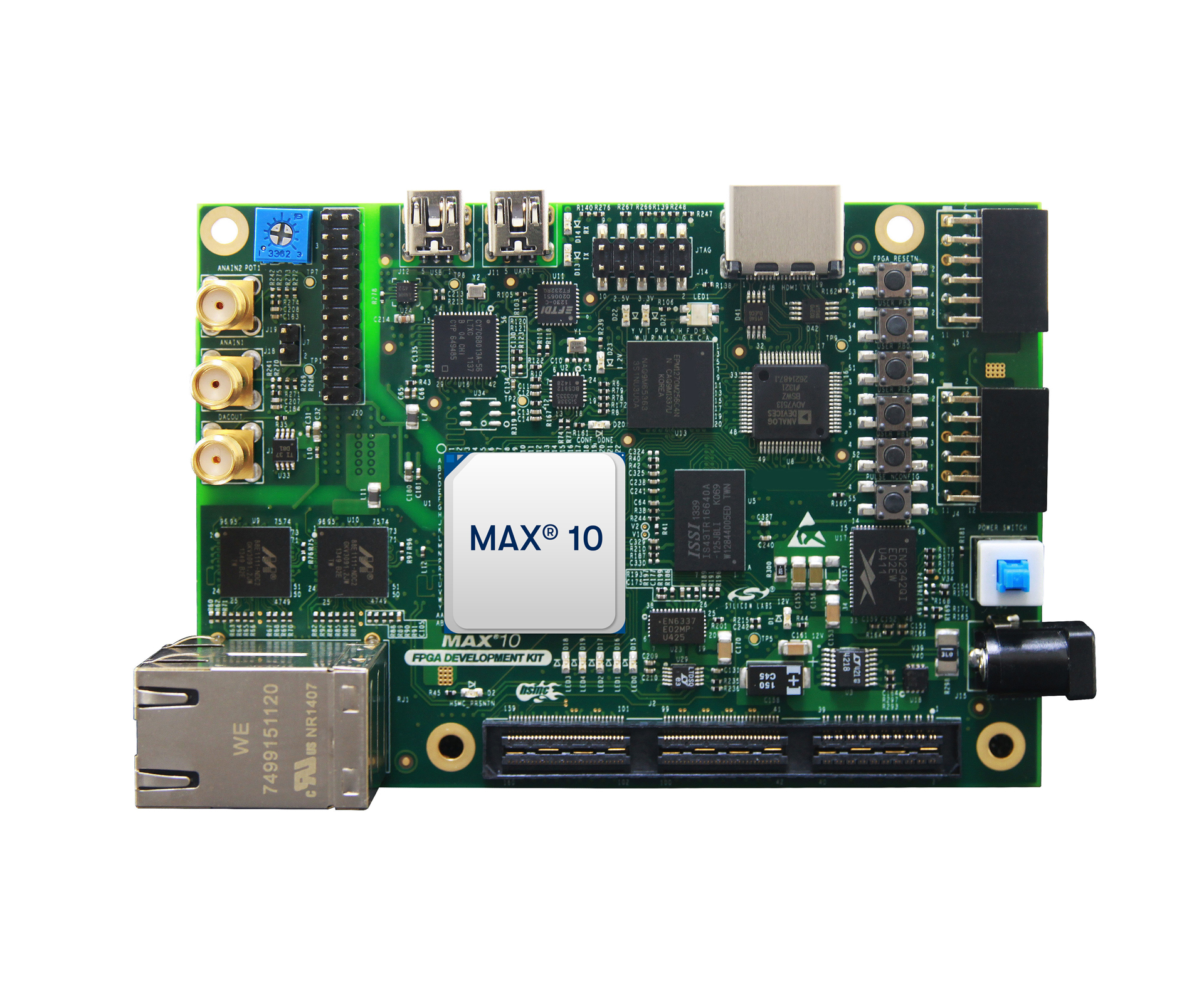
MAX 10 FPGA Development Kit — Evaluation Board with DDR3, ADC, HDMI, and Expansion Headers (Source: Altera)
4. Video: MAX 10 FPGA Development Tutorial
This video demonstrates getting started with Intel MAX 10 FPGA development using the maXimator board and Quartus Prime Lite software. Topics covered include project setup, pin assignment, VHDL/Verilog design entry, and JTAG programming—directly applicable to designs using the 10M16SAU169I7G.
5. Equivalents, Cross-Reference, and Lifecycle
The 10M16SAU169I7G carries an Active production status from Intel/Altera. The “I7G” suffix denotes industrial temperature grade (−40°C to +100°C) with speed grade 7. For designs requiring alternative specifications, engineers should consider:
- 10M16SAU169C8G — Same 16K LE device in UBGA-169, commercial temperature (0°C to +85°C) with faster speed grade 8. Pin-compatible direct swap when industrial temperature is not required.
- 10M08SAU169C8G — Lower-density variant with 8,000 logic elements in the same UBGA-169 footprint. Cost-optimized for designs needing fewer logic resources.
- 10M25SAE144C8G — Higher-density 25K LE MAX 10 device in 144-pin EQFP package. Ideal for designs requiring more logic and I/O resources.
- Lattice MachXO3LF-6900C — A competing non-volatile FPGA from Lattice Semiconductor with approximately 6,900 LUTs, integrated flash, and instant-on capability. Suitable for vendor diversification strategies.
Pin migration is supported across MAX 10 devices sharing the same package footprint. Use Intel’s Pin Migration Viewer in Quartus Prime to verify I/O compatibility. Check 10M16SAU169I7G Inventory & Pricing at WWDParts for current lead times and stock availability.
6. Frequently Asked Questions (FAQ)
Q1: What is the 10M16SAU169I7G and what applications is it designed for?
The 10M16SAU169I7G is a non-volatile FPGA from Intel’s MAX 10 family featuring 16,000 logic elements, integrated dual 12-bit ADC, and on-chip configuration flash in a 169-ball UBGA package. It targets industrial control systems, motor drives, sensor aggregation hubs, building automation, automotive infotainment, and communications infrastructure requiring instant-on FPGA functionality with industrial-grade temperature tolerance (−40°C to +100°C).
Q2: What is the difference between the 10M16SAU169I7G and 10M16SAU169C8G?
Both share the same 16,000 LE core and UBGA-169 package. The I7G operates over the industrial temperature range (−40°C to +100°C) with speed grade 7, while the C8G covers the commercial range (0°C to +85°C) with faster speed grade 8. Choose the I7G for harsh environments and the C8G for cost-optimized designs in controlled conditions.
Q3: Does the 10M16SAU169I7G require an external configuration flash memory?
No. The MAX 10 family integrates on-chip configuration flash memory, enabling instant-on operation without any external configuration device. The 10M16SAU169I7G supports dual-configuration images—a factory safe image and an application image—for remote field updates with automatic fallback if the application image fails.
Q4: How many analog input channels does the integrated ADC support?
The 10M16SAU169I7G includes dual 12-bit SAR ADC blocks (ADC1 and ADC2) with up to 18 analog input channels available across both blocks. Each ADC achieves up to 1 MSPS sampling rate with 12-bit resolution, suitable for temperature monitoring, voltage sensing, and basic data acquisition.
Q5: What development tools and software are needed to program the 10M16SAU169I7G?
Intel’s Quartus Prime Lite Edition (free, no license required) fully supports the MAX 10 family. The toolchain includes schematic capture, Verilog/VHDL synthesis, place-and-route, timing analysis (TimeQuest), and JTAG programming. For system-level integration, Platform Designer (formerly Qsys) enables building Nios II soft-processor systems with peripherals.
Q6: Can I use the 10M16SAU169I7G for DDR3 memory interfaces?
Yes. The 10M16SAU169I7G supports DDR2, DDR3, and LPDDR2 external memory interfaces through dedicated I/O pins with DQS/DQ alignment circuitry. Intel provides a hardened DDR memory controller IP via Quartus Prime’s IP Catalog. Note that the UBGA-169 package’s 130 I/O pins may limit DDR3 data bus width; consult the MAX 10 Pin-Out Files for this specific package configuration.