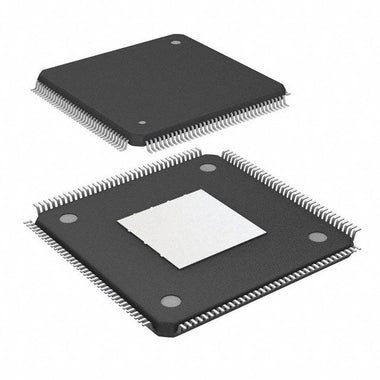
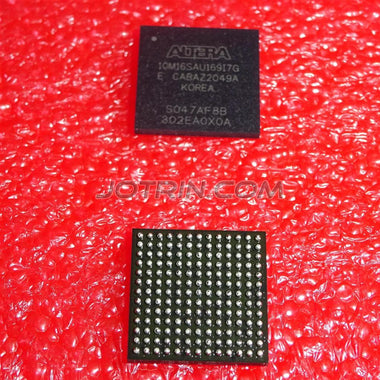
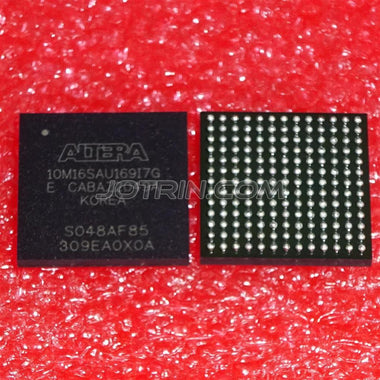
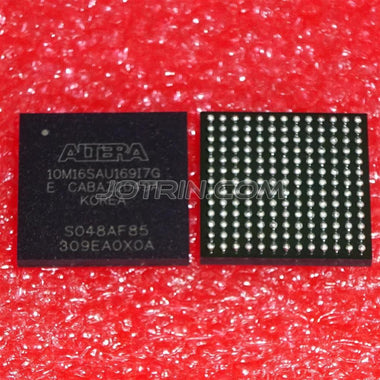
1. 10M16SAU169I7G Overview
The 10M16SAU169I7G is a non-volatile FPGA from Altera (now Intel) belonging to the MAX 10 family. Built on a 55nm process technology, this device integrates 16,000 logic elements, embedded flash memory, analog-to-digital converters (ADC), and phase-locked loops (PLLs) into a compact 169-pin UBGA package. The "I7G" suffix indicates an industrial temperature grade (-40°C to +100°C) with speed grade 7, making it suitable for harsh-environment deployments.
The MAX 10 family is unique among FPGAs because it features internal configuration flash memory, eliminating the need for an external configuration device. This single-chip solution reduces board space, simplifies design, and lowers total system cost—ideal for applications ranging from industrial automation to IoT edge computing.
Whether you're looking for a reliable FPGA for prototyping or a production-ready solution, the 10M16SAU169I7G offers the perfect balance of logic density, integrated features, and cost efficiency.
2. Key Specifications & Parameters
| Parameter | Value |
|---|---|
| Part Number | 10M16SAU169I7G |
| Manufacturer | Altera (Intel) |
| Family | MAX 10 (10M16) |
| Logic Elements (LEs) | 16,000 |
| Logic Array Blocks (LABs) | 1,000 |
| Embedded Memory | 549 Kb (M9K blocks) |
| Embedded Multipliers (18×18) | 45 |
| PLLs | 4 |
| ADC | Dual ADC (up to 1 MSPS, 12-bit) |
| User Flash Memory (UFM) | Yes (internal non-volatile storage) |
| Max User I/O (U169 pkg) | 130 |
| Max LVDS Pairs | 22 |
| External Memory Interface | DDR3, DDR2, LPDDR2, SRAM |
| I/O Standards | 3.3V / 2.5V / 1.8V / 1.5V LVCMOS, LVTTL, SSTL, HSTL, LVDS |
| Core Voltage | 1.2V |
| I/O Supply Voltage | 3.0V – 3.3V |
| Technology Node | 55nm |
| Package | 169-UBGA (U169), 11 × 11 mm |
| Speed Grade | 7 |
| Operating Temperature | -40°C to +100°C (Industrial) |
| Configuration | Internal flash (single-chip, no external config device needed) |
| Instant-On | Yes (< 10 ms power-up to user mode) |
3. Architecture & Block Diagram
The MAX 10 architecture combines traditional FPGA programmable logic with non-volatile flash memory on a single die. The 10M16SAU169I7G device floorplan features logic array blocks (LABs) arranged in a grid, surrounded by I/O banks, embedded memory columns (M9K blocks), DSP multiplier blocks, and PLLs at the corners.

Key architectural highlights include:
- Dual Configuration Flash (CFM): Supports dual-image configuration for remote field updates with fallback protection.
- User Flash Memory (UFM): On-chip non-volatile storage for user data, calibration constants, or encryption keys.
- Integrated ADC: Dual 12-bit, 1 MSPS analog-to-digital converters eliminate the need for external ADC ICs in sensor-heavy designs.
- Instant-On: Configuration from internal flash in under 10 ms—critical for applications requiring fast boot times.
4. Pinout & Package Information
The 10M16SAU169I7G is housed in a 169-ball UBGA (Ultra-thin Ball Grid Array) package measuring 11 × 11 mm with a 0.8 mm ball pitch. This compact form factor provides 130 user I/O pins organized across multiple I/O banks, supporting a wide range of voltage standards.

The U169 package offers excellent signal integrity characteristics thanks to its BGA construction, with controlled impedance routing and minimal lead inductance. I/O banks are organized to support bank-level voltage assignment, allowing designers to interface with multiple voltage domains simultaneously.
For detailed pin assignments and I/O bank mapping, refer to the official Altera MAX 10 Pin-Out Files available through Intel's FPGA documentation portal.
5. Applications & Circuit Design
The 10M16SAU169I7G is well-suited for a broad range of applications thanks to its integrated features and industrial-grade operating range:
- Industrial Automation: Motor control, sensor aggregation, PLC co-processing, and real-time I/O management.
- IoT Edge Computing: Sensor data preprocessing with integrated ADC, protocol bridging, and edge AI inference acceleration.
- Communication Infrastructure: Protocol conversion, data routing, and custom interface bridging for telecom equipment.
- Medical Devices: Portable diagnostic equipment, patient monitoring systems, and medical imaging preprocessing.
- Automotive: ADAS sensor fusion, dashboard display controllers, and in-vehicle networking bridges.

When designing with the 10M16SAU169I7G, key considerations include proper power supply decoupling (separate 1.2V core and 3.3V I/O rails), JTAG interface for programming and debugging, and thermal management in industrial-temperature environments. The MAX 10 development ecosystem provides comprehensive reference designs and evaluation kits to accelerate your design cycle.
Video Tutorial: Getting Started with MAX 10 FPGA
6. FAQ – Frequently Asked Questions
What is the 10M16SAU169I7G?
The 10M16SAU169I7G is an industrial-grade non-volatile FPGA from Altera's MAX 10 family. It features 16,000 logic elements, 549 Kb embedded memory, dual ADC, 4 PLLs, and internal configuration flash in a 169-UBGA package. It operates from -40°C to +100°C.
Does the 10M16SAU169I7G require an external configuration memory?
No. The MAX 10 family integrates configuration flash memory (CFM) on-chip, enabling single-chip FPGA solutions. The 10M16SAU169I7G supports dual-image configuration for safe remote updates with automatic fallback to a known-good image.
What is the operating temperature range of the 10M16SAU169I7G?
The "I" in the part number suffix indicates industrial temperature grade, supporting junction temperatures from -40°C to +100°C. This makes it suitable for harsh environments including outdoor installations, industrial equipment, and automotive applications.
What software is used to program the 10M16SAU169I7G?
The 10M16SAU169I7G is programmed using Intel Quartus Prime software (Lite Edition is free). It supports Verilog, VHDL, and schematic-based design entry. Programming is done via JTAG using a USB-Blaster or compatible programmer.
What is the difference between 10M16SAU169I7G and 10M16SAU169C8G?
Both share the same 10M16 die in a U169 package. The key differences are temperature grade ("I" = Industrial: -40°C to +100°C vs. "C" = Commercial: 0°C to +85°C) and speed grade (7 vs. 8). The I7G variant is rated for harsher environments but at a slightly lower speed grade.
Can the 10M16SAU169I7G be used for analog signal acquisition?
Yes. The MAX 10 10M16 integrates dual 12-bit ADCs capable of up to 1 MSPS sampling rate with up to 18 analog input channels (package-dependent). This eliminates the need for external ADC chips in many sensor-interfacing and mixed-signal applications.