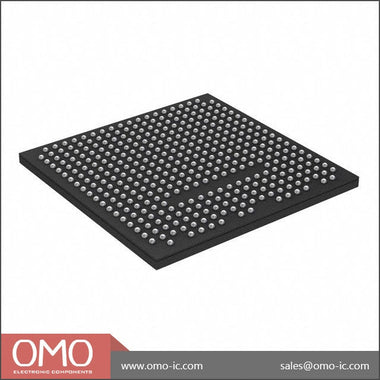
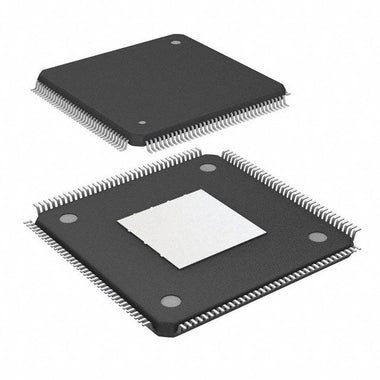
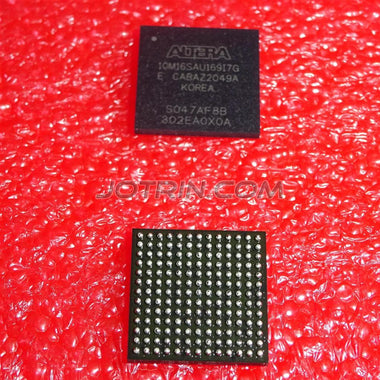
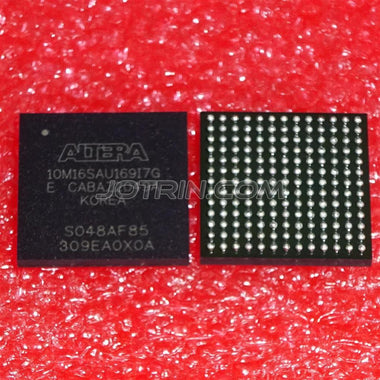
1. 10M16SAU169I7G Overview
The 10M16SAU169I7G is a non-volatile FPGA from the Intel (Altera) MAX 10 family, built on a 55nm flash process technology. It integrates 16,000 logic elements, 549Kb of embedded SRAM, dual 12-bit ADCs, and user flash memory into a single chip — eliminating the need for external configuration devices and enabling true instant-on operation.
Designed for industrial-grade applications, the 10M16SAU169I7G operates across the extended temperature range of -40°C to +100°C and comes in a compact 169-UBGA (11×11 mm) package. Its integrated analog and digital resources make it an ideal choice for sensor interfaces, motor control, industrial automation, and embedded vision systems.
Whether you're designing a cost-sensitive IoT endpoint or a mixed-signal control system, the MAX 10 platform delivers the flexibility of an FPGA with the simplicity of a CPLD. For engineers comparing FPGA options, see our guides on the ICE40UP5K-SG48I (Lattice iCE40) and the XC6SLX45-2FGG484I (Xilinx Spartan-6).
2. Key Specifications & Parameters
| Parameter | Value |
|---|---|
| Part Number | 10M16SAU169I7G |
| Family | Intel (Altera) MAX 10 |
| Logic Elements (LEs) | 16,000 |
| Logic Array Blocks (LABs) | 1,000 |
| Embedded Memory | 549 Kb (M9K blocks) |
| User Flash Memory | Up to 736 Kb (UFM) |
| 18×18 Multipliers | 45 |
| PLLs | 4 |
| User I/O Pins | 130 (U169 package) |
| Max LVDS Pairs | 22 |
| ADC | Dual 12-bit, up to 1 MSPS |
| Core Voltage (VCC) | 1.2V (1.15V–1.25V) |
| I/O Voltage | 1.2V to 3.3V (programmable) |
| Process Technology | 55 nm Flash |
| Package | 169-UBGA (11×11 mm) |
| Temperature Range | -40°C to +100°C (Industrial) |
| Speed Grade | 7 |
| External Memory | DDR3, DDR3L, DDR2, LPDDR2, SRAM |
| Configuration | Internal (on-chip flash), JTAG |
| RoHS Compliant | Yes (lead-free, "G" suffix) |
3. Block Diagram & Architecture
The MAX 10 architecture integrates logic, memory, DSP, clock management, ADC, and flash configuration into a unified programmable fabric. The block diagram below illustrates the major functional blocks of a MAX 10 development platform featuring the 10M16 device:
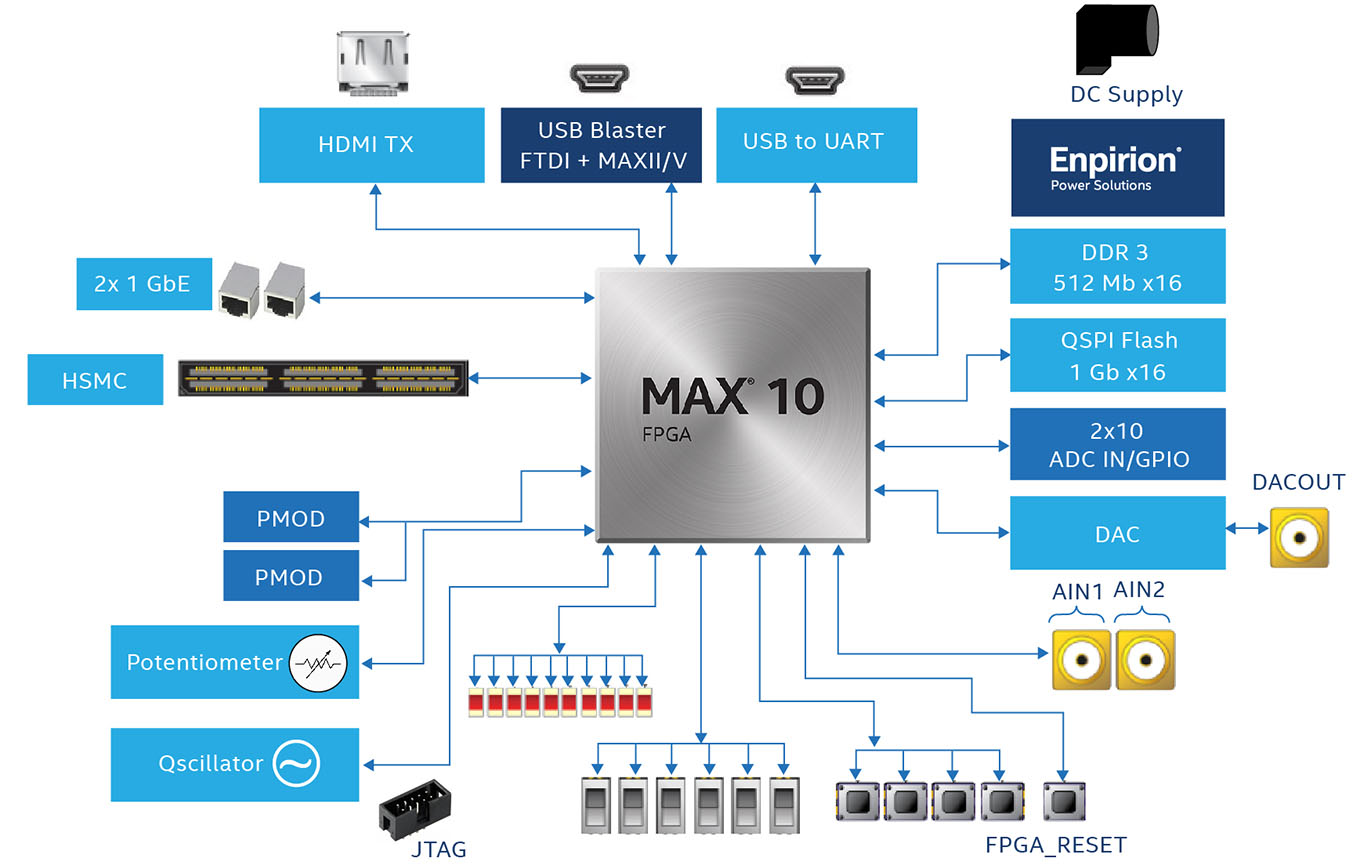
Key architectural highlights include:
- Logic Array Blocks (LABs): Each LAB contains 16 logic elements with 4-input LUTs and programmable registers
- M9K Memory: 9,216-bit blocks configurable as RAM, ROM, FIFO, or shift registers
- DSP Blocks: 18×18 embedded multipliers for signal processing and math-intensive applications
- Dual ADC: 12-bit successive-approximation ADCs with analog multiplexer for up to 18 channels
- On-chip Flash: Dual-boot and remote system upgrade capability with internal configuration storage
4. Pinout & Package Information
The 10M16SAU169I7G is housed in a 169-ball UBGA package with an 11×11 mm body size and 0.8 mm ball pitch. The compact form factor makes it suitable for portable and space-constrained applications while still providing 130 user I/O pins across multiple I/O banks.

The U169 package supports the following I/O standards: 3.3V/2.5V/1.8V/1.5V/1.2V LVCMOS, LVTTL, SSTL, HSTL, HSUL, LVDS, Mini-LVDS, RSDS, and LVPECL. Each I/O bank can be independently configured to a specific voltage level, allowing mixed-voltage interfacing in a single design.
For detailed pin assignments and bank mapping, consult the official MAX 10 FPGA Device Overview documentation.
5. Application Circuit & Development Kits
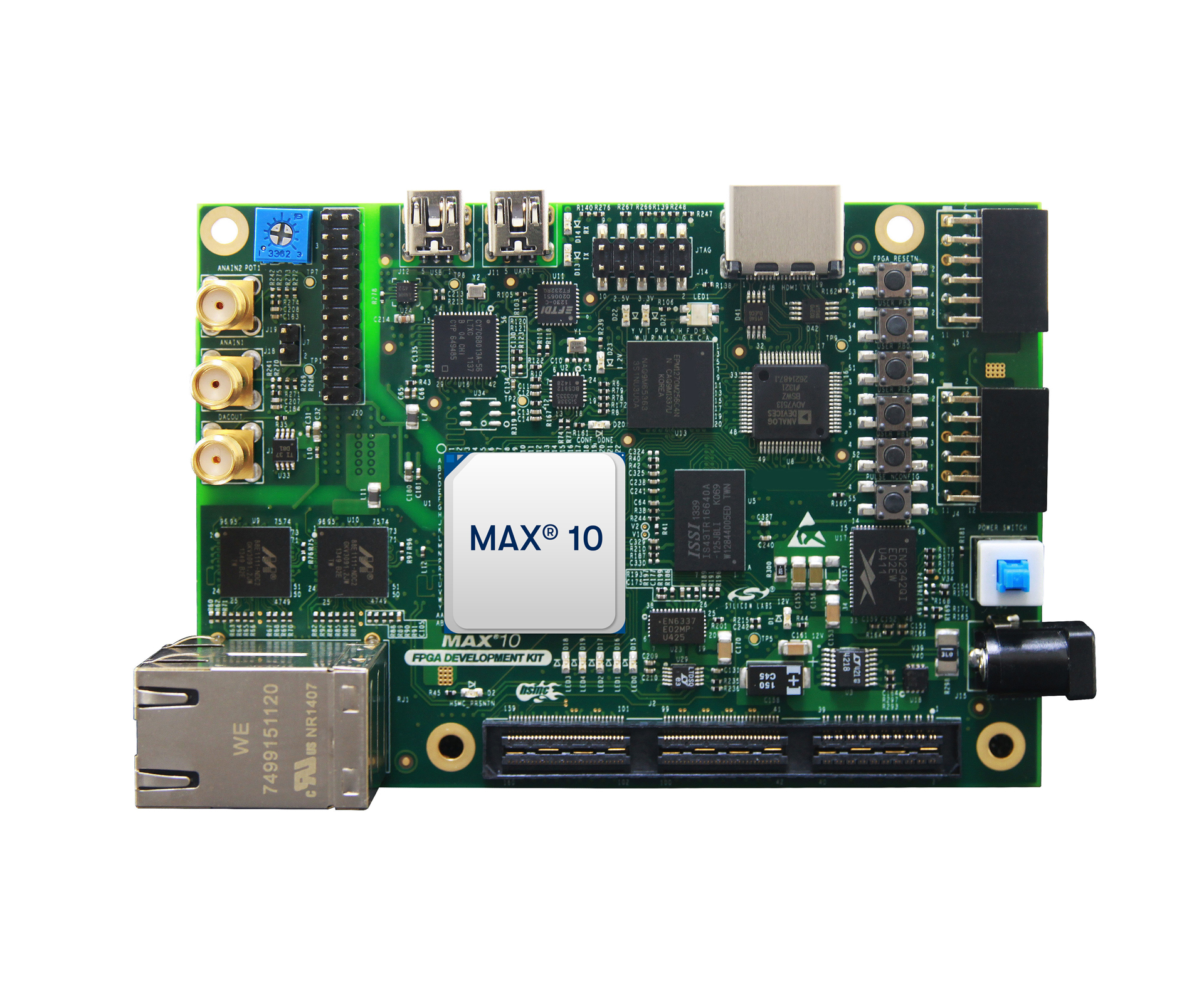
The MAX 10 FPGA Development Kit provides a comprehensive hardware platform for prototyping designs using the 10M16SAU169I7G and related MAX 10 devices. Below is the development kit board, which includes onboard DDR3 memory, Ethernet, HDMI, and HSMC expansion connectors:
Typical application areas for the 10M16SAU169I7G include:
- Industrial Automation: Motor control, sensor fusion, PLC co-processing
- Embedded Vision: Image pre-processing, camera interfaces (MIPI CSI-2)
- IoT Edge Computing: Protocol bridging, data aggregation, local inference
- Mixed-Signal Systems: Leveraging the integrated dual ADC for direct sensor acquisition
- Communication: Protocol conversion, base-band processing, SDR front-ends
For another FPGA design reference, see our detailed guide on the LFE5U-85F-8BG381I (Lattice ECP5).
Video Tutorial: Getting Started with MAX 10 FPGA
6. Frequently Asked Questions
What is the 10M16SAU169I7G?
The 10M16SAU169I7G is an Intel/Altera MAX 10 family FPGA featuring 16,000 logic elements, 549Kb embedded memory, integrated dual 12-bit ADC, and user flash memory in a compact 169-UBGA package. It supports industrial temperature range (-40°C to +100°C) with speed grade 7.
What package type does the 10M16SAU169I7G use?
The 10M16SAU169I7G uses a 169-ball Ultra Fine-pitch Ball Grid Array (UBGA) package measuring 11mm × 11mm with 0.8mm ball pitch. The "U169" designation in the part number indicates this compact BGA form factor suitable for space-constrained designs.
Does the 10M16SAU169I7G have an integrated ADC?
Yes. The MAX 10 family includes dual analog-to-digital converters (ADCs) with up to 12-bit resolution and 1 MSPS sampling rate, supporting up to 18 analog input channels. This enables mixed-signal designs without external ADC components.
What supply voltage does the 10M16SAU169I7G require?
The core supply voltage (VCC) is 1.2V (range 1.15V–1.25V). I/O banks support programmable voltages from 1.2V to 3.3V. The analog supply (VCCA) for the ADC block is 2.5V.
What external memory interfaces does the 10M16SAU169I7G support?
The 10M16SAU169I7G supports DDR3, DDR3L, DDR2, and LPDDR2 SDRAM interfaces as well as SRAM. The integrated hard memory controller provides efficient memory access with minimal logic utilization.
What design software is used to program the 10M16SAU169I7G?
The 10M16SAU169I7G is programmed using Intel Quartus Prime software (Lite Edition is free). The device supports JTAG configuration and internal boot from on-chip flash memory, enabling instant-on operation without external configuration devices.