When designing a compact, multi-sensor machine vision system, the challenge often lies in aggregating and processing high-speed data streams without overwhelming the main system processor. The Lattice LFE5U-45F-8BG381C, part of the ECP5 family, is purpose-built for this "pre-processing" and "bridging" role. It excels at handling functions like interfacing directly with multiple MIPI CSI-2 image sensors, performing real-time image processing such as debayering and color correction, and then bridging this processed data to a standard interface like Gigabit Ethernet or PCI Express, all within a low-power, cost-effective footprint.

Table of Contents
Application Context: Where LFE5U-45F-8BG381C Fits in the System
In a modern industrial automation or robotics system, a common requirement is to capture video from multiple angles simultaneously for inspection, guidance, or situational awareness. Let's consider a system with two 1080p30 MIPI CSI-2 image sensors. A host CPU, perhaps an ARM-based SoC, is responsible for high-level decision-making but lacks the specialized I/O and parallel processing power to directly interface with and process two raw video streams.
This is where the LFE5U-45F-8BG381C serves as an essential co-processor and interface bridge. In the system block diagram, it sits between the image sensors and the host CPU. Its primary role is to receive the high-speed differential data from the sensors, process it in real-time, and present it to the host in a more manageable format.
Here's a breakdown of its function within this machine vision application:
- Sensor Interface: The FPGA's high-speed SERDES (Serializer/Deserializer) blocks are configured as MIPI D-PHY receivers. The LFE5U-45F-8BG381C has four SERDES channels, each capable of running well over 1.25 Gbps. A typical 1080p30 sensor might use a 4-lane MIPI CSI-2 interface. This FPGA can comfortably handle a single 4-lane sensor or, more efficiently, two sensors each using 2 lanes. The FPGA logic implements the MIPI CSI-2 protocol decoder to extract the raw pixel data from the incoming packets.
-
Image Signal Processing (ISP) Pipeline: Once the raw Bayer-pattern data is extracted, it's fed into an ISP pipeline implemented in the FPGA's fabric. This is where the 44K Logic Look-Up Tables (LUTs) and 200 DSP slices of the LFE5U-45F-8BG381C are critical. The pipeline can perform tasks such as:
- Debayering: Converting the raw single-color-per-pixel data into a full RGB image.
- Color Space Conversion (CSC): Converting from RGB to YUV for more efficient compression or processing by the host.
- Frame Buffering: The 1944 kbits of embedded block RAM (EBR) are used to buffer lines or entire frames of video. This is crucial for synchronizing the two video streams and handling timing differences between the input and output interfaces.
- Image Scaling/Cropping: Adjusting the resolution to match the host's requirements.
- Output Bridging: After processing, the video data needs to be sent to the host CPU. The LFE5U-45F-8BG381C offers several options. Its SERDES can be re-purposed to create a single-lane PCI Express Gen1/Gen2 endpoint, allowing for high-bandwidth DMA transfers directly to the host's memory. Alternatively, a soft IP core for Gigabit Ethernet (using SGMII on the SERDES) or a simple parallel bus interface using the general-purpose I/O can be implemented. This flexibility allows the designer to choose the most suitable interface for their system architecture.
In this context, the FPGA offloads the host CPU from the deterministic, high-rate, and computationally intensive tasks of sensor interfacing and initial image processing. The host simply receives clean, processed frames over a standard interface, freeing it to run complex algorithms like object detection or navigation. The LFE5U-45F-8BG381C, therefore, acts as a powerful and reconfigurable hardware accelerator, enabling a more modular and efficient system design.
Core Specifications for This Application
| Parameter | Value | Application Relevance |
|---|---|---|
| Logic Slices (4-input LUTs) | 43.8 k | Determines the complexity of the ISP pipeline, protocol controllers, and glue logic that can be implemented. 44k LUTs are ample for a dual-camera processing pipeline. |
| DSP Slices | 200 | Crucial for accelerating multiply-accumulate operations used in image filtering, debayering, and color space conversion, significantly improving performance and reducing logic utilization. |
| Embedded Block RAM (EBR) | 1944 kbits | Essential for line buffers and frame buffers within the ISP pipeline. This amount is sufficient for buffering portions of a 1080p frame to manage data flow and clock domain crossing. |
| SERDES/PCS Channels | 4 | The core feature for this application. These channels are configured as MIPI D-PHY receivers for the cameras and can also be used for high-speed output like PCIe or SGMII. |
| Maximum User I/O | 205 | Provides sufficient pins for camera control signals (I2C, reset, clocks), configuration flash, debug interfaces (JTAG, UART), and a potential parallel output bus if SERDES is not used. |
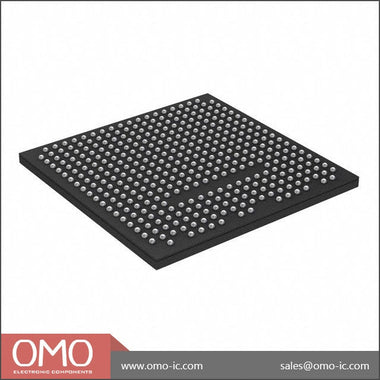
| Package | 381-ball caBGA (17x17mm) | A compact package that enables small form-factor designs. The 0.8mm ball pitch is manageable for standard 4-6 layer PCB manufacturing processes. |
| Core Voltage (VCC) | 1.1 V | The low core voltage contributes to lower static and dynamic power consumption, which is critical for thermally constrained or battery-powered applications. |
| Speed Grade | -8 | This is a "fast" speed grade, ensuring better timing margins. This is vital for high-frequency designs involving fast camera interfaces and internal processing clocks, making it easier to achieve timing closure. |
Reference Circuit and Component Selection
A successful design with the LFE5U-45F-8BG381C hinges on a robust support circuit, particularly for power, clocking, and configuration. A poorly designed support system will lead to instability, configuration failures, and poor performance, regardless of how well the HDL code is written.
Power Delivery Network (PDN): The ECP5 family requires several voltage rails. A typical power scheme includes:
- VCC (1.1V): This is the core logic voltage and the most power-hungry rail. A high-efficiency switching regulator (buck converter) capable of delivering at least 2-3A is recommended. The layout for this rail is critical; it requires a low-impedance path from the regulator to the BGA balls, with extensive decoupling. Place a combination of 10uF, 1uF, and 100nF ceramic capacitors as close as possible to every VCC/GND ball pair, following the datasheet recommendations precisely.
- VCCAUX (2.5V or 3.3V): This rail powers auxiliary internal circuits, including the PLLs and some I/O-related logic. A low-noise LDO is often sufficient, as the current draw is lower than the core. Proper decoupling is still essential, especially near the PLL power pins.
- VCCIO (1.2V to 3.3V): The ECP5 has multiple I/O banks, and each can be powered independently. For our machine vision application, the banks connected to the MIPI D-PHY receivers might be powered at 1.2V or 1.8V to match the I/O standard, while banks connected to a configuration flash or control signals might run at 3.3V. This flexibility is a key advantage. Each VCCIO rail needs its own set of decoupling capacitors.
Clocking: A stable clock source is non-negotiable. A 25 MHz or 50 MHz crystal oscillator is a common choice to feed one of the FPGA's primary clock input pins. This reference clock is then used by the internal PLLs to generate the various high-speed clocks needed for the SERDES, the ISP pipeline, and the output interface. It is critical to route the clock signal on the PCB with controlled impedance and keep it away from noisy digital signals to minimize jitter, which can be detrimental to SERDES performance.
Configuration: The LFE5U-45F-8BG381C is a SRAM-based FPGA, meaning it must be configured at every power-up. The most common method is to use an external SPI flash memory device. The FPGA is set to Master SPI mode, where it automatically reads its configuration bitstream from the flash upon power-up. Select a Quad-SPI (QSPI) flash with sufficient capacity (e.g., 64Mbit or 128Mbit) to store the bitstream. The connection is straightforward: connect the FPGA's dedicated SPI pins (CS, MISO, MOSI, CLK) to the flash chip. Ensure pull-up resistors are placed on the CS and data lines as recommended in the ECP5 Hardware Checklist. You can Browse ECP5 Series documentation on the Lattice website for detailed configuration guides.
JTAG Interface: Always include the JTAG header (TDI, TDO, TMS, TCK) in your design. This is essential for debugging during development with tools like Lattice Diamond and for programming the configuration flash in-system. These pins should have weak pull-up or pull-down resistors to prevent them from floating.
Design Pitfalls and How to Avoid Them
| Common Mistake | Symptom | Fix |
|---|---|---|
| Inadequate Power Decoupling | FPGA fails to configure (DONE pin stays low), random bit errors in high-speed data, system instability under load. | Strictly follow the datasheet's decoupling capacitor recommendations. Use a PDN analysis tool. Place capacitors as close to the BGA balls as possible, using multiple vias to connect to power and ground planes. |
| Incorrect SERDES Lane Polarity/Swapping | MIPI or PCIe link fails to train or establish a connection. No data is received, or link status registers indicate an error. | Double-check the schematic and layout against the sensor/connector datasheet. The P/N pairs for differential signals must be correctly routed. Use the polarity inversion features within the FPGA's SERDES block if a layout error is discovered post-fabrication. |
| Ignoring Clock Domain Crossing (CDC) | Metastability issues causing intermittent, unpredictable functional failures that are difficult to reproduce. Data corruption between clock domains. | Identify all paths that cross between asynchronous clock domains (e.g., MIPI clock to internal processing clock). Use proper CDC synchronizers, such as a two-stage flip-flop synchronizer for single-bit signals or an asynchronous FIFO for multi-bit data buses. |
| Forgetting Configuration Pin Strapping | FPGA does not attempt to configure from SPI flash, or enters an unknown state. The `INITN` pin may be held low. | Review the ECP5 datasheet for the `PROGRAMN`, `INITN`, and `DONE` pins. Ensure they have the correct pull-up or pull-down resistors to enable the desired configuration mode (e.g., Master SPI). The `M` pins (if present on the package) also select the configuration mode and must be tied correctly. |
Avoiding these pitfalls requires a methodical design process. The most critical phase is pre-layout simulation and schematic review. For power integrity, use the manufacturer's power estimation tools early in the design cycle to size your regulators correctly. For signal integrity, especially with SERDES, use a layout tool that supports differential pair routing and impedance control. Before sending a board to fabrication, perform a thorough "pin scrub" where you verify the connection, I/O standard, and direction of every single pin on the FPGA against the project requirements. This tedious step can save weeks of debugging time. Finally, always consult the manufacturer's hardware design checklist or application notes, as they contain a wealth of distilled experience on what works and what doesn't.
Performance Optimization Tips
Once the basic circuit is functional, several steps can be taken to optimize performance, power, and reliability.
Thermal Management: The LFE5U-45F-8BG381C is relatively power-efficient, but a high-utilization, high-frequency design can still generate significant heat. Use the Lattice Diamond Power Calculator to estimate junction temperature. If it approaches the maximum rating (specified in the datasheet for the 'C' commercial grade), thermal mitigation is necessary. The 381-ball BGA package is designed to dissipate heat through the balls into the PCB's ground and power planes. A solid ground plane with an array of thermal vias directly under the FPGA is the first line of defense. For more demanding applications, a small heatsink attached to the top of the package with thermal adhesive may be required. The ECP5 also includes an on-chip temperature sensor diode accessible via the `sysCONFIG` primitive, allowing for real-time temperature monitoring by the FPGA logic or an external device.
Signal Integrity for SERDES: For the MIPI D-PHY or PCIe interfaces, maintaining signal integrity is paramount. The differential traces on the PCB must be routed with a controlled impedance (typically 100 ohms). Keep the traces as short as possible and ensure the lengths of the P and N lines are matched to within a few mils to minimize skew. Avoid routing over splits in the reference ground plane and use stitching vias when changing layers to provide a continuous return path for the high-frequency currents.
Logic and Timing Optimization: To get the most out of the FPGA fabric, pay attention to the synthesis and place-and-route tool settings. Use timing constraints (e.g., `create_clock`, `set_input_delay`) to inform the tools about your design's performance requirements. If you have a critical path that is failing timing, analyze the timing report. Sometimes, manually instantiating a DSP block for a multiplication instead of letting the tool infer it from generic logic can drastically improve timing. Similarly, pipelining long combinatorial paths by adding register stages will increase latency slightly but allow for a much higher clock frequency.
Related Components and Accessories
A successful LFE5U-45F-8BG381C implementation requires a carefully selected bill of materials. Here are some complementary components that work well in a typical design:
- Power Management: For the 1.1V core, a buck converter like the Texas Instruments TPS62xxx series or Analog Devices' Power by Linear LTM46xx µModule regulators are excellent choices. For the VCCAUX and VCCIO rails, low-noise LDOs such as the TI LP5907 or the Analog Devices ADP151 are suitable.
- Configuration Flash: A reliable QSPI flash memory is essential. Look for devices from manufacturers like Winbond (e.g., W25Q128JV), Micron (e.g., MT25QL series), or ISSI. A 128Mbit (16MB) device provides ample space for the FPGA bitstream and potentially other system data.
- Clock Oscillator: A high-quality, low-jitter crystal oscillator is critical. For a 25MHz reference, a part like the Abracon ASTX-H11 or the SiTime SiT8008 series provides a stable clock source for the FPGA's PLLs.
- Connectors: For MIPI CSI-2 interfaces, high-density, impedance-matched connectors like the Hirose DF40 or Samtec QSH/QTH series are commonly used to connect the camera module to the main PCB.
Procuring all the necessary components for a prototype or production run can be a challenge. WWDParts streamlines this process by offering a wide range of FPGAs and their supporting components. You can Check LFE5U-45F-8BG381C Inventory & Pricing directly on our platform to get started with your design.
Video Demonstration
Frequently Asked Questions (LFE5U-45F-8BG381C FAQ)
How do I configure the SERDES on the LFE5U-45F-8BG381C for a MIPI CSI-2 receiver?
Configuring the SERDES for MIPI CSI-2 involves using the D-PHY primitive available in the Lattice Diamond software. You need to instantiate this primitive in your HDL code and configure its parameters for the correct data rate and number of lanes. The ECP5 SERDES/D-PHY is highly flexible, supporting both the low-power and high-speed modes of the MIPI specification. You will also need to implement the CSI-2 protocol layer in the FPGA fabric to decode the packets received by the D-PHY.
What is the recommended power-up sequence for the LFE5U-45F-8BG381C?
According to the Lattice ECP5 Family Datasheet, the recommended power-up sequence is VCC (1.1V), followed by VCCAUX (2.5V/3.3V), and then the VCCIO banks. This ensures that the core logic is stable before the auxiliary circuits and I/O are enabled. While the device has some tolerance, following this sequence is best practice for ensuring reliable power-on initialization and configuration. A power sequencer IC or carefully designed power regulator enable signals can be used to implement this.
Can the LFE5U-45F-8BG381C directly drive a 1080p HDMI or DisplayPort monitor?
Yes, it is possible. The SERDES channels can be configured to implement a DVI/HDMI transmitter using TMDS signaling, or a DisplayPort source. This requires implementing the respective protocol logic (TMDS encoder or DisplayPort packetizer) in the FPGA fabric. The 44k LUTs are sufficient for this task alongside a moderate ISP pipeline. However, for HDMI, you would also need an external HDMI level shifter/protection IC as the FPGA I/O does not directly support the full HDMI electrical specification.
What is a compatible configuration flash memory for the LFE5U-45F-8BG381C?
The LFE5U-45F-8BG381C supports a wide range of SPI and Quad-SPI (QSPI) flash memories for configuration. The key is to select a device that is supported by the Lattice Diamond programming tools. Popular and well-tested choices include the Winbond W25Q series, the Micron MT25Q series, and the ISSI IS25LP/WP series. A 64Mbit or 128Mbit device is typically recommended to provide enough space for the FPGA's configuration bitstream, with extra room for user data or a secondary "golden" image for fail-safe updates.
How should I handle clock domain crossing (CDC) between a camera's MIPI clock and the FPGA's internal processing clock?
This is a critical design consideration. The data coming from the MIPI D-PHY will be in the clock domain of the recovered MIPI clock, while your ISP pipeline runs on a separate internal oscillator-derived clock. The correct way to transfer the data is using an asynchronous FIFO (First-In, First-Out) buffer, which is easily implemented using the FPGA's embedded block RAM. You write the incoming pixel data into the FIFO using the MIPI clock and read it out for processing using your internal system clock. This properly isolates the two domains and prevents metastability and data corruption.