Request a Quote · 10M16SAU169I7G

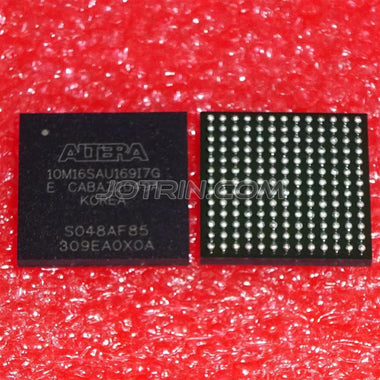
10M16SAU169I7G — Altera MAX 10 FPGA in UBGA-169 Package
The 10M16SAU169I7G is a non-volatile FPGA from the Intel (formerly Altera) MAX 10 family. Built on a 55 nm flash process, this device integrates 16,000 logic elements, embedded SRAM, user flash memory, PLLs, and an analog-to-digital converter into a compact 169-pin UBGA package. It targets industrial-grade applications with an operating temperature range of −40°C to +100°C and is commonly used in motor control, sensor interfaces, embedded vision preprocessing, and communication protocol bridging.
Table of Contents
1. Overview and Core Features
The Intel MAX 10 family occupies a unique position among low-cost FPGAs by offering instant-on capability through internal configuration flash. The 10M16SAU169I7G variant provides 16,000 logic elements organized into 1,000 logic array blocks (LABs), making it suitable for designs that require moderate logic density without an external configuration device.
Key features of this device include:
- Non-volatile configuration — dual configuration images stored in on-chip flash enable instant-on operation and remote update capability.
- Integrated ADC — a 12-bit, 1 MSPS successive-approximation ADC with up to 18 analog input channels reduces external component count for sensor-driven designs.
- User flash memory — up to 675 Kb of on-chip user flash for storing calibration data, encryption keys, or application parameters without external EEPROM.
- DDR3/DDR2 memory interface — hard memory controller IP supports DDR3, DDR2, and LPDDR2 SDRAM for data-intensive applications.
- DSP capability — 45 embedded 18×18 multipliers enable efficient digital signal processing for filtering and math-intensive workloads.
For designers seeking a cost-effective FPGA with integrated analog and memory, the 10M16SAU169I7G provides a compelling single-chip solution.
2. Specifications and Parameter Table
| Parameter | Value |
|---|---|
| Manufacturer | Intel (Altera) |
| Family | MAX 10 |
| Logic Elements (LEs) | 16,000 |
| Logic Array Blocks (LABs) | 1,000 |
| Embedded Memory (M9K Blocks) | 549 Kb (61 M9K blocks) |
| User Flash Memory | 675 Kb |
| 18×18 Multipliers | 45 |
| PLLs | 4 |
| ADC | 1 (12-bit, 1 MSPS) |
| Max User I/O (U169 Package) | 130 |
| Max LVDS Pairs | 22 |
| I/O Standards | 3.3 V / 2.5 V / 1.8 V / 1.5 V LVCMOS, LVTTL, SSTL, HSTL, LVDS |
| Process Technology | 55 nm (TSMC flash process) |
| Core Voltage | 1.2 V |
| I/O Supply Voltage | 3.0 V – 3.3 V |
| Speed Grade | 7 (slowest) |
| Temperature Range | −40°C to +100°C (Industrial) |
| Package | UBGA-169 (11 mm × 11 mm) |
| External Memory Interface | DDR3, DDR2, LPDDR2, SRAM |
| Configuration | Internal (dual boot), JTAG |
| Bitstream Security | AES-256 encryption |
Looking for 10M16SAU169I7G Inventory?
Check our real-time stock levels, pricing, and volume discounts for global distribution.
Check 10M16SAU169I7G Stock3. Architecture and Block Diagram
The MAX 10 architecture arranges logic, memory, and I/O resources in a column-based fabric. Each logic array block (LAB) contains 16 adaptive logic modules (ALMs), with M9K embedded memory blocks distributed across the device for localized data storage. The 10M16 variant provides four PLLs positioned at the device corners to support flexible clock management across I/O banks.
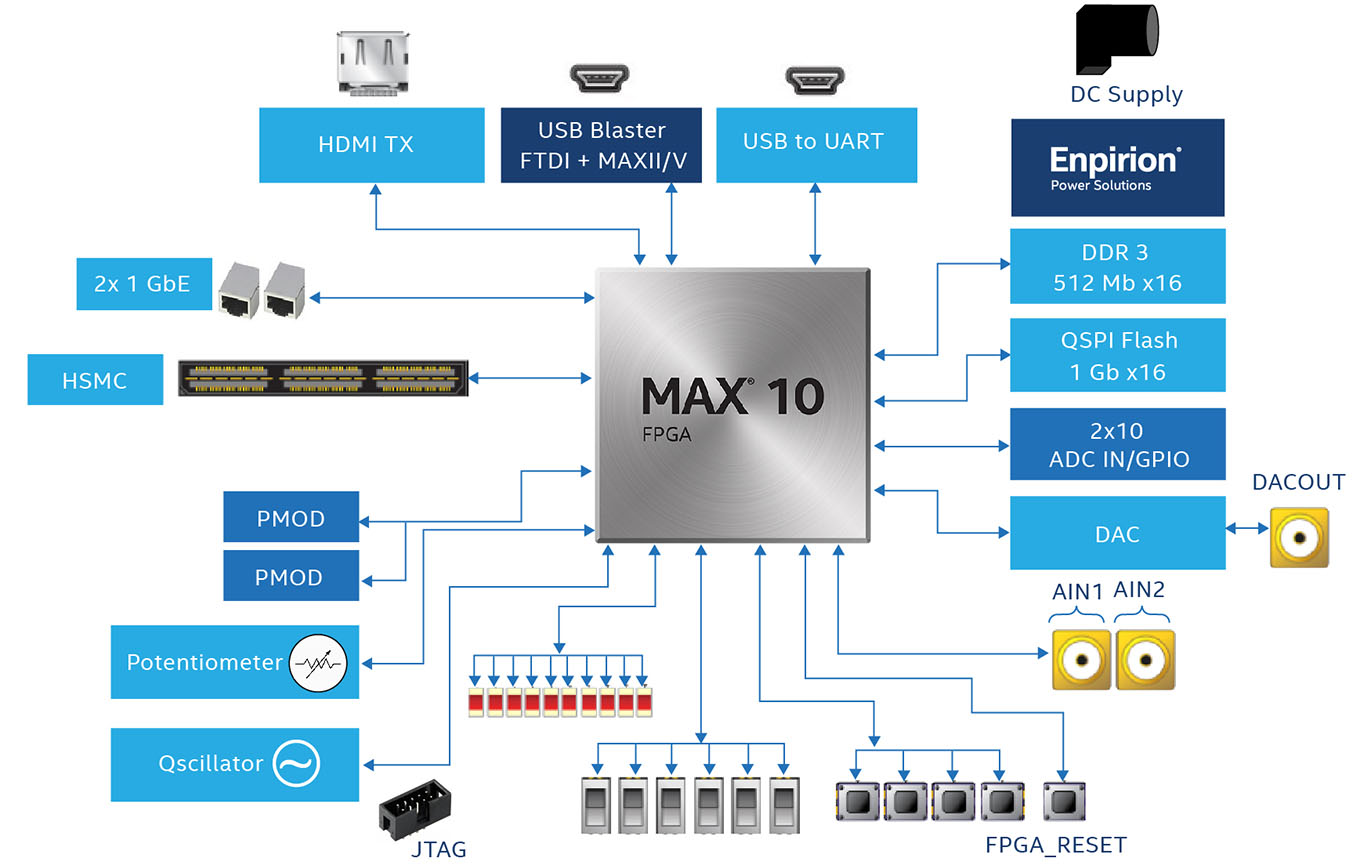
MAX 10 FPGA Development Kit Block Diagram (Source: Altera)
The integrated ADC block connects to a dedicated analog input bank, providing up to 18 single-ended channels or 9 differential pairs. A temperature sensing diode (TSD) is also available for on-die thermal monitoring. Configuration is handled by the on-chip flash controller, which supports dual configuration images for safe remote updates — if one image fails, the device automatically boots from the second image.
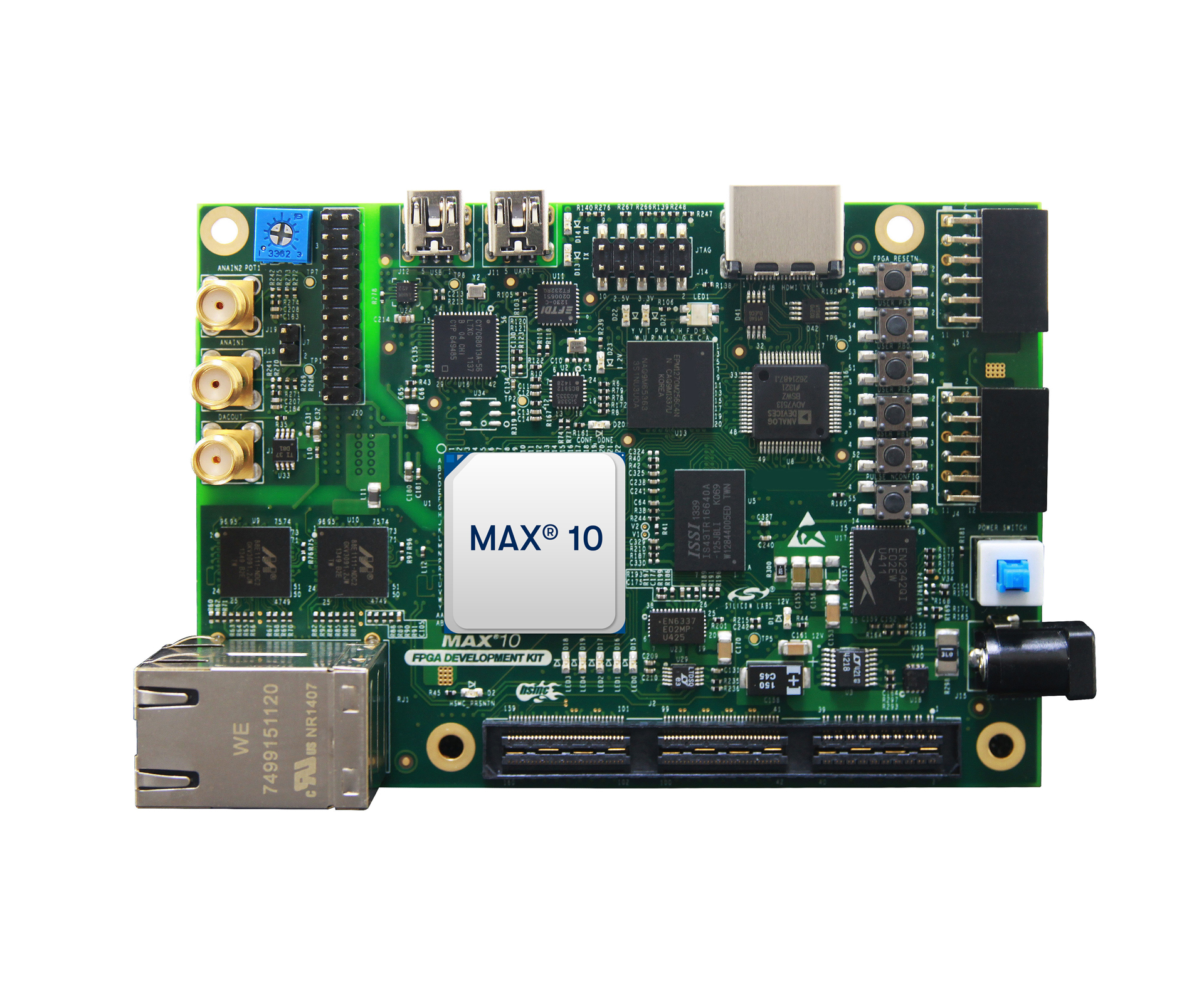
MAX 10 FPGA Development Kit — Evaluation Platform (Source: Altera)
4. Video: MAX 10 FPGA Tutorial
5. Equivalents, Cross-Reference, and Lifecycle
The 10M16SAU169I7G is currently in active production by Intel (Altera brand). The MAX 10 product line was introduced in 2014 and continues to receive long-term support. Engineers evaluating alternatives should consider the following cross-reference options:
- 10M16SAU169C8G — same device in commercial temperature range (0°C to +85°C) with speed grade 8. A lower-cost option when industrial temperature is not required.
- 10M16SCU169I7G — 10M16 variant with analog function enabled (single supply ADC), same industrial temperature and U169 package.
- 10M25SAU169I7G — pin-compatible upgrade with 25,000 LEs for designs requiring additional logic headroom within the same U169 footprint.
For migration to newer families, the Altera Cyclone 10 LP offers a similar logic density with improved power efficiency, though it lacks the integrated ADC and user flash of the MAX 10 platform.
6. Frequently Asked Questions (FAQ)
What is the 10M16SAU169I7G?
The 10M16SAU169I7G is an Intel (Altera) MAX 10 family FPGA with 16,000 logic elements in a 169-pin UBGA package. It features a 55 nm flash-based architecture with integrated ADC, user flash memory, and an industrial operating temperature range of −40°C to +100°C.
What is the operating temperature range of the 10M16SAU169I7G?
The device supports an industrial temperature range from −40°C to +100°C (junction temperature). The “I” suffix in the part number denotes the industrial grade rating.
Does the 10M16SAU169I7G include an analog-to-digital converter?
Yes. The MAX 10 10M16SAU169I7G integrates a 12-bit successive-approximation ADC capable of 1 MSPS. It supports up to 18 single-ended analog input channels and includes an on-die temperature sensing diode.
What external memory interfaces does this FPGA support?
The 10M16SAU169I7G supports DDR3, DDR2, and LPDDR2 SDRAM through a hard memory controller. It also supports single-data-rate SRAM interfaces. Maximum DDR3 data rates reach up to 300 MHz (600 Mbps per pin).
What software tools are needed to program the 10M16SAU169I7G?
The device is programmed using Intel Quartus Prime Lite Edition (free) or Quartus Prime Standard Edition. Design entry supports Verilog, VHDL, and schematic capture. On-board programming uses a USB-Blaster or USB-Blaster II JTAG interface.
Can the 10M16SAU169I7G replace an external EEPROM or configuration device?
Yes. The MAX 10 architecture stores its configuration bitstream in on-chip flash, eliminating the need for an external configuration PROM. Additionally, 675 Kb of user flash memory is available for application data storage, potentially replacing a small external EEPROM.
Alan Carter, Senior Hardware Engineer
Alan has over 15 years of experience in embedded systems design, specializing in ARM Cortex architectures, PCB routing for high-speed digital signals, and industrial IoT deployments. He frequently contributes technical teardowns and architecture comparisons.