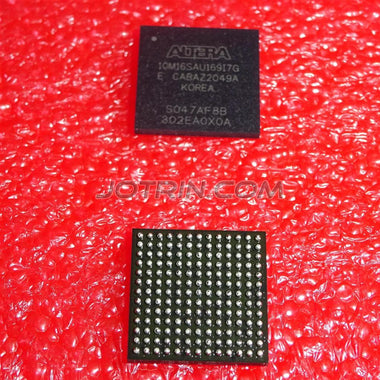
The 10M16SAU169I7G is a non-volatile FPGA from Intel's (formerly Altera) MAX 10 family, offering 16,000 logic elements in a compact 169-UBGA package. Built on 55nm flash technology, it combines FPGA flexibility with instant-on capability, integrated ADC, and internal configuration storage — eliminating the need for external configuration devices. This guide covers detailed specifications, pinout information, block architecture, and practical application notes for engineers working with this versatile FPGA.
Key Specifications & Parameters
The 10M16SAU169I7G belongs to the Intel MAX 10 FPGA family, designed for cost-sensitive, low-power applications that require instant-on functionality. Below is a comprehensive table of its core parameters:
| Parameter | Value |
|---|---|
| Manufacturer | Intel (Altera) |
| Family | MAX 10 (10M16) |
| Part Number | 10M16SAU169I7G |
| Logic Elements (LEs) | 16,000 |
| Logic Array Blocks (LABs) | 1,000 |
| Embedded Memory (M9K RAM) | 549 Kb (562,176 bits) |
| Embedded Multipliers (18×18) | 45 |
| PLLs | 4 |
| User I/O Pins | 130 |
| ADC Blocks | 1 (12-bit, up to 1 MSPS) |
| Internal Configuration Flash | Yes (Dual boot capable) |
| User Flash Memory (UFM) | 2,368 Kb |
| Package | 169-UBGA (11 × 11 mm) |
| Process Technology | 55 nm Flash |
| Core Voltage | 1.2 V |
| I/O Voltage Range | 2.85 V – 3.465 V (3.3 V nominal) |
| Operating Temperature | −40 °C to +100 °C (Industrial) |
| Speed Grade | 7 (lowest power) |
| I/O Standards | 3.3 V / 2.5 V LVTTL, LVCMOS, SSTL, HSTL, LVDS |
| Max LVDS Pairs | 22 |
| FPGA Bitstream Security | Yes (AES-256 encryption) |
| RoHS Compliant | Yes |
| Status | Active |
The "S" in the part number denotes single-supply operation, "A" indicates the analog feature variant (with ADC), "U169" is the 169-ball UBGA package, "I" means industrial temperature range, and "7G" specifies speed grade 7 with lead-free (green) packaging.
Block Diagram & Architecture Overview
The MAX 10 architecture integrates programmable logic, embedded memory, DSP blocks, and analog capabilities into a single chip. The 10M16SAU169I7G features a regular fabric of LABs, each containing 16 logic elements with 4-input LUTs and registers, surrounded by M9K memory blocks and 18×18 embedded multipliers for DSP functions.

Figure 1: 10M16SAU169I7G schematic symbol and block-level pin configuration.
Key architectural highlights include:
- Instant-On: Internal flash stores the configuration bitstream, enabling the FPGA to be operational within milliseconds of power-up — no external EEPROM required.
- Integrated ADC: A 12-bit SAR ADC with up to 18 analog input channels (in dual-supply variants) supports on-die temperature sensing and external analog signal conversion.
- Dual Configuration Images: The internal flash supports two configuration images for remote update with fail-safe fallback.
- User Flash Memory: 2,368 Kb of non-volatile storage available for user data, eliminating the need for an external serial flash in many designs.
Pinout & Package Information
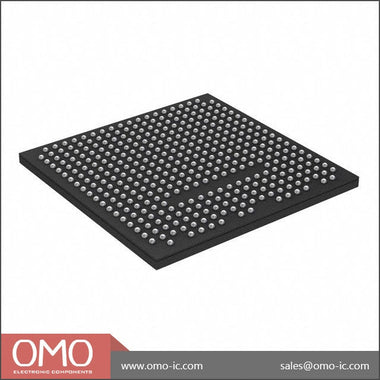
The 10M16SAU169I7G is packaged in a 169-ball UBGA (Ultra-thin Ball Grid Array) with an 11 × 11 mm body size and 0.8 mm ball pitch. The compact footprint makes it ideal for space-constrained applications such as portable instruments and embedded controllers.

Figure 2: 10M16SAU169I7G 169-UBGA package footprint and land pattern.
The 169-UBGA package provides 130 user I/O pins organized across multiple I/O banks, supporting a range of voltage standards from 1.2 V to 3.3 V. Pin assignments should be planned carefully using Intel's Quartus Prime Pin Planner tool to ensure proper bank voltage grouping and signal integrity.
Power Supply Pins: The device requires VCC (1.2 V core), VCCIO (per-bank, 2.5 V or 3.3 V), VCCA (2.5 V for PLL analog), and VCCINT (1.2 V). Proper decoupling with 100 nF and 10 µF capacitors is recommended on all supply pins.
Application Circuit & Design Examples
The 10M16SAU169I7G is widely used in industrial control, motor drive, sensor fusion, and IoT edge applications. Below is a typical development platform featuring the MAX 10 FPGA for rapid prototyping:

Figure 3: Intel MAX 10 FPGA Development Kit — a reference platform for prototyping designs with MAX 10 devices.
Typical Application Areas:
- Industrial Automation: Motor control with built-in ADC for current sensing, PLC I/O expansion, and sensor hub aggregation.
- IoT Edge Devices: Instant-on FPGA logic for protocol bridging (SPI/I2C/UART), real-time filtering, and low-latency sensor data processing.
- Board Management Controllers: Power sequencing, voltage/temperature monitoring via integrated ADC, and system health reporting.
- Display & Video: LED panel controllers, video format conversion, and timing generation for LCD interfaces.
For design resources and reference schematics, visit the wwdparts FPGA collection or download the official Quartus Prime Lite Edition (free) from Intel to begin your design.
Video Tutorial & Design Resources
Watch this tutorial to get started with Intel MAX 10 FPGA development, including Quartus Prime setup, pin assignment, and programming:
Helpful Design Resources:
- wwdparts Technical Blog — more FPGA and semiconductor guides
- wwdparts Intel (Altera) Components — browse and purchase MAX 10 FPGAs
- Contact wwdparts Engineering Support — for bulk orders and technical questions
Frequently Asked Questions (FAQ)
What is the difference between the 10M16SAU169I7G and 10M16SAU169C8G?
The "I7" suffix indicates industrial temperature range (−40 °C to +100 °C) with speed grade 7, while "C8" denotes commercial temperature range (0 °C to +85 °C) with speed grade 8. The I7G variant is better suited for harsh environments, while the C8G offers slightly higher clock speeds for commercial applications.
Does the 10M16SAU169I7G require an external configuration memory?
No. The MAX 10 FPGA integrates internal configuration flash memory, enabling instant-on operation without any external EEPROM or flash device. It also supports dual configuration images for remote update with automatic fallback to a known-good image.
What design software is required to program the 10M16SAU169I7G?
Intel Quartus Prime Lite Edition (free) fully supports MAX 10 devices. It includes synthesis, place-and-route, timing analysis, the Pin Planner, and the integrated Platform Designer (formerly Qsys) for system-level design. A USB-Blaster or USB-Blaster II programmer is needed for JTAG programming.
How many analog input channels does the 10M16SAU169I7G ADC support?
The "SA" variant (single-supply with ADC) provides one ADC block with a 12-bit SAR converter capable of up to 1 MSPS. The number of available external analog input channels depends on the specific package variant; in the U169 package, up to 9 dedicated analog input pins are available, plus the on-die temperature sensor channel.
Can the 10M16SAU169I7G be used in automotive or safety-critical applications?
The industrial-grade (I7G) variant is rated for extended temperatures (−40 °C to +100 °C), making it suitable for many industrial and some automotive-adjacent applications. However, it is not AEC-Q100 qualified. For automotive-grade requirements, consult Intel's automotive FPGA portfolio or contact Intel for screening options.
What is the typical power consumption of the 10M16SAU169I7G?
Power consumption varies significantly based on design utilization, clock frequency, and I/O activity. For a typical design using ~50% of logic resources at 100 MHz, expect approximately 150–300 mW total. Use Intel's Early Power Estimator (EPE) spreadsheet for accurate estimates based on your specific design. The speed grade 7 is the lowest-power option in the MAX 10 family.