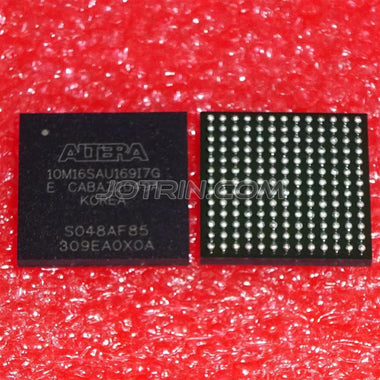
The 10M16SAU169I7G is a non-volatile FPGA from Intel's (formerly Altera) MAX 10 family, fabricated on a 55 nm embedded flash process with a 1.2 V core supply. It integrates 16,000 logic elements, 549 Kb of M9K embedded SRAM, 4 PLLs, an integrated 12-bit ADC, and on-chip configuration flash memory in a compact 169-ball UBGA package. Rated for industrial-grade operation (-40 °C to +100 °C) with speed grade 7, the 10M16SAU169I7G targets industrial automation, sensor acquisition, motor control, and embedded processing applications where non-volatile instant-on operation and extended temperature reliability are critical.
What Is the 10M16SAU169I7G?
The 10M16SAU169I7G belongs to the MAX 10 FPGA family, which is unique among Intel FPGAs because it integrates configuration flash memory directly on-chip. This eliminates the need for external serial configuration ROMs (such as EPCS/EPCQ devices), reduces BOM cost, and enables instant-on operation — the FPGA configures itself from internal flash within milliseconds of power-up. The device also supports dual configuration images for fail-safe remote firmware updates.
The "I7G" suffix indicates industrial temperature range (-40 °C to +100 °C) and speed grade 7. While speed grade 7 is the slowest available for MAX 10, it provides adequate timing margins for most industrial and embedded applications operating at moderate clock frequencies. The industrial temperature qualification makes this part suitable for outdoor equipment, factory automation, and automotive-adjacent systems where junction temperatures may exceed commercial limits.
Key architectural features include 1,000 logic array blocks (LABs), 549 Kb of M9K embedded memory organized as dual-port SRAM blocks, 18×18 embedded multipliers for DSP functions, and 4 general-purpose PLLs for clock synthesis and management. The integrated 12-bit SAR ADC with up to 17 analog input channels allows direct sensor interface without external analog conversion hardware.

Pinout Configuration and Packaging
The 10M16SAU169I7G is housed in a 169-ball UBGA (Ultra FineLine Ball Grid Array) package with an 11 × 11 mm body size and 0.8 mm ball pitch. This compact package provides 130 general-purpose I/O pins organized across multiple I/O banks, each supporting configurable voltage standards including LVTTL, LVCMOS (1.2 V, 1.5 V, 1.8 V, 2.5 V, 3.3 V), SSTL, HSTL, and up to 22 LVDS differential pairs.
The I/O banks share a common VCCIO supply within each bank but can operate at different voltages across banks, providing mixed-voltage interfacing capability. Dedicated pins include JTAG (TCK, TMS, TDI, TDO), clock inputs, analog input channels for the ADC, and power/ground connections. The package supports both 4-layer and 6-layer PCB stack-ups, though a 4-layer design with careful fanout is sufficient for most applications given the 0.8 mm ball pitch.

Specifications Parameter Table
| Parameter | Value |
|---|---|
| Part Number | 10M16SAU169I7G |
| Family | MAX 10 (10M16) |
| Manufacturer | Intel (Altera) |
| Logic Elements (LEs) | 16,000 |
| Logic Array Blocks (LABs) | 1,000 |
| Embedded Memory (M9K) | 549 Kb (562,176 bits) |
| User Flash Memory (UFM) | 2,368 Kb |
| 18×18 Embedded Multipliers | 45 |
| PLLs | 4 |
| ADC | 12-bit SAR, up to 1 MSPS, 17 channels |
| User I/O Pins | 130 (in U169 package) |
| Max LVDS Pairs | 22 |
| Package | 169-UBGA (11 × 11 mm, 0.8 mm pitch) |
| Core Voltage | 1.2 V |
| I/O Voltage | 1.2 V / 1.5 V / 1.8 V / 2.5 V / 3.3 V |
| Process Technology | 55 nm (embedded flash) |
| Speed Grade | 7 (industrial slowest) |
| Temperature Range | -40 °C to +100 °C (Industrial) |
| External Memory Support | DDR2, DDR3, LPDDR2, SRAM |
| Configuration | Internal flash (instant-on), JTAG |
| I/O Standards | LVTTL, LVCMOS, PCI, SSTL, HSTL, LVDS |
| RoHS Compliant | Yes (lead-free) |
Typical Applications and Circuit Considerations
The 10M16SAU169I7G is widely used in industrial control systems, sensor data acquisition, motor drive controllers, building automation, and embedded processing platforms. Its on-chip ADC simplifies mixed-signal designs where sensor data (temperature, current, voltage) must be digitized directly by the FPGA without external analog front-end ICs. The integrated user flash memory enables non-volatile storage of calibration data, encryption keys, or Nios II processor firmware.
For power supply design, the 10M16SAU169I7G requires a 1.2 V core supply (VCCINT), a 2.5 V analog supply (VCCA) for the PLLs, a 2.5 V PLL supply (VCCD_PLL), and per-bank VCCIO supplies at the selected voltage level. A typical power solution uses an Intel-recommended multi-rail PMIC or discrete LDO regulators. Each power pin requires a 100 nF MLCC decoupling capacitor, with 10–47 µF bulk capacitors per rail. The JTAG pins (TCK, TMS, TDI) require 10 kΩ pull-up or pull-down resistors per Intel's configuration guidelines.
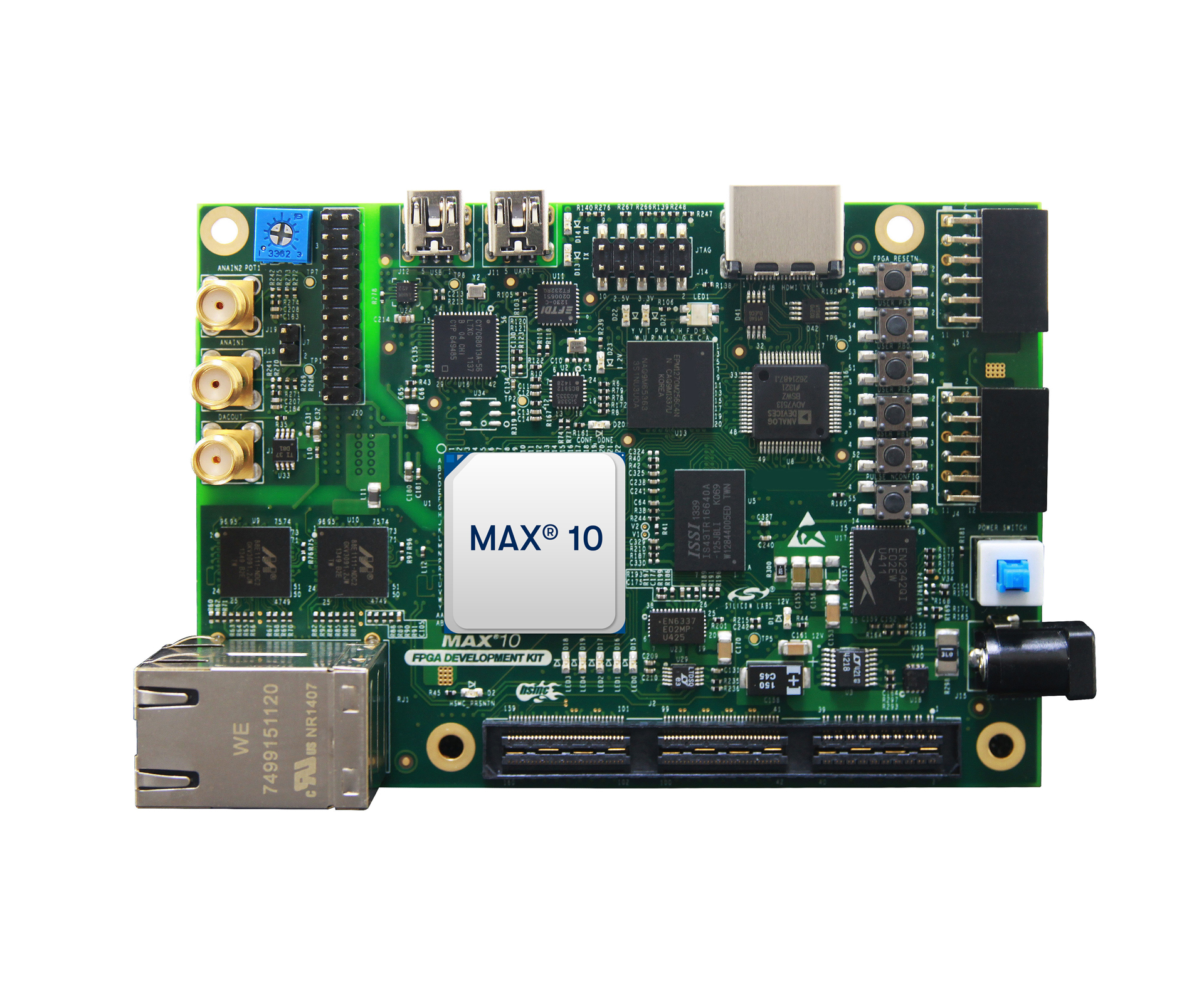
The MAX 10 FPGA Development Kit from Intel provides a reference design platform for prototyping with the 10M16 and 10M50 devices, including onboard JTAG, DDR3 memory, Ethernet PHY, and expansion headers.
Equivalents and Cross-Reference
The following table lists pin-compatible and functionally similar alternatives to the 10M16SAU169I7G for cross-reference and second-sourcing:
| Part Number | Difference |
|---|---|
| 10M16SAU169C8G | Commercial temp (0–85 °C), speed grade 8 (faster) |
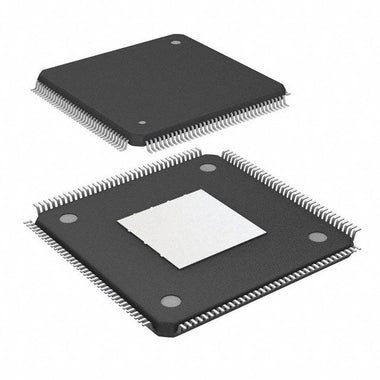
| 10M16SAE144I7G | Same die, 144-EQFP package (through-hole friendly) |
| 10M08SAU169I7G | Same package, 8K LEs (lower density, lower cost) |
| 10M25SAU324I7G | 25K LEs, 324-UBGA (higher density upgrade path) |
| 10M04SCE144C8G | 4K LEs, 144-EQFP, commercial temp — entry-level MAX 10 |
For a broader overview of MAX 10 FPGA options, see our 10M08SAE144C8G guide.
FAQ — Common Engineering Questions
What is the difference between 10M16SAU169I7G and 10M16SAU169C8G?
Both devices share the same silicon die — 16,000 logic elements, 549 Kb embedded memory, and 169-UBGA package. The key differences are operating temperature and speed grade. The 10M16SAU169I7G is an industrial-grade part rated from -40 °C to +100 °C with speed grade 7 (slowest), while the 10M16SAU169C8G is a commercial-grade part rated from 0 °C to 85 °C with speed grade 8 (faster). Choose the I7G variant for harsh-environment deployments where extended temperature operation is required.
What development tools are needed to program the 10M16SAU169I7G?
The 10M16SAU169I7G is programmed using Intel Quartus Prime Lite Edition, which is free with full MAX 10 support and no license restrictions. Design entry supports Verilog HDL, VHDL, and schematic capture. A USB Blaster or USB Blaster II JTAG programmer is required for configuration. The MAX 10 family supports internal configuration via on-chip flash memory, eliminating the need for an external configuration ROM. ModelSim-Intel FPGA Edition handles functional and timing simulation.
Does the 10M16SAU169I7G have an integrated ADC?
Yes. The MAX 10 10M16 device integrates up to two 12-bit successive-approximation-register (SAR) ADC blocks with up to 17 analog input channels and a 1 MSPS conversion rate. This eliminates the need for external ADC ICs in mixed-signal applications such as sensor monitoring, power management, and industrial control. The ADC is configured through the Quartus Prime Modular ADC IP Core and operates from a dedicated analog supply rail.
What package type is the 10M16SAU169I7G and what are its PCB layout requirements?
The 10M16SAU169I7G uses a 169-ball Ultra FineLine BGA (UBGA) package with an 11 × 11 mm body and 0.8 mm ball pitch. This compact footprint makes it suitable for space-constrained designs. PCB layout requires a minimum of 4 routing layers for full pin escape. Each power pin needs a 0.1 µF ceramic decoupling capacitor placed close to the BGA pad, with 10–47 µF bulk capacitors per power rail. BGA soldering requires a reflow oven with a controlled thermal profile.
What external memory interfaces does the 10M16SAU169I7G support?
The MAX 10 family supports DDR2 SDRAM, DDR3 SDRAM, LPDDR2, and SRAM external memory interfaces through the built-in External Memory Interface (EMIF) hard IP. Quartus Prime provides the UniPHY-based memory controller megafunction for automated calibration and timing closure. In the 169-UBGA package, pin count limits practical memory bus width, so most designs implement a 16-bit DDR3 interface or single-rank DDR2 configuration.
What is the on-chip user flash memory capacity of the 10M16SAU169I7G?
The MAX 10 10M16 device provides up to 2,368 Kbit (296 KB) of on-chip user flash memory (UFM) alongside the configuration flash memory (CFM). This UFM can be used for non-volatile data storage, calibration coefficients, encryption keys, or firmware for a Nios II soft processor. The UFM is accessed through the Quartus Prime On-Chip Flash IP Core and supports sector-based erase and program operations with over 20,000 program-erase cycle endurance.
Video Tutorial: Getting Started with MAX 10 FPGA
Need the 10M16SAU169I7G for your project? Check real-time stock and pricing at wwdparts.com — your trusted source for genuine Intel/Altera FPGA components with full traceability and competitive pricing.