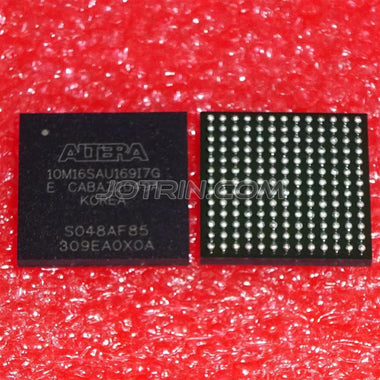
Overview of the 10M16SAU169I7G
The 10M16SAU169I7G is a non-volatile FPGA from the Intel (Altera) MAX 10 family, manufactured on a 55 nm flash process. It delivers 16,000 logic elements in a compact 169-pin UBGA package, making it an ideal choice for cost-sensitive, low-power embedded designs that require instant-on capability and single-chip integration. Unlike SRAM-based FPGAs, MAX 10 devices store their configuration in on-chip flash memory, eliminating the need for an external configuration device and reducing board area and BOM cost.
With an integrated dual analog-to-digital converter (ADC), user flash memory (UFM), and support for DDR3 external memory interfaces, the 10M16SAU169I7G bridges the gap between CPLDs and mid-range FPGAs. It is well suited for industrial control, motor drives, sensor aggregation, communications gateways, and IoT edge processing.
If you are sourcing this part or looking for pin-compatible alternatives, visit the wwdparts FPGA collection for competitive pricing and fast shipping.
Key Specifications & Parameters
| Parameter | Value |
|---|---|
| Part Number | 10M16SAU169I7G |
| Family | Intel (Altera) MAX 10 |
| Logic Elements (LEs) | 16,000 |
| Logic Array Blocks (LABs) | 1,000 |
| Embedded Memory (M9K Blocks) | 549 Kb (562,176 bits) |
| 18 × 18 Embedded Multipliers | 45 |
| PLLs | 4 |
| User I/O Pins (U169 Package) | 130 |
| Maximum LVDS Pairs | 22 |
| Analog-to-Digital Converter (ADC) | Dual ADC (up to 1 MSPS, 12-bit) |
| User Flash Memory (UFM) | Yes (Avalon-MM accessible) |
| Internal Configuration Flash | Yes (instant-on, no external PROM needed) |
| External Memory Interface | DDR3, DDR2, LPDDR2, SRAM |
| Core Voltage | 1.2 V |
| I/O Supply Voltage | 2.85 V – 3.465 V (3.3 V typical) |
| I/O Standards | LVTTL, LVCMOS (1.0–3.3 V), SSTL, HSTL, HSUL, LVDS |
| Package | 169-UBGA (11 × 11 mm) |
| Speed Grade | 7 (industrial) |
| Operating Temperature | −40 °C to +100 °C (TJ) |
| Process Technology | 55 nm Flash |
| RoHS Compliant | Yes |
| FPGA Bitstream Security | Yes (AES-256 encryption) |
Block Diagram & Architecture
The MAX 10 architecture integrates logic, memory, DSP, ADC, and flash into a single monolithic die. The diagram below shows the high-level interconnection of key functional blocks including the user-programmable logic fabric, embedded memory columns, PLLs, I/O banks, and the dual ADC subsystem.

The logic fabric is organized into LABs of 10 LEs each, with a column-based routing architecture that provides deterministic timing. Four PLLs support clock multiplication, division, and phase shifting for high-speed designs.
Pinout & Package Information
The 10M16SAU169I7G is housed in a 169-ball UBGA package with an 11 × 11 mm body size and 0.8 mm ball pitch. The compact footprint makes it suitable for space-constrained applications while still providing 130 user I/O pins across multiple I/O banks.

For detailed pin assignments and recommended PCB landing pad patterns, refer to the official MAX 10 FPGA Pin-Out Files available from the wwdparts blog. When designing your PCB, ensure proper decoupling on VCCINT, VCCIO, and VCCA rails as specified in the device datasheet.
Typical Applications & Design Resources
The 10M16SAU169I7G is widely used in the following application areas:
- Industrial automation & motor control – Leveraging the integrated ADC for sensor acquisition and the DSP blocks for PID loop computation.
- Communications gateways – Protocol bridging (SPI, I²C, UART, Ethernet) with instant-on boot for always-ready operation.
- IoT edge nodes – Compact form factor with low power consumption and on-chip flash for secure boot and configuration storage.
- Test & measurement – High-speed data capture using the 12-bit ADC and DDR3 buffering for oscilloscope and data-logger front ends.
- Display & video processing – LVDS I/O support enables direct connection to flat-panel displays.

Intel provides the Quartus Prime Lite Edition (free) for MAX 10 development, including the Platform Designer (Qsys) system integration tool. Evaluation kits such as the MAX 10 FPGA Development Kit and the Arrow DECA board offer out-of-the-box hardware platforms for prototyping.
Video Tutorial
Browse more FPGA and semiconductor resources at the wwdparts.com homepage.
Frequently Asked Questions
What is the 10M16SAU169I7G?
The 10M16SAU169I7G is a non-volatile FPGA from the Intel (Altera) MAX 10 family. It features 16,000 logic elements, 549 Kb of embedded memory, 45 DSP multipliers, a dual 12-bit ADC, and user flash memory in a compact 169-UBGA package. It is designed for industrial-temperature operation from −40 °C to +100 °C.
Does the 10M16SAU169I7G require an external configuration device?
No. MAX 10 FPGAs use internal flash memory for configuration storage, enabling instant-on operation and eliminating the need for an external PROM or flash chip. This reduces BOM cost and PCB area.
What development software supports the MAX 10 FPGA?
Intel's Quartus Prime Lite Edition (free license) fully supports all MAX 10 devices including the 10M16SAU169I7G. It includes synthesis, place-and-route, timing analysis, and the Platform Designer (Qsys) for system-on-chip integration.
What is the maximum operating frequency of the 10M16SAU169I7G?
The maximum operating frequency depends on the design complexity and routing. With speed grade 7, typical user designs achieve core clock rates in the range of 150–300 MHz. The four on-chip PLLs support output frequencies up to 472.5 MHz for clock generation.
Can the 10M16SAU169I7G interface with DDR3 memory?
Yes. The MAX 10 device family supports DDR3, DDR2, LPDDR2, and SRAM external memory interfaces through a soft memory controller IP generated by Platform Designer. However, the U169 package has a limited pin count (130 I/O), so carefully plan your I/O budget when adding a DDR3 interface.
Where can I buy the 10M16SAU169I7G?
The 10M16SAU169I7G is available from authorized distributors and semiconductor suppliers. Visit wwdparts.com for competitive pricing, stock availability, and fast worldwide shipping on MAX 10 FPGAs and other electronic components.