10M16SAU169I7G Datasheet, Specifications & Application Guide | Altera MAX 10 FPGA
1. Overview of the 10M16SAU169I7G
The 10M16SAU169I7G is a high-performance FPGA from the Intel (Altera) MAX 10 family, built on a 55nm process technology. As a non-volatile FPGA, it integrates flash memory for instant-on configuration, eliminating the need for an external configuration device. This makes it an ideal choice for cost-sensitive and space-constrained designs in industrial automation, motor control, communications infrastructure, and IoT edge computing.
The MAX 10 family uniquely combines FPGA logic with analog-to-digital converter (ADC) blocks, user flash memory, and DDR3 external memory interfaces — all within a single chip. The 10M16SAU169I7G variant offers 16,000 logic elements in a compact 169-pin UBGA package with industrial-grade temperature range (-40°C to +100°C).
Designers working with Altera FPGAs can explore related components on our site, including the wwdparts semiconductor blog for more technical guides, our FPGA component catalog, and our about page for sourcing support.
2. Key Specifications & Parameters
| Parameter | Value |
|---|---|
| Part Number | 10M16SAU169I7G |
| Manufacturer | Intel (Altera) |
| Family | MAX 10 |
| Logic Elements (LEs) | 16,000 |
| Logic Array Blocks (LABs) | 1,000 |
| Embedded Memory (M9K Blocks) | 549 Kb (562,176 bits) |
| 18×18 Embedded Multipliers | 45 |
| Phase-Locked Loops (PLLs) | 4 |
| User I/O Pins | 130 |
| Max LVDS Pairs | 22 |
| Analog-to-Digital Converter | Yes (Dual ADC) |
| User Flash Memory | Yes |
| Internal Configuration | Yes (Single/Dual Boot) |
| External Memory Support | DDR3, DDR2, LPDDR2, SRAM |
| Package | 169-UBGA (11 × 11 mm) |
| Process Technology | 55 nm |
| Core Voltage | 1.2 V |
| I/O Voltage | 3.0 V / 3.3 V |
| Operating Temperature | -40°C to +100°C (Industrial) |
| Speed Grade | 7 |
| Bitstream Security | AES-128 Encryption |
| Design Software | Quartus Prime (Lite / Standard) |
3. Block Diagram & Architecture
The MAX 10 FPGA architecture is organized around a grid of Logic Array Blocks (LABs), surrounded by embedded memory (M9K) blocks, 18×18 multipliers for DSP functions, and I/O elements along the periphery. Four PLLs provide flexible clocking, while the integrated dual ADC block enables direct analog signal acquisition without external components.
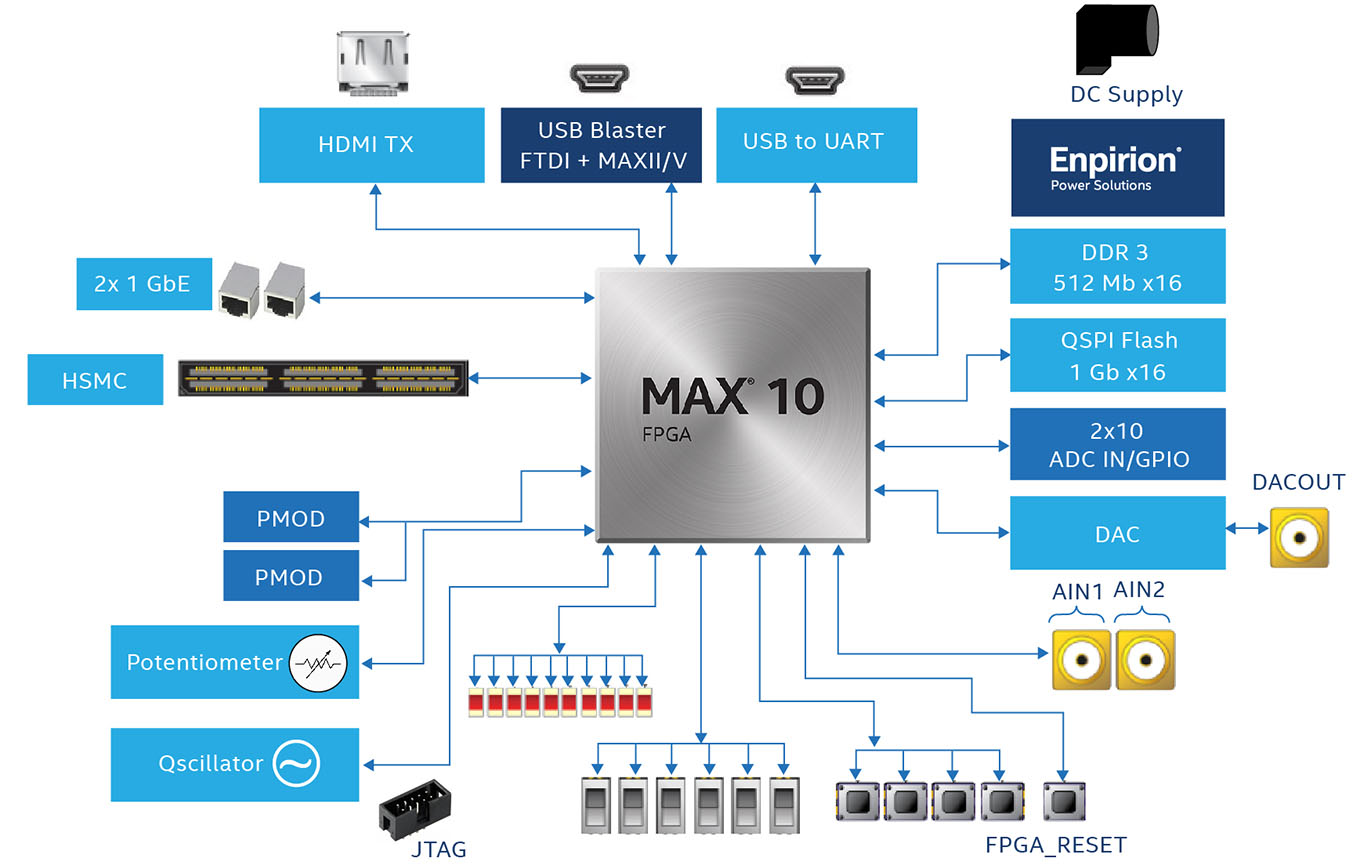
Figure 1: MAX 10 FPGA device architecture and functional block diagram showing internal resources including LABs, M9K memory, PLLs, ADC, and I/O banks.
4. Pinout & Package Information
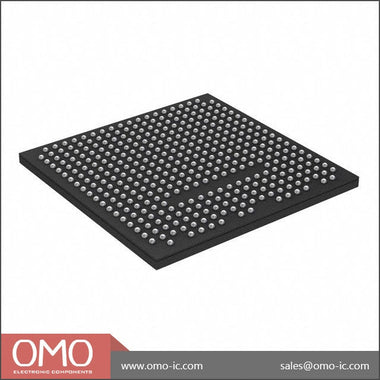
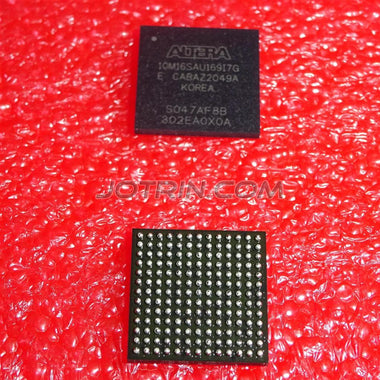
The 10M16SAU169I7G is housed in a 169-ball UBGA (Ultra FineLine BGA) package measuring 11 × 11 mm. The compact BGA footprint makes it suitable for high-density PCB designs. The package provides 130 user I/O pins organized across multiple I/O banks, supporting a wide range of I/O standards including 3.3V LVTTL, LVCMOS, SSTL, HSTL, and LVDS.

Figure 2: 10M16SAU169I7G in 169-UBGA package (11 × 11 mm). The device supports 130 user I/Os with multi-voltage I/O bank architecture.
5. Typical Applications & Circuit Design
The 10M16SAU169I7G is widely used in embedded system prototyping, industrial control, motor drives, sensor fusion, and communications infrastructure. Its integrated ADC makes it particularly attractive for mixed-signal designs where board space and BOM cost are critical considerations.
Common application scenarios include:
- Industrial IoT gateways — protocol bridging, sensor aggregation, and edge processing
- Motor control — PWM generation, encoder interface, and closed-loop control
- Video/image processing — frame buffering with DDR3 interface
- Communications — multi-channel data acquisition and signal conditioning
- Test & measurement — leveraging the dual ADC for direct analog input
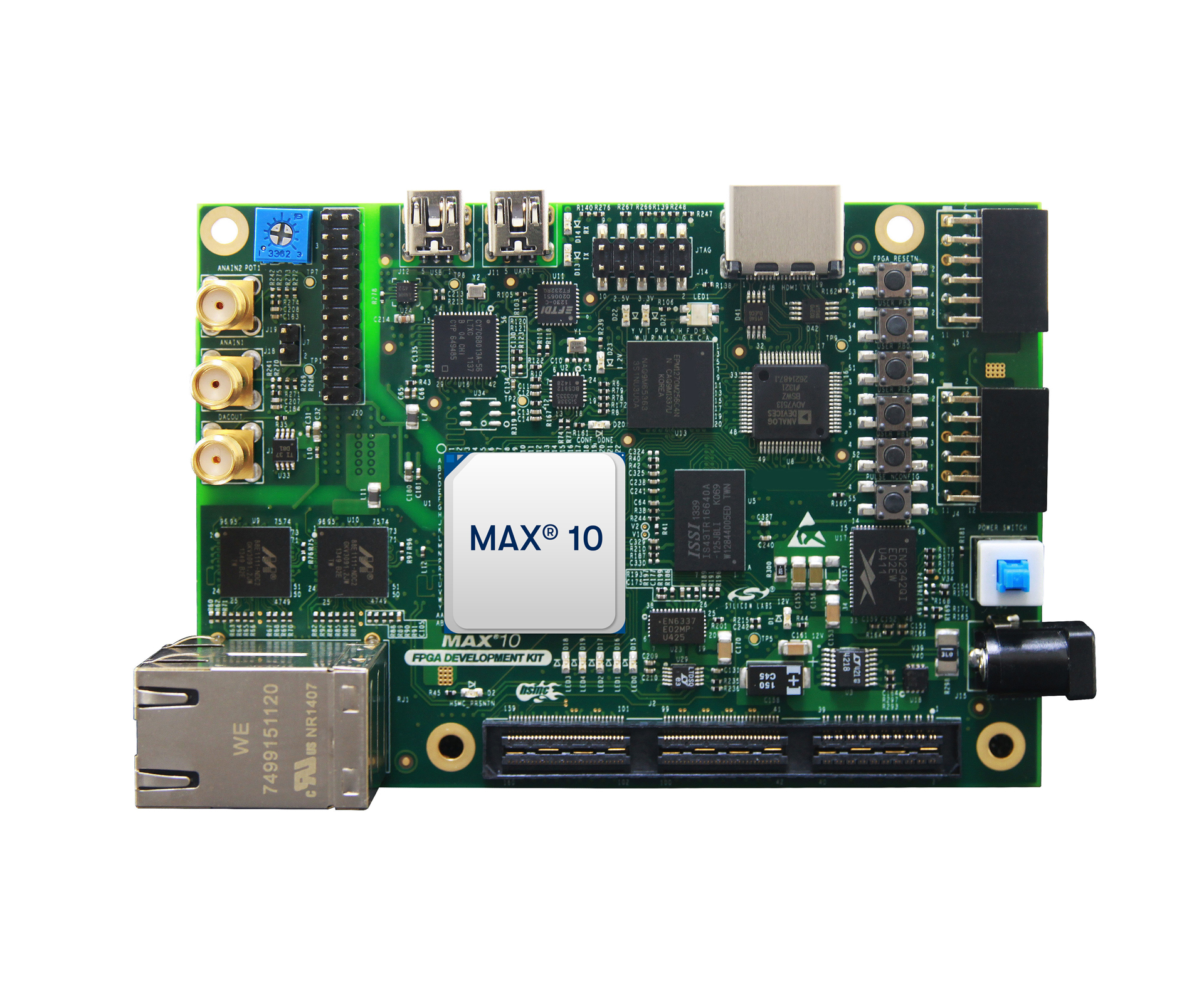
Figure 3: MAX 10 FPGA Development Kit — a reference design platform showcasing typical application circuits including DDR3 memory, Ethernet, USB, and HDMI interfaces.
Video Tutorial: Getting Started with MAX 10 FPGA
6. Frequently Asked Questions (FAQ)
What is the difference between the 10M16SAU169I7G and 10M16SAU169C8G?
The 10M16SAU169I7G is the industrial-grade variant (I7G) with an operating temperature range of -40°C to +100°C and speed grade 7, while the 10M16SAU169C8G is the commercial-grade variant (C8G) with a 0°C to +85°C range and speed grade 8. Both share the same 16,000 LE architecture and 169-UBGA package.
Does the 10M16SAU169I7G require an external configuration memory?
No. The MAX 10 family features integrated non-volatile flash memory for configuration storage, providing instant-on capability. The 10M16SAU169I7G supports both single-image and dual-image boot configurations directly from its internal flash, eliminating the need for an external EEPROM or flash device.
What design software is needed to program the 10M16SAU169I7G?
The 10M16SAU169I7G is supported by Intel Quartus Prime Lite Edition (free) and Quartus Prime Standard Edition. ModelSim-Intel FPGA Edition is used for simulation. The device can be programmed via JTAG using an Intel USB-Blaster or USB-Blaster II programmer.
How many ADC channels does the 10M16SAU169I7G have?
The 10M16SAU169I7G includes a dual analog-to-digital converter (ADC) block with up to 18 analog input channels (depending on I/O bank configuration). Each ADC supports 12-bit resolution with a sampling rate up to 1 MSPS, making it suitable for temperature sensing, voltage monitoring, and general-purpose analog signal acquisition.
Can the 10M16SAU169I7G interface with DDR3 memory?
Yes. The MAX 10 family includes a hard memory controller supporting DDR3, DDR2, and LPDDR2 external memory interfaces. The 10M16SAU169I7G can interface with DDR3 SDRAM at speeds up to 300 MHz (600 Mbps data rate), providing expanded memory bandwidth for data buffering and processing applications.
What are the power supply requirements for the 10M16SAU169I7G?
The 10M16SAU169I7G requires a 1.2V core supply (VCCINT), a 2.5V PLL supply (VCCA), and I/O bank supplies (VCCIO) that can be set to 1.2V, 1.5V, 1.8V, 2.5V, or 3.3V depending on the I/O standard used. A 3.0V or 3.3V supply is needed for the internal flash and analog blocks. Intel provides power estimation tools in Quartus Prime to help size voltage regulators.